Insurance claims reconciliation is proving that the claims figures an insurer reports (paid losses and loss adjustment expense, case reserves, recoveries and the claims data behind its reserve estimates) agree across the claims system, the general ledger, the actuary's analysis and the statutory statement, and explaining every difference. In practice it is three separate ties done by three teams for three purposes: claims accounting ties the claims system to the general ledger at each close; the appointed actuary ties the data used in the reserve analysis to Schedule P; and the independent CPA tests the year's claim activity. Each team proves its own link, and a difference that falls between two of them can travel all the way into the filed statement. Botminds' Premium & Claims Reconciliation does the accounting tie at each close, clusters every break by cause with its source document, and keeps the result in one log the actuary and the auditors can read.
The examples come from a fictional sample insurer, Larkspur Mutual Insurance Group, at its third-quarter 2026 close in the solution. The regulatory sources are the NAIC's 2026 guidance on actuarial opinions, the NAIC examiners' control repository and an SEC enforcement release, linked where they appear.
Three teams reconcile the same claims data, for three different reasons
Today
Ties claims system to general ledger each month in a spreadsheet; the break file stays on a shared drive.
With agents
Reviews breaks already clustered by cause, each with its source, in a log the actuary and auditors can open.
Still theirs: Owning the claims-to-ledger tie and approving what is an error.
Today
Reconciles the reserving data to Schedule P at year-end and finds a gap that was explained in July but never written down.
With agents
Starts from the signed claims ties and their documented items, such as top-sides, before mapping data to Schedule P.
Still theirs: The Schedule P reconciliation and the opinion.
Today
Tests the year’s payments and asks for support that lives in someone’s email.
With agents
Selects from a log where every reconciling item links to its source and shows who signed.
Still theirs: Independent testing.
Today
Learns of a break when one of the other two finds it.
With agents
Signs each claims tie with the reconciling items listed and aged.
Still theirs: The signature, and the decision on every entry.
What is claims reconciliation in insurance?
Claims reconciliation in insurance is the set of checks that prove claims data agrees with the books and statements it feeds, at every level where it is summarised. A payment starts as a line in the claims system, becomes part of a daily batch in the general ledger, is aggregated by accident year and line of business in Schedule P, and is projected by the actuary into an estimate of unpaid claims. Each step summarises the one before, and each summary can lose or add something.
The NAIC examiners' control repository for property and casualty reserves describes the risk the reconciliations exist to address: "The claims data utilized by the actuary to estimate reserves does not correspond to the data in the insurer's claims system and to the data in the insurer's accounting records" (NAIC Financial Examiners Handbook (E) Technical Group, exposure drafts, October 2020). It names the controls examiners expect against that risk, from reconciling the actuarial data to the claims system and accounting records to the appointed actuary reconciling the analysis data to Schedule P.
"Inventories of reported and unpaid claims are maintained and periodically reconciled to the general ledger."
NAIC examiners' control repository for P&C reserves, exposure draft (2020)
Three ties, three teams, and the gaps between them
The three ties compare different things at different times, which is why each can pass while the claims data as a whole is wrong. The accounting tie compares balances at a month-end. The actuary's tie compares cumulative data by accident year and line at the valuation date. The CPA's test samples the calendar year's activity. A difference in one is invisible to the others unless someone carries it across.
The three claims ties side by side
| Question | Claims accounting | Appointed actuary | Independent CPA |
|---|---|---|---|
| Compares | Claims system detail with general ledger balances | Data used in the reserve analysis with Schedule P | A sample of the year’s claim payments and reserves with their support |
| When | Every month-end and quarter-end close | At the year-end valuation, often on data rolled forward | Interim work and year-end fieldwork |
| Level | Account, then claim by claim | Accident year and segment, as fine as practical | Transactions selected for testing |
| What it misses alone | Whether the data the actuary used matches | Whether the general ledger matches the claims system | Cumulative history from earlier years |
Who reconciles claims data to the general ledger?
Claims accounting reconciles claims data to the general ledger, usually a claims accountant or claims reconciliation analyst who prepares each tie and a manager or the controller who reviews and signs it. The accounts are paid losses, paid LAE, case reserves, salvage and subrogation, and often the ceded paid loss recoverable. At the sample insurer the claims accountant prepares five of the ten insurance ties; the work of that seat is described in claims reconciliation specialist.
For larger insurers the tie is also a control that management reports on. The NAIC's Model Audit Rule requires insurers with $500 million or more of direct written and assumed premium to file a management report on internal control over financial reporting (NAIC Model #205, Section 17), and the claims reconciliations are among the controls behind it. That makes the accounting tie the one link the insurer owns outright.
How does the actuary reconcile to Schedule P?
The appointed actuary reconciles the data used in the reserve analysis to Schedule P of the annual statement, by segment and accident year, and documents the reconciliation in the actuarial report. The NAIC's 2026 regulatory guidance says a summary reconciliation combining all years and all lines does not demonstrate data integrity (quoted in Schedule P reconciliation), and expects detailed reconciliations of the data at the finest level of segmentation that is possible and practical (NAIC Actuarial Opinion (C) Working Group, 2026 Regulatory Guidance).
The guidance also explains why the actuary's tie and the CPA's work are not interchangeable. The working group treats them as two different data checks: the actuary's Schedule P reconciliation, and annual testing by independent CPAs of the completeness and accuracy of the data. Among its changes for 2026, the instructions now state explicitly that the reconciliation should compare the data the appointed actuary used with Schedule P, and clarify the actuary's responsibilities when someone else produced it.
What the actuary's tie does not do is reach back to the claims system. Schedule P is itself built from the general ledger and the claims data, so if the claims-to-ledger tie is wrong, the actuary can reconcile perfectly to a wrong Schedule P. The accounting tie is the actuary's foundation, which is why it is worth sharing in a form the actuary can read. How reserve data is checked before it becomes triangles is set out in data validation software for actuaries.
What does the external auditor test on claims?
The external auditor tests claim payments and reserves for the year being audited, and the design and operation of the controls over them, including the reconciliations. The NAIC's 2026 guidance describes the scope plainly: the CPA's procedures generally cover the current calendar year's loss and loss adjustment expense activity, such as payments made this year on claims from any accident year (NAIC AOWG, 2026; why that leaves cumulative data to the actuary is in Schedule P reconciliation).
That focus is the gap. Reserve projections use cumulative data across many accident years, so the guidance adds that calendar-year testing alone "may render insufficient testing" for the actuary's purposes. An error made three years ago in a since-closed claim can sit in cumulative paid losses, invisible to this year's audit sample and to this month's general ledger tie, until the actuary's triangle shows a development pattern nobody can explain.
When each claims tie runs across one statement year
- Monthly closes, January to December12 closes
- Year-endJan
- Analysis on data before year-endQ4
- Roll forward, Schedule P reconciliation, opinionJan–Mar
- Interim testingQ4
- Year-end fieldwork to the audited reportJan–May
Why do claims data and the general ledger disagree?
Claims data and the general ledger disagree because they are built differently: the claims system holds every payment and reserve change claim by claim on its effective date, while the general ledger takes daily summary batches plus manual journals. Most differences are timing and mapping; the ones that matter are journals that exist on only one side, and transactions one side never received.
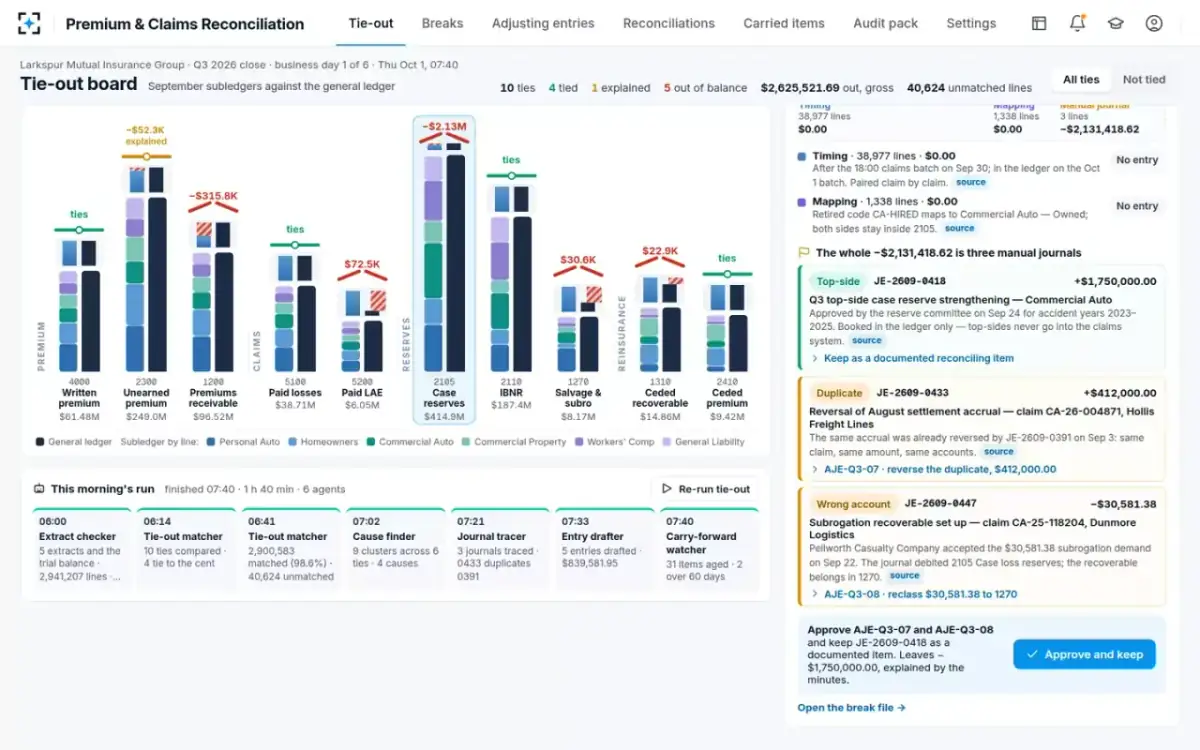
At the sample insurer, case loss reserves were out by −$2,131,418.62 on the first morning of the close, across 40,318 unmatched lines. 38,977 were reserve changes entered after the 18:00 claims batch on September 30, in the general ledger on the October 1 batch; paired claim by claim they net to $0.00. 1,338 carried a retired cost code and also net to $0.00. Three manual journals carried the whole amount: a documented top-side, a duplicate reversal, and a subrogation recoverable booked to the wrong account.
The worst disagreement is the claim that never reached the books at all. In 2009 the SEC charged an insurer over reinsurance claims it had been notified of before filing its annual report; according to the complaint, "the claims were not properly recorded in the Company's books and records, which caused Bancinsurance's 2003 financial statements to materially understate the Company's expenses and loss reserves." The company and its chief executive settled without admitting or denying the allegations (SEC Litigation Release No. 21300). No reconciliation of the general ledger to itself would have caught it; a tie between what the claims side knew and what the books held could.
What is a case reserve reconciliation?
A case reserve reconciliation proves that the case reserves in the general ledger equal the open-claim reserves in the claims system at the reconciliation date, with every difference explained. It is the hardest claims tie, because reserves change constantly, the general ledger sees only the net movement of each batch, and top-side adjustments recommended by actuaries or management are booked in the general ledger alone.
The top-side is the item that most needs a shared log. At the sample insurer a $1,750,000.00 strengthening of Commercial Auto case reserves, backed by the reserve committee's minutes of September 24, would show as a break every quarter if nobody documented it, and a top-side that shows as a break every quarter is one somebody will eventually reverse. Kept as a documented reconciling item, it reads explained, carries its minutes, and is visible to the actuary who recommended it and the auditor who will select it. Whether the case reserves themselves are adequate is a separate question, covered in case reserve review.
The case reserve break: three journals, each with its source
How should reconciliation breaks be logged, and who owns the log?
Reconciliation breaks should be logged once, with enough detail that each of the three teams can use the same entry, and the controller should own the log, because the controller signs the ties and approves the entries. Three private logs, one per team, produce three explanations of the same difference, or none.
Three private logs against one shared break log
Three logs: In the accountant’s workbook, the actuary’s data notes and the auditor’s workpapers, separately.
One shared log: Once, with cause, lines, net, source, owner, age and status.
Three logs: Explained by accounting in July, rediscovered by the actuary in February.
One shared log: Kept as one item with the minutes, visible to all three.
Three logs: Fixed in the general ledger; the actuary’s data still carries it.
One shared log: Logged with its correcting entry, so the actuary can adjust the analysis data too.
Three logs: Gathered on request, from three places.
One shared log: Already linked: each item to its source, each entry to its approval.
What each logged break should carry
| Field | Why each team needs it |
|---|---|
| Account, claim and accident year | Accounting ties by account; the actuary works by accident year and segment; the auditor samples by claim. |
| Cause (timing, mapping, manual journal, currency, missing feed) | Tells the actuary whether the analysis data is affected or only the month-end balance. |
| Lines and net | A cluster of 38,977 lines netting to $0.00 is a different problem from three lines carrying $2.1 million. |
| Source document | Minutes, claim note, journal pair, mapping table: the evidence each reviewer would otherwise ask for. |
| Resolution and entry | Clears on the next batch, kept as documented, or corrected by a named approved entry. |
| Owner, age and status | Escalation before items go stale; the sample insurer escalates carried items after 60 days. |
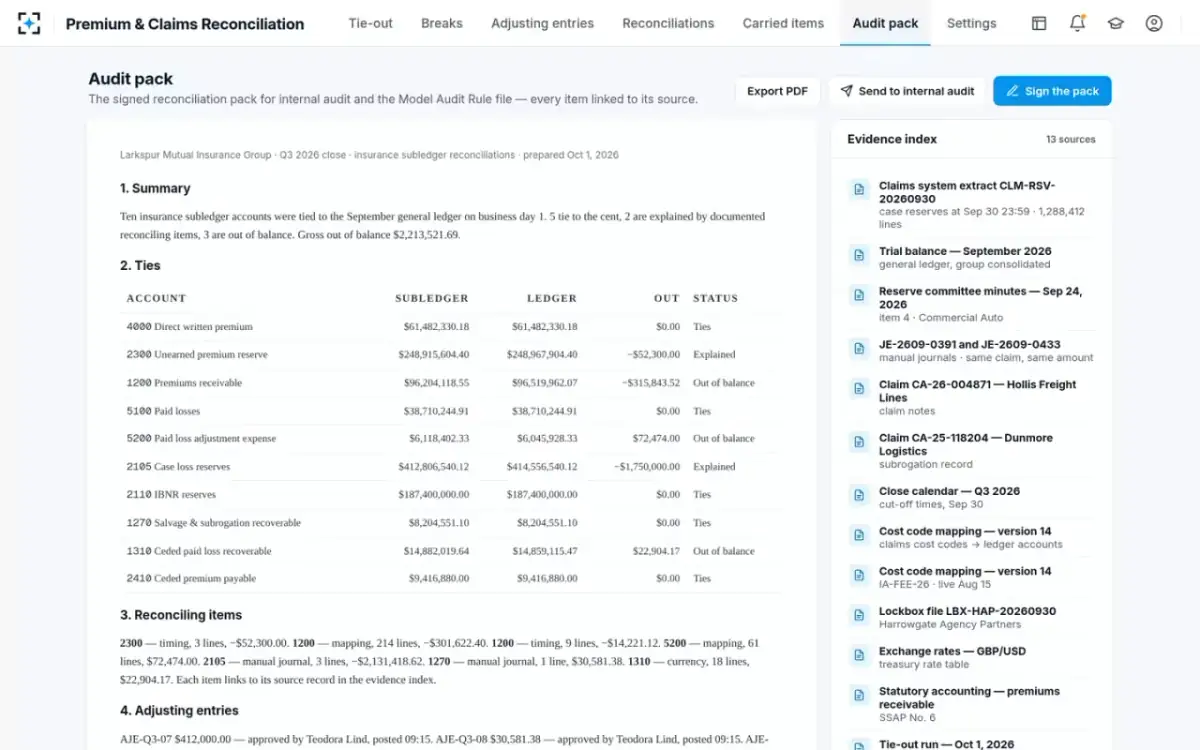
In the solution, each tie's break file and the carried items feed an audit pack with an evidence index, thirteen sources at the sample close, from the claims system extract to the reserve committee minutes; it is prepared for internal audit and the Model Audit Rule file and exports to PDF. How the tie itself is proved step by step is in the general ledger reconciliation process; when a third-party administrator pays the claims, start with TPA reconciliation.
One pack for the controller, the actuary and the auditors
To see the claims ties, the break log and the audit pack on a sample of your own extracts, start from Premium & Claims Reconciliation.
Questions people ask
How often should claims be reconciled?
The claims accounts should be reconciled to the general ledger at every month-end close, and formally at each quarter-end when the statutory quarterly statement is prepared. The actuary's Schedule P reconciliation is annual, at the year-end valuation, so the monthly accounting tie is the only one that catches a break while it is fresh.
Is the actuary's Schedule P reconciliation the same as the accounting reconciliation?
No. The accounting tie compares the claims system with the general ledger at a date; the actuary's compares the data used in the reserve analysis with Schedule P by accident year and segment. Both are needed, and the second rests on the first, because Schedule P is built from the same books.
What causes claims data to change between reconciliations?
Late-entered reserve changes, reopened claims, voided and reissued payments, recoveries, cost code changes and claim system migrations. The NAIC's 2026 guidance names mergers, acquisitions and changes in claim systems among the circumstances that can make it difficult for the actuary to reconcile to Schedule P.
Who should own unresolved claims reconciliation differences?
Each difference should have a named owner, usually the preparer of the tie, and the controller should own the log as a whole and sign each tie with its open items listed. Unowned differences tend to be carried forward and written off late.
Does the CPA's audit replace the claims reconciliation?
No. The CPA tests a sample of the year's activity and the controls over it; one of those controls is the insurer's own reconciliation. An audit without a reconciliation behind it has less to rely on and more to test.