Using AI for account reconciliation at an insurer works when the AI does the mechanical part of the job (matching lines, grouping what does not match by cause, reading the manual journals and drafting adjusting entries with their support) and a person reviews and approves every entry before anything reaches the general ledger. The reason is not caution for its own sake: an account reconciliation is an internal control, and a control needs a preparer and a separate approver. An AI that both drafts and approves an entry has removed the second pair of eyes the control exists to provide. Botminds' Premium & Claims Reconciliation applies that rule to the insurance subledgers, premium, receivables, claims, reserves and reinsurance, tied to the general ledger at every close: its agents draft, and only a named person approves.
The examples on this page come from a fictional sample insurer, Larkspur Mutual Insurance Group, closing its third quarter of 2026 in the solution, with a financial controller, a claims accountant and a premium accountant who are equally fictional. The regulatory and audit sources are the NAIC, the PCAOB and the U.S. Treasury, linked where they appear.
Three agent steps, two people, and the line each agent may never cross
Agent
Extract checker and tie-out matcherLoads the policy, billing, claims, reinsurance and reserving extracts and the trial balance at 06:00, proves control totals, ties each subledger to its general ledger account and matches lines by claim, policy or treaty, amount and effective date.
Never: changes a source or a general ledger balance, or matches outside the tolerance in Settings; it stops the run on a control total that does not agree.
Agent
Cause finder and journal tracerClusters the unmatched lines by cause and nets each cluster; reads each manual journal with its preparer, approver and support.
Never: calls a cluster explained without a source document. It flags any journal whose preparer and approver are the same person.
Agent
Entry drafterDrafts adjusting entries with debit and credit lines, support and the effect on every tie, and routes them for approval.
Never: posts. Only a person approves.
A person decides
Claims or premium accountantReviews each drafted entry against its support and returns any that are wrong.
A person decides
Financial controller, and the CFO from $1MApproves or rejects, and signs with the meaning of the signature; entries post on the next general ledger batch.
Can AI do account reconciliations?
Yes, for the parts of a reconciliation that follow written rules, and preparers are already trying it. When the PCAOB's staff asked public companies how they use generative AI, some said they use it "to assist in the performance of less complex and repetitive processes, such as preparing account reconciliations or to assist with identifying reconciling items" (PCAOB staff Spotlight on generative AI, July 2024). The same outreach found that "human involvement in supervising the use of GenAI and reviewing GenAI output continues to be important."
The parts that follow rules are most of the hours. Proving that an extract is complete is arithmetic. Tying an account in total is a subtraction. Matching lines by claim number, amount and date within a window is a join. Grouping the rest by cause (timing, mapping, manual journal, currency) is pattern recognition over fields the systems already hold. Even reading a journal's support, a memo, minutes or a claim note, and checking that it says what the journal does, is reading.
What does not follow rules is the decision. Whether a $412,000.00 reversal is a duplicate or a legitimate second entry on a reopened claim, whether a top-side reserve should stay or be questioned, whether a mapping slip is a one-off or a sign of a broken feed: those are judgments with consequences for the financial statements, and the person who makes them has to be accountable for them.
What is maker-checker in accounting, and why AI makes it stricter
Maker-checker, or four eyes, means the person who prepares an entry or a reconciliation is never the person who approves it. It is the simplest form of segregation of duties, and it is what makes a reconciliation a control instead of a worksheet. AI does not change the principle; it changes where it can quietly fail.
The first failure is the agent as checker. If the same system drafts an entry and marks it approved, there was only one pair of eyes. The second is the rubber stamp: an approver who clicks "approve all" on fifty entries drafted overnight has the form of a second review without the substance. The PCAOB staff heard the concern directly: firms said generative AI used by preparers "could amplify certain existing information technology risks (e.g., risks related to the segregation of duties)" (PCAOB, 2024).
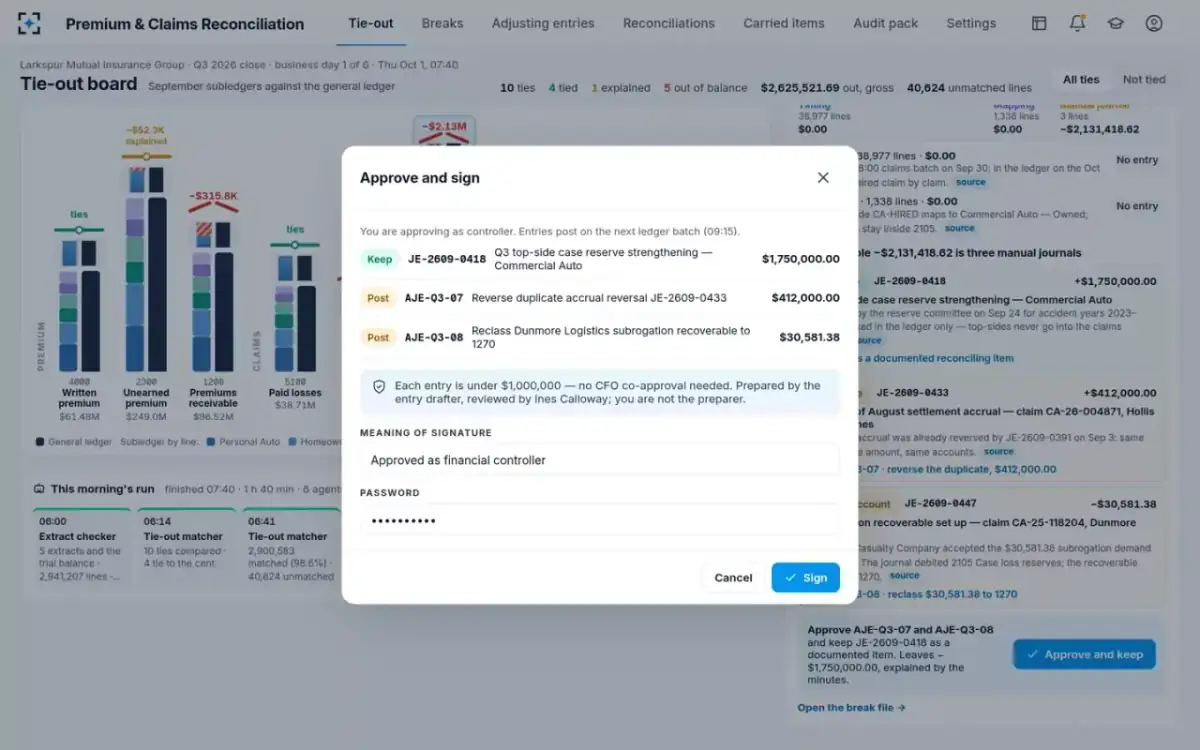
The remedy is design, not policy. In the solution, the drafter cannot post at all; the approval dialog checks that the approver is not the preparer and that the amount is within the approver's limit; the CFO co-approves any entry of $1,000,000 or more; and each approval is signed with a password and the meaning of the signature, "Approved as financial controller", recorded together. At the sample close, five entries worth $839,581.95 waited for approval, and none of them could move until a person acted.
One decision, three journals: keep one, post two, and sign
Who approves AI-drafted adjusting entries?
A named person with the authority for that amount approves AI-drafted adjusting entries, exactly as for an entry an accountant drafted. In practice that means an approval matrix: the controller below a limit, a second approver such as the CFO above it, and a reviewer between the drafter and the approver. At the sample insurer the controller approves entries under $1,000,000 and the CFO co-approves from $1,000,000; both are settings, with the approvers named.
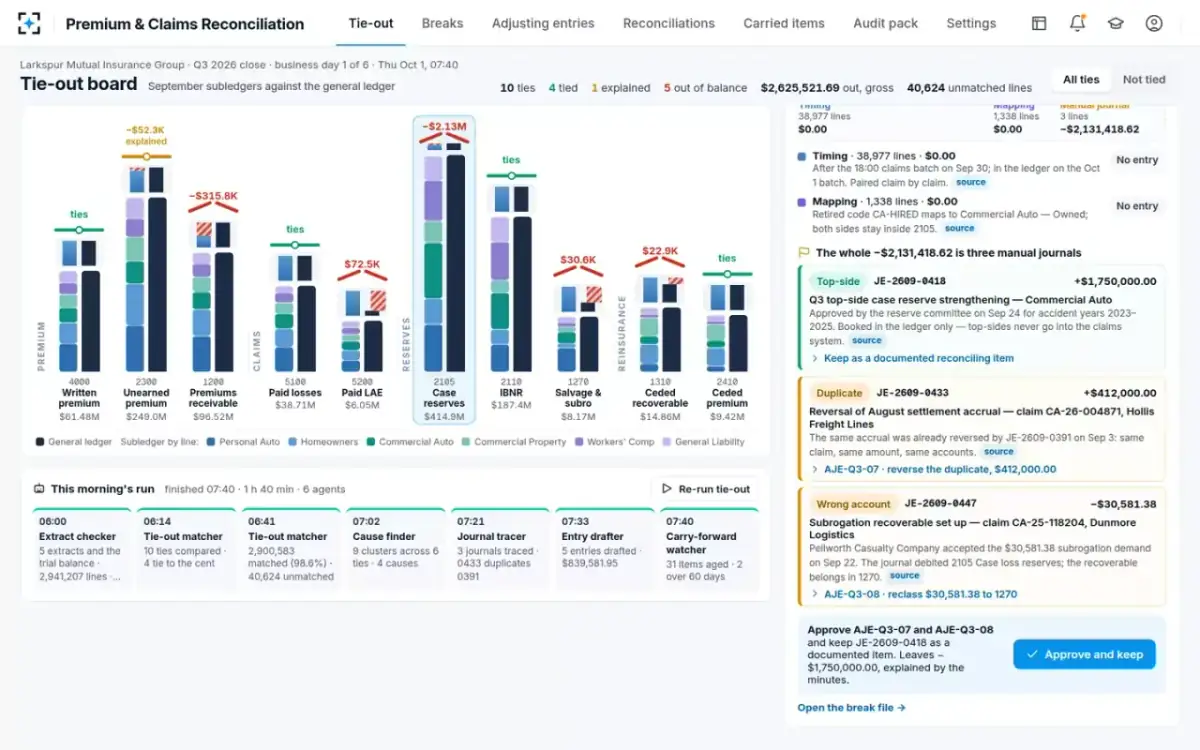
The matrix has to cover the company's own manual journals too, because that is where reconciliation breaks come from. At the sample close the journal tracer read the three journals behind a −$2,131,418.62 case reserve break. One was a $1,750,000.00 top-side backed by the reserve committee's minutes, kept as a documented reconciling item. One was a $412,000.00 duplicate reversal. The third, a $30,581.38 subrogation recoverable booked to the wrong account, had been posted under a company rule that journals below $50,000 need no approval. The agents did not fix that rule; they made it visible, which is the job.
Who does what when agents draft and people approve
Today
Not in the process: the accountant drafts every entry by hand after sorting the breaks.
With agents
Drafts each entry with its support and its effect on every tie, at 07:33 on day one.
Still theirs: Nothing it can post. It cannot approve, post or write off.
Today
Drafts, explains and often informally approves her own corrections.
With agents
Reviews what the agent drafted and returns anything wrong.
Still theirs: The review, and the judgment on what is an error.
Today
Approves a stack of entries late in the close, with little time to read support.
With agents
Approves before the 09:15 batch with the support, the limit check and the preparer check in one dialog.
Still theirs: Approval and the signature.
Today
Re-performs reconciliations it cannot trace to source.
With agents
Opens one pack where every item links to its source and shows who signed.
Still theirs: Testing the control, independently.
How does the Model Audit Rule apply to reconciliations?
The Model Audit Rule applies to reconciliations because they are part of the internal control over financial reporting that larger insurers must assess and report on. The NAIC's Annual Financial Reporting Model Regulation requires every insurer with $500 million or more of annual direct written and assumed premium to file a management report on internal control over financial reporting, signed by the chief executive and chief financial officers (NAIC Model #205, Section 17).
The report must include "an assertion, to the best of management’s knowledge and belief, after diligent inquiry, as to whether its internal control over financial reporting is effective to provide reasonable assurance regarding the reliability of financial statements in accordance with statutory accounting principles."
NAIC Annual Financial Reporting Model Regulation (#205), Section 17D(2)
That assertion is why a reconciliation done by an AI without a real approver is a problem rather than a saving. Management may not call its controls effective while an unremediated material weakness exists, and if the approval step is a formality, the control has a design gap of the kind auditors evaluate as a possible material weakness. The regulation also requires management to document the basis for its assertion and make it available at the financial condition examination. A reconciliation file that records who drafted, who reviewed and who approved each entry, with the support, is that basis.
Two further rules sit beside it. The independent accountant must tell the commissioner in writing about any unremediated material weaknesses it noted, within 60 days after the audited financial report is filed (Model #205, Section 11). And the use of AI itself is governed by each state's adoption of the NAIC's AI model bulletin, which the guide to the NAIC AI model bulletin adoption map tracks state by state.
Is AI reconciliation auditable? What internal audit needs to see
AI reconciliation is auditable when every output can be traced to an input and a rule, and a person's decision is recorded at every point where the numbers change. Preparers told the PCAOB staff what makes it hard: "the 'black-box' nature of some GenAI tools and the lack of consistent output produced by GenAI, which raise questions around the auditability of certain GenAI-created output" (PCAOB, 2024).
Internal audit needs five things from an AI-assisted reconciliation, and each can be built in:
- Completeness of input. The extract's record count and control total, agreed to the source system's own report.
- The rule behind every match. Not "matched by AI" but the fields and tolerance that paired the lines, so a sample can be re-performed.
- The document behind every explanation. A cluster called "timing" has to show the cut-off and the lines on each side of it; a journal called "supported" has to link to the support.
- Separated people. Preparer, reviewer and approver named, with times, and the approval limit that applied.
- Repeatability. The same extracts and settings produce the same result when the run is repeated.
In the solution, that becomes the audit pack: the summary, all ten ties, the reconciling items, the adjusting entries with who approved them, and an evidence index of thirteen sources at the sample close, from the claims extract to the reserve committee minutes and the currency rate table. It is prepared for internal audit and the Model Audit Rule file and exports to PDF. The agents' own steps are on the activity trail with what each did and when.
The three journals behind a $2.1 million break, each with its source and its fix
The risks of AI in the month-end close, and the control for each
The risks of AI in the month-end close are specific, and each has a control that can be written into the tool rather than left to policy. The U.S. Treasury's 2024 report on AI in financial services describes the best known of them, hallucination, in which a generative model convincingly produces an incorrect output (U.S. Treasury, AI in Financial Services, December 2024). In a reconciliation, a hallucination looks like a plausible explanation with nothing behind it.
Six ways AI can weaken a reconciliation, and the control that stops each
| Risk | What it looks like at close | Control built into the process |
|---|---|---|
| Invented explanation | A cluster labelled timing with no cut-off evidence | No cluster is explained without a source document for every line or journal |
| Agent posts | An entry reaches the general ledger without a person | The drafter cannot post; entries go on the next batch only after approval |
| Rubber-stamp approval | Fifty overnight entries approved in one click | Approval limits, a CFO co-approval from $1M, preparer and approver checked, signature meaning recorded |
| Over-matching | Unrelated lines paired to make a tie look clean | Matches only within the tie tolerance and date window in Settings, with the rule shown |
| Silent write-off | Old reconciling items quietly cleared to expense | Agents never write off; carried items over 60 days escalate to the owner and controller |
| Drifting mappings | A new cost code lands in the wrong account for months | Mapping changes are proposals that take effect only after approval in Settings |
Two of these risks are older than AI. Old reconciling items written off late and new cost codes mapped to the wrong account are the ordinary failures of a spreadsheet close. The difference is speed: an AI that is wrong is wrong across two million lines before anyone looks. That is the argument for making the controls part of the tool. For how the cluster rules decide what counts as explained, see the guide to the general ledger reconciliation process.
What to ask before AI touches your reconciliations
Ask how the tool separates drafting from approval, and ask to see it fail. A demonstration where every match succeeds proves very little; a demonstration on your own extracts where a control total disagrees and the run stops proves a great deal. The checklist below is what we would want answered on our own data before going live.
Eight questions to ask a vendor of AI reconciliation, on your own extracts
- Can the agent post, approve or write off anything?
The only acceptable answer for a control is no, enforced by the system, not by a user role someone can change.
- What happens when a control total does not agree?
The run should stop and say which source and by how much, before any matching.
- Show the rule behind one match and one cluster.
If the tool cannot show the fields and tolerance, internal audit cannot re-perform a sample.
- What evidence makes a cluster explained?
Ask whether you can set it, and whether a cluster without a document stays open.
- How are approval limits and preparer checks enforced?
Look for named approvers, amount limits, co-approval and a recorded meaning of signature.
- Does the same input give the same output?
Run the same close twice. Different results on identical data is an audit finding waiting to happen.
- What does it do with old reconciling items?
Aging and escalation are good; automatic clearing is not.
- Which of our systems does it read, and how?
Policy administration, billing, claims, reinsurance, reserving and the general ledger, read as they are, without replacing any of them.
Where AI reconciliation fits at an insurer, and where it does not
AI reconciliation fits where an insurer already produces daily or month-end extracts from its operating systems and closes into a general ledger with a stable chart of accounts; it does not fit as a substitute for either. Premium & Claims Reconciliation is built for the insurance subledger ties, from written and unearned premium and premiums receivable to paid losses, LAE, case reserves, salvage and subrogation and ceded balances, and it reads the systems an insurer already closes from. It does not replace the general ledger, the claims system or the people who sign.
Three situations call for fixing something else first. If extracts cannot be produced at all, there is nothing to tie. If the chart of accounts has no stable mapping from cost and coverage codes, every month will produce the same mapping cluster until the table is owned by someone. And if approval limits are not written down, the agents can enforce only what the company has decided. In each case the agents will make the gap faster to see, which is useful, but they will not close it. The guide to insurance accounting software covers what sits underneath, and Premium & Claims Reconciliation shows the whole close.
Questions people ask
Can AI post journal entries to the general ledger?
Technically, many tools can; for a controlled close, it should not. An entry that reaches the general ledger without a person's approval has skipped the review that makes the reconciliation a control. In Premium & Claims Reconciliation the drafter cannot post, and approved entries go on the next scheduled batch.
Does the Model Audit Rule apply to every insurer?
The annual CPA audit applies to insurers generally under a state's version of NAIC Model #205, with exemptions for the smallest companies. The management report on internal control over financial reporting applies to insurers with $500 million or more of annual direct written and assumed premium, and a commissioner can also require it from a company in financial difficulty. States adopt the model with their own variations, so the domiciliary state's rule governs.
Is an AI-drafted entry a manual journal?
For control purposes it should be treated as one: it is non-routine, it changes balances, and it needs support and approval. Auditing standards already single out non-standard entries for testing, so an AI-drafted correction should carry the same documentation as any manual adjustment, and more, since the rule that produced it should be visible too.
What evidence does internal audit need from AI reconciliation?
Proof the input was complete, the rule behind each match, a source document for each explanation, named preparer, reviewer and approver with times and limits, and a result that repeats on the same data. Those five let an auditor re-perform a sample instead of trusting the tool.
Should the same AI tool reconcile and analyse the variance?
It can, as long as both outputs are drafts. The risk is not that one tool does two things but that its explanation of a variance is accepted without the evidence behind it. Keep the rule that nothing is explained without a document, whichever step produced the explanation.