The general ledger reconciliation process is the routine of comparing each general ledger account with the independent source that supports it, at an insurer usually a subledger in the policy administration, billing, claims, reinsurance or reserving system, then identifying every difference, explaining it with evidence, correcting the errors through approved adjusting entries and documenting the result for a reviewer. Its most common failure is stopping when the two balances agree. A tie only proves that the totals match; two errors of the same size in opposite directions, or a manual journal with no support, tie just as well. Botminds' Premium & Claims Reconciliation runs the process for the insurance subledgers with agents that tie, match, cluster and trace, and it marks an account explained only when every difference has a source document behind it.
The worked examples on this page come from a fictional sample insurer, Larkspur Mutual Insurance Group, closing its third quarter of 2026 in the solution. The audit and regulatory sources are the PCAOB's auditing standards, Florida and Texas insurance regulators and the SEC, linked where they appear.
Tied versus explained: what each status actually proves
Tied: The subledger total and the general ledger balance agree within tolerance on one date.
Explained: Every line that differed has a named cause and a document, and every error has an approved fix.
Tied: Invisible. A $50,000 overstatement and a $50,000 understatement in the same account tie perfectly.
Explained: Visible, because lines are matched individually before the total is trusted.
Tied: Either a break every quarter or quietly netted into the total.
Explained: A documented reconciling item with the approval and minutes beside it.
Tied: Accepted as a lump sum that should clear next month.
Explained: Paired line by line across the cut-off, so a real error cannot hide inside the timing.
Tied: Check the subtraction.
Explained: Re-perform a sample from source to explanation without asking the preparer.
Tied: Unexplained differences, often written off late.
Explained: Aged items with owners, escalated before they go stale.
What are the steps in the general ledger reconciliation process?
The steps are the same for every account: prove the inputs, compare the balances, match the detail, explain what is left, correct, and sign. What changes for an insurer is the number of systems feeding the general ledger and the cut-offs between them, which is why each step has to be done in order.
Eight steps from extract to signed reconciliation
- Fix the cut-off and the date
Reconcile both sides as of the same moment. Know each system’s last-day cut-off before you start.
- Prove the subledger extract
Agree record counts and control totals to the source system’s own report. An incomplete extract creates false breaks.
- Compare the balances
Subledger total against the trial balance account, with the tolerance written down in advance.
- Match the detail
Pair lines by policy, claim or treaty, amount and effective date, allowing one-to-many matches.
- Cluster what does not match
Timing, mapping, manual journal, currency, missing feed. Net each cluster; a cluster that nets to zero is still worth reading.
- Trace every manual journal
Preparer, approver, date, description and support. A journal without support is a finding, not a reconciling item.
- Correct through approved entries
Draft with support, review by a second person, approve within limits. Never correct the source to make the tie work.
- Document and sign
Balances, reconciling items with age and owner, entries, and who prepared, reviewed and approved.
What is the difference between a tied and an explained reconciliation?
A tied reconciliation shows the two balances agree; an explained reconciliation shows why each line that differed did so, with evidence, and what was done about it. The distinction matters most in accounts with many lines and frequent manual adjustments, which describes most insurance balance sheet accounts: case reserves change daily, premiums receivable move with every payment and endorsement, and both attract top-side journals.
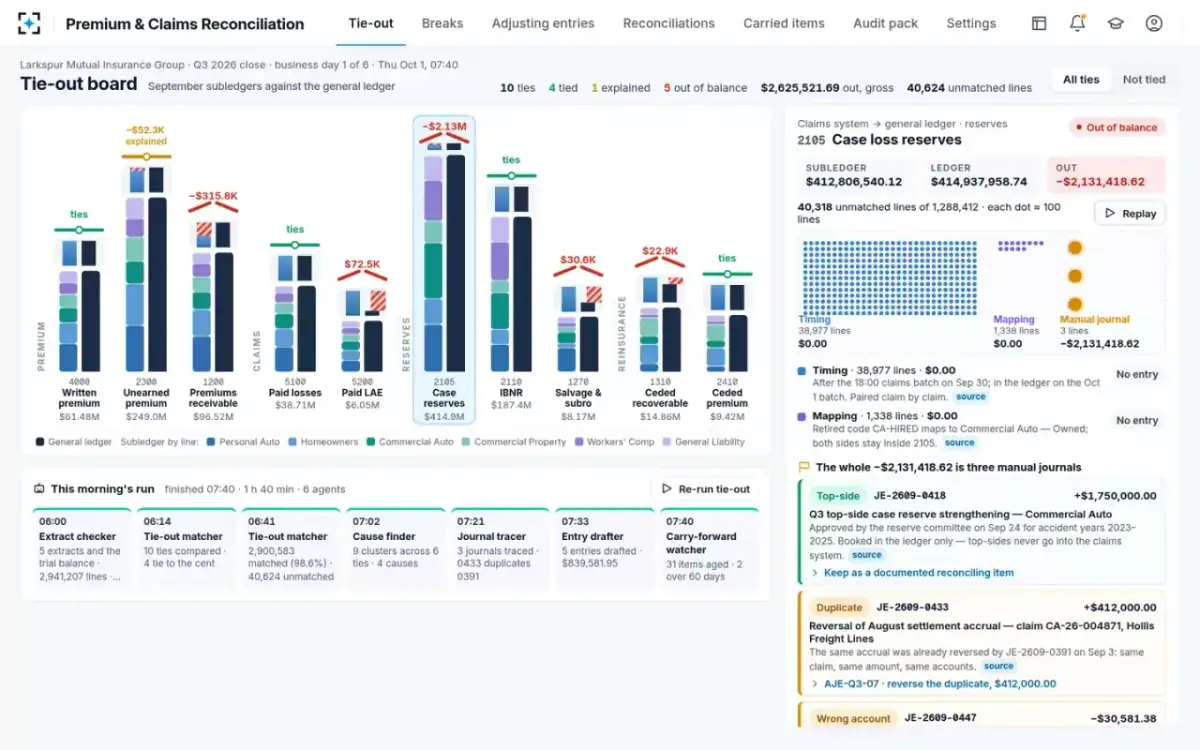
The sample insurer's case loss reserves show the difference in a single account. On the morning of business day one the subledger read $412,806,540.12 and the general ledger $414,937,958.74, a break of −$2,131,418.62 across 40,318 unmatched lines out of 1,288,412. Almost every unmatched line was harmless, and almost all the money was in three lines.
Where a $2.1 million case reserve break sits: almost all the lines, none of the money
| Cluster | Lines | Share of unmatched lines | Net amount |
|---|---|---|---|
| Timing: reserve changes after the 18:00 cut-off on Sep 30 | 38,977 | 96.7% | $0.00 |
| Mapping: claims on a retired cost code | 1,338 | 3.3% | $0.00 |
| Manual journals posted only to the general ledger | 3 | under 0.01% | −$2,131,418.62 |
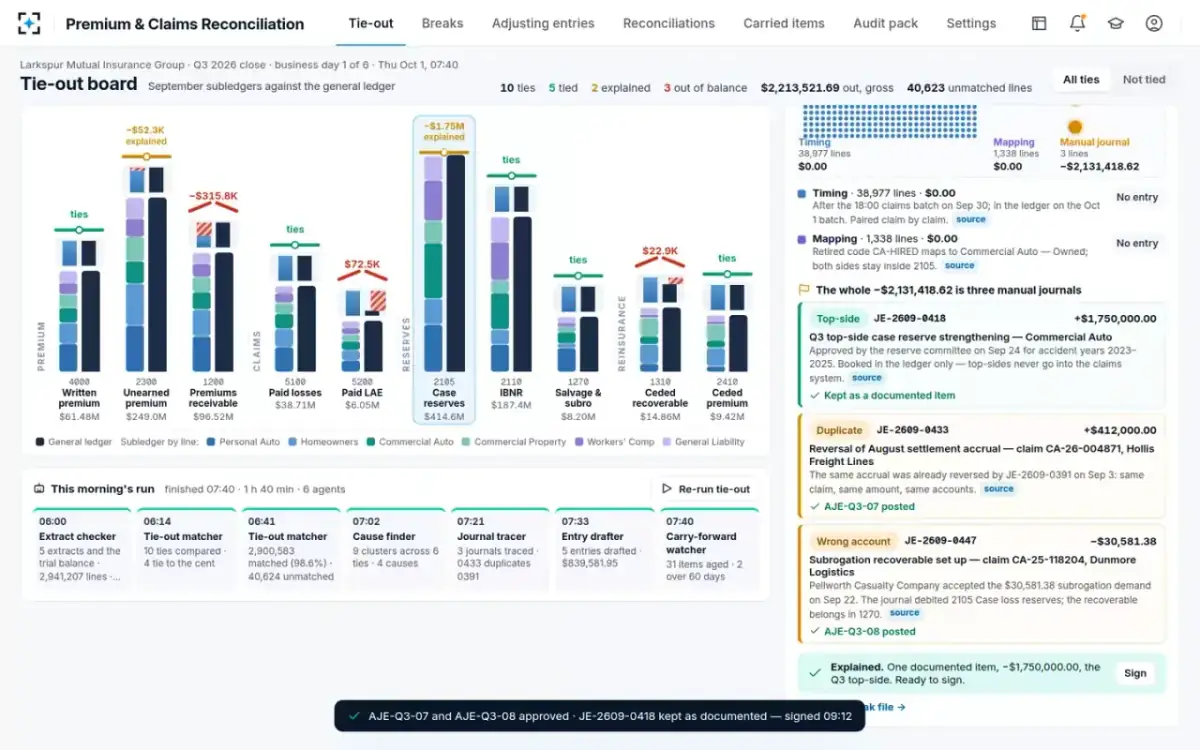
A team that stops at the tie would book a plug or carry the break; a team that matches line by line finds the three journals. One was a documented top-side to keep, one a duplicate reversal to undo, and one a recoverable booked to the wrong account. After the controller approved two entries, the account read −$1,750,000.00 explained: the top-side, with the reserve committee's minutes beside it.
Offsetting breaks: how a tie hides two errors
Offsetting breaks are two or more differences in the same account that cancel in total, so the account ties while both sides are wrong in detail. They are the reason a zero difference is not evidence on its own.
Take an illustrative case, not from the sample. A claims accountant books a $412,000 settlement accrual reversal twice, which understates case reserves by $412,000. In the same month a reserve increase of $412,000 on a different claim fails to post to the general ledger because of a mapping error. The account ties to the cent. Next month the missing increase arrives and the duplicate stays, and the account breaks by $412,000 with no obvious cause, a month after both errors were made.
Offsetting breaks are also how a balance can be supported in total while the judgments inside it are not. In 2020 the SEC charged an insurer and its former CFO over judgmental adjustments to loss reserves that, it alleged, diverged from the company's actuarial estimates and exceeded $300 million by the end of 2015, without adequate supporting documentation; both settled without admitting or denying the allegations (SEC Litigation Release No. 24838). A reconciliation that only asks whether the books agree with themselves would never have raised those adjustments. One that asks for the document behind each top-side would.
How do you reconcile a subledger to the general ledger in insurance?
You reconcile an insurance subledger to the general ledger by accepting that the two record the same business differently, and pairing them at the level where they agree. The subledgers post line by line on effective date; the general ledger takes daily summary batches plus manual journals. Comparing them in total tells you whether there is a problem; only line matching tells you what it is.
Three insurance specifics make this harder than an ordinary subledger. First, cut-offs: at the sample insurer the claims batch closes at 18:00 on the last day, policy administration at 20:00 and billing at 22:00, so each system produces its own timing cluster at every month-end. Second, mapping: claims and policy systems carry cost codes and coverage codes that a mapping table translates into general ledger accounts, and a retired or new code quietly sends lines to the wrong place. Third, top-sides: reserve and premium adjustments recommended by actuaries or management are booked only in the general ledger and will never appear in a subledger.
Forty thousand unmatched lines, clustered into three causes
What are reconciling items, and how long should they stay open?
A reconciling item is a documented difference between the general ledger and its source that is expected and understood at the reconciliation date. It should stay open only as long as its cause says it should: a timing item until the next batch, a documented top-side until the next reserve review, and an error not at all, because an error needs an entry, not a label.
Four kinds of reconciling item, and how long each should live
| Kind | Example from the sample close | Should clear |
|---|---|---|
| Timing | Three homeowners cancellations processed after the 20:00 policy cut-off on Sep 30, −$52,300.00 | On the next batch, Oct 1 |
| Documented permanent | Q3 top-side strengthening of Commercial Auto case reserves, $1,750,000.00 | When the reserve committee next reviews it; aged at each close |
| Error | Duplicate reversal of an August settlement accrual, $412,000.00 | Never carried: corrected by an approved entry |
| Unidentified | Unapplied agency cash from a July lockbox sweep, $18,440.00, 72 days old | Investigated now; escalated past the company’s limit |
For premium balances there is also a hard statutory limit. Under the NAIC's statutory accounting for receivables from agents, reconciling items between the insurer's account and an agent's account that are more than 90 days due are nonadmitted, which takes them out of surplus however collectible they are. The guide to non-admitted premium receivables and the 90-day rule prices what that costs, and uncollected premiums and agents' balances walks through the statement line.
Manual journals and top-sides: where auditors look first
Auditors look first at manual journals, because that is where errors and fraud enter a reconciled account. The PCAOB's auditing standard on fraud says material misstatements "often involve the manipulation of the financial reporting process by (a) recording inappropriate or unauthorized journal entries throughout the year or at period end," and directs auditors to test them (PCAOB AS 2401.58).
Inappropriate entries may be applied to accounts that "have not been reconciled on a timely basis or contain unreconciled differences."
PCAOB AS 2401.61, Consideration of Fraud in a Financial Statement Audit
The same paragraph lists what suspicious entries look like, among them entries made to seldom-used accounts, entries by people who do not usually post journals, and period-end or post-closing entries with little or no description. The last reads like a description of an insurance top-side booked on the last day of the quarter. A top-side is usually legitimate, and it is also exactly the kind of entry an auditor will select. The defense is the same in both cases: a description, an approver, and the document that authorized it, filed with the reconciliation where the auditor will look.
At the sample close, the journal tracer read each manual journal in the case reserve break with its preparer, approver and support. The $1,750,000.00 top-side had the reserve committee's minutes; the duplicate was found by comparing it with the original journal, same claim, same amount, same accounts; the misposted recoverable was found because the claim note said where it belonged. The agents flag any journal without support and any journal whose preparer and approver are the same person.
What an auditor tests, and what a regulator tests
An auditor tests whether the reconciliation control works; a regulator tests whether the filed statement agrees with the books behind it. The CPA, under the PCAOB's standard for an integrated audit, must evaluate the period-end financial reporting process, which the standard defines to include the procedures for initiating, authorizing, recording and processing journal entries in the general ledger (PCAOB AS 2201.26). That is a test of design and operation: was each reconciliation done, reviewed and evidenced.
Regulators come at it from the filing. When Florida's Office of Insurance Regulation examined a property insurer's September 2008 quarterly statement, it found uncollected premiums reported net of the nonadmitted portion, so the net admitted line was understated by $473,806, and it wrote: "We recommend that the Company verify that financial information provided to the Office reconciles with corresponding subsidiary ledgers" (Florida OIR, Royal Palm Insurance Company, 2008). Texas, in the rule it adopted in 2000 on audited financial reports, requires the notes to the audited statutory statements to reconcile, and describe, any differences between those statements and the annual statement filed with the department (Texas Department of Insurance, 28 TAC §7.85 adoption order).
Between them, the auditor and the regulator test the two ends of the chain. The general ledger reconciliation is the middle link, and it is the one only the insurer can document.
How to document a reconciliation so it survives review
Document a reconciliation so that a reviewer who has never seen the account can re-perform it from the file. That means the balances on both sides with their sources and dates; the tolerance used; each reconciling item with its amount, cause, age, owner and the document that supports it; each correcting entry with its approval; and the names and dates of preparer, reviewer and approver.
The common failure is a file that is correct but only understandable to its preparer. Spreadsheets rebuilt each month carry formulas, hidden tabs and notes in the preparer's shorthand, and a reviewer either trusts them or starts again. In the solution, each tie carries its own break file, with the agents' steps from the 06:00 extract check to the drafted entries and each journal's support, and the signed ties go into an audit pack with an evidence index. The case for agents drafting and people approving is set out in using AI for account reconciliation.
The board after approval: one documented item instead of a $2.1 million break
Every reconciliation in the solution follows the same eight steps; see them run across all ten insurance ties on Premium & Claims Reconciliation.
Questions people ask
What is the difference between account reconciliation and general ledger reconciliation?
The terms overlap. General ledger reconciliation usually means proving each balance sheet account against its supporting detail, while account reconciliation is the broader practice that includes bank, intercompany and subledger reconciliations. At an insurer, the subledger reconciliations for premium, receivables, claims, reserves and reinsurance are the largest and most error-prone part of either.
How often should general ledger accounts be reconciled?
High-volume and high-risk accounts, such as premiums receivable and case reserves, are normally reconciled every month and formally at each quarter-end, when the NAIC quarterly statement is prepared. Low-activity accounts can be reconciled quarterly if the risk assessment supports it. The sample insurer also runs a pre-close tie every night in the last five days of the month to find breaks before day one.
What is a plug in a reconciliation?
A plug is an unexplained amount booked to make a reconciliation tie. It hides the difference instead of explaining it, and auditors treat it as a sign that the control did not work. An explained reconciliation leaves the difference visible as a reconciling item with a cause, or corrects it with an approved entry.
Who should review a general ledger reconciliation?
Someone other than the preparer, with authority over the account, typically an accounting manager or the controller, and for material accounts a second level such as the CFO. The reviewer should be able to re-perform a sample from the file alone. Internal audit then tests the control independently.
What tolerance should a reconciliation use?
A tolerance should be set in advance, per account, and small enough that a real error cannot hide inside it. The sample insurer uses $1,000 or 0.001% of the balance, whichever is lower; on a $412 million reserve account that is $1,000, not $4,128. Differences inside tolerance are still recorded, just not chased.