A claims reconciliation specialist, usually titled claims accountant or claims reconciliation analyst at an insurer, is the person who proves at every close that the claims system and the general ledger agree on paid losses, paid loss adjustment expense (LAE), case reserves, and salvage and subrogation, and who explains every difference before the books are signed. The work is hard because the two systems are built differently: the claims system posts each payment and reserve change claim by claim on its effective date, while the general ledger takes daily summary batches plus manual journals, so a perfectly normal month can produce tens of thousands of unmatched lines. Botminds' Premium & Claims Reconciliation exists for that seat: its agents load the extracts, tie each account, cluster the unmatched lines by cause and draft the correcting entries, and the specialist reviews what they found instead of sorting lines by hand.
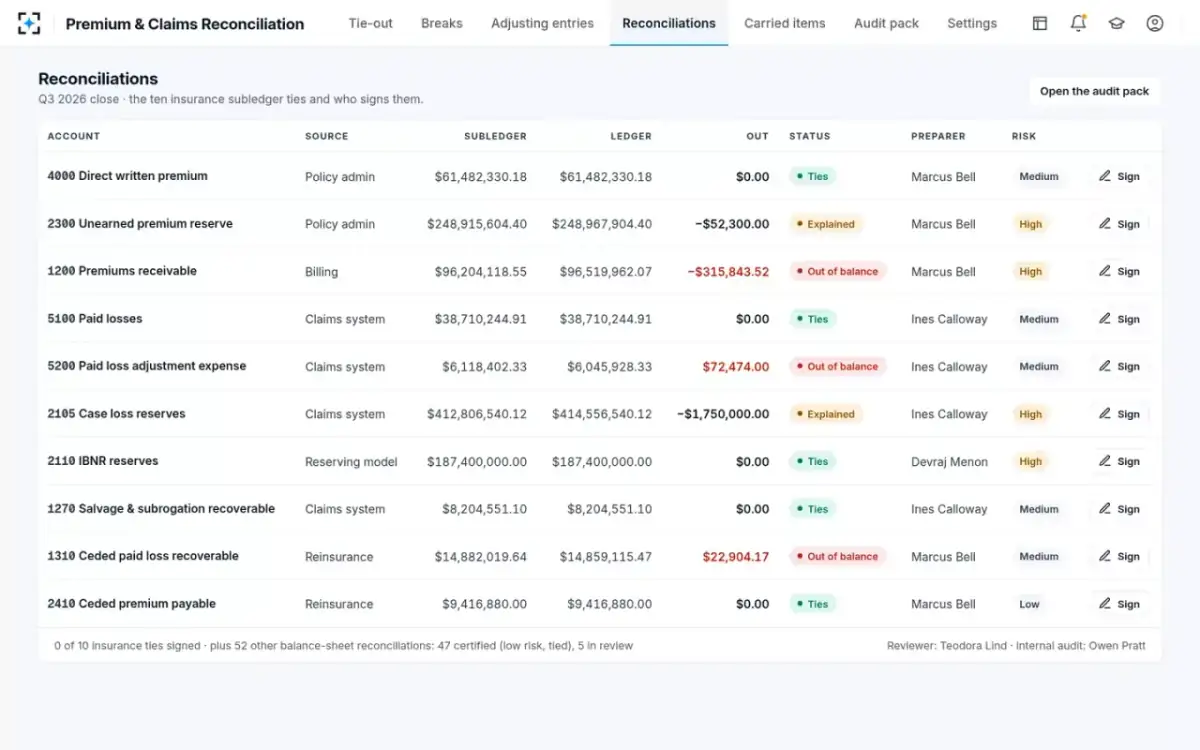
The examples on this page come from a fictional sample insurer, Larkspur Mutual Insurance Group, at its third-quarter 2026 close, as it runs through the solution. Its claims accountant, Ines Calloway, prepares five of the ten insurance subledger ties. The research figures come from the U.S. Bureau of Labor Statistics, the NAIC, the New York insurance regulator and the Casualty Actuarial Society, linked where they appear.
The accounting seat insurers draw from
1.6M
accountants and auditors employed in the United States in 2025
8%
of them work in finance and insurance, BLS reports
$83,680
median annual wage for accountants and auditors, May 2025
What does a claims reconciliation specialist do?
A claims reconciliation specialist ties every claims-related balance in the general ledger to the system that produced it, finds the lines that do not match, explains why, and prepares the correcting entries for someone else to approve. The job runs on the close calendar: extracts on the first business day, ties by the second, explanations and entries before the controller signs. Between closes it is quieter work, mostly chasing the reconciling items carried from last month.
The duties are steady from one insurer to the next. The specialist proves that the claims extract is complete, compares it with the trial balance account by account, matches the unmatched lines claim by claim, reads the manual journals that touched each account, and writes up what is left as a reconciling item with its support. Where a journal was wrong, the specialist drafts the reversal or reclass. Where it was right but lives only in the general ledger, such as a top-side reserve adjustment, the specialist documents it so it stops looking like an error every quarter.
Four seats at one close, before and with agents doing the sorting
Today
Receives 40,318 unmatched case reserve lines on day one and sorts them by hand for most of the week.
With agents
Opens three clusters, two of which net to $0.00, and reviews two drafted entries with their support beside them.
Still theirs: Reviewing every drafted entry, and deciding what is a real error.
Today
Spends half the close on lockbox cash that arrived without policy numbers.
With agents
Sees 214 payments already traced to one agency feed, with the entry to apply them drafted.
Still theirs: Calling the agency, and owning the premium ties.
Today
Learns on day four or five which journals caused a seven-figure break.
With agents
Reads an explained board before 08:00 and approves two entries before the 09:15 batch.
Still theirs: Approval, and the signature on each tie.
Today
Sees the same top-side reserve flagged as a break every quarter.
With agents
Sees it kept as a documented reconciling item, traced to the committee minutes.
Still theirs: The reserve itself and its support.
The claims accounts a specialist ties at every close
Most insurers ask the claims seat to tie four or five accounts, and each has its own source and its own way of breaking. Paid losses and paid LAE come from the claims payment run, case reserves from the claims system's open inventory, salvage and subrogation from recoveries, and often the ceded paid loss recoverable from the reinsurance system. IBNR usually belongs to the reserving actuary, because no claims system holds it.
Five claims accounts, their sources, and how each tends to break
| Account | Comes from | Breaks most often because |
|---|---|---|
| Paid losses | Claims payment run, bank clearing | Payments issued after the claims cut-off and booked the next day; voided checks reversed in one system only. |
| Paid LAE | Claims payments to adjusters, defense counsel and vendors | A new vendor or cost code maps to the wrong expense account. |
| Case reserves | Open-claim inventory in the claims system | Reserve changes after the cut-off, retired cost codes, and top-side journals that never enter the claims system. |
| Salvage and subrogation | Recovery entries on each claim | A recovery booked against case reserves instead of the recoverable account. |
| Ceded paid loss recoverable | Reinsurance system, by treaty | Currency revaluation and cash in transit on quarterly settlements. |
The reinsurance line deserves its own owner where an insurer cedes heavily. Matching a reinsurer's statement against the cedant's books is a different job, covered in the guide to premium reconciliation across cedant, broker and reinsurer; the claims seat only needs the recoverable in the general ledger to agree with the reinsurance system.
What is a claims reconciliation break? The five shapes it takes
A claims reconciliation break is any difference between the claims system and the general ledger for the same account and date that has not yet been explained. Most breaks are not errors. They are the same transaction seen by two systems at different moments, and the specialist's first job is to separate those from the few that change the numbers.
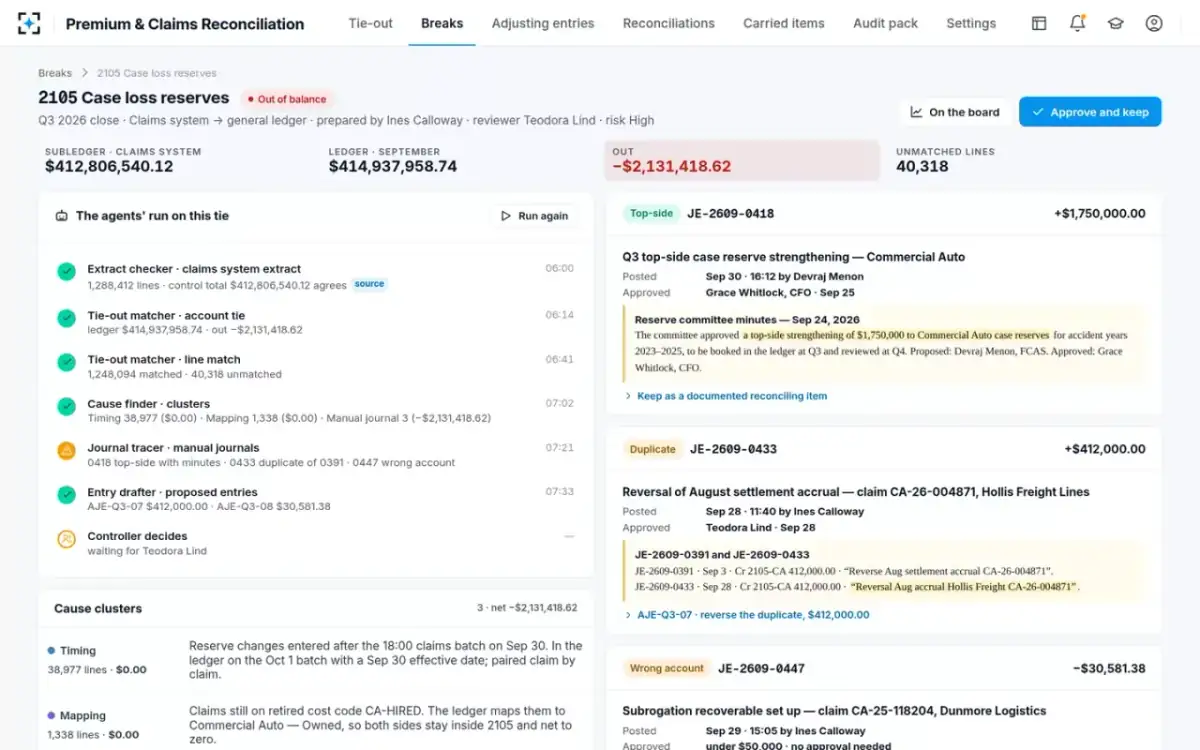
At the sample insurer, case loss reserves were out by −$2,131,418.62 on the morning of business day one: subledger $412,806,540.12, general ledger $414,937,958.74. Of 1,288,412 lines, 40,318 did not match. Clustered by cause, they took five shapes, and only one of them moved money:
- Timing. 38,977 lines were reserve changes entered after the 18:00 claims batch on September 30. They sat in the claims system on the 30th and in the general ledger on the October 1 batch. Paired claim by claim, they net to $0.00.
- Mapping. 1,338 lines carried a retired cost code that the general ledger still mapped to the same account. They also net to $0.00, but they will keep appearing until the mapping table is cleaned up.
- Top-side. A $1,750,000.00 strengthening of Commercial Auto case reserves, approved at the reserve committee, booked straight to the general ledger. It is right, and it will never be in the claims system.
- Duplicate. A $412,000.00 journal reversing an August settlement accrual that had already been reversed on September 3: same claim, same amount, same accounts.
- Wrong account. A $30,581.38 subrogation recoverable booked against case reserves instead of the salvage and subrogation account.
Three journals carried the whole break. That is the usual pattern: thousands of lines that look alarming and net to nothing, and a handful of manual entries that matter. The page on the general ledger reconciliation process explains why a tie that comes out to zero can still hide two errors that cancel.
The break file: every step on the case reserve tie, with each journal's support beside it
The systems a claims accountant works between
The specialist's desk sits between five systems that were never designed to agree on the same day. The claims system holds payments and reserves claim by claim. The bank or payment platform holds what actually cleared. The general ledger holds daily summaries and manual journals. The reinsurance system holds what is recoverable by treaty. And the reserving model holds IBNR and any top-side adjustment the actuaries recommend.
Each hand-off between them has a cut-off. At the sample insurer the claims batch closes at 18:00 on the last day, policy administration at 20:00 and billing at 22:00. Every transaction keyed after those times lands in the next day's batch, which is why month-end and quarter-end produce timing breaks that would never exist in the middle of a month. A specialist who knows the cut-offs can name the timing cluster before opening it.
The actuaries depend on the same data. The Casualty Actuarial Society's reserving text lists consistency with financial statement data, which may have been externally audited, among the first checks an actuary should make on claims data (Friedland, Estimating Unpaid Claims Using Basic Techniques, CAS). If the claims accountant's tie is not done, or not documented, the actuary inherits the break without knowing it. How the accounting tie, the actuary's tie and the auditor's test fit together is the subject of insurance claims reconciliation: the three-way tie nobody owns.
How do you reconcile claims payments to the general ledger?
You reconcile claims payments to the general ledger by proving the extract is complete, tying it to the account in total, matching the lines that differ by claim number, amount and date, and explaining each remaining difference with a document. The order matters, because each step shrinks the work for the next.
- Prove the extract. Agree record counts and the control total to the claims system's own report before comparing anything. A short extract creates false breaks.
- Tie in total. Compare the extract with the trial balance account for the same date. If they agree within tolerance, stop and document. If not, keep going.
- Match line by line. Pair payments by claim, amount and effective date, allowing a window of a day or two for cut-offs. Allow one-to-many and many-to-one pairs: a single check can settle several claim lines.
- Cluster what is left. Group unmatched lines by cause (timing, mapping, manual journal, currency, missing feed) and net each group.
- Trace the journals. Read every manual journal in the account: who posted it, who approved it, and what supports it.
- Draft, review, sign. Draft correcting entries with support, have a second person review them, and leave the approval to the controller.
Paid losses are usually the easiest tie because a payment is a discrete event that both systems see. Case reserves are the hardest, because reserves change constantly and the general ledger only sees the net movement for each batch. At the sample insurer, paid losses tied to the cent at $38,710,244.91, while case reserves produced the 40,318-line break described above.
"It is recommended that the Facility properly reconcile supplementary ledgers to the general ledger at the end of each financial period to provide for proper accounting, proper audit trail and proper verification of its financial reports."
New York Insurance Department, Report on Examination of New York Mutual Underwriters (2006)
What examiners and auditors expect the seat to produce
Examiners expect the reconciliation to exist, to be done every period, and to be supported. The New York recommendation above followed an examination that found the facility "has not been reconciling supplementary ledger reports to the general ledger," with the result that balances in commissions payable, contingent commissions payable and premiums receivable "were either overstated or understated" at year-end (NY Insurance Department, 2006). It is an old report, and the finding is still the most common one in a reconciliation file: the work was done informally and never written down.
For larger insurers the reconciliation is also an internal control in the formal sense. The NAIC's Annual Financial Reporting Model Regulation, the "Model Audit Rule", requires insurers with $500 million or more of direct written and assumed premium to file a management report on internal control over financial reporting, signed by the chief executive and chief financial officers (NAIC Model #205, Section 17). Claims reconciliations are among the controls that report rests on, so the specialist's file is evidence that someone other than the specialist will test.
The practical output is a reconciliation that a reviewer can follow without asking: the balances on both sides, every reconciling item with its amount, age, cause, owner and document, the entries proposed, and who prepared, reviewed and signed it.
Which hours agents take, and which stay with the specialist
Agents take the sorting; the specialist keeps the judgment. In Botminds' estimate for one quarter-end close, most of a specialist's first days go to loading extracts, tying accounts, sorting unmatched lines and tracing journals, work that is mechanical once the rules are written down. Review, approval and sign-off are the part that stays, and they grow as a share of the work because everything before them shrinks.
Where the first days of a quarter close go, by spreadsheet and with Premium & Claims Reconciliation
By spreadsheet · 4.5 days
- Load extracts, prove totals · 11%
- Tie each account · 11%
- Sort unmatched lines · 34%
- Trace journals · 22%
- Draft entries · 11%
- Review and sign · 11%
With the solution · 0.9 days
- Load, tie, sort, trace, draft (agents) · 56%
- Review and sign · 44%
The specialist's remaining work is the part no rule can do. Is a duplicate reversal really a duplicate, or did the claim reopen? Should a top-side be kept as a documented item or questioned with the actuary? Is a vendor's new cost code a mapping slip or a sign that adjusting expense is being booked somewhere it should not be? In the solution, a cluster cannot be marked explained without a source document behind every line or journal, and the agents never post, change a source system or write an item off. The specialist reviews; the controller approves.
Ten insurance subledger ties, who prepares each, and its risk
Claims accountant skills, pay and the path into the seat
The seat needs an accountant who also understands claims. The accounting half is ordinary: double entry, accruals, journal support and a reconciliation that a reviewer can follow. The insurance half is not. A specialist needs to know how statutory accounting treats losses and LAE, how case reserves move when a claim is reported, adjusted, settled and reopened, how salvage and subrogation are recorded, and how reinsurance changes what is recoverable.
The occupation it sits in is large. BLS counts about 1.6 million accountants and auditors in 2025, with 8% in finance and insurance, a median wage of $83,680 in May 2025, and employment projected to grow 5% from 2025 to 2035 (BLS Occupational Outlook Handbook). BLS does not break out claims accountants, so pay for the specialist title depends on the insurer and the market; the median is a reference point, not a benchmark for the seat.
The usual path runs from general accounting or claims operations into claims accounting, then to a senior or lead role that owns the reconciliation calendar, and from there to an accounting manager or controller role. The specialists who move fastest are the ones whose files explain themselves. To see how the solution supports that file, from extracts to signed ties, start from Premium & Claims Reconciliation.
Questions people ask
What is claims reconciliation in insurance?
Claims reconciliation is proving that the claims balances in the general ledger (paid losses, paid LAE, case reserves, salvage and subrogation, and recoverables) agree with the claims system that produced them, and explaining every difference. It is done at each month-end or quarter-end close. The actuary's separate reconciliation of claims data to Schedule P uses the same underlying data for a different purpose.
Is claims reconciliation done monthly?
At most insurers the claims accounts are reconciled every month, and more formally at each quarter-end, when the NAIC quarterly statement is prepared. Statutory statements are filed quarterly and annually, so an account that is only reconciled at year-end leaves three quarters of filings resting on unproven balances.
What systems does a claims accountant use?
A claims accountant typically works with the claims administration system, the payment or bank platform, the general ledger, the reinsurance system and spreadsheets or a reconciliation tool in between. Where a third-party administrator pays claims, the TPA's bordereau and funding requests are a sixth source, covered in the guide to TPA reconciliation.
How many accountants work in insurance?
BLS reports about 1.6 million accountants and auditors in the United States in 2025, with 8% employed in finance and insurance combined. That is roughly 128,000 people on BLS's rounded figures, across banks and insurers; BLS does not publish a separate count for insurance carriers' claims accountants.
Can AI replace a claims reconciliation specialist?
AI can do the sorting: matching lines, clustering the unmatched ones by cause and drafting the obvious entries. It should not approve or post them, because the reconciliation is a control and needs a second person. The guide on using AI for account reconciliation sets out where that line sits.