Insurance accounting software is the set of systems that record an insurer's premium, claims, reinsurance and investment activity and turn it into GAAP and statutory financial statements: a general ledger, the policy administration and billing systems that hold premium detail, the claims system, the reinsurance system, and the statutory reporting tool that produces the NAIC annual and quarterly statements. Most insurers have all of these already. What they lack is proof, at every close, that the detail in each system agrees with the general ledger, and that is where a close goes slow and audit findings come from. Botminds' Premium & Claims Reconciliation is built for that gap: a layer that reads the systems you have without replacing any of them, ties each subledger to its general ledger account, explains every break, and drafts the correcting entries for a person to approve.
The examples on this page come from a fictional sample insurer, Larkspur Mutual Insurance Group, at its third-quarter 2026 close in the solution. The control and statutory references are the NAIC's model regulation and accounting materials and a Casualty Actuarial Society study text, linked where they appear.
One stack, read as it is: six systems in, four things out, nothing posted without a person
Systems you already run
Reconciliation layer
- Check extracts and control totals
- Tie each account, match lines
- Cluster breaks by cause
- Trace manual journals and support
- Draft adjusting entries
- Age carried items
What comes back
What is insurance accounting software?
Insurance accounting software is any system that records insurance transactions in a form the insurer's financial statements can be built from, and in practice it is several systems, not one. The general ledger is often the same product a bank or a manufacturer would use. The insurance-specific parts are the subledgers, which hold premium, claims and reinsurance detail by policy, claim and treaty, and the statutory layer, which turns balances into the NAIC blank with its admitted and nonadmitted columns, Schedule P and the rest.
The statutory layer is what makes insurance accounting different. Statutory accounting principles are set out in the NAIC's Accounting Practices and Procedures Manual, and each U.S. GAAP standard is adopted, adopted with modification, or rejected for statutory purposes (NAIC, statutory accounting principles). Premium is recorded on the policy's effective date and earned over the term; receivables over ninety days due are nonadmitted; losses and loss adjustment expense are reserved at management's best estimate. Software that does not know those rules can still hold the balances, but someone has to apply the rules around it.
Do insurers need special accounting software?
Insurers need insurance-aware subledgers and statutory reporting; they do not necessarily need an insurance-specific general ledger. A general ledger's job is to hold balances by account and period and to accept journals with controls around them, and that job is the same in any industry. The insurance knowledge lives upstream, in the systems that calculate earned premium or case reserves, and downstream, in the statutory statement.
The assets page shows why the downstream part matters. Statutory accounting counts only assets available to pay policyholders; the rest are nonadmitted and come straight off surplus (NAIC, statutory accounting principles; the rules are read in nonadmitted assets). Several follow fixed tests, such as the ninety-day rule on premium receivables (non-admitted premium receivable). A general ledger does not apply those formulae; the reconciliation and reporting around it must.
So the question behind most searches for insurance accounting software is narrower than it looks: not "which general ledger", but "how do we prove, every close, that the insurance subledgers and the general ledger agree, and apply the statutory rules to what they hold".
What systems feed insurance accounting?
Six systems feed a property and casualty insurer's accounting, each on its own schedule and cut-off. At the sample insurer the claims batch closes at 18:00 on the last day of the month, policy administration at 20:00 and billing at 22:00. Every transaction keyed after those times lands in the next day's general ledger batch, which is why every quarter-end opens with timing breaks.
What each system feeds, and the general ledger account it must tie to
| System | Feeds | Ties to (sample chart) | Typical break |
|---|---|---|---|
| Policy administration | Written premium, unearned premium reserve | 4000 Direct written premium; 2300 Unearned premium | Cancellations after the cut-off |
| Billing and lockbox | Premiums receivable, cash application | 1200 Premiums receivable | Payments without policy numbers sent to unapplied cash |
| Claims system | Paid losses and LAE, case reserves, recoveries | 5100, 5200, 2105, 1270 | Reserve changes after the cut-off; retired cost codes |
| Reinsurance system | Ceded recoverables and ceded premium | 1310, 2410 | Foreign currency revaluation |
| Reserving model | IBNR and top-side adjustments | 2110 IBNR; 2105 for top-sides | Top-sides booked only in the general ledger |
| General ledger | Trial balance, manual journals | Every account above | Duplicates and journals to the wrong account |
The reinsurance row has a second reconciliation behind it, between the cedant, the broker and the reinsurer, which is a different job with its own guide: insurance reconciliation software for broker and reinsurer statements. Premium billed to employer groups and premium reported by managing general agents on bordereaux have their own solutions too, Group Premium Reconciliation and Premium Bordereaux Reconciliation. This page is about the direct business tied to the insurer's own general ledger.
Can reconciliation work with your existing general ledger?
Yes, if the reconciliation layer only reads. It needs a trial balance, the general ledger's journal detail with preparer, approver and support, and extracts from each subledger; it gives back drafted entries that people approve and that post through the general ledger's normal import. Nothing about the general ledger's configuration has to change.
A close on an existing general ledger: read at night, explain by morning, post at 09:15
Agent
Pre-close tie, nightlyIn the last five days of the month, ties each account at 23:30 so breaks show before the close starts.
Never: changes a source system or a general ledger balance.
Agent
Day one, 06:00Loads the month-end extracts and trial balance and proves control totals against each source.
Never: matches anything before every control total agrees.
Agent
By 07:40Ties ten accounts, matches the 2,941,207 lines it loaded, clusters the rest by cause and drafts the entries.
Never: posts. It drafts only.
A person decides
Accountants and controllerReview the drafted entries, approve within limits and sign each tie.
A person decides
General ledger batch, 09:15Approved entries post through the general ledger’s normal import, like any other journal.
The tie-out board at 07:40 on day one
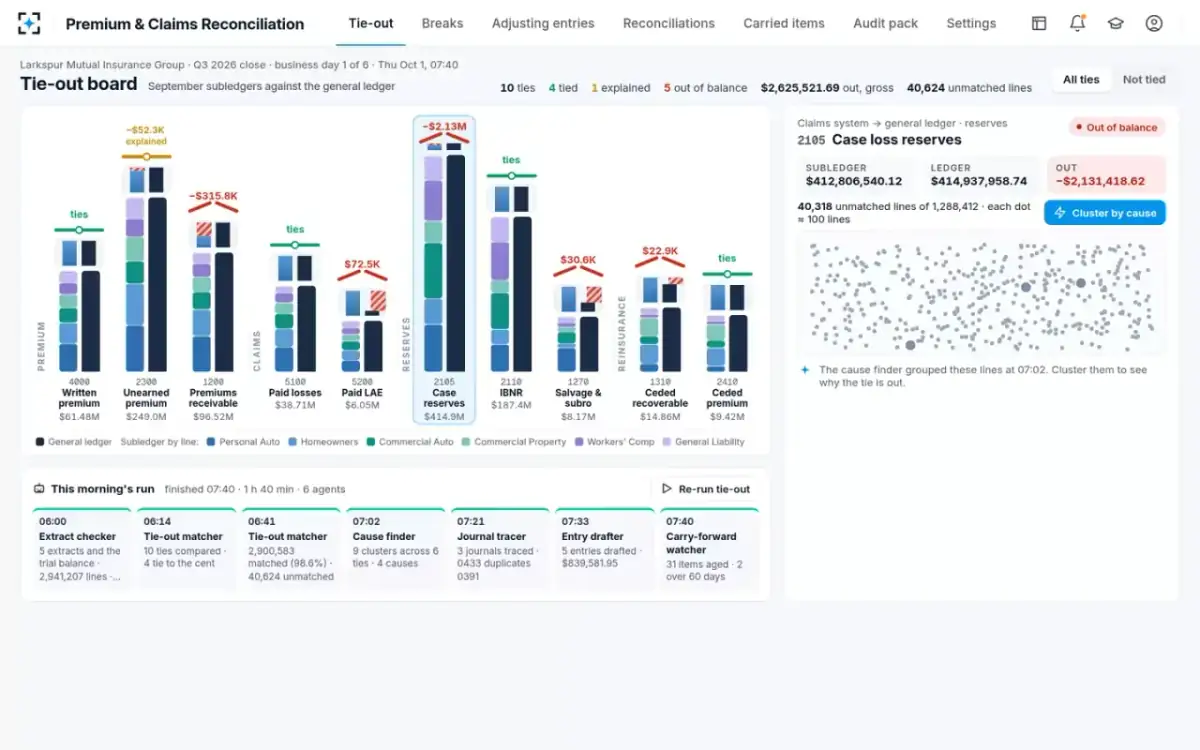
Replace the general ledger or layer on top: what each route costs
Replacing a general ledger, policy system or claims system is a multi-year program, and it does not remove the reasons subledgers break. A new general ledger still takes summary batches; a new policy system still has a cut-off; actuaries still book top-sides; cost codes still change. The breaks move; they do not disappear. Layering reconciliation on top fixes the thing that hurts at close, and leaves the bigger decisions to be made on their own merits.
Two routes to a faster, cleaner close
| Question | Replace a core system | Add a reconciliation layer |
|---|---|---|
| What it fixes | Old technology, product limits, data model | Unexplained breaks, manual sorting, missing support at close |
| What it does not fix | Cut-offs, top-sides and mapping changes, which a new system also has | Bad source data, missing extracts, an unmapped chart of accounts |
| Who is disrupted | Every user of the system, through migration and parallel runs | The close team, for one or two closes run side by side |
| Risk to the statements | Conversion errors in opening balances and history | Low: read-only, and every entry is approved by a person |
| When value arrives | After cut-over | From the first close it runs on |
The two are not exclusive. An insurer that is replacing its claims system has the most to gain from a reconciliation layer during the conversion, when two claims systems feed the same accounts and every difference has to be explained to the auditors.
What controls do auditors expect from accounting software?
Auditors expect accounting software to support the insurer's internal control over financial reporting, which the NAIC's Model Audit Rule defines as a process that includes policies and procedures that "Pertain to the maintenance of records that, in reasonable detail, accurately and fairly reflect the transactions and dispositions of assets," together with procedures that make sure transactions are recorded as the statutory statements require (NAIC Model #205, Section 3). For a reconciliation layer that becomes a short, testable list.
Seven controls an auditor will test in a reconciliation layer
- Read-only access to sources
The tool cannot change a policy, a claim or a ledger balance; it can only read.
- Completeness of every extract
Record counts and control totals proved against each source before matching starts.
- Versioned settings
Tolerances, cut-offs, mappings and approval limits are changed only with approval, and each version is kept.
- Segregation of duties
Drafter, reviewer and approver are different; the system checks limits and the preparer before it accepts a signature.
- Evidence for every explanation
No reconciling item without the document behind it.
- A complete activity trail
Every agent step and every human decision with who, what and when.
- One scope per company
Each legal entity’s general ledger is reconciled in its own scope, so statements for one company never draw on another’s data.
For insurers that already report under Sarbanes-Oxley, Model #205 lets a SOX-compliant group file its Section 404 report with an addendum instead of a separate report, provided the controls that matter to the statutory statements were in scope. Either way, the reconciliation controls are among the ones tested. The guide on using AI for account reconciliation covers the approval rules in detail.
Close rules as settings: tolerances, cut-offs, approvals and the mapping table
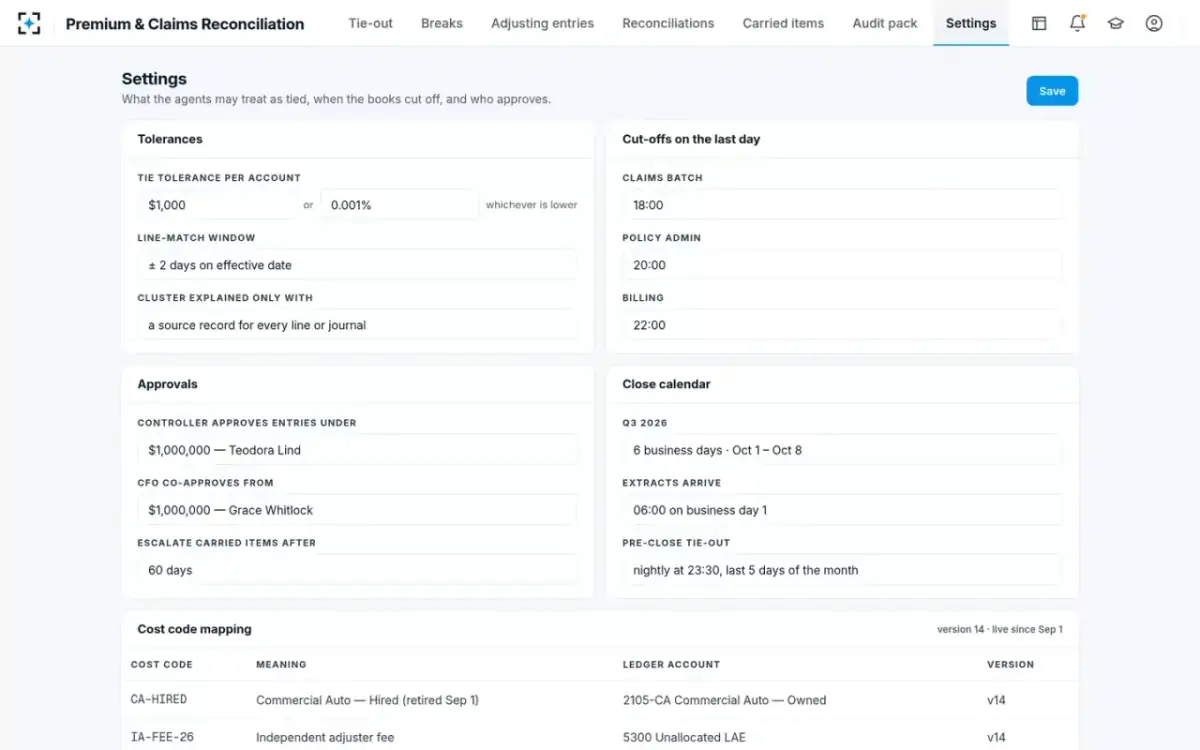
Does insurance accounting software produce statutory statements?
Statutory statements are usually produced by dedicated annual statement software that takes balances from the general ledger and detail from the subledgers and lays them out on the NAIC blank. A reconciliation layer does not replace that software; it proves that the balances going into it are right and explained. Under state law the annual statement is due on or before March 1 and quarterly statements within 45 days of quarter-end, Minnesota's statute being typical (Minnesota Statutes §60A.13), so the time spent explaining breaks comes straight out of the time left to prepare the filing.
Some statutory figures depend directly on the reconciliation. Premiums receivable more than ninety days due are nonadmitted, so a receivable that is wrong because cash was not applied changes the admitted assets on the statement; the guide to non-admitted premium receivables shows the arithmetic. At the sample insurer the solution reported $1,842,116.30 of receivables more than 90 days past due across 312 accounts for the statutory statement, and the audit pack carried the evidence index behind every tie.
How long does implementation take, and what do you bring?
Implementation is measured in closes, not years, because nothing is migrated. You bring your account map, the close calendar with each system's cut-off, your approval limits and approvers, and a sample of past reconciliations; the first run replays a closed quarter you already know the answer to. The plan below is illustrative; the length depends on how quickly extracts can be produced.
An illustrative path to go-live, measured in closes
- Account map, cut-offs, limits1 wk
- Extracts from each system1 wk
- Replay a closed quarter and compare with your own file2 wks
- Live close in parallel with the spreadsheet process1 month
The audit pack: the signed close, with an evidence index
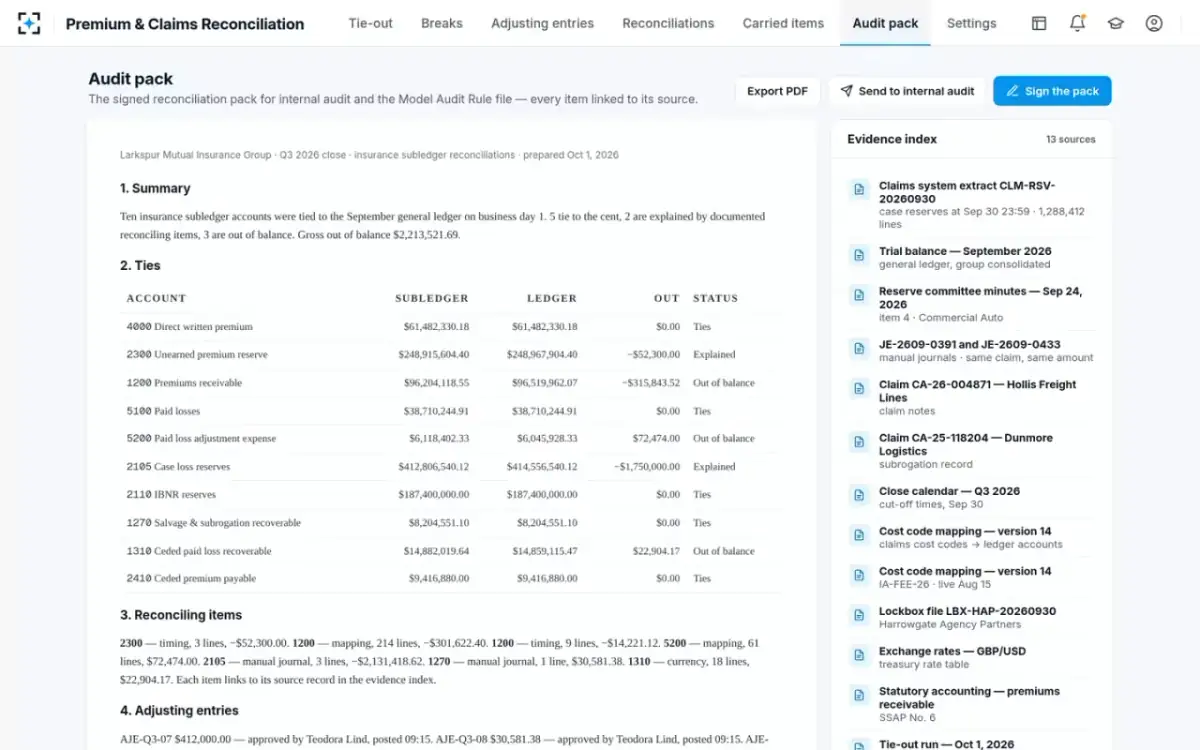
To see the whole close on a sample of your own extracts, start from Premium & Claims Reconciliation; the guide comparing reconciliation automation tools with insurance-aware matching covers what to test before you choose.
Questions people ask
What is the difference between a subledger and a general ledger in insurance?
A subledger holds the detail (each policy's premium, each claim's payments and reserve, each treaty's recoverable), usually in the operating system that created it. The general ledger holds balances by account, built from daily summary batches of that detail plus manual journals. The reconciliation proves that the two describe the same business on the same date.
Do we need to replace our general ledger to close faster?
Usually not. Most time at an insurer's close goes on finding and explaining differences between the subledgers and the general ledger, and that work stays after a general ledger replacement, because cut-offs, top-sides and mapping changes stay. A reconciliation layer attacks that time directly; a replacement is a decision to make for other reasons.
What is the difference between the Model Audit Rule and SOX?
Sarbanes-Oxley Section 404 applies to SEC registrants and their GAAP statements; the NAIC Model Audit Rule, as each state adopts it, applies to insurers' statutory statements and requires a management report on internal control from insurers with $500 million or more of direct written and assumed premium. A SOX-compliant group can use its 404 report plus an addendum, if the statutory controls were in its scope.
Can a reconciliation layer handle more than one insurance company?
It should reconcile each company separately, because each files its own statutory statement. In Premium & Claims Reconciliation each company's general ledger is its own scope, and every agent step and decision is on that company's activity trail.
What do we need to provide to start?
An account map from subledger codes to general ledger accounts, the close calendar with each system's cut-off, approval limits and approvers, extracts from each system and the trial balance, and a sample of past reconciliations. The first run replays a quarter your team has already closed, so results can be compared line by line.