Reinsurance reconciliation software compares what a ceding insurer's own books say with what its counterparties say and shows where they differ. For reinsurance, the counterparties are brokers and reinsurers, and the documents are the broker's statement of account and the reinsurer's technical account, which arrive as PDFs, spreadsheets and emails in each sender's own layout. That makes the buying question unusual: the software must read documents it does not control and sit between systems it should not replace, the cedant's general ledger, the brokers' accounting systems and the reinsurers' books, and then explain each difference well enough for a person to act on it. Botminds' Reinsurance Account Reconciliation is built that way: six agents read the cedant's general ledger export, the broker's statement and the reinsurer's technical account as they arrive, tick the items that agree in all three and explain every one that does not, and the reinsurance accountant agrees the account.
Screens and figures come from the solution's fictional sample data: Calder Ridge Mutual's 2026 commercial property quota share, placed by Ashgrove Re Partners, with Northfold Re writing 30% of the cession.
Four sources for one account, kept by three companies, in four formats
| Source | Kept by | Arrives as | What the software must take from it |
|---|---|---|---|
| Ceded account | The cedant, in its general ledger | A nightly spreadsheet export of account lines | Each item with treaty, period, loss reference, currency and rate |
| Statement of account | The broker, in its own system | A PDF or spreadsheet, often by email, sometimes revised | Each line with page and line number, and the balance it claims |
| Technical account | The reinsurer, in its own books | An emailed statement or remittance advice | Each item under the reinsurer's own references |
| Bank file | The cedant's bank | A daily file of receipts and payments | Cash calls, settlements and receipts outside the broker |
What is insurance reconciliation software?
It is software that matches two or more accounts of the same money and isolates the differences. Insurers use several kinds: bank reconciliation for cash, commission reconciliation for agencies, premium bordereau reconciliation for delegated authority, and reinsurance account reconciliation for treaties. They share a matching engine in principle and differ in what they must read and what decides a difference.
Reinsurance differs from the other three in two ways. Three companies keep the same account, and none of them takes orders from the others about format. And the arbiter of a difference is a contract: the treaty's currency, accounts, cash-call, tax and brokerage clauses decide who is right, so the software has to read wordings as well as statements. A reconciliation tool built for bank statements, which share formats and have no contract behind each line, will match the easy items and leave the reinsurance-specific ones in a queue.
What formats do reinsurance statements come in?
Whatever the sender's system produces. In the sample quarter Calder Ridge's version was a spreadsheet export from its general ledger, Ashgrove's statement of account was a two-page PDF of particulars with debit and credit columns, and Northfold's technical account came by email in its own order with its own claim references. Revised statements arrive the same way, often weeks later.
Brokers and reinsurers have no reason to change their formats for one cedant, and a project that depends on them doing so will wait. The working requirement is that the software reads each layout as it comes, without a template built per sender, and proves it read it correctly. That proof has two parts: every item carries the document, page and line it was read from, and the items read from each statement must add up to that statement's own balance before anything is matched.
Three statements read and matched, with each step of the run in view
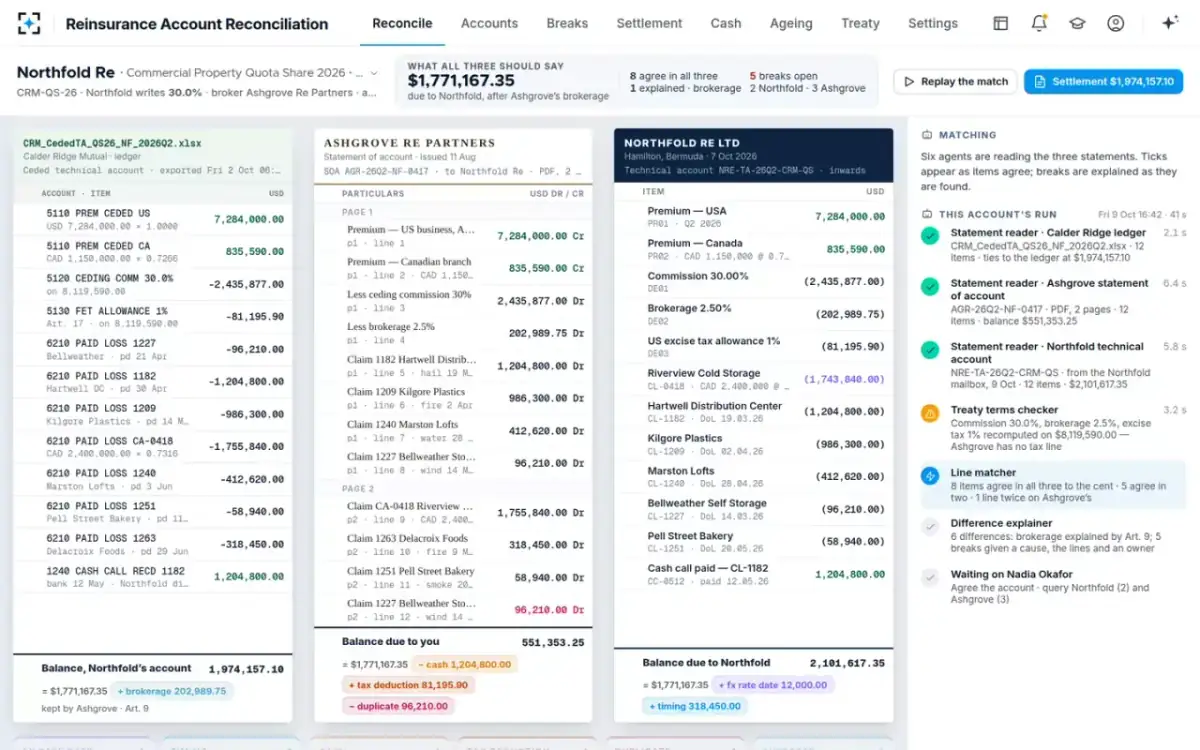
Can software read broker statements reliably?
It can, if reliability is defined as traceability rather than trust. A reader that turns a broker's PDF into items will sometimes misread a line, and the defence is not a promise of accuracy but a design in which every figure points back to its page and line, a statement that does not add up is reported rather than forced, and no figure is ever altered to make a match. In the solution, the statement reader "never alters a figure", and a person can open any tick or explanation and see the source line beside it.
One account, read and matched, on the sample data
41s
for six agents to read three statements, tick and explain
8
items ticked in all three statements to the cent
5
breaks given a cause, the lines and an owner, plus brokerage explained
Supervisors are moving the same way. EIOPA's opinion on AI governance and risk management says undertakings "should be able to provide to competent authorities and auditors a global and comprehensive explanation about the functioning of the AI system" (EIOPA, Opinion on AI governance and risk management, 2025). For reconciliation, the practical form of that explanation is the line-by-line trail: what was read, from where, what was matched to what, and which clause decided each difference.
Does reconciliation software connect to the general ledger?
It should read from it and write nothing back. The cedant's ceded technical account comes out of the general ledger, and the reconciliation needs it every day or every night; but an adjustment found by the reconciliation belongs to the party that owns the error, and for the cedant that means a person booking it in the general ledger with the usual approvals. Software that posts its own corrections has become part of the accounting system, with everything that implies for change control and audit.
In the solution the connection is an export: the ceded technical account, sent nightly, read like any other statement. The agents never book an adjustment, accept a difference or change a counterparty's figure. That keeps the integration small, a file and a mailbox rather than an interface project, and it keeps the accounting system's controls where they are.
Integrate, don't replace: what the software sits between
The right shape is a reader in the middle, not a new accounting system. The cedant keeps its general ledger, the broker keeps its broker system, the reinsurer keeps its books, and the reconciliation reads all of them and writes three kinds of output: queries to the party that must correct, a settlement draft for the cedant's approvers, and chasers for overdue balances. The broker's obligations help here. Under the NAIC intermediary model the broker's authorization must provide that it renders accounts accurately detailing all material transactions and that the insurer may audit and copy its accounts in a usable form (NAIC Model #790), which is the basis for asking a broker to send what the reconciliation needs.
The daily bank file, matched to settlements and cash calls
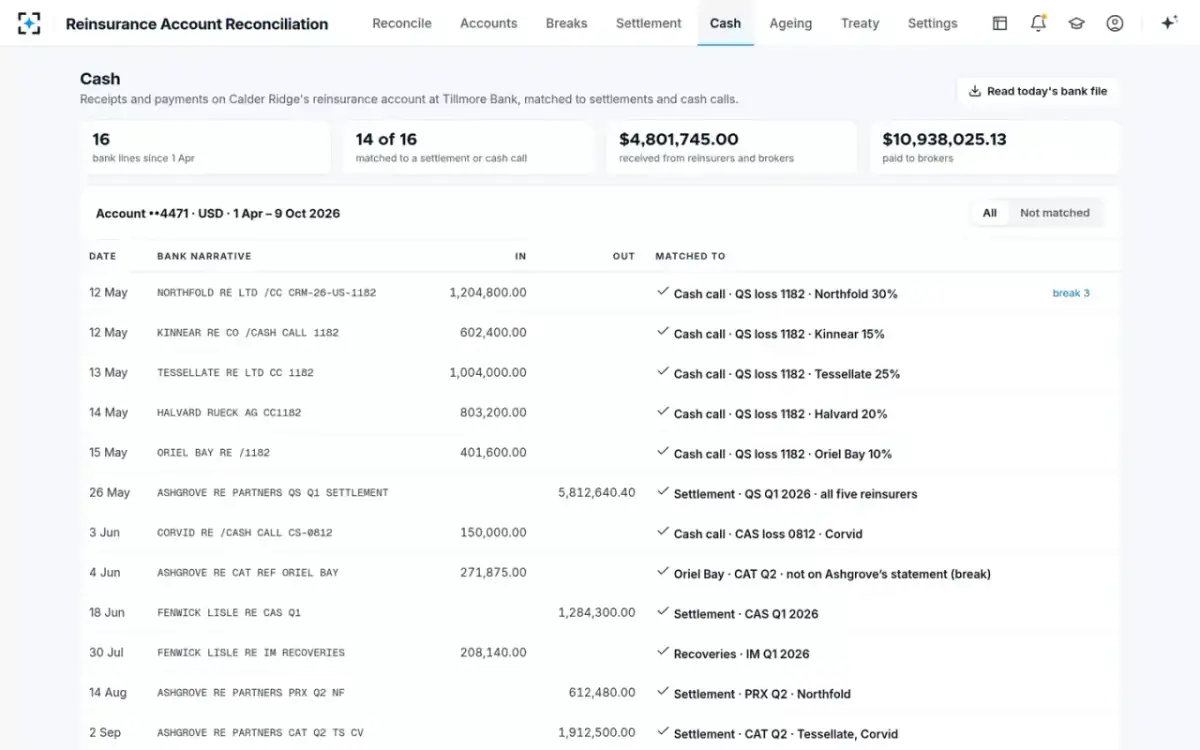
What happens when a broker sends a revised statement?
The account is matched again, and only what changed needs a person. Brokers and reinsurers can be invited as guests to see the queries on their own statements and upload revisions; a revised statement goes through the same reading and matching as the original, and a break the revision corrects closes with the new line cited.
A revised broker statement, from upload to a closed break
A person decides
Broker accounts technicianReads the query on the broker's own statement, which names each wrong line, the right figure and the clause, and uploads a revised statement.
Agent
Statement readerReads the revision into items with page and line and checks it adds up to its new balance.
Never: carries over a figure from the earlier version
Agent
Line matcherTicks the corrected items against the cedant's and the reinsurer's versions.
Never: matches across treaties, quarters or reinsurers
Agent
Difference explainerMarks each break the revision corrects, and explains anything new the revision introduced.
A person decides
Reinsurance accountantAccepts the closures and agrees the account once all three versions say the same thing.
What should insurance reconciliation software check?
The checks that matter are the ones a tie-out cannot do. A buyer should ask to see each of the following on a past quarter of its own statements, because each is where a reinsurance account goes wrong without anyone noticing.
Eight things to test on your own statements before buying
- Reads each sender's layout as it arrives
Your three most awkward broker PDFs, without a template built for each.
- Proves each statement adds up
Items read must sum to the statement's own balance before matching; a mismatch is reported.
- Cites page and line for every item
So any tick or explanation can be checked in seconds.
- Reads the treaty, not just the statements
Commission, brokerage, tax allowances, currency and cash-call clauses taken from the wording.
- Explains each difference with a cause and an owner
Exchange-rate date, timing, deduction, cash, duplicate, share or missing item, and who corrects.
- Matches the bank file
Cash calls and receipts outside the broker credited in the next account.
- Writes nothing to your books
Adjustments are booked by people in the general ledger.
- Keeps a trail an auditor can follow
Who ticked, explained, accepted, queried and signed, and under which version of the rules.
What reconciliation software cannot fix, and where a spreadsheet is enough
Reconciliation software finds and explains differences; it does not make late counterparties punctual, settle coverage disputes or compute what the treaty's adjustable features should be. Knowing those limits before buying keeps the project honest.
Late statements. Software can only match what has arrived. It can make lateness visible, a square per party per account that fills when a statement lands, and send reminders on a schedule (in the sample settings, on day 15, 30 and 45 after the account date), but a reinsurer that sends its technical account seven weeks after the broker's statement still holds the quarter up. In the sample, Northfold's technical account was dated 7 October against a broker statement of 11 August.
Coverage disputes. When a reinsurer refuses a loss because it questions coverage, the difference is not an accounting error and no clause about currency or timing will settle it. The reconciliation should list it as a disputed item with its owner and age, and leave the argument to claims and counsel; how such a dispute plays out in the cash is followed in one disputed cash call.
Adjustable features. Reinstatement premiums, sliding-scale commissions and profit commissions have to be calculated before they can be reconciled. The reconciliation checks that every statement carries the same figure; working the figure out from the wording is the job of Ceded Reinsurance Accounting.
Small programs. A cedant with one or two treaties, one broker and one currency may agree its accounts in an afternoon with a careful spreadsheet. The case for software grows with the number of reinsurers on each panel, the number of brokers and currencies, and the amount of cash that moves outside the broker's statements; in the sample company's quarter, 28 accounts and 84 statements produced 30 differences worth $3,622,308.85.
How long does reconciliation software take to set up?
For reinsurance, the setup is mostly reading, and it is bounded by documents rather than by integration work. Reinsurance Account Reconciliation is configured from the treaty wordings, examples of each broker's and reinsurer's statement layouts and a quarter of past statements; the general ledger connection is a nightly export and the bank connection a daily file. The first test should replay a closed quarter and compare the differences found with what the team found by hand.
That replay is also the honest way to judge any product's claims. Count the items it ticked that your team ticked, the differences it explained that your team found, and the ones it found that your team did not. How rule-based matching and agents compare on one account shows what to expect from each, and the cost guide prices the result.
The query the software drafts for the broker, with every line quoted
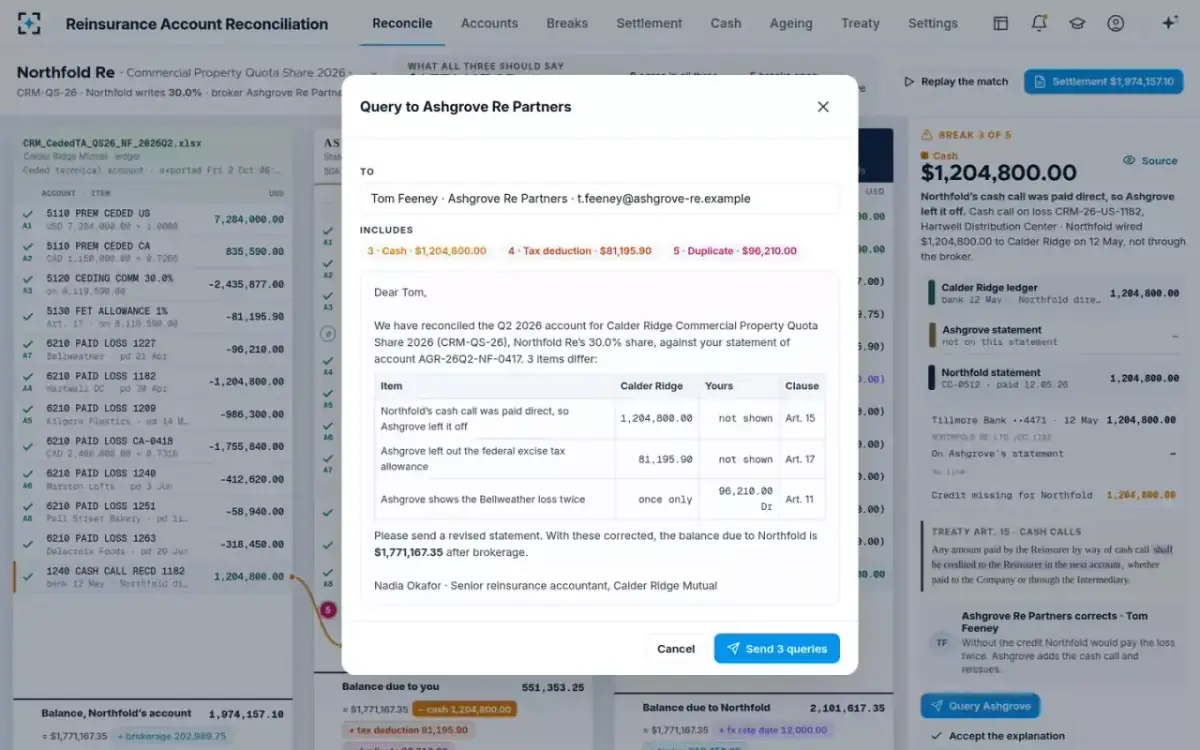
Software that reads what arrives, writes nothing to the books and explains every difference with its lines and clause fits beside the systems a cedant already runs. To see it on a quarter of your own statements, start from Reinsurance Account Reconciliation.
Questions people ask
What is a three-way reconciliation in reinsurance?
It is agreeing the same account across three parties' versions: the cedant's ceded account, the broker's statement of account and the reinsurer's technical account. An item is ticked only when it agrees in all three; premium reconciliation across cedant, broker and reinsurer works through the tick line by line.
What does insurance reconciliation mean?
It means agreeing an insurer's own figures with an independent source for the same money: the bank for cash, an agency for commission, a coverholder for delegated premium, or a broker and reinsurer for a treaty account. The goal is the same in each: every difference found, explained and owned before the balance is relied on.
Can reconciliation software handle foreign currency?
It should convert each foreign item under the treaty's currency clause, not under one global rule. In the sample, a Canadian loss of CAD 2,400,000 converted at the book rate of 0.7316 on the payment date gives $1,755,840.00; the reinsurer's quarter-end rate of 0.7266 gave $12,000.00 less, and the clause decided which was right.
Is premium bordereau reconciliation the same thing?
No. A premium bordereau lists policies and premium risk by risk, whether written by a coverholder under delegated authority or ceded under a treaty, and its reconciliation checks those risks and their premium against the insurer's own figures. A reinsurance account reconciliation agrees a treaty's quarterly balance across cedant, broker and reinsurer; the documents, parties and deciding clauses differ.
Do brokers and reinsurers need to use the software?
No. They can keep sending statements as they do now; the queries reach them by email. In Reinsurance Account Reconciliation they can also be invited as guests to see the queries on their own statements and upload revisions, which are matched again.