Reinsurance balances receivable are the amounts a company is owed under its reinsurance contracts and has not yet collected: for a ceding insurer, chiefly losses it has paid that its reinsurers must reimburse and balances due to it on agreed accounts; for a reinsurer, premium due from its cedants. They are reconciled by agreeing the cedant's account, the broker's statement of account and the reinsurer's technical account, and the usual test is that the three tie out. That test is necessary and not sufficient: all three can repeat the same wrong share, the same wrong exchange-rate date or the same missing tax line, and agree perfectly. Botminds' Reinsurance Account Reconciliation therefore checks every balance against the treaty wording as well as against the other two statements, so a balance is called right only when it is right under the contract.
Worked figures below come from the solution's fictional sample data, Calder Ridge Mutual's 2026 commercial property quota share and its reinsurer Northfold Re; the illustrative variations are labelled. Statutory rules are quoted from NAIC texts and the U.S. Code, linked where they appear.
A three-way tie-out proves the statements agree, not that the balance is right
What the tie-out shows: Each statement adds up to its own balance, and the three balances agree.
What can still be wrong: Nothing about whether the items are the right ones. Three statements built from one wrong input agree perfectly.
What the tie-out shows: The reinsurer's share of each item is the same in all three.
What can still be wrong: All three can apply last year's line, or another reinsurer's, if the panel changed at renewal.
What the tie-out shows: Foreign-currency items convert to the same dollars.
What can still be wrong: All three can use the quarter-end rate where the currency clause names the book rate on the transaction date.
What the tie-out shows: Deductions match where they appear.
What can still be wrong: If no statement shows the federal excise tax allowance, the missing line ties out at zero.
What the tie-out shows: Items agree within the quarter.
What can still be wrong: A loss paid on the last days of the quarter can be in the wrong account on every statement.
What the tie-out shows: Each line has a partner.
What can still be wrong: A loss entered twice at source has two partners on every statement.
What are reinsurance balances receivable?
On a cedant's books, they are mainly two things: paid losses and loss expenses its reinsurers owe, and net balances due to it on agreed accounts. On a reinsurer's books, they are mainly premium due from cedants, net of commission. The labels in the U.S. statutory annual statement differ by side, and the difference matters when balances are reconciled across companies.
On the assumed side, the rule carried into SSAP No. 62R, quoted here from NAIC Issue Paper No. 75, puts reinsurance premiums receivable with direct business receivables as "Agents' balances or uncollected premiums" (NAIC Issue Paper No. 75). On the ceded side, the cedant's paid-loss recoveries sit in a separate asset. A Casualty Actuarial Society study text describes that asset as reflecting "amounts that are expected to be recovered from a reinsurer on losses and LAE that have been paid by the company, but do not include expected reinsurance recoveries for loss and LAE reserves" (Odomirok et al., CAS, 2014 text). Line numbers in that text have since moved; the concept has not.
What is the difference between a reinsurance receivable and a recoverable?
"Recoverable" usually means the reinsurer's share of losses, and only the paid part of it is a receivable in the balance-sheet sense. The unpaid part, the reinsurer's share of case reserves and incurred but not reported losses, is shown as a reduction of the cedant's loss reserves rather than as an asset. The same CAS text gives the reason: "loss and LAE are already reflected net of reinsurance on the balance sheet."
For reconciliation, the distinction decides what can be ticked. A paid loss has a date, an amount and a currency on three statements and can be matched line by line. An unpaid recoverable is an estimate that moves every quarter, and its accuracy belongs to reserving and to the management of recoveries; how paid and unpaid recoverables are reported draws the line. The quarterly account reconciles the paid items and the cash; the estimate is out of its reach.
Matched is not proof: five ways a balance ties out and is still wrong
Every error in this section survives a three-way tie-out, because each is made once at source and copied downstream, or made the same way by each party. All five appeared, in one form or another, in the sample company's second quarter.
The wrong share. Panels change at renewal. If a reinsurer moves from 25% to 30% and the cedant's account still applies 25%, the broker and reinsurer, working from that account, repeat it. On Northfold's $96,210.00 share of one loss the gap would be $16,035.00 (illustrative arithmetic: 30% against 25% of the $320,700 loss at 100%), and on the quarter's premium it would be $1,353,265.00.
The wrong exchange-rate date. A currency clause names a rate, often the book rate on the transaction date. A statement that uses the quarter-end rate for every foreign item can agree with another that does the same. In the sample, Northfold alone used the quarter-end rate on a Canadian loss, which made the difference visible; had all three done so, the balance would have tied out $12,000.00 wrong.
The missing tax line. Premium a U.S. cedant pays to a foreign reinsurer carries a federal excise tax of one cent per dollar of premium paid (26 U.S.C. §4371(3)), and treaties often have the reinsurer allow it. A statement with no tax line agrees with another with no tax line. In the sample the allowance was $81,195.90, 1% of $8,119,590.00, and the broker's statement left it off; the full rules are in the guide to the federal excise tax on reinsurance.
The wrong period. A loss paid on 29 June belongs in the second-quarter account under a wording that includes all losses paid during the quarter. Northfold booked it in the third. Had the cedant also posted it late, all three would have agreed on a second-quarter balance $318,450.00 too high in Northfold's favour, and a third-quarter balance wrong by the same amount the other way.
The duplicate at source. The broker's statement showed one $96,210.00 loss twice, on page 1 line 8 and page 2 line 12. It was caught because the cedant's books showed it once. A duplicate in the cedant's own export would be copied by everyone downstream and tie out.
How are exchange rates applied in reinsurance accounts?
By the treaty's currency clause, which names the currency of account and the rate for converting everything else. The rate between the parties is a term of the contract, and the reconciliation has to read it. The sample wording, Article 14, says amounts in other currencies "shall be converted at the rates of exchange used in the Company's books on the date of the transaction", and the solution's settings offer three rules: the book rate on the transaction date, the rate at quarter end, or the rate on the settlement date.
One Canadian loss, two conversions, one clause that decides
| Step | Calder Ridge | Northfold Re |
|---|---|---|
| Loss paid, Northfold's 30% | CAD 2,400,000 on 22 May | CAD 2,400,000 |
| Rate used | 0.7316, the book rate on 22 May | 0.7266, the 30 June quarter-end rate |
| Converted | $1,755,840.00 | $1,743,840.00 |
| Difference | $12,000.00, owed to Northfold | (0.0050 × 2,400,000) |
| Who corrects | No one; Article 14 names the book rate | Northfold, in a revised technical account |
A rate difference is small per item and steady across a book. The sample company had five open exchange-rate breaks in the quarter, worth $25,530.00 in total. The value of catching them is less the money than the rule: once a reinsurer's technical accountant sees the clause quoted beside both conversions, the next quarter's account comes in on the right rate.
When is a reinsurance balance overdue?
When it passes the date the contract sets, and for statutory purposes the 90-day mark matters most. On premium, the rule carried into SSAP No. 62R says: "Reinsurance premiums more than 90 days overdue should not be included as receivable except (a) to the extent the assuming insurer maintains unearned premium and loss reserves as to the ceding insurer, under normal principles of offset accounting, or (b) where the ceding insurer is licensed and in good standing in assuming insurer's state of domicile" (NAIC Issue Paper No. 75).
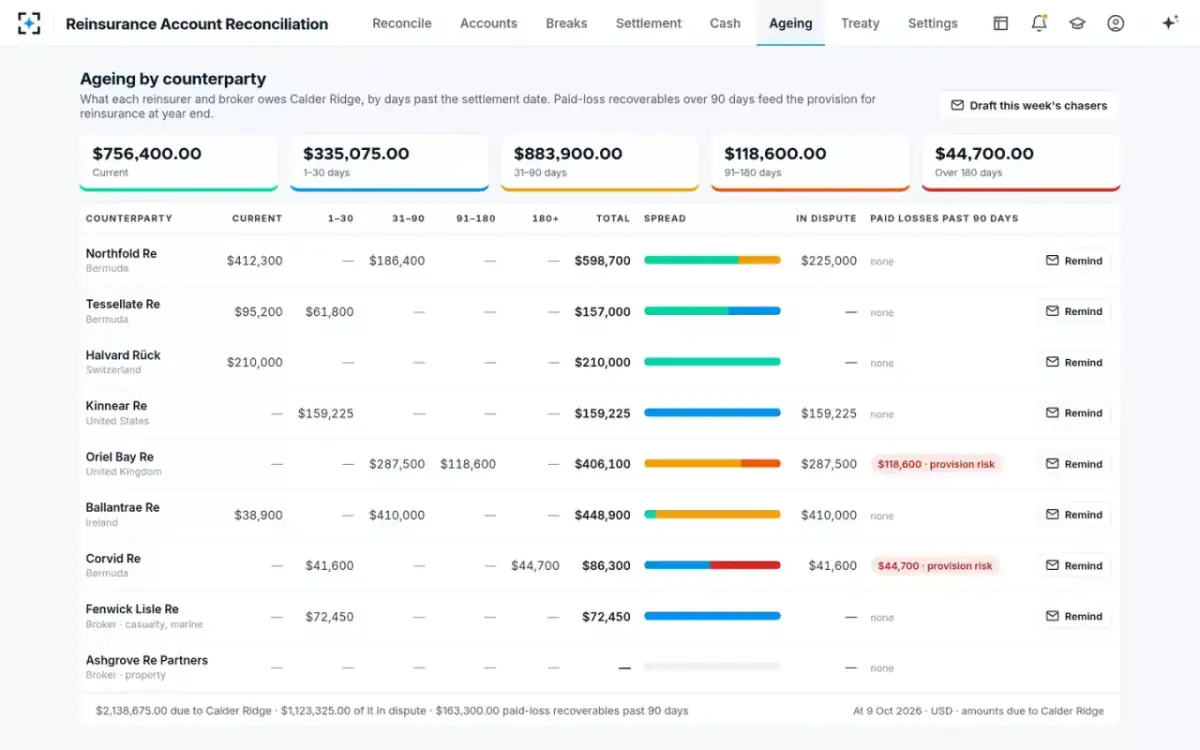
On the cedant's side, paid-loss recoveries that are long overdue cost surplus at year end. The same issue paper explains that statutory accounting keeps a liability, the provision for reinsurance, for unsecured recoverables from unauthorized reinsurers and for certain overdue balances owed by authorized ones. The CAS text described Schedule F's parts as listing each reinsurer, the amounts ceded and the collateral held, and separately an ageing of ceded balances; that was as of its 2014 edition, and the schedule has since been restructured. How the overdue test is applied each year is set out in the Schedule F penalty guide; for reconciliation, the point is that a balance left unagreed is a balance that ages.
Every counterparty's balance by age, with paid losses past 90 days flagged
Why do reinsurance balances not agree, and which differences carry the money?
They disagree because three parties build the same account from different data at different times, and the differences that carry the money are not the frequent ones. In the sample company's quarter, exchange-rate breaks were frequent and small; cash breaks were few and large.
Where $3.6 million of open differences sat, by cause
Cash differences dominate because a single cash call or remittance outside the broker's statement moves a whole loss share at once. They are also the ones most likely to produce a double payment, which is why the solution matches the bank file to settlements and cash calls every day rather than at quarter end. One disputed cash call shows how such a difference is worked through when the reinsurer pushes back.
What causes reconciliation differences that the treaty can settle?
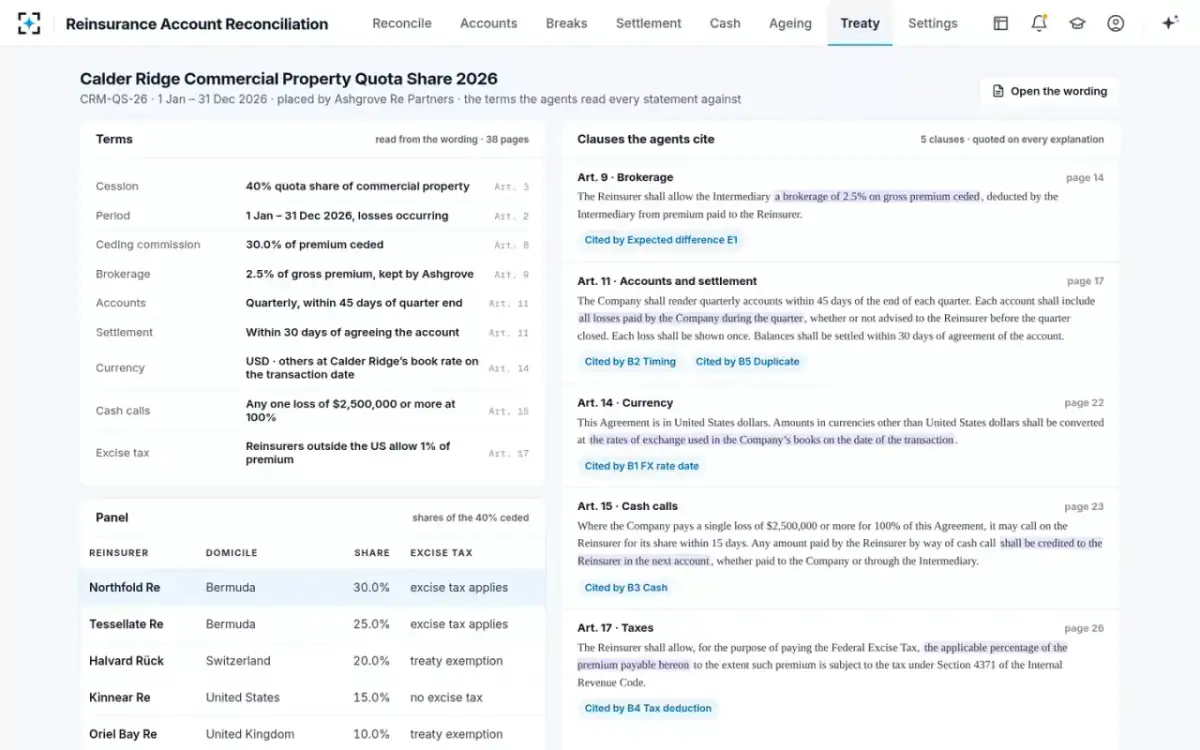
Those that turn on a term of the contract: the rate, the period, the deductions and the shares. Settling them from the wording is the solution's design: its treaty terms checker reads the wording and the panel, recomputes ceding commission, brokerage, the excise tax allowance and each reinsurer's share from the cedant's figures, and the difference explainer quotes the clause that decides who is right. A missing item has no clause to settle it; the explanation names the party without the item, and where the wording is silent it says so and the accountant decides.
The treaty terms every balance is tested against
Testing a reinsurance balance beyond the tie-out
A balance that ties out should still pass six checks against the contract before it is called right. Each takes minutes when the wording has been read once and the terms are on file, and hours when someone has to find the clause each quarter.
Six checks that a tied-out reinsurance balance is also right
- Recompute each share from the signed panel
Not from last quarter's account; panels change at renewal and mid-term.
- Convert every foreign item under the currency clause
Book rate on the transaction date, quarter-end rate or settlement-date rate, as the wording says.
- Recompute every deduction
Commission, brokerage and the excise tax allowance where it applies; a missing line agrees with a missing line.
- Test the period of each late-quarter item
A loss paid in the last days of a quarter belongs to that quarter under an "all losses paid during the quarter" wording.
- Look for duplicates at source
Same loss reference, same amount, two lines, including in the cedant's own export.
- Match the cash, not just the statements
Cash calls and receipts outside the broker must appear as credits in the next account.
Run this way, a reconciliation produces two answers rather than one: whether the parties agree, and whether the balance is right under the contract. To see both on your own treaties, start from Reinsurance Account Reconciliation.
Questions people ask
What is reinsurance payable on paid losses?
It is the reinsurer's side of a cedant's paid-loss recovery: losses the cedant has paid that the reinsurer owes and has not yet reimbursed. NAIC Issue Paper No. 75, whose rule was carried into SSAP No. 62R, says "Assumed reinsurance payable on paid losses should be classified as a separate liability item on the balance sheet", so it should mirror the cedant's paid-loss receivable once both sides agree.
What are funds held under reinsurance treaties?
They are amounts a cedant keeps back from what it would otherwise pay its reinsurer, usually as security for the reinsurer's obligations. Under the same statutory rule they are reported separately, as "Funds held by company under reinsurance treaties" on the cedant's side, and the reinsurer shows the mirror asset; a reconciliation has to treat movements in them as cash on both sides.
Are reinsurance premiums payable netted against receivables?
Only in limited cases. Ceded premiums payable are a liability that may be deducted from amounts due from the same reinsurer where a legal right of offset exists, but statutory accounting reports paid-loss recoverables as an asset without offset. The offset guide sets out the rules and the insolvency exceptions.
Who reconciles reinsurance balances?
At the cedant, the reinsurance accountant agrees each account with the broker and the reinsurer, and the credit controller chases what is overdue; at the broker, an accounts technician; at the reinsurer, a technical accountant. In the sample, 28 accounts across six treaties and seven reinsurers were reconciled in one quarter, with 79 of 84 statements in.
Does a tie-out satisfy the auditors?
It shows the counterparties agree, which is evidence about existence. It says less about whether the amount is right under the contract, which is why recomputing shares, rates and deductions from the treaty is a separate test. A balance that ties out and is recomputed from the wording carries both kinds of evidence.