The Schedule F penalty for reinsurance is the provision for reinsurance: a liability a U.S. property and casualty insurer must carry in its statutory annual statement for reinsurance it may not collect, computed in Schedule F and charged directly to surplus. It applies to three kinds of balance: recoverables from unauthorized reinsurers that are not secured, paid-loss recoverables more than 90 days overdue, and disputed amounts. For authorized reinsurers the decisive line is the slow-payer test: when more than 20% of a reinsurer’s paid-loss recoverables, plus what it paid in the last 90 days, is over 90 days overdue, the 20% charge stops applying only to the overdue amounts and applies to everything recoverable from that reinsurer, less allowed offsets. Botminds’ Reinsurance Recoverables Management runs that test weekly for every reinsurer, ages every balance and chases it, so a credit controller sees the line coming months before 31 December.
The rules below are described from the Casualty Actuarial Society’s study note on financial reporting, written in 2014 about the 2011 annual statement, and from NAIC texts. The form has changed since 2011 and the current annual statement instructions are sold by the NAIC, so check column-level detail against them. Product examples use the solution’s fictional sample insurer, Ashgrove Mutual.
The lines a ceded team works to: seven thresholds from the annual statement and the NAIC models
90 days
A paid-loss recoverable more than 90 days past due, for a reason other than dispute, is overdue
Annual statement instructions, as the CAS study note describes them
20%
Overdue share of a reinsurer’s paid recoverables plus the last 90 days’ receipts above which it is a slow payer
Annual statement, slow-payer test
20% of the base
The provision charged: on overdue and disputed paid amounts, or, for a slow payer, on everything recoverable less offsets
Annual statement, provision for reinsurance
15%
Share of a reciprocal-jurisdiction reinsurer’s recoverables overdue and in dispute that shows a lack of prompt payment
NAIC Model Regulation 786
$100,000
Per-cedent overdue undisputed paid balance counted in the 15%-of-cedents test
NAIC Model Regulation 786
$50 million
Aggregate undisputed paid recoverables 90 days or more overdue that shows a lack of prompt payment
NAIC Model Regulation 786
50% of surplus
Recoverables from one reinsurer or group that oblige the insurer to notify its commissioner within 30 days
NAIC Model Law 785
What is the Schedule F penalty?
It is the industry’s name for the provision for reinsurance, a statutory liability set up in Schedule F of the annual statement for reinsurance that may not be collected. The CAS study note describes its reach: "This penalty applies to all reinsurers that are slow to pay or that are disputing amounts owed to the ceding company and unauthorized reinsurers that do not meet the collateral requirements of the ceding company’s domiciliary state" (Odomirok et al., CAS).
It exists because statutory accounting is built for solvency. When the NAIC codified statutory accounting, its Issue Paper No. 75 kept the provision deliberately: it "was maintained as part of statutory accounting as an added measure of conservatism", because "there is no other apparent independent measure of the adequacy of the estimates" (NAIC Issue Paper No. 75). The provision is a minimum. Where an insurer’s own experience says more is uncollectible, the same paper requires the excess to be charged through operations, not added to the provision.
What is a slow paying reinsurer? The 20% test, worked
A slow-paying reinsurer is an authorized reinsurer whose paid-loss recoverables more than 90 days overdue exceed 20% of its total paid-loss recoverables plus the amounts it paid the insurer in the 90 days before 31 December. The receipts in the denominator are the subtle part: a reinsurer that pays a lot recently earns a larger denominator, and a payment against an old balance cuts the numerator without shrinking the denominator, because the money moves from one term to the other.
Two sample reinsurers just over the 20% line: what the test is made of
Tessaly Re · 20.2%
- Over 90 days overdue, $1.84M · 20%
- Other paid recoverables, $4.28M · 47%
- Received in the last 90 days, $2.98M · 33%
Pemberton Re · 20.3%
- Over 90 days overdue, $0.99M · 20%
- Other paid recoverables, $2.05M · 42%
- Received in the last 90 days, $1.83M · 38%
Because only the numerator moves when a slow payer pays, the distance to the line is easy to compute. Tessaly needs about $20,000 of its overdue balance paid to fall below 20% (0.2 × $9.10 million is $1.82 million, against $1.84 million overdue); Pemberton about $16,000. A credit controller who knows those figures in October can make two phone calls; one who learns them in February can only explain them.
How is the provision for reinsurance calculated?
The provision is computed reinsurer by reinsurer and summed across three groups: unauthorized reinsurers, authorized reinsurers that pass the slow-payer test, and authorized reinsurers that fail it. The CAS study note gives a formula for each, reproduced below in its terms; the 2011 form placed them in Schedule F Parts 5, 6 and 7.
The provision for reinsurance, by reinsurer group, as the CAS study note sets it out
| Reinsurer group | Provision | In words |
|---|---|---|
| Authorized, passes the 20% test | 20% × (C + D) | 20% of paid recoverables more than 90 days overdue and not in dispute, plus 20% of paid recoverables in dispute |
| Authorized, fails the 20% test (slow payer) | 20% × max[A − min(A, B); E] | 20% of everything recoverable from the reinsurer less allowed offsets, or of its overdue paid balance if that is larger |
| Unauthorized | min[A; A − B] + min[B; 20% × C] + min[B; 20% × D] | The unsecured balance in full, plus up to 20% of overdue and disputed amounts, limited to the security held |
The study note’s worked example shows the scale. Its fictional insurer’s 2011 provision was $283,000: $237,000 for unauthorized reinsurance and $46,000 for overdue authorized reinsurance. Of the $46,000, $45,000 came from two slow payers, 20% of a $225,000 base, and $1,000 from a reinsurer that passed the test with 1.7% overdue: 20% of $1,000 overdue plus 20% of $4,000 in dispute (Odomirok et al., CAS).
The cliff at 20%: one point changes the base
The slow-payer test is a cliff, not a slope. Below 20%, the charge applies to overdue and disputed paid amounts. Above it, it applies to the greater of everything recoverable less offsets and the overdue paid balance. For a reinsurer that also carries large unpaid-loss and IBNR recoverables, crossing the line multiplies the provision.
One reinsurer either side of the line: $20,000 more overdue, 23 times the provision
That is why a weekly view of the test is worth more than a year-end one. In the solution’s sample program, the collections agent runs the test every week against the threshold the company sets, drafts reminders at 30, 60 and 90 days, and escalates to the credit controller at 90 days; the controller and the head of ceded reinsurance decide what to do about a reinsurer close to the line. Offsets, commutations and write-offs, which also change the base, stay with them.
What is overdue reinsurance, and when does the 90-day clock start?
Overdue, for the provision, means a paid-loss recoverable more than 90 days past due for a reason other than dispute. When the clock starts is set by the instructions, and it is not the bill date. In the 2011 instructions as the CAS study note describes them, a recoverable’s age runs from the contract’s terms on when claims are to be paid, or when they are to be reported, or, if the contract specifies neither, from "the date when the amount recoverable exceeds $50,000 for a particular reinsurer and is entered in the insurance company’s financial accounts as a paid recoverable"; smaller amounts with no contract dates are reported as current (Odomirok et al., CAS).
A bill’s due date is written on it: the contract’s terms start the clock
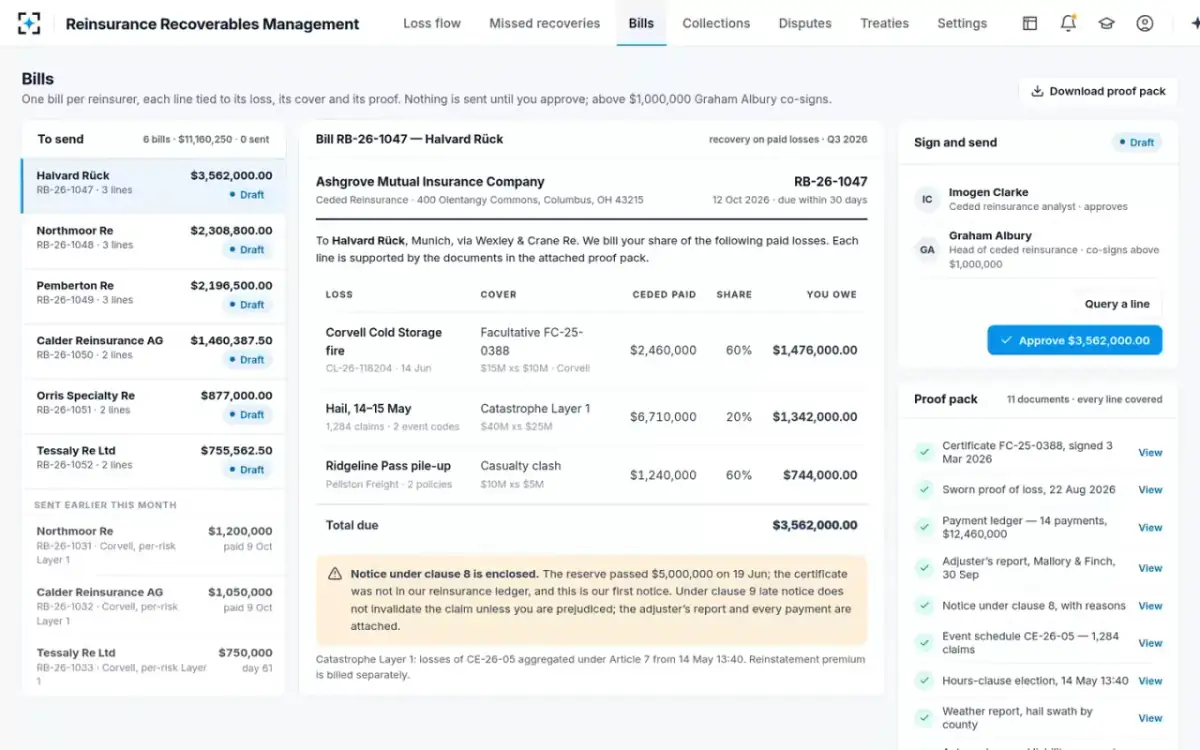
The practical consequence is that billing speed protects the test. A recovery that waits until quarter end to be billed can already be weeks old under the contract’s terms when the reinsurer first sees it. The solution’s design target, one day from a paid movement to a bill with its proof, exists for that reason.
Does disputed reinsurance count as overdue?
No, but it is not free either. Disputed amounts are kept out of the overdue figure that decides whether a reinsurer is a slow payer. They are not kept out of the provision: for a reinsurer that passes the test, the study note’s formula charges 20% of "(1) the amount of reinsurance recoverable on paids more than 90 days overdue plus (2) amounts in dispute excluded from the recoverable on paids more than 90 days overdue" (Odomirok et al., CAS). For a slow payer, disputed overdue amounts are inside the base.
Either side of the 20% line: what the provision rests on
Passes the slow-payer test: 20% of it
Fails it: Inside the base; the base is usually far larger
Passes the slow-payer test: 20% of them
Fails it: Inside the base when overdue
Passes the slow-payer test: No charge
Fails it: Inside the base, less allowed offsets
Passes the slow-payer test: No effect
Fails it: Reduce the base
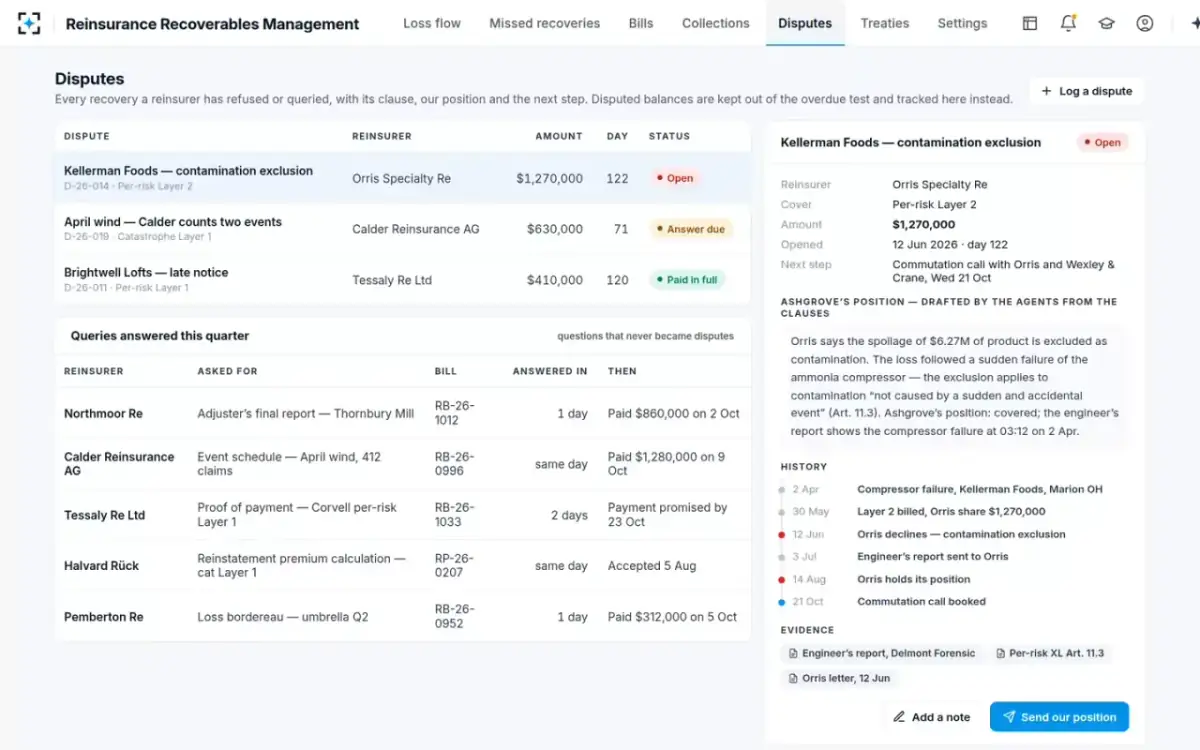
What makes something a dispute is narrow. Under the annual statement instructions reproduced in NAIC Issue Paper No. 75, a recoverable is in dispute "by reason of notification, arbitration or litigation", with notification meaning "a formal written communication from a reinsurer denying the validity of the coverage" (NAIC Issue Paper No. 75). A query about documents is not a dispute, and logging it as one hides a slow payer. The same instructions required disputed amounts to be identified where those from one reinsurer exceeded 5% of surplus, or all disputes 10%.
Disputes kept apart, each with its clause and next step
How does Schedule F affect surplus?
Directly. The provision is booked as a liability and its change goes to surplus without passing through income. The CAS study note describes it as "treated as an additional liability on the balance sheet (though no real liability exists)" (Odomirok et al., CAS). So a slow payer discovered at year end reduces surplus in the quarter it is discovered, whatever the reinsurer eventually pays.
Surplus is the denominator of most solvency measures, which is why actuaries and regulators read the same schedule. The appointed actuary is told to examine Schedule F for paid recoverables over 90 days past due before commenting on collectibility. Where recoverables sit on the statutory balance sheet explains how the paid and unpaid balances behind the provision are reported.
How close a book can run, and the regulator’s other lines
No rule says how close to 20% a reinsurer may sit; it is a credit policy question. The arithmetic above suggests a working answer: watch any reinsurer above about 15% weekly, and for each one know the cash that takes it back under 20%. The solution’s threshold is a setting, 15%, 20% or 25%, for that purpose.
The same overdue data also measures the reinsurer against the regulator’s tests. Under the NAIC model regulation, a reciprocal-jurisdiction reinsurer shows a lack of prompt payment where more than 15% of its recoverables are overdue and in dispute, where more than 15% of its cedents have undisputed paid recoverables 90 days or more overdue above $100,000 each, or where such balances exceed $50 million in total (NAIC Model Regulation 786). Reciprocal jurisdictions came with the 2019 revisions to the model law, adopted by all 56 NAIC jurisdictions by 22 September 2022 (NAIC, Covered Agreement). For the full set of numbers a ceded team can report from the same data, see the reinsurance recovery ratio and five more numbers; to see the test run weekly on your own program, start from Reinsurance Recoverables Management.
Questions people ask
Is the Schedule F penalty the same as the provision for reinsurance?
Yes. "Schedule F penalty" is the common name for the provision for reinsurance, the statutory liability computed in Schedule F for unsecured, overdue and disputed recoverables. The CAS study note uses both terms for the same charge.
Does the provision apply to unauthorized reinsurers?
Yes, and usually most heavily: an unauthorized reinsurer’s recoverables count against surplus in full except to the extent they are secured by funds held, letters of credit or other allowed collateral. In the study note’s worked example, $237,000 of a $283,000 provision came from unauthorized reinsurance.
Can a slow-paying reinsurer get back under 20% before year end?
Yes, by paying overdue balances. Because a payment moves money from the paid-recoverable term to the receipts term, the denominator stays the same and only the numerator falls, so the cash needed is the overdue amount minus 20% of the denominator. For the sample reinsurer at 20.2%, that was about $20,000.
Is the provision for reinsurance required under GAAP?
No. NAIC Issue Paper No. 75 notes that statutory accounting requires the provision, and that “Under GAAP, no such liability is required”, although both require an assessment of whether recorded recoverables can be collected.
Do certified reinsurers face the same overdue tests?
They face their own. Under the NAIC model regulation, a certified reinsurer’s required collateral rises by at least one rating level where more than 15% of its cedents have undisputed paid recoverables 90 days or more overdue above $100,000 each, or where such balances exceed $50 million in total. How certified reinsurers enter the current Schedule F calculation is set by the current instructions.