Reinsurance claim notification requirements are set by each contract, not by statute: a facultative certificate or excess of loss treaty tells the ceding insurer when to report a loss (often when a reserve passes a share of the attachment, or "promptly" once a loss "appears likely" to reach the cover), what to send with it, and when the reinsurer must pay once proof arrives. Under New York law as the state’s highest court stated it in 1992, a reinsurer cannot escape a late notice without showing it was prejudiced, unless the contract makes notice a condition precedent. In practice the notice is usually missed for a duller reason: the certificate that required it was never in the reinsurance team’s list of covers. This case follows one such loss. Botminds’ Reinsurance Recoverables Management exists to catch it: its agents check every paid loss against every cover each night, including certificates filed outside the reinsurance system, and draft the notice and the bill with its proof.
The insurer, the insured, the reinsurers and every date in the case are fictional, and new to this page: Merrow Valley Mutual, its insured Oakhurst Textile Mill, and two reinsurers, Quillon Re and Brackwater Re. The screens show the same pattern in the solution’s own sample program.
From the payment that crossed the attachment to the last cash: the bill, the query, the late-notice point and two clocks
- Found, confirmed, notice and bill: 3 days
- Reinsurer’s reviewPaid day 35
- Found, confirmed, notice and bill: 3 days
- No reply; reminder at 3030 d
- Query, answered11 d
- Late notice raised, answered26 d
- Point withdrawn; paidPaid day 88
What are reinsurance claim notification requirements?
They are the clauses in each reinsurance contract that say when the insurer must report a loss, to whom, and with what. They come in three common forms. A reserve trigger requires notice once the insurer’s reserve passes a stated amount, often a share of the attachment; a CAS text on reinsurance gives the usual reporting threshold as "one half of an excess contract attachment point" (Patrik, "Reinsurance", CAS). A "likely to involve" trigger asks for notice once a loss appears likely to reach the cover. And a list of named events, such as a death or a suit above a value, triggers notice regardless of reserve.
The requirements are private terms, so they differ from contract to contract, and a certificate placed by an underwriter may differ from the treaties the reinsurance team negotiated. That is where notice goes wrong: the team knows its treaties’ triggers, and does not know a certificate exists.
Two clauses from a real facultative certificate, read for what they require
Clause C · notice and association
“Prompt notice shall be given by the company to the Underwriting Managers on behalf of the Reinsurers of any occurrence or accident which appears likely to involve this reinsurance …”
What it requires. Notice as soon as the loss looks likely to reach the certificate, not when it is paid. No fixed number of days, so “prompt” is judged case by case. The same clause gives the reinsurer a right to associate in the defence of the claim.
Clause D · what the court called follow the fortunes
Covered claims the company settles bind the reinsurers, who must pay their shares of those settlements (paraphrased; the clause is quoted in follow the fortunes vs follow the settlements).
What it requires. The reinsurer pays its share of covered settlements the insurer makes. The proof the insurer sends has to show the claim is covered and settled, not re-argue the settlement.
The case: a fire, a certificate in the wrong file, and a clock already running
In January 2026 an underwriter at Merrow Valley Mutual bound a facultative certificate on Oakhurst Textile Mill: $10 million excess of $5 million, Quillon Re 70% and Brackwater Re 30%, placed through a broker, governed by New York law. The certificate’s notice clause followed the Unigard pattern, prompt notice of any occurrence likely to involve the reinsurance, with no words making notice a condition precedent; its settlement clause made amounts payable within 30 days of receipt of proof of payment. The broker sent the binder by email. The underwriter filed it with the policy. Nobody sent it to the ceded reinsurance team.
A fire in the carding room in May destroyed most of one building. The claims manager reserved the loss at $1.8 million in the first week and $6.2 million three weeks later, once the adjuster had the stock and machinery figures. At that moment the loss plainly appeared likely to involve the certificate, which attached at $5 million. The per-risk treaty, which the ceded team did know about, topped out at $5 million, and its own notice went out on time. The certificate’s did not.
Day 0 in the timeline is the payment, in late summer, that took paid losses to $5,600,000: $600,000 into the certificate. In a quarterly process that amount would have been retained on the net line until a reinsurer audit or a broker query surfaced it, if anything did. Here the nightly check read the payment, searched the underwriting files for any cover on the policy, and found the binder.
The same pattern in the solution’s sample program: a loss above the treaty, a certificate in the underwriting file
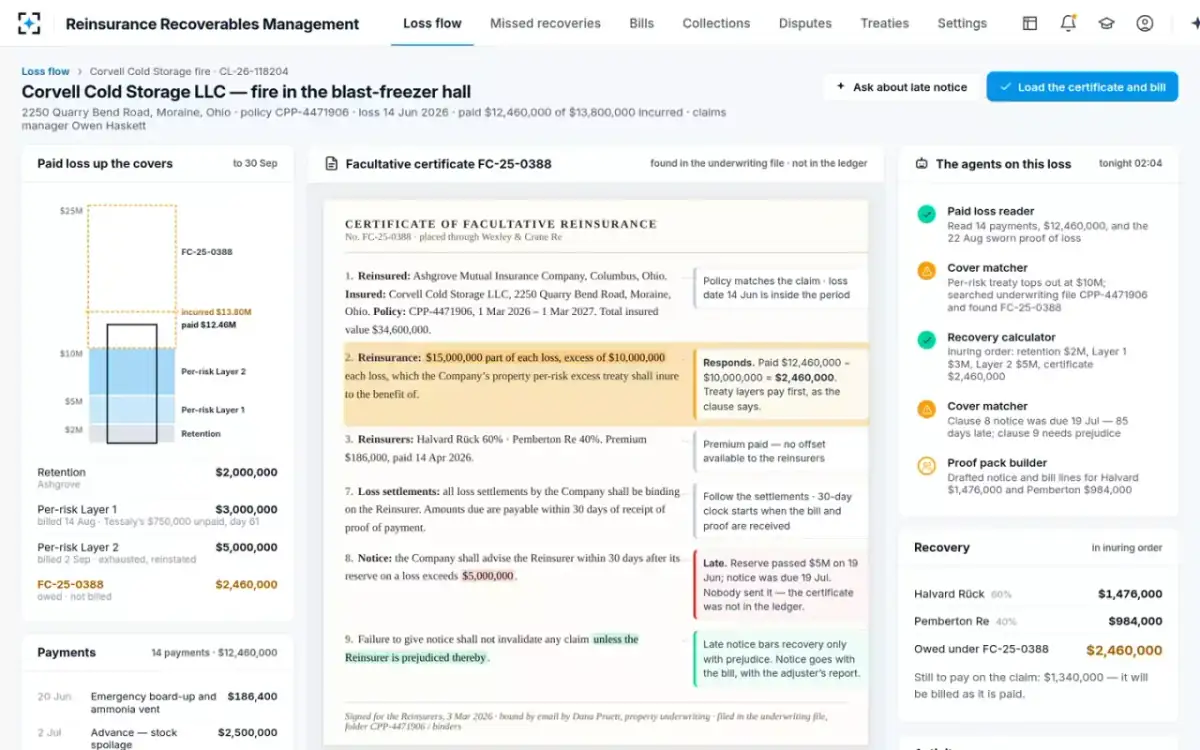
Day 1 to day 3: confirm the certificate, then notice and bill together
A certificate found outside the reinsurance system is not a recovery yet. It may be a quote rather than a binder, or a version superseded before inception. In the solution, a found certificate goes to the ceded analyst before anything else happens; at Merrow Valley she checked the signed binder against the broker’s placing slip on day 1 and loaded it on day 2. On day 3 the notice and the first bill went out together, through the broker, with the notice’s lateness explained rather than hidden.
Sending them together matters. A notice alone invites the reinsurer to reserve and wait; a bill alone, months after the loss, invites the question why the reinsurer is hearing of it for the first time. Together, with the documents, they let the reinsurer’s claims department do in one pass what it would otherwise do in three.
What is a proof of loss in reinsurance, and what documents do reinsurers need to pay?
In reinsurance, proof of loss is the set of documents that shows the claim is covered by the contract, was settled or paid by the insurer, and reaches the reinsurer’s layer. For a property certificate that usually means the documents below. Each answers a question the reinsurer’s examiner will otherwise ask.
Nine documents went with the first bill, and the question each one answers
| Document | The reinsurer’s question it answers |
|---|---|
| Signed certificate and the broker’s binder | Was the cover bound before the loss, on these terms? |
| Policy declarations | Is this the risk and period the certificate reinsures? |
| Sworn proof of loss from the insured | What did the insured claim, and when? |
| Adjuster’s reports, first and latest | What happened, and how was the loss valued? |
| Cause-and-origin report | Is the peril covered, and is any exclusion in play? |
| Payment history, every payment and date | Has the insurer paid, and how much above the attachment? |
| Calculation in inuring order | Did the per-risk treaty respond first, and what is each share? |
| Notice, with the reason it is late | When should we have heard, and what did we lose by hearing late? |
| Invitation to associate | Can we still take part in the handling of the claim? |
The last document is the one most often left out, and in this case it decided the argument that followed. The right to associate, the reinsurer’s right to consult on the handling of the claim, is the main way a late notice can hurt a reinsurer. Offering it with the notice, while the claim was still open, gave Quillon Re the chance it said it had lost.
Does late notice void reinsurance? In New York, not without prejudice
Not automatically. In 1992 New York’s Court of Appeals answered a question certified by the federal Second Circuit: must a reinsurer prove prejudice before it can rely on late notice? It said yes. The certificate in that case, issued by Unigard on a North River excess policy for Owens-Corning, required prompt notice; North River’s duty to notify arose in April 1987, and its notice reached Unigard on 2 September 1987, which the trial court found untimely. It did not matter, because Unigard had shown no prejudice.
All we hold here is that the reinsurer must demonstrate how it was prejudicial and may not rely on the presumption of prejudice that applies in the late notice disputes between primary insurers and their insureds.
New York Court of Appeals, Unigard Security Ins. Co. v North River Ins. Co., 79 N.Y.2d 576 (1992)
The court gave its reasons in terms that still describe reinsurance: a reinsurer "is not responsible for providing a defense, for investigating the claim or for attempting to get control of the claim", so "failure to give the required prompt notice is of substantially less significance for a reinsurer than for a primary insurer" (Unigard). Two limits matter for a ceded team. The holding turned on a clause with nothing "indicating that the parties intended that the giving of notice should operate as a condition precedent"; the court cited a certificate that said notice "is a condition precedent to any liability", where the answer would differ. And it is New York law as stated in 1992; other states and countries, and later cases, can differ. Read your own clause and take legal advice.
At Merrow Valley, Quillon Re raised the late notice on day 44, after its query had been answered. The analyst’s reply, drafted from the clause and the file and sent by a person, made three points: the certificate made notice no condition precedent; the claim was still open and Quillon had been invited to associate on day 3; and the adjuster’s valuation, which Quillon’s examiner had reviewed, was not disputed. Quillon withdrew the point on day 70 and paid on day 88.
What is a reinsurance bill, and when is it due?
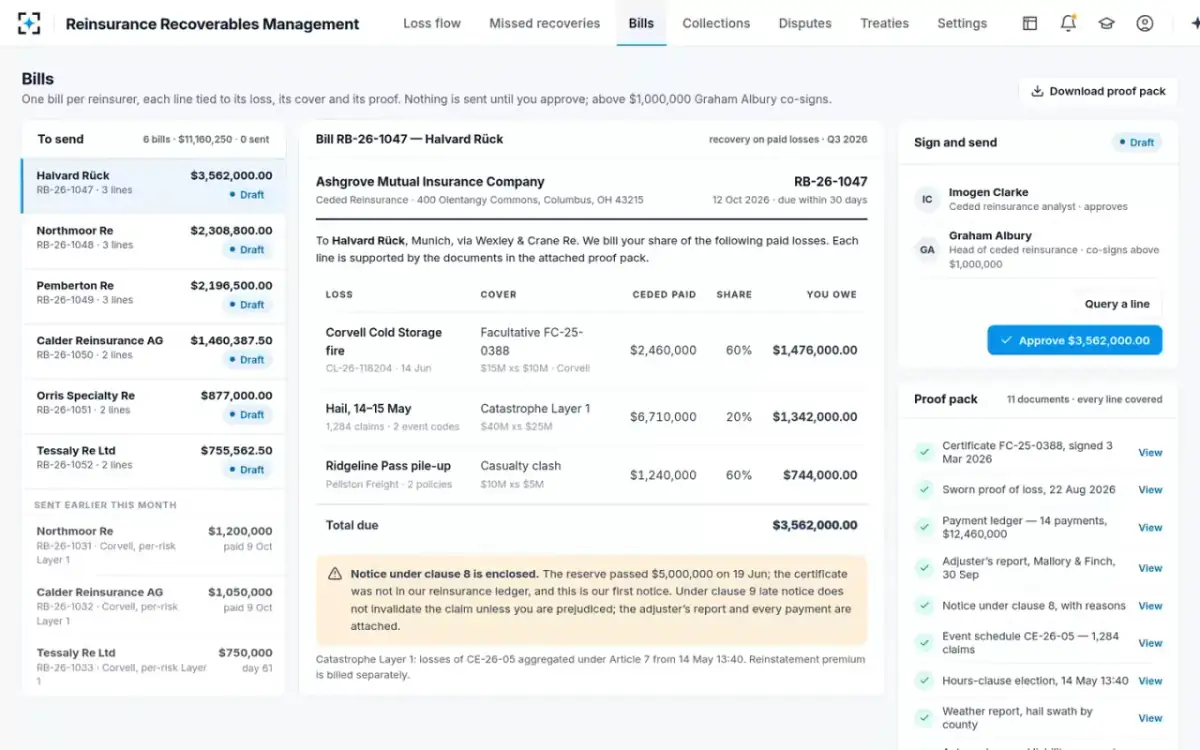
A reinsurance bill is the insurer’s demand on one reinsurer for its share of paid losses under one or more contracts, each line tied to its loss, its cover and its proof. Its due date comes from the contract: the Oakhurst certificate made amounts payable within 30 days of receipt of proof of payment, so the bill’s date and the date the proof arrived set the clock, not the date of the loss.
A bill with notice enclosed, in the solution’s sample program
How long do reinsurers take to pay? Two clocks run at once
Two clocks run on every bill, and they measure different things. The contract clock runs from receipt of proof to the due date, 30 days in the Oakhurst certificate. The ageing clock is the one the annual statement uses to judge whether a reinsurer pays slowly: under the 2011 instructions described in a CAS study note, a paid recoverable is aged from the contract’s terms on when claims are to be paid or reported, or, if the contract says nothing, from the date an amount over $50,000 is entered in the accounts as a paid recoverable (Odomirok et al., CAS). Either way, a bill sent months late starts the reinsurer’s 30 days months late, and can leave the insurer’s own books showing an old balance the reinsurer has only just seen.
In the case, Brackwater Re paid on day 35, two days after the due date. Quillon took 88, and most of that was a query and an argument, not delay. No public source measures typical payment times across reinsurers; the NAIC’s model credit-for-reinsurance regulation instead sets the line at which slow payment becomes a regulatory matter, discussed below.
How do you chase a reinsurer? Reminders at 30, 60 and 90 days
Chase by age, through the broker, with the proof re-attached and disputes kept apart from delay. In the solution’s configuration the collections agent drafts a reminder at 30, 60 and 90 days after the bill, matches each morning’s remittances to bills, and escalates to the credit controller at 90 days. At Merrow Valley the 30-day reminder to Quillon drew the query; the 60-day reminder went out while the late-notice point was being answered, and noted that the query had been closed.
A query is not a dispute, and treating it as one has a cost. Under the annual statement instructions reproduced in NAIC Issue Paper No. 75, a recoverable is in dispute only when the reinsurer has denied coverage in writing or the matter has gone to arbitration or litigation (NAIC Issue Paper No. 75; the Schedule F penalty guide quotes the definition). Quillon’s late-notice letter came close; a controller would log it as a dispute only if it denied coverage, and track it separately either way.
What happens after 90 days overdue?
After 90 days a balance stops being a collections matter and starts affecting the books and the reinsurer’s standing. At year end, the annual statement’s slow-payer test compares each reinsurer’s paid recoverables more than 90 days overdue with its total paid recoverables plus amounts received in the last 90 days; above 20%, the provision the insurer must hold for that reinsurer rises sharply. The Schedule F penalty works that test and the provision in full.
The 90-day line also follows the reinsurer. The NAIC model regulation raises a certified reinsurer’s required collateral by at least one rating level where more than 15% of its cedents have undisputed paid recoverables 90 days or more overdue above $100,000 each, or where such balances exceed $50 million in total (NAIC Model Regulation 786). Neither Merrow Valley balance got there. For how the five people on a recoveries desk divide this work, see the recoveries desk, seat by seat; to see the notice, the bill and the chase on your own program, start from Reinsurance Recoverables Management.
Questions people ask
Is there a standard reinsurance claim notification form?
No regulator prescribes one; the contract sets what notice must contain, and brokers and reinsurers have their own formats. A useful notice names the contract and certificate, the insured and policy, the loss date and cause, the current reserve and paid amounts, the reason notice is being given now, and an invitation to associate.
Does a reserve or a payment trigger reinsurance notice?
Usually a reserve, or the likelihood of reaching the cover, rather than a payment. Excess contracts commonly ask for notice once a reserve passes a share of the attachment, often half; a "likely to involve" clause asks for notice as soon as the loss looks likely to reach the layer. Waiting for a payment above the attachment is almost always late.
Can a reinsurer deny a claim for late notice?
It can raise it, and whether it succeeds depends on the clause and the governing law. Under New York law as stated in Unigard (1992), a reinsurer must show prejudice unless the contract makes notice a condition precedent. Offering the right to associate with the notice, while the claim is open, is the strongest practical answer.
Who should send notice to reinsurers, claims or the ceded team?
Whoever can see both the claim and every contract it reaches. In most companies that is the ceded reinsurance team, working from claims’ reserve changes. The case shows why the split fails: claims set the reserve on time, and the ceded team did not know the certificate existed.
How long should an insurer keep reinsurance claim documents?
At least as long as any recovery, dispute or audit on the contract can run, which for long-tail casualty can be decades. As a reference point, the NAIC model act for reinsurance intermediaries requires brokers to keep a complete file on each transaction for at least ten years after the contract expires.