A reinsurance claims analyst at a ceding insurer decides which treaty layers and facultative certificates respond to each paid loss, gives the reinsurers the notice and proof their contracts ask for, and bills them; at a reinsurer, the same title belongs to the person who reviews those reports and pays them. Neither works alone. A recovery starts with the large-loss claims manager who pays the claim, passes to the ceded reinsurance analyst who matches it to the program, is signed off by the head of ceded reinsurance, booked by the reinsurance accountant and chased by the credit controller. The work is hard because every handoff can drop a dollar the contract says is owed. Botminds' Reinsurance Recoverables Management puts six agents under those seats: they check every paid loss against every cover each night, build each bill with its proof and chase it, while the people decide.
The examples on this page come from the solution's sample program: a fictional insurer, Ashgrove Mutual, whose third quarter of 2026 closed with 4,812 paid claims worth $96.40 million. Everyone named is fictional. The research figures come from the Bureau of Labor Statistics, the Casualty Actuarial Society and the NAIC, linked where they appear.
Five seats carry one recovery, and each keeps a decision
Today
Pays and reserves the big claims. Hears from the ceded team when it needs a report, usually after the bill has been queried.
With agents
Sees each large loss climb its tower against the retention, the layers and any certificate, with the proof the bill will need listed while the file is still open.
Still theirs: The claim itself: coverage, reserve, settlement
Today
Bills at quarter end from a paid-loss extract and finds the recoveries she thinks to look for.
With agents
Starts the day with a sweep of every paid loss against every cover, and decides on findings that already carry the clause and the arithmetic.
Still theirs: Which covers respond; event merges; approval of every bill
Today
Owns the panel and sees large bills at quarter end, built by hand.
With agents
Co-signs each bill above a threshold with every line, clause and proof document in front of him.
Still theirs: Large bills, disputes strategy, commutations
Today
Books bills and remittances by hand and rebuilds each reinsurer’s balance for the annual statement.
With agents
Gets remittances matched to bills each morning, short payments logged with a reason, disputed balances kept apart.
Still theirs: The books, offsets the contracts allow, Schedule F
Today
Ages balances from a spreadsheet and chases the largest ones first.
With agents
Sees every reinsurer by age band and the slow-payer test weekly, with reminders drafted and escalation at 90 days.
Still theirs: Escalations, offsets, commutation requests, write-offs
What does a reinsurance claims analyst do?
On the ceded side, a reinsurance claims analyst turns paid and reserved losses into notices and bills that the treaties and certificates support. The job has three parts. First, matching: for each loss, find every cover in force on the loss date and apply them in the order the contracts set, which for a property program usually means the facultative certificates and per-risk treaties respond before the catastrophe cover. Second, reporting: give each reinsurer the notice its contract requires, often when a reserve, not a payment, crosses a threshold. Third, billing: compute each reinsurer’s share, attach the proof, and send the bill, usually through the broker that placed the business.
On the assumed side, the role reads the same documents from the other end. A Casualty Actuarial Society text on reinsurance describes the work plainly: "The reinsurer’s claims department usually reviews individual case reserve reports and specifies additional case reserves (ACR) on individual claims as necessary" (Patrik, "Reinsurance", CAS). A cedant’s analyst who knows what the reinsurer’s examiner will check writes better bills, which is why many people in these seats move between cedants, brokers and reinsurers over a career.
The most common confusion is between this role and the ceded reinsurance analyst. At many companies they are one seat. Where they are split, the claims analyst owns notice and proof on large losses, and the ceded analyst owns the program, the bills and the balances. The rest of this page treats them as one desk, because a recovery needs both halves.
Reinsurance Recoverables Management: one recovery, agent steps and person steps
Agent
Paid loss readerReads every paid and reserve movement, claim file, event code and line of business each night.
Never: Changes a claim
Agent
Cover matcherTests each paid loss against every treaty layer and facultative certificate in force on the loss date, including certificates found in underwriting files and broker email.
Never: Treats a cover as responding without the clause cited
A person decides
Ceded reinsurance analystAccepts or dismisses each finding, loads any certificate found outside the program, confirms event merges.
Agent
Proof pack builderDrafts one bill per reinsurer, each line tied to its loss, its cover and its documents, and drafts notice where it is owed.
Never: Sends a bill
A person decides
Head of ceded reinsuranceCo-signs every bill above the threshold the company sets, $1,000,000 in the sample program.
Agent
Collections chaserMatches remittances, ages each balance, drafts reminders at 30, 60 and 90 days, runs the slow-payer test weekly.
Never: Offsets, commutes or writes off
A person decides
Credit controller and accountantOwn escalation, offsets and write-offs; book the balances that go into the annual statement.
Who bills reinsurance recoveries, and from what?
The ceding company bills, normally through its ceded reinsurance team, and the bill rests on paid losses. A recovery on an excess of loss treaty is usually billed claim by claim; a proportional treaty is more often settled through a periodic account. The CAS text puts the difference in one line: "Most excess contracts require individual case reports, while most proportional contracts allow summary loss reporting" (Patrik, CAS). That is why excess recoveries carry most of the leakage: each one needs somebody to notice that a specific claim has crossed a specific attachment.
The inputs are four: the paid and reserve movements from the claims system, the treaty slips and wordings, the facultative certificates, and the event codes that group catastrophe claims. A bill without proof is a request for a query. Ashgrove’s bills carry a proof pack for every line, and the largest, to the fictional reinsurer Halvard Rück, held eleven documents: the signed certificate, the sworn proof of loss, the payment history, the adjuster’s report, the notice, the event schedule, the hours-clause election and the calculation among them.
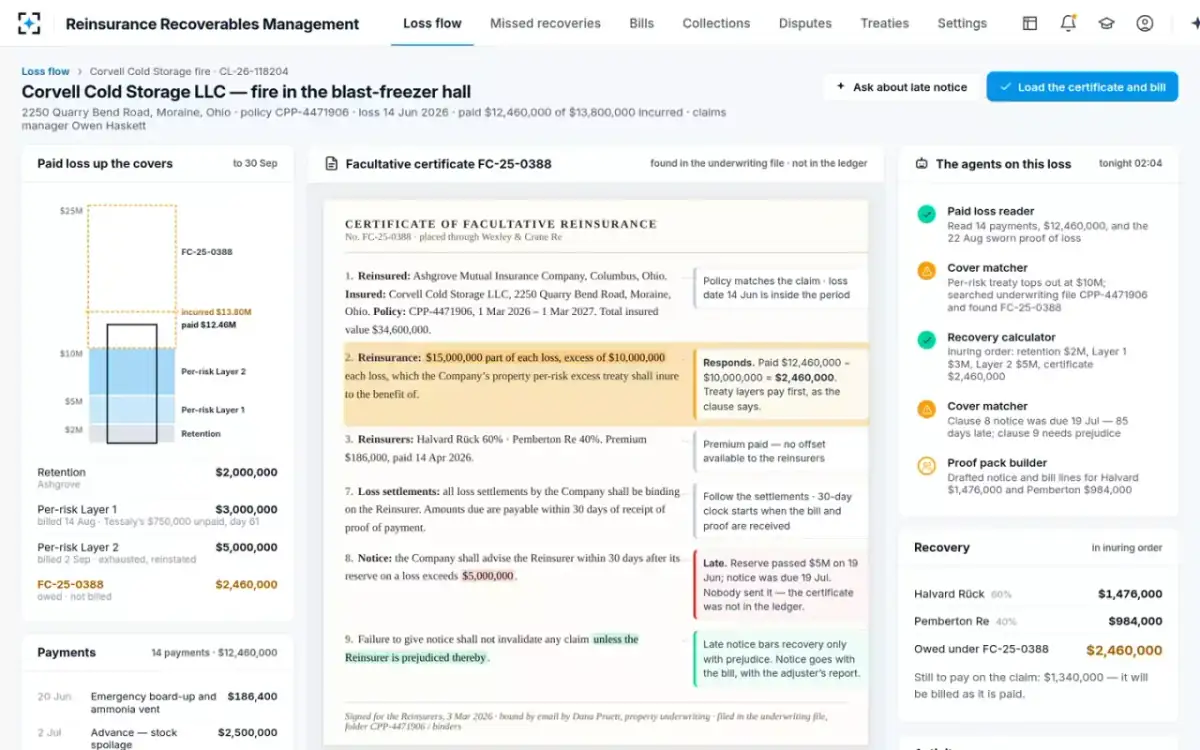
The large-loss manager’s view: one fire loss against its tower
How are large losses reported to reinsurers?
Large losses are reported by individual notice when the contract’s trigger is met, and the trigger is often a reserve threshold rather than a payment. The CAS text puts the usual level at half the excess contract's attachment point, and it explains why reports run late: a serious claim can sit below that level for a long time because a claims handler, short of information, may reserve to the most likely outcome rather than the worst (Patrik, CAS). The claims that blow through the attachment are the ones reported late, which is the opposite of what the reinsurer needs.
Ashgrove’s certificate on the Corvell fire shows the mechanics. Its notice clause asks for advice within 30 days after the reserve on a loss exceeds $5,000,000, half of the $10 million attachment. The reserve passed $5 million on 19 June, so notice was due by 19 July. Nobody sent it, because the certificate was not in the ceded team’s list of covers. By the time the nightly check found it, on 12 October, the notice was 85 days late. The certificate’s next clause says late notice does not invalidate the claim unless the reinsurer is prejudiced, so the bill went with the notice, the adjuster’s report and every payment attached. What reinsurance claim notification requires, and what late notice costs, follows a loss like this one day by day.
A claim reported to the cedant must first be perceived as being reportable to the reinsurer, then must filter through the cedant’s report system to its reinsurance accounting department, then may journey through an intermediary to the reinsurer, then must be booked and finally appear in the reinsurer’s claim system.
Gary S. Patrik, “Reinsurance”, Foundations of Casualty Actuarial Science, Casualty Actuarial Society
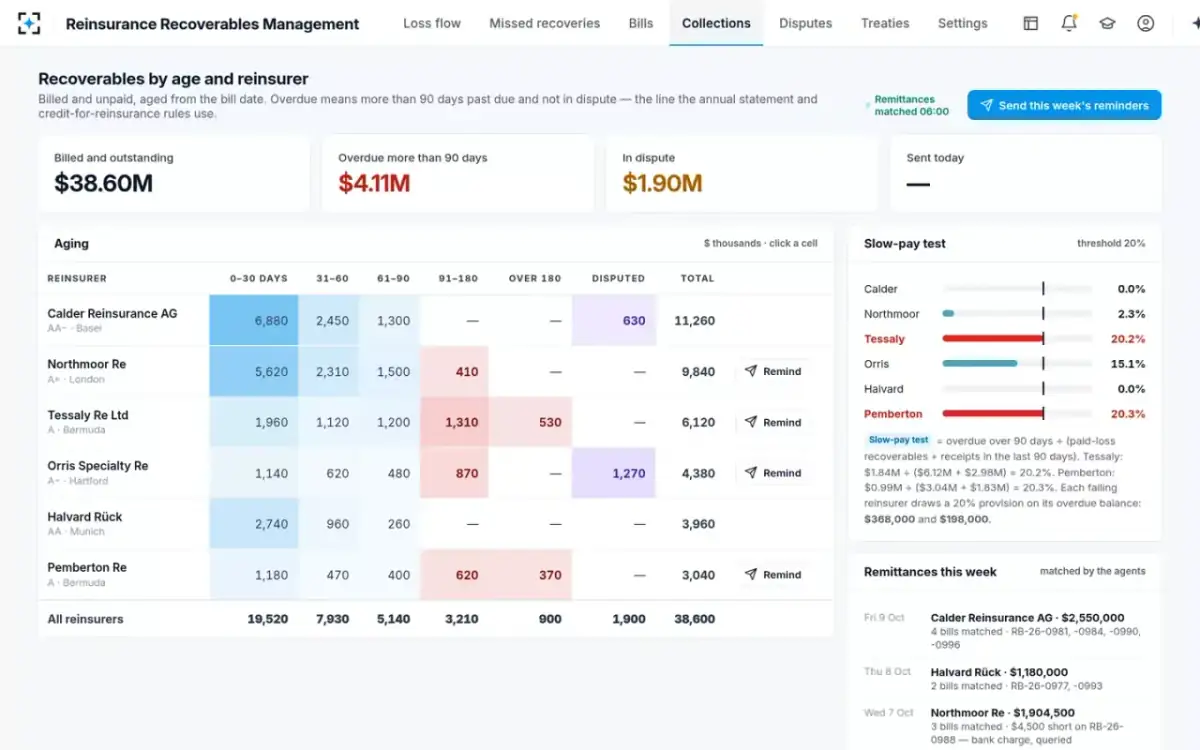
The credit controller’s week runs on ages, not amounts
Once a bill is sent, the recovery belongs to collections, and the credit controller’s tools are the age bands and the 90-day line. Ashgrove’s board ages every balance into bands from 0–30 days to over 180, keeps disputed amounts in a column of their own, and shows each reinsurer against the slow-payer test. On the sample quarter, $38.60 million was billed and outstanding, of which $4.11 million was more than 90 days overdue and $1.90 million in dispute.
The 90-day line matters because regulators and actuaries read it. The CAS study note on financial reporting quotes the NAIC instructions to appointed actuaries: before commenting on reinsurance collectibility, the actuary should, among other things, "examine Schedule F for the current year for indications of regulatory action or reinsurance recoverable on paid losses over 90 days past due" (Odomirok et al., CAS, quoting the 2011 instructions). The NAIC’s model credit-for-reinsurance regulation uses the same line to judge reinsurers: a certified reinsurer’s collateral rises by at least one rating level where more than 15% of its cedents have undisputed paid recoverables 90 days or more overdue above $100,000 each, or where such balances exceed $50 million in total (NAIC Model Regulation 786). The Schedule F penalty and its 20% and 90-day lines sets out what the annual statement charges when a reinsurer pays slowly.
The credit controller’s board: every reinsurer by age
Disputes need their own handling because they change the arithmetic. Under the annual statement instructions an NAIC issue paper set out in 1998, a recoverable counts as in dispute only once the reinsurer has denied coverage in writing, or the matter is in arbitration or litigation (NAIC Issue Paper No. 75; the definition is quoted in the Schedule F penalty guide). A reinsurer’s query is not a dispute. A controller who files every query as a dispute keeps it out of the overdue figures and hides a slow payer; one who never logs disputes overstates the overdue line.
Where recoveries go missing between the seats
Most missed recoveries are not arithmetic errors; they are handoffs that did not happen. On Ashgrove’s sample quarter the nightly check found five recoveries that nobody had billed, worth $11,160,250 across six reinsurers, and each one fell into a different gap between two seats.
Five missed recoveries, five handoffs that failed
| Handoff | What should pass | What happened in the sample quarter | Owed |
|---|---|---|---|
| Underwriting to ceded | Every facultative certificate bound | Corvell fire: certificate FC-25-0388 bound by email on 3 March and kept in the underwriting file, so the loss above $10 million was booked as retained | $2,460,000 |
| Claims coding to ceded | One event per catastrophe | May hail: the claims system opened a second event code when the storm crossed a county line; $18.93M and $12.78M each sat under the $25M retention | $6,710,000 |
| Two claims files to ceded | Both policies hit by one occurrence | Ridgeline Pass pile-up: an auto policy paid $3.90M and a general liability policy $2.34M; together $1.24M above the clash retention | $1,240,000 |
| Claims payments to the bill run | Every loss that crosses a retention | Brookfield Avenue: a $412,600 payment on 29 September took the loss past $2M the day after the quarterly bill run closed | $338,250 |
| Policy form to line of business | The line the treaty covers | Three umbrella claims on form UMB-07 booked as general liability, so the 50% quota share was never ceded | $412,000 |
The pattern is the argument for looking at handoffs rather than people. Each seat did its own job correctly: the underwriter bound the certificate, the claims system coded the storm by county, the claims handlers paid the right policies, the bill run ran on its date. What failed was the passage of information from one seat to the next, and no single seat owns a passage. The reinsurance claims process, tested with planted misses, turns this list into an audit any team can run on a closed quarter.
How many people work on recoveries? No public count exists
No government series counts ceded reinsurance or recoveries staff, so any figure for team size is a company’s own. The nearest public data is the Bureau of Labor Statistics occupation of claims adjusters, examiners and investigators, which covers everyone from field adjusters to the examiners who review claims, and does not separate reinsurance. It is still useful as a market signal for the seats on this page.
The nearest public data: claims occupations, all of insurance
$78,000
median annual wage, claims adjusters, examiners and investigators, May 2025
$79,280
median in direct insurance carriers other than life, health and medical
376,100
jobs held in 2025, all claims adjusters, examiners and investigators
−6%
projected change in employment, 2025 to 2035
The BLS projects the occupation to shrink, and its reason is relevant: it expects technology to take over some of the tasks these workers do now (BLS). In a recoveries team the tasks that automate are the mechanical ones on this page: pulling the extract, matching losses to covers, aggregating events, computing shares and drafting reminders. The judgements stay where they are.
What changes, seat by seat, when agents take the mechanical work
The change is in where each person starts the day. The ceded analyst no longer builds a list of candidates from an extract; she reviews findings that already name the loss, the cover, the clause and the calculation, and accepts or dismisses them. The claims manager sees the reinsurance consequence of a reserve as he sets it. The head of ceded reinsurance signs large bills with the proof in front of him rather than a summary. The controller works an aged list with reminders drafted. The accountant receives matched remittances.
The limits are as important as the jobs, and they are written into the agents rather than left to policy. The agent that reads claims never changes a claim. The cover matcher never treats a cover as responding without citing the clause, and a certificate it finds outside the program goes to a person before it is used. The event aggregator proposes merges and never makes one. The calculator never bills above a limit and never rounds in the company’s favour. The bill builder never sends a bill, and the collections agent never offsets, commutes or writes off a balance. Reinsurance claims management with agents sets these limits against the jobs one by one.
The analyst’s view: what the books show before the nightly check
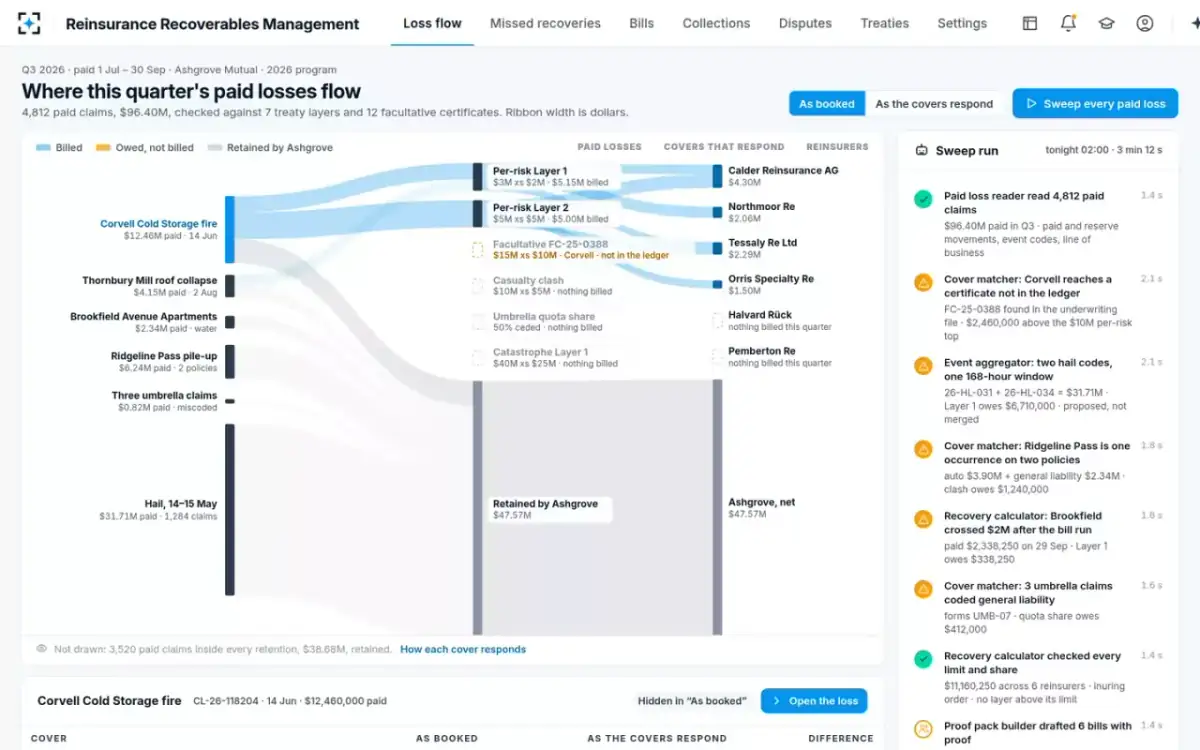
For a head of ceded reinsurance the practical question is which seat feels the change first. On the evidence of the sample quarter, it is the analyst’s: four of the five findings were matching and coding problems that only the person who owns the program can confirm. To see the whole desk on your own program, start from Reinsurance Recoverables Management.
Questions people ask
What is a reinsurance claims handler?
At a reinsurer, the claims handler receives the cedant’s loss reports, checks them against the contract and pays or queries them; the CAS text notes that a reinsurer’s claims department reviews individual case reserve reports and may add its own case reserves. At a cedant, the same title is used for the person who prepares those reports and bills. Both read the same clause: what the contract says must be reported, when, and with what proof.
What is the salary of a reinsurance claims analyst?
No government series publishes reinsurance claims pay separately. The nearest figure is the BLS median for claims adjusters, examiners and investigators, $78,000 in May 2025, and $79,280 in direct insurance carriers other than life, health and medical. Reinsurance roles that combine claims, contract and accounting knowledge often sit above that occupation median, but there is no public source that measures it.
What is a ceded reinsurance analyst?
The ceded reinsurance analyst works for the insurer that buys reinsurance and owns its program: the layers, shares, certificates and the recoveries due under them. In the sample program the analyst owns recoveries on the treaties and 12 facultative certificates, approves every bill and confirms every catastrophe event merge. Where a company has a separate reinsurance claims analyst, that role usually owns notice and proof on the largest losses.
Do reinsurers have to be told about every claim?
No. An excess of loss contract usually asks for individual reports only on losses likely to reach the layer, and the CAS text puts the typical reporting threshold at about half the attachment point. Proportional treaties more often use summary reporting through periodic accounts. The contract decides, so the threshold has to be read from each wording, not assumed.
What does a credit controller do in reinsurance?
The credit controller follows each billed recovery until the cash arrives: ageing balances, sending reminders through the broker, escalating at 90 days and deciding with the head of ceded reinsurance on offsets, commutations and write-offs. The 90-day line is the one the annual statement and the NAIC model regulation use, so the controller’s list is also an early view of what the year-end figures will show.