A reinsurance recovery system is the software a ceding insurer uses to find what its reinsurers owe on paid losses, bill it with proof and collect it. Using AI for reinsurance recoveries raises a fair question: which of those tasks may a machine do, and which must a person keep? The answer from supervisors is a proportionality test, not a list of banned uses. The NAIC’s model bulletin on AI asks insurers to scale controls to the harm a decision can do to consumers; the EU insurance supervisor adds the impact on the firm’s own finances and legal obligations. Billing a reinsurer touches no consumer, which puts most recoverables work in a lower tier, but a bill, an event election or a write-off binds the company, which keeps those decisions with people. Botminds’ Reinsurance Recoverables Management is built on that line: six agents read, match, calculate and draft; people approve, elect, send and write off.
Product examples come from the solution’s sample program, a fictional insurer called Ashgrove Mutual. Supervisory texts are quoted from the NAIC, EIOPA and the Bank of England, linked where they appear.
Reinsurance Recoverables Management, task by task: how far each is automated, and whether it binds the company
Read paid and reserve movements; flag coding that disagrees with the policy form
AutomationDecision support
Binds the company?No
Who actsAgent
Match each loss to every treaty layer and certificate, with the clause cited
AutomationDecision support
Binds the company?No
Who actsAgent; a person accepts each finding
Calculate shares, limits used and reinstatement premium
AutomationDecision support
Binds the company?No
Who actsAgent; arithmetic shown on every line
Draft bills, notices and proof packs
AutomationDecision support
Binds the company?No, until sent
Who actsAgent drafts; a person approves
Match remittances; age balances; draft reminders
AutomationConstrained execution
Binds the company?No
Who actsAgent, within rules the company sets
Load a certificate found outside the reinsurance system
AutomationKept with people
Binds the company?Yes: it changes the program
Who actsCeded analyst
Elect an hours-clause window; merge event codes
AutomationKept with people
Binds the company?Yes: a contractual election
Who actsCeded analyst
Send a bill; send a position on a dispute
AutomationKept with people
Binds the company?Yes: a demand on a counterparty
Who actsAnalyst; a second signature above a threshold
Offset, commute or write off a balance
AutomationKept with people
Binds the company?Yes: it changes an asset
Who actsCredit controller with the head of ceded
What is a reinsurance recovery system?
It is the system that holds what reinsurers owe the insurer on paid losses: the program of treaties and certificates, the losses matched to them, the bills, the balances and the disputes. Older systems store and calculate; the matching is done by people from a quarterly extract. An AI recovery system adds agents that do the matching on every loss, read certificates in documents rather than waiting for someone to key them, group catastrophe claims under each treaty’s hours clause, and draft bills and reminders. The governance question arises from that change: the system now proposes recoveries, not just records them.
Is AI used in reinsurance claims? What supervisors’ surveys show
AI is widely used in insurance, mostly for internal work, and mostly with people deciding. No supervisor publishes a figure for reinsurance recoverables specifically, but two recent surveys describe the setting. EIOPA’s generative-AI survey of European insurers found that 64% of reported use cases were internal back-office applications, and that insurers named inaccurate outputs as the main risk (EIOPA, Generative AI Market Survey). The Bank of England and FCA’s 2026 survey of UK financial firms found 93% of responding insurers using AI, and measured how much autonomy firms give agents.
UK financial firms give AI agents little autonomy: share of respondents with agents deployed at each level
The same survey asked which actions firms expect agents to take on their own within a year, and the answer was few: no more than 9% of respondents expected agents to approve or decline customer outcomes, to initiate, execute or block payments, or to change limits, thresholds and controls (Bank of England and FCA, 2026). A recovery system built the same way lets agents draft the bill and keeps the act of sending it, and of moving money, with people.
What are the rules for AI in insurance claims, and do they reach a reinsurance bill?
In the U.S., the main text is the NAIC’s Model Bulletin on the Use of Artificial Intelligence Systems by Insurers, adopted on 4 December 2023. The NAIC’s adoption map shows it adopted in 29 jurisdictions as of 8 October 2026, with California, Colorado, New York and Texas issuing insurance-specific rules or guidance of their own (NAIC adoption map). The bulletin names "claim management" among the stages of the insurance life cycle where AI is deployed (NAIC Model Bulletin).
Its controls, though, are built around consumers. The bulletin defines an "Adverse Consumer Outcome" as "a decision by an Insurer that is subject to insurance regulatory standards enforced by the Department that adversely impacts the consumer in a manner that violates those standards", and asks that an insurer’s program "be designed to mitigate the risk that the Insurer’s use of an AI System will result in Adverse Consumer Outcomes" (NAIC Model Bulletin). A reinsurance recovery is a claim by one insurer on another under a contract between them. As New York’s highest court put it, a reinsurance contract "confers no rights on the insured" (Unigard v North River, 1992). The policyholder has already been paid by the time a recovery is billed. So the bulletin’s consumer-harm test places recoverables work low, though its governance expectations, documentation and senior accountability still apply to any AI program an insurer runs.
Five tests the NAIC bulletin sets, applied to a recovery
The bulletin asks that controls be "commensurate with" the insurer’s own assessment of risk, considering five things. Applied to a recovery system, they sort the tasks cleanly.
The NAIC bulletin’s five considerations, applied to a reinsurance recovery system
| The bulletin asks about | In a reinsurance recovery system | What follows |
|---|---|---|
| The nature of the decisions the system makes, informs or supports | Which covers respond, how much each reinsurer owes, when to bill and chase | Contractual and financial decisions between companies |
| The type and degree of potential harm to consumers | None directly: the policyholder has been paid before any recovery is billed | The consumer-harm tier is low |
| How far humans are involved in the final decision | A person accepts every finding, elects every event window and approves every bill | Humans make every final decision that binds the company |
| Transparency and explainability to whoever is affected | The affected party is the reinsurer, who sees the clause, the calculation and the proof on each line | Explainability is to a counterparty, and it is built into each bill |
| Reliance on third-party data, models and AI systems | A vendor’s agents read the insurer’s claims and program data | Third-party due diligence, contract terms and audit rights apply |
The EU view: internal use, but money and legal obligations count
EIOPA’s Opinion on AI governance, published in August 2025, gives the most useful test for a recovery system because it looks at the firm as well as the customer. It asks insurers to assess each AI use for impact, taking into account among other criteria "the extent to which the AI system is used in consumer-facing applications or for purely internal purposes that do not involve decision-making with a direct customer impact" (EIOPA Opinion on AI governance and risk management).
The extent to which an AI system can have an impact on the financial position of an undertaking (e.g. substantial number of claims, contracts, Gross Written Premiums, solvency ratios etc.), or on the legal obligations of an undertaking is also relevant.
EIOPA, Opinion on AI governance and risk management, EIOPA-BoS-25-360, paragraph 3.4
That paragraph is why a recovery system cannot be treated as low-risk just because it is internal. Recoverables are an asset, slow-paid recoverables reduce surplus through the provision for reinsurance, and a bill or a write-off changes the company’s legal position with a reinsurer. EIOPA’s answer is proportionality: governance "for AI systems that have a low or very limited impact on customers or undertakings themselves would be very limited, as opposed to those AI systems that pose higher risks" (EIOPA, paragraph 3.6). Reading and calculating sit in the first group; sending, electing and writing off in the second. The Schedule F penalty shows how a slow-paid balance reaches surplus.
Can AI approve a reinsurance recovery?
It can recommend one, and in a well-governed system it cannot approve or send it. Approval means the company asserts that a contract supports a demand on a counterparty, and that assertion should have a named person behind it. In the sample program the ceded analyst approves every bill and the head of ceded reinsurance co-signs above $1,000,000; both signatures and the time are shown on the bill, and the proof pack stays with it.
Approved, co-signed and only then sent
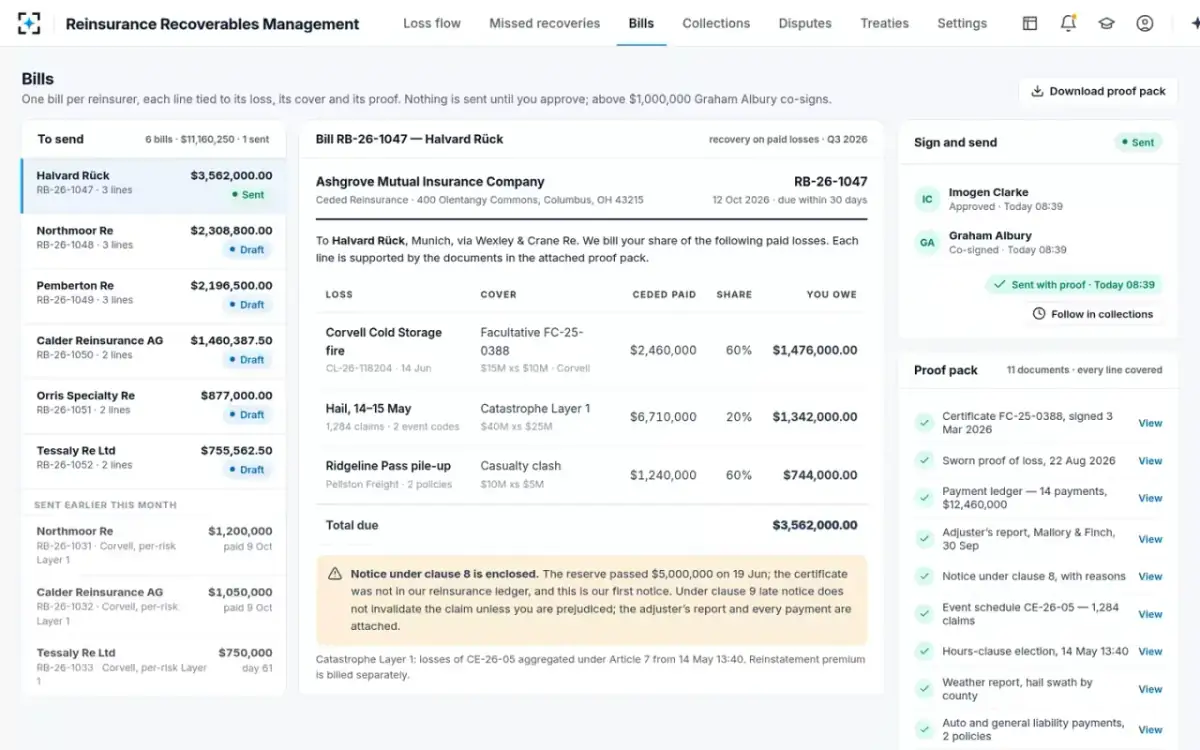
The same rule covers the other binding acts. The event aggregator proposes merges across event codes and never makes one, because the hours-clause election is the company’s contractual right. A certificate the cover matcher finds in an underwriting file goes to a person before it is used, because it may be a quote rather than a binder. And the collections agent never offsets, commutes or writes off. The jobs and limits of agents in reinsurance claims management sets out each limit beside the job it bounds.
What is human oversight of AI, in a recoveries team?
Human oversight means a named person can see what the system did and why, and decides every action that binds the firm. EIOPA describes it as part of effective internal control, with defined roles, escalation and "sufficient training ... to ensure that the human oversight of AI systems is effective" (EIOPA, paragraph 3.32). In a recoveries team that translates into three practical tests. Can the analyst check a finding from its clause and arithmetic without the vendor? Does every decision carry its decider and time? And can a supervisor or auditor replay the steps that produced a bill?
Every step of the nightly check, with what it found and why
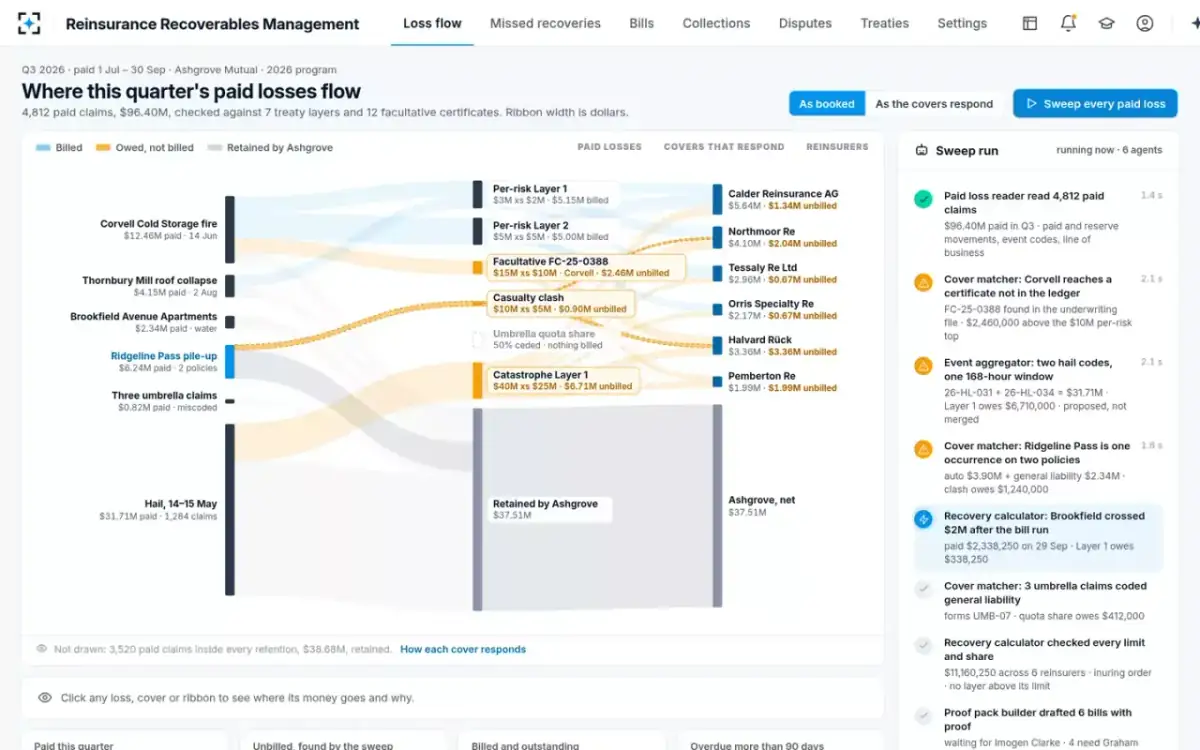
What a recovery system should log for an examiner
The NAIC bulletin tells insurers that the department may ask, in an investigation or examination, for documentation of how AI systems are governed and used; its Section 4 lists the kinds of information it may request (NAIC Model Bulletin). For a recovery system the useful log is concrete: every agent step, every finding with the clause and calculation behind it, every acceptance or dismissal with its person and reason, every bill with its approver and co-signer, and every change to a setting as a new version. The solution keeps all of these, and the proof pack stays attached to the bill it supports.
Third-party diligence belongs in the same file. The bulletin asks insurers to address how they acquire and rely on AI systems developed by third parties, including contract terms that let the insurer audit the vendor and require its cooperation with regulatory inquiries. A buyer should ask for those terms in the contract, not in a slide. To see how the limits work on your own program, start from Reinsurance Recoverables Management, or test them in a pilot on last quarter’s paid losses.
Questions people ask
Does the NAIC AI bulletin apply to reinsurance?
It applies to insurers’ use of AI systems in the states that adopt it, 29 jurisdictions as of 8 October 2026, and it names claim management among the uses in scope. Its controls are scaled to the risk of adverse consumer outcomes, which a recovery billed between two insurers does not directly create, so most recoverables tasks fall in a low tier. The governance, documentation and third-party expectations still apply to the insurer’s AI program as a whole.
How do insurers govern AI?
Under the NAIC bulletin, through a written AI systems program covering governance, risk management controls and internal audit, with responsibility vested in senior management accountable to the board. EIOPA’s Opinion asks for a risk-based, proportionate assessment of each AI use and governance measures scaled to it, including data governance, human oversight and explainability.
Is AI in reinsurance recoverables high-risk under the EU AI Act?
Not on EIOPA’s reading. Its Opinion notes that, for insurance, the AI Act treats as high-risk the AI used for risk assessment and pricing of individuals in life and health insurance, and it addresses the insurance AI systems that are neither prohibited nor high-risk. Recoveries between two insurers fall in that second group; check your own uses against the Act with your lawyers.
Can AI write off an uncollectible reinsurance balance?
It should not. A write-off changes an asset and the company’s position with a reinsurer, and in statutory accounting an amount found uncollectible is charged through operations. In the solution the collections agent can age, remind and report; offsets, commutations and write-offs are the credit controller’s decisions with the head of ceded reinsurance.
What makes AI output trustworthy enough to bill on?
Evidence a person can check without the system: the clause that makes the cover respond, the calculation in inuring order, and the documents that prove each element. EIOPA’s survey found insurers name inaccurate outputs as the main risk of generative AI, which is why the solution attaches the clause and arithmetic to every line and a person approves before anything is sent.