Reinsurance recovery software reads an insurer’s paid losses, works out which treaty layers and facultative certificates owe on each one, calculates and bills each reinsurer’s share with its proof, and follows the balance until it is paid. The way to choose one is not a demonstration on the vendor’s data; it is a pilot on a quarter you have already closed. Give the software last quarter’s paid losses and your program, let it produce the bills it thinks were owed, and compare them, line by line, with the bills your team actually sent. Every line in the difference column is either money you missed or a mistake the software made, and your own analyst decides which. Botminds’ Reinsurance Recoverables Management is built to be piloted this way: its six agents check every paid loss against every cover and present each recovery as a finding with its clause and arithmetic, for a person to accept or dismiss.
The worked example uses the solution’s sample program, a fictional insurer called Ashgrove Mutual with a third quarter of 2026 of 4,812 paid claims and $96.40 million paid. Targets are design goals; the time estimates are Botminds’ own and are labelled as such.
A four-week pilot, and most of it is your analyst judging findings
- Program and data loadedWeek 1
- First run1 d
- Analyst accepts or dismisses each finding9 d
- Scoring and business caseWeek 4
What is reinsurance recovery software?
It is software that turns a ceding insurer’s paid losses into reinsurance bills and collections. The minimum it must do is four things: read every paid and reserve movement from the claims system; hold the reinsurance program, meaning every treaty layer and facultative certificate with its retention, limit, shares, period and clauses; match each loss to the covers that respond, in the order the contracts set; and calculate, bill and age each reinsurer’s share. Some products stop at the calculation and leave matching to people; some add collections and dispute tracking.
The distinction that matters is where matching happens. Software that bills only the losses an analyst has flagged reproduces the misses of the manual process faster. Software that tests every loss against every cover, including certificates that never reached the reinsurance system, can find money nobody was looking for. Only a pilot on your own quarter shows which kind you are buying.
Why pilot on a closed quarter rather than watch a demonstration
A closed quarter has an answer key that you already own: the bills your team sent. A demonstration shows what software does on data built to show it well; a closed quarter shows what it does on your coding, your certificates and your wordings, with the bills you sent as the baseline. It also costs nothing in risk, because nothing the pilot produces is sent to a reinsurer.
A closed quarter is also where most leakage hides. Recoveries are missed when information sits outside the place the process looks, and a quarter that has closed contains every one of those cases in their natural proportions: certificates filed with underwriting, storms split by county, retentions crossed after the bill run, claims coded to the wrong line. The planted-miss test adds known cases on top, if you want an answer key for recall as well as for value.
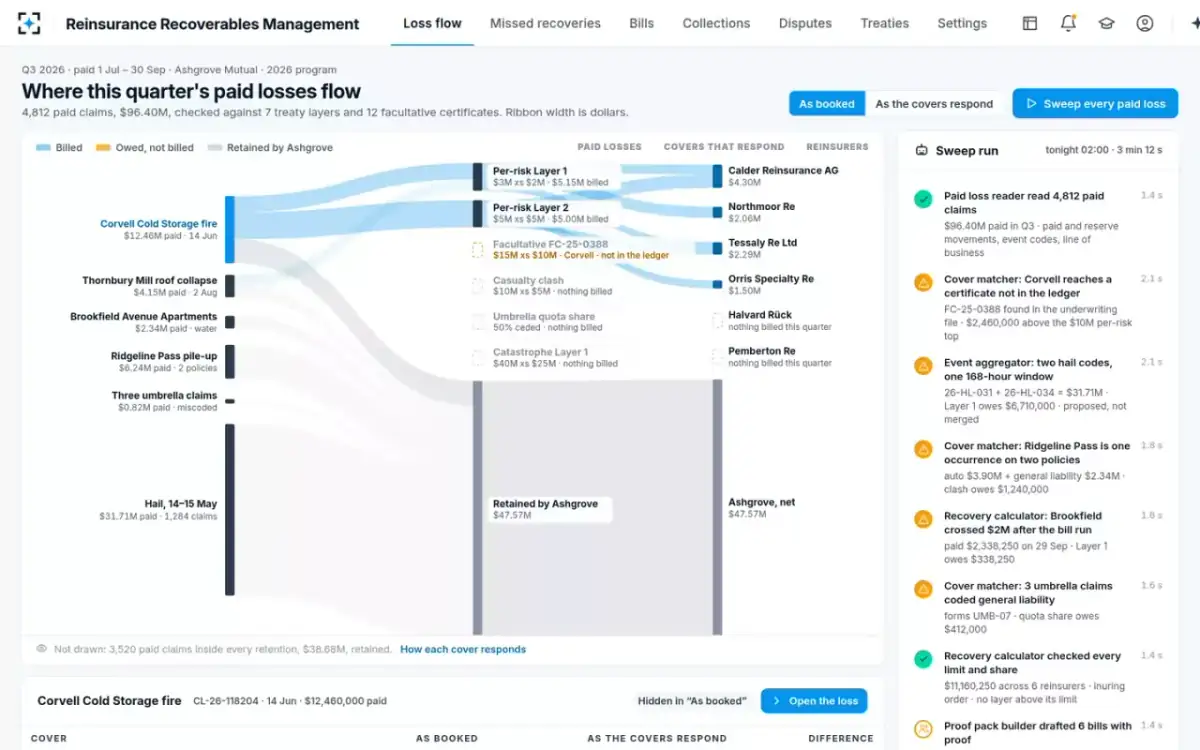
What the books showed before the pilot’s first run
What data does a recoveries pilot need?
It needs the quarter’s losses, the whole program those losses can reach, and the bills that went out. The program is the part teams underestimate. A loss paid this quarter on a losses-occurring basis reaches the program of the year it occurred, so a pilot on one quarter usually needs the treaties and certificates of several years. And the certificates have to include the ones that never reached the reinsurance system, which means giving the software read access to underwriting files and the broker mailbox, not just the ceded team’s folder.
What to hand over for a one-quarter pilot
- Paid and reserve movements for the quarter
Claim number, policy, policy form, line of business, loss date and time, event code, payment and reserve history. Read-only access is enough.
- Every treaty slip and wording for each year with losses paid
Retentions, limits, shares, periods, hours clauses, inuring provisions, reinstatement terms and notice clauses.
- Every facultative certificate, wherever it is kept
Including underwriting files and broker email. In the sample quarter the largest single miss was a certificate filed with underwriting.
- The bills actually sent for the quarter
The answer key. Without it the pilot can show findings but cannot show the difference.
- Event codes and, for catastrophe events, the claims’ loss times
Aggregation runs on loss time under the hours clause, not on the code the claims system assigned.
- Remittances and the open balance by reinsurer
Optional for a recoveries pilot; needed to test ageing, the slow-payer test and remittance matching.
- One analyst’s time for about nine days
Someone who owns the program has to accept or dismiss every finding. That judgement is the result.
How long does a pilot take? Four weeks, and most of it is review
Four weeks is a realistic plan for one quarter of a mid-sized program, and the critical path is the program load and the review, not the run. Week one loads the treaties and certificates and connects read-only to the claims data; the treaty terms are what the software reasons from, so this is where to spend care. The run takes minutes. Then the analyst reviews each finding: is the cover right, is the clause right, is the arithmetic right, would the reinsurer pay it. Week four turns the accepted findings into the business case and the dismissed ones into the error rate.
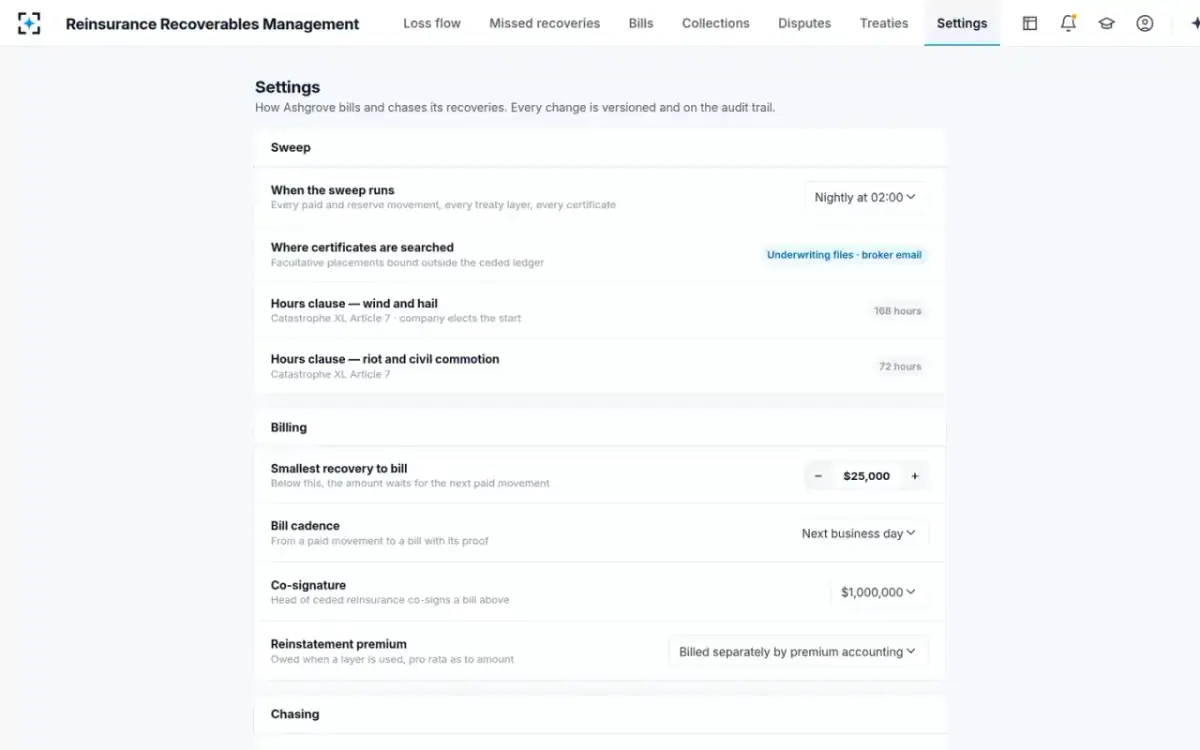
The settings belong in week one too, because they change what the software reports. In the solution they include when the check runs, where certificates are searched, the hours clause for each peril, the smallest recovery worth a bill, the bill cadence and the co-signature threshold. A pilot run with the team’s own settings produces a result the team recognises.
The settings a pilot fixes in week one
Can software find recoveries we missed? Only if it looks where you did not
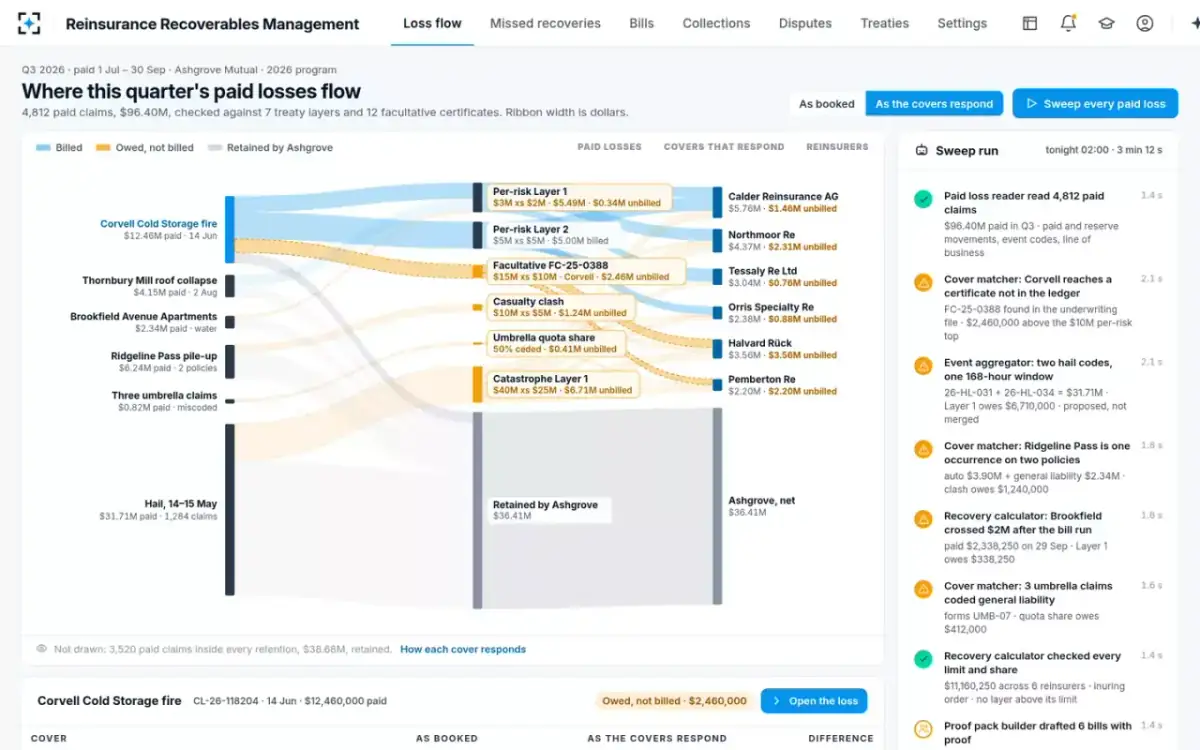
It can, if it tests every loss against every cover and looks for covers outside the reinsurance system; otherwise it finds what your team would have found, sooner. On the sample quarter the nightly check found five recoveries the team had not billed, worth $11,160,250. The causes are the evidence that it looked in new places: a certificate in an underwriting file, a storm split across two event codes, two policies hit by one occurrence, a retention crossed after the bill run, and three claims coded to the wrong line.
The difference column on the sample quarter: five findings, each accepted by the analyst
| Loss | Why it was missed | Cover | Found |
|---|---|---|---|
| Hail, 14–18 May | Two event codes, each under the $25M retention; one 168-hour window | Catastrophe layer 1, $40M xs $25M | $6,710,000 |
| Corvell Cold Storage fire | Certificate bound by email on 3 March, filed with underwriting | Facultative FC-25-0388, $15M xs $10M | $2,460,000 |
| Ridgeline Pass pile-up | Auto $3.90M and general liability $2.34M on two claim files | Casualty clash, $10M xs $5M | $1,240,000 |
| Three umbrella claims | Policy form UMB-07 booked as general liability | Umbrella quota share, 50% | $412,000 |
| Brookfield Avenue | Crossed $2M on 29 September, a day after the bill run | Per-risk layer 1, $3M xs $2M | $338,250 |
The same table, run on your quarter, is the pilot’s output. Each row should carry the clause that makes the cover respond and the calculation, so that the analyst can judge it without asking the vendor. A row the analyst cannot verify alone is a failure of the software, even if the number turns out right, because the reinsurer will ask the same questions.
What is a good result in a pilot?
A good result has four properties, and none of them is a target dollar figure. Every finding can be verified from its clause and arithmetic by the person who owns the program. No finding bills something the contracts do not support, such as a catastrophe layer computed gross of a per-risk recovery, or a claim outside the hours window. The findings include at least some of the structural misses, the kind that recur every quarter, rather than only timing differences. And the run is repeatable: the same data gives the same findings.
Dismissed findings are part of a good result, not a blemish on it, provided each is dismissed for a reason the software can learn from: a certificate that was a quote and never bound, a merge the analyst rejects on the wording. The error rate is the dismissed findings over all findings; what matters is that none of them would have reached a reinsurer, because the software cannot send a bill a person has not approved. The jobs and limits of agents in reinsurance claims sets out where those approvals sit.
The business case is the difference column, plus the days
The business case has two parts. The first is money: the accepted findings, which are recoveries the quarter’s bills left on the insurer’s net line. Report them gross and by cause, and be conservative about recurrence: a certificate filed with underwriting is likely to recur, a one-off coding error may not. The second is time. A recovery billed at quarter end waits weeks before it reaches the reinsurer, and under the annual statement instructions the CAS study note describes, a paid recoverable can start ageing from the contract’s payment terms or, where those are silent, from the date it is booked as a paid recoverable over $50,000 (Odomirok et al., CAS), not from the bill. A late bill uses up days of the 90 before the reinsurer sees it.
Where a quarter’s recovery work goes, by hand and with the solution: Botminds’ estimate
- Extract3 d
- Matching losses to covers5 d
- Events2 d
- Shares and bills4 d
- Queries and chasing5 d
- Extract, matching, events1.5 d
- Shares and bills1 d
- Queries and chasing2 d
Measure the second part in the pilot rather than taking anyone’s estimate, including ours: time the analyst’s review of findings and compare it with how long the quarter’s bill run took. The design target the solution is built to is one day from a paid movement to a bill with its proof, against a quarter-end bill run by hand.
The same quarter after the pilot’s findings are accepted
Where recovery software does not fit, and what a pilot cannot show
It fits programs with excess of loss and facultative covers, where recoveries are claim by claim. The CAS text notes that proportional contracts mostly let the insurer report losses in summary rather than claim by claim (Patrik, "Reinsurance", CAS); a program that is mostly proportional and settled through periodic accounts has a reconciliation problem more than a recovery problem, which is what Reinsurance Account Reconciliation addresses. It does not decide coverage disputes, commutations or write-offs; those stay with people. And a pilot on one quarter cannot show collections performance over a year or how the software behaves through a catastrophe season.
A pilot also cannot settle what the balance-sheet consequences of slow payment will be; those depend on the year-end tests, and disputed amounts are handled differently from overdue ones. Under the annual statement instructions reproduced in NAIC Issue Paper No. 75, disputes, meaning written denials of coverage, arbitrations and lawsuits, are identified separately (NAIC Issue Paper No. 75). To run a pilot on your own closed quarter, start from Reinsurance Recoverables Management; to decide which numbers to report afterwards, see the reinsurance recovery ratio and five more numbers.
Questions people ask
What does reinsurance recoverables software cost?
There is no public price list for this category, and no government or research source measures it. The useful comparison is the pilot’s difference column against the annual cost: accepted findings on one quarter, adjusted for which causes will recur, plus the analyst days saved. A vendor that will not run a pilot on a closed quarter is asking you to price the software without that comparison.
Should we build or buy reinsurance recoveries software?
Building the calculation is straightforward; building the matching, the certificate search outside the reinsurance system, the hours-clause aggregation and the proof assembly is the hard part, and it has to be maintained as wordings change every renewal. Either way, the closed-quarter pilot is the acceptance test: the build has to beat the bills the team already sent.
Does the pilot need write access to the claims system?
No. The solution reads paid and reserve movements and never changes a claim, so read-only access is enough. Findings are reviewed inside the solution, and nothing is sent to a reinsurer during a pilot.
Can a pilot cover more than one quarter?
Yes, and on a losses-occurring program it should load every year whose losses were still being paid. Running two or three closed quarters shows whether the causes of missed recoveries repeat, which is the strongest evidence for the business case.
What if the software finds nothing?
Then you have evidence that the quarter was billed completely, which is worth having, provided the software was shown every certificate and tested every loss. Check that with planted cases before concluding: a run that finds nothing because it never looked outside the reinsurance system proves nothing.