Is reinsurance recoverable a current asset? Not in the sense the question assumes, because insurers do not present classified balance sheets. U.S. statutory statements list assets without a current or non-current split, and the SEC’s rules for insurance company balance sheets list "Reinsurance recoverable" as a caption with no "total current assets" line, unlike the rules for commercial companies. What statutory accounting does instead is split recoverables by whether the loss has been paid: recoverables on paid losses are reported as an admitted asset, while recoverables on unpaid losses and IBNR are netted against the loss reserves. Then a provision is charged against surplus for balances that are overdue, disputed or unsecured. So the useful question is not whether a recoverable is current but how old it is, whether it is secured, and whether the reinsurer accepts it. Botminds’ Reinsurance Recoverables Management works on exactly those three: it bills each paid loss with proof, ages every balance and keeps disputes apart.
Sources are NAIC Issue Paper No. 75 (the 1998 antecedent of today’s statutory rule, SSAP No. 62R), the Casualty Actuarial Society’s study note on statutory reporting, and the SEC’s Regulation S-X. Product examples use the solution’s fictional sample insurer, Ashgrove Mutual.
Paid and unpaid recoverables are reported differently, and neither is labelled current
Recoverable on paid losses: The reinsurers’ share of losses and expenses the insurer has already paid
Recoverable on unpaid losses and IBNR: The reinsurers’ share of case reserves and IBNR not yet paid
Recoverable on paid losses: An admitted asset: amounts recoverable from reinsurers
Recoverable on unpaid losses and IBNR: Netted against the liability for losses and loss expenses
Recoverable on paid losses: An asset
Recoverable on unpaid losses and IBNR: An asset; reserves are shown gross
Recoverable on paid losses: Not on the statutory balance sheet, even where offset criteria are met
Recoverable on unpaid losses and IBNR: Inside the net reserve presentation
Recoverable on paid losses: Aged; over 90 days overdue it feeds the provision and the slow-payer test
Recoverable on unpaid losses and IBNR: Not aged; it is not yet due
Recoverable on paid losses: Overdue and disputed amounts, and a slow payer’s whole balance less offsets
Recoverable on unpaid losses and IBNR: Counted in a slow payer’s base and in unsecured unauthorized balances
Is reinsurance recoverable a current asset? Insurers do not classify that way
The current / non-current split is a feature of commercial company balance sheets, and insurance balance sheets are built differently. The SEC’s Regulation S-X shows it most simply. Rule 5-02, for commercial and industrial companies, includes the caption "Total current assets, when appropriate" (17 CFR 210.5-02). Rule 7-03, for insurance companies, runs from investments and cash through receivables, "Reinsurance recoverable", deferred policy acquisition costs and other assets to total assets, with no current subtotal at all (17 CFR 210.7-03).
The statutory annual statement filed with state regulators is unclassified too. Its asset page lists investments, premiums and agents’ balances, amounts recoverable from reinsurers and other assets by line, and the test of an asset is whether it is admitted, not whether it is current. Anyone building a liquidity ratio from an insurer’s statements has to make the current judgement themselves, and the right way to make it differs for paid and unpaid recoverables.
What is reinsurance recoverable on paid losses?
It is what reinsurers owe the insurer for losses and loss adjustment expenses the insurer has already paid. The CAS study note describes the asset line as covering only recoveries on losses and LAE already paid; expected recoveries on reserves are left out because the reserves themselves are already shown net of reinsurance (Odomirok et al., CAS). In the 2011 annual statement the study note describes, it was "amounts recoverable from reinsurers" on the asset page, line 16.1, and it reconciled to the paid columns of Schedule F.
It is an admitted asset. The NAIC’s Issue Paper No. 75 adopted the earlier accounting manual’s rule in plain words: "Reinsurance recoverable on loss payments is an admitted asset" (NAIC Issue Paper No. 75). It is also kept gross: the same paper says it is to be reported as an asset without offset against amounts the insurer owes the same reinsurer, even where the general offsetting criteria would allow it. A paid recoverable is therefore a receivable in all but name, and of everything on this page it is the nearest to a current asset.
What is reinsurance recoverable on unpaid losses?
It is the reinsurers’ share of losses the insurer has reserved but not yet paid: case reserves and IBNR. Statutory accounting does not show it as an asset at all. Issue Paper No. 75 sets the rule: recoverables on unpaid case reserves and IBNR are presented as a contra-liability, deducted from the gross liability for losses and loss adjustment expenses rather than shown among the assets (NAIC Issue Paper No. 75).
The paper is candid that this is presentation, not principle. Unpaid recoverables "also meet the statutory definition of an asset", it says, but continue as a contra-liability "because a change to “gross” presentation would necessitate extensive changes in and restatement of the reporting of ceded reinsurance in schedules and exhibits of the Annual Statement" (NAIC Issue Paper No. 75). The practical effect is that most of a property-casualty insurer’s reinsurance protection is invisible on the face of the statutory balance sheet; it appears in Schedule F and in the restatement that shows the balance sheet gross of reinsurance.
Where recoverables sit on the statutory balance sheet
Assets
Cash and invested assets
Premiums and agents’ balances
Amounts recoverable from reinsurers paid losses and LAE · line 16.1 in 2011
Funds held by or deposited with reinsured companies
Other admitted assets
Liabilities and surplus
Losses and loss expenses, net of reinsurance unpaid recoverables netted here
Unearned premiums, net of reinsurance
Funds held under reinsurance treaties
Provision for reinsurance line 16 in 2011 · change charged to surplus
Surplus as regards policyholders
Where do recoverables appear on the balance sheet?
In three places, two of them on the liability side. Paid recoverables are an asset. Unpaid recoverables reduce the net loss and loss expense reserves. And the provision for reinsurance, a liability that exists only in statutory accounting, is set against both where balances are overdue, disputed or unsecured. The CAS study note describes the provision as "a statutory liability established for reinsurance recoverables that may not be collectable", whose change "is recorded directly to surplus" (Odomirok et al., CAS).
Two other lines often move with them. Funds the insurer withholds from a reinsurer under the treaty are a liability that can serve as security for recoverables, and ceded balances payable can be offset where the contract and the rules allow. That is why the provision formula subtracts allowed offsets before applying its 20% charge to a slow-paying reinsurer. The Schedule F penalty, worked, shows how those offsets and the 20% and 90-day lines combine.
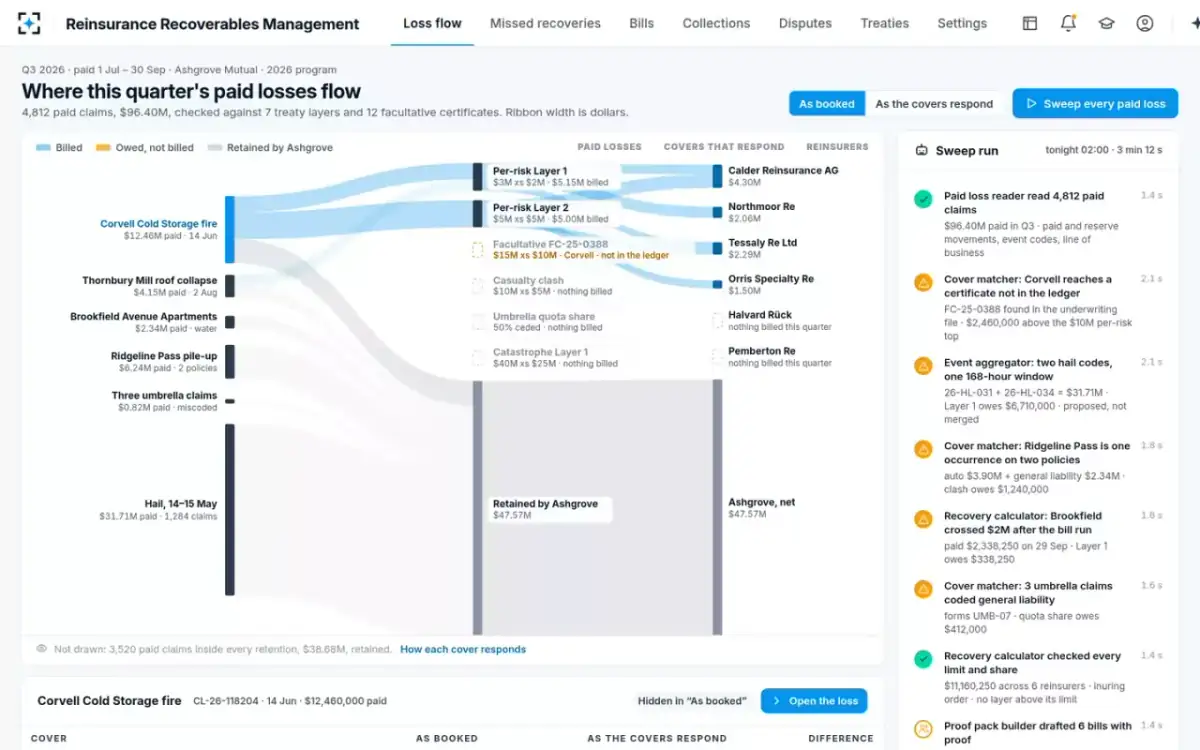
Recoverables before they reach the balance sheet: what is billed, what is retained
Is reinsurance recoverable a current asset under GAAP?
GAAP does not settle it either, because the SEC’s Rule 7-03, which sets the balance-sheet captions for insurers filing GAAP statements with the SEC, has no current subtotal either. What differs from statutory accounting is the gross presentation. Issue Paper No. 75 records the difference: unpaid recoverables are a contra-liability in statutory statements, while "Under GAAP, these recoverables are reported as assets" (NAIC Issue Paper No. 75). A GAAP balance sheet therefore shows a much larger reinsurance recoverable than a statutory one for the same insurer, because it includes the reinsurers’ share of reserves.
GAAP has no provision for reinsurance. The same paper notes that the statutory provision has no GAAP counterpart, while "both statutory accounting and GAAP require an assessment of the collectibility of recorded reinsurance recoverables" (NAIC Issue Paper No. 75). The statutory provision is a separate, formula-driven minimum on top of that assessment.
The same recoverable in three frameworks
| Framework | Paid-loss recoverable | Unpaid-loss recoverable | Current or non-current? |
|---|---|---|---|
| Statutory (SSAP No. 62R; annual statement) | Admitted asset, no offset | Netted against loss reserves | Not classified |
| U.S. GAAP for insurers | Asset | Asset; reserves shown gross | Not classified on the face of the statement |
| SEC Regulation S-X, Rule 7-03 | Within the caption "Reinsurance recoverable" | Within the same caption | No current-asset subtotal in the rule |
Reinsurance recoverable vs receivable: two words people mix up
Recoverable is what a reinsurer owes on losses; receivable is what someone owes on premium. The distinction has teeth in statutory accounting, because the two age differently. The CAS study note records that "Premiums that are more than 90 days past due from an agent or a direct policyholder are considered nonadmitted assets" (Odomirok et al., CAS): an old premium receivable disappears from admitted assets. An old paid-loss recoverable stays admitted, but draws the provision for reinsurance once it is more than 90 days overdue, and can take the reinsurer’s whole balance into the provision if it fails the slow-payer test.
The words also differ on the reinsurer’s side of the same transaction. To the insurer it is a recoverable; to the reinsurer the same amount is a loss payable. Reconciling the two views is a separate job, done account by account, set out in reinsurance balances receivable.
The lenses that do matter: age, security and dispute
For anyone judging the quality of recoverables, three questions replace "is it current?". How old is it, measured from the contract’s terms rather than the bill? Is it secured, by funds held, letters of credit or trusts, or owed by a reinsurer that need not post collateral? And does the reinsurer accept it, or has it formally denied coverage? The provision for reinsurance is built from exactly those three, which is why regulators and appointed actuaries read Schedule F’s ageing and collateral columns rather than any current/non-current split.
Who reads recoverables, and what each needs to see
Today
Rebuilds each reinsurer’s paid balance and ageing for the annual statement at year end.
With agents
Gets every paid recoverable aged from day one, disputes logged apart, remittances matched each morning.
Still theirs: The books, offsets, the Schedule F filing
Today
Asks management about collectibility problems and reads last year’s Schedule F.
With agents
Sees overdue and disputed balances by reinsurer during the year, with their causes.
Still theirs: The opinion on reserves net of reinsurance
Today
Learns which balances are old when the controller asks why.
With agents
Sees the slow-payer test weekly and the cash that keeps each reinsurer under 20%.
Still theirs: Escalations, commutations, the panel
Today
Reads gross and net figures and has to guess at liquidity.
With agents
Can be shown age, security and dispute for every paid balance, which is what liquidity actually depends on.
Still theirs: Their own classification for their own ratios
How long until a recoverable turns into cash
For paid recoverables, the contract decides: many certificates and treaties make amounts payable within a set period after proof of payment, 30 days in the solution’s sample certificate, and a bill sent late starts that clock late. For unpaid recoverables, cash follows the underlying claims, and for long-tail casualty that can take years; the CAS text on reinsurance notes that claim report lags to reinsurers "are generally longer, especially for casualty excess losses" (Patrik, "Reinsurance", CAS). Anyone forced to label recoverables current or non-current should split them the same way: paid recoverables by their contractual due dates and age, unpaid recoverables by the payout pattern of the reserves they offset.
The program behind the recoverables: every layer and certificate, with its shares
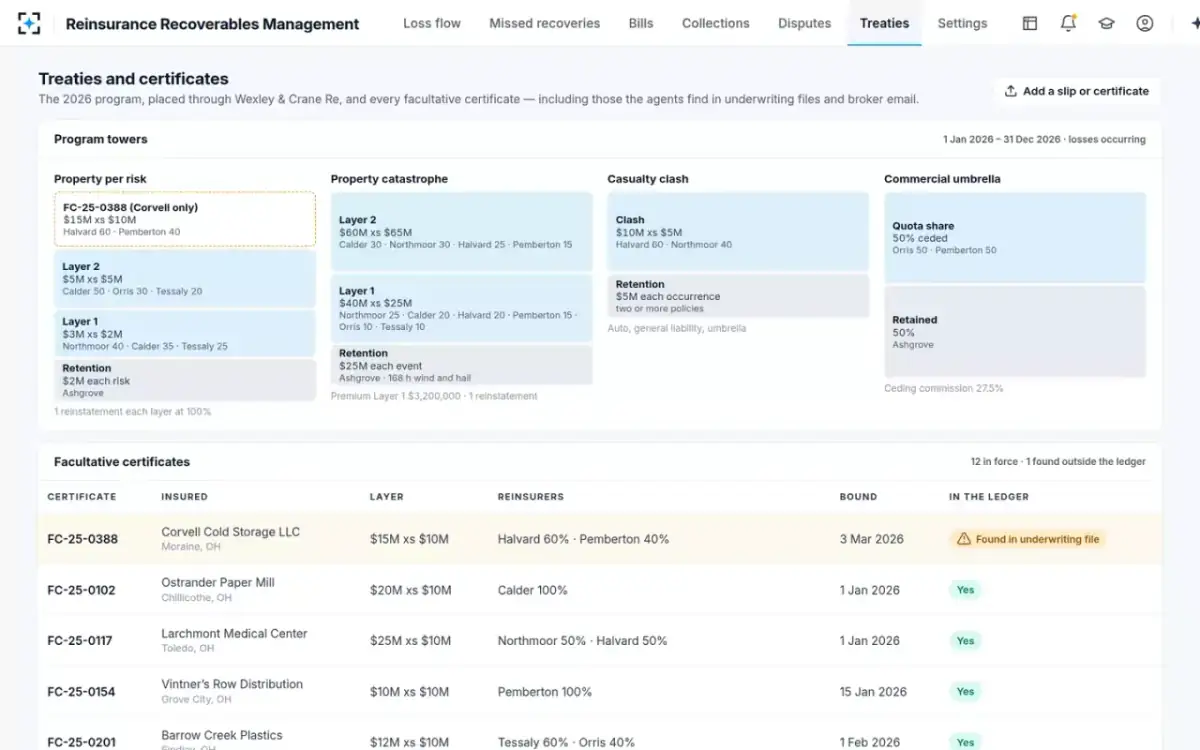
The cheapest way to improve the quality of a recoverables balance is to shorten the time between a payment and a bill, because the age that matters starts with the contract, not with the bill. In the sample program, $38.60 million was billed and outstanding at quarter end, $4.11 million of it more than 90 days overdue and $1.90 million in dispute. To see your own recoverables aged, secured and sorted by reinsurer, start from Reinsurance Recoverables Management.
Questions people ask
Is reinsurance recoverable an asset?
Yes. Recoverables on paid losses are an admitted asset in statutory accounting and an asset under GAAP. Recoverables on unpaid losses meet the definition of an asset too, but statutory statements show them netted against loss reserves, while GAAP shows them as assets with reserves gross.
What is the provision for reinsurance?
A statutory liability for reinsurance that may not be collected: unsecured balances with unauthorized reinsurers, paid recoverables more than 90 days overdue, disputed amounts, and the wider balance of reinsurers that fail the slow-payer test. Its change goes straight to surplus, and GAAP has no equivalent liability.
Are reinsurance recoverables admitted assets?
Paid-loss recoverables are: NAIC Issue Paper No. 75 records the rule that reinsurance recoverable on loss payments is an admitted asset, with unauthorized reinsurance included in the asset and reflected separately as a liability where required. Overdue balances from authorized reinsurers stay admitted and are reflected through the provision for reinsurance.
Do insurers net reinsurance recoverables against amounts owed to reinsurers?
Not for paid-loss recoverables on the statutory balance sheet, which are reported gross even where offset criteria are met. Allowed offsets, such as funds held and balances payable, do reduce the base on which a slow payer’s provision is calculated.
What is a reinsurance recoverable in an insurance company’s accounts?
The amount the insurer expects to collect from its reinsurers under the program it bought: on losses already paid, as an asset, and on losses reserved but unpaid, inside the net reserves. The amount and timing are set by each treaty and certificate.