Reinsurance claims management, on the ceding insurer’s side, is the work of reporting losses to reinsurers, billing what each treaty and facultative certificate owes on paid losses, and collecting it. Most of that work is reading and arithmetic, which agents can do on every loss every night: reading paid movements, matching each loss to the covers in force, grouping catastrophe claims under the hours clause, computing shares and drafting bills with proof. The rest is a set of decisions that bind the company to a position with a counterparty, and those stay with people. Botminds’ Reinsurance Recoverables Management is built on that split: six agents do the reading, matching and drafting, and the ceded analyst, the head of ceded reinsurance and the credit controller decide. This page sets the jobs against the limits, one by one, and ends with what to ask any vendor.
The examples come from the solution’s sample program, the fictional Ashgrove Mutual and its third quarter of 2026: 4,812 paid claims worth $96.40 million. All names are fictional.
Reinsurance Recoverables Management: seven jobs, what agents do, and what only a person decides
Read paid and reserve movements
Agents doReads every movement, claim file, event code and line of business each night; flags a policy form that disagrees with its line of business.
A person decidesAny change to the claim, its reserve or its coding.
Why the line sits thereThe claim belongs to claims. What the reinsurer is billed must match what the claims system says.
Match each loss to its covers
Agents doTests the loss against every treaty layer and facultative certificate in force on the loss date, in inuring order, and cites the clause that makes each respond.
A person decidesWhether a certificate found outside the program is loaded; whether an ambiguous wording responds.
Why the line sits thereA certificate in an email may not be the one that was bound. A person checks before it becomes a bill.
Group catastrophe claims
Agents doGroups claims by peril and loss time under each treaty’s hours clause and proposes the window and any merge of event codes.
A person decidesThe hours-clause election and every merge.
Why the line sits thereThe contract gives the election to the insurer, and it binds every later bill on that event.
Calculate each recovery
Agents doApplies retentions, layers, shares, limits used and reinstatement premium, with the arithmetic on every line.
A person decidesReview of the calculation as part of approving the bill.
Why the line sits thereArithmetic is checkable; the agent never bills above a limit or rounds in the insurer’s favour.
Draft bills, notices and proof
Agents doBuilds one bill per reinsurer, each line tied to its loss, cover and documents, and drafts notice where it is owed.
A person decidesApproval of every bill; a second signature above a set amount.
Why the line sits thereA bill is a demand on a counterparty under a contract between two companies.
Chase and match cash
Agents doMatches remittances to bills, ages balances, drafts reminders at 30, 60 and 90 days, runs the slow-payer test.
A person decidesEscalation, offset, commutation and write-off.
Why the line sits thereEach one changes an asset on the balance sheet and the relationship with a reinsurer.
Answer queries and disputes
Agents doDrafts the insurer’s position from the wording and the evidence for each refused or queried line.
A person decidesSending the position; arbitration; settlement.
Why the line sits thereA position on coverage is a legal stance the company owns.
What is reinsurance claims management?
It is the operational side of a reinsurance program: turning losses the insurer has paid into money the reinsurers owe, on the terms each contract sets. The NAIC’s own description of reinsurance makes the dependency plain: "the reinsurer's obligation arises only when the company's liability under its original insurance policy or reinsurance agreement has been incurred" (NAIC, Reinsurance). The recovery follows the claim, and its size and timing are fixed by the wording, not by the claims system.
Three things make it hard. A program has many covers with different triggers: per-risk excess of loss responds to one risk, catastrophe excess of loss to one event, a clash cover to one occurrence across several policies, a quota share to a line of business. The covers respond in an order the contracts set; a CAS study note gives the usual property case, where the catastrophe cover applies only to what the insurer retains after its per-risk treaties and facultative certificates have responded (Clark, Basics of Reinsurance Pricing, CAS). And the information needed sits in four places: the claims system, the treaty wordings, facultative certificates that may be filed with underwriting, and the event codes the claims team assigns. A claims management process is only as good as its ability to join them.
What can AI do in reinsurance claims? Six jobs that are reading and arithmetic
Agents can do the six jobs whose output a person can check line by line. Reading every paid and reserve movement is volume. Matching each loss to the covers in force is a lookup plus an ordering rule. Grouping catastrophe claims is a time-window calculation, once the window is chosen. Computing shares, limits used and reinstatement premium is arithmetic. Drafting a bill and assembling its proof is document work. Matching remittances and ageing balances is reconciliation. None of these needs judgement about a counterparty; each needs completeness, which is what people find hardest at quarter end.
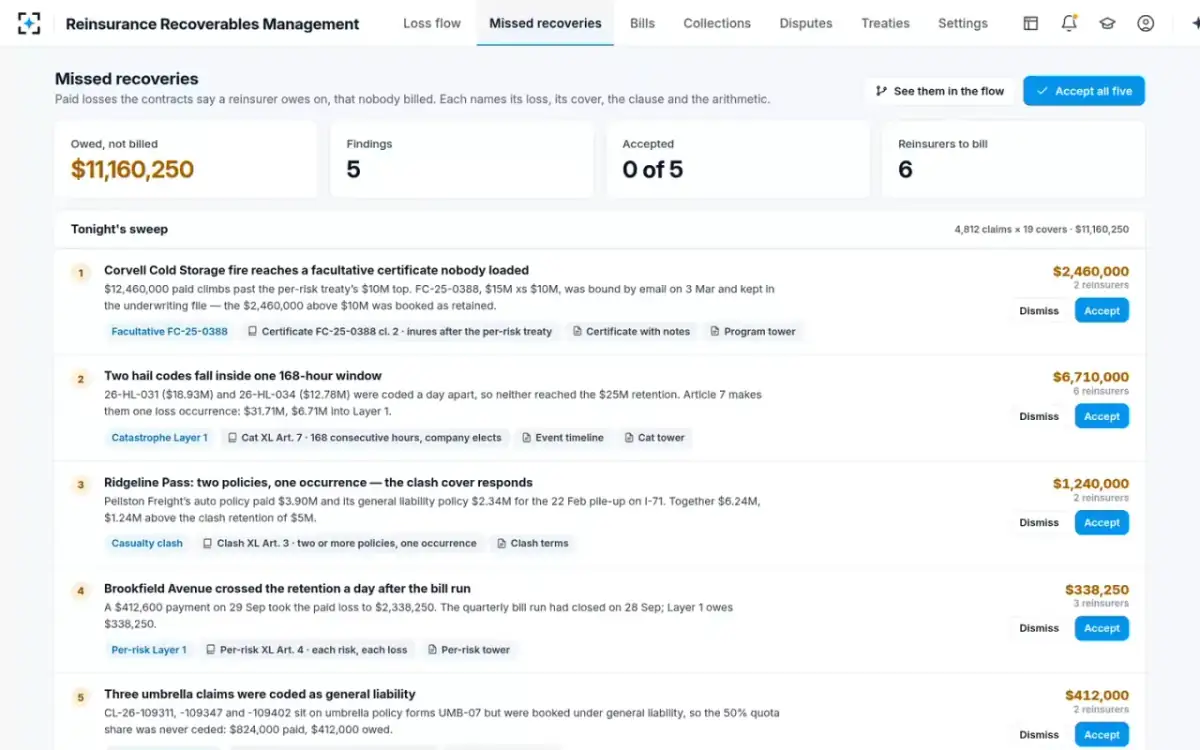
On Ashgrove’s sample quarter, the nightly check ran in 3 minutes 12 seconds and found five recoveries that nobody had billed: $11,160,250 across six reinsurers. One was a facultative certificate bound by email and never loaded; one was a hailstorm the claims system had split into two event codes; one was a pile-up that hit two policies under a clash cover; one was a loss that crossed a retention the day after the bill run; and one was three umbrella claims coded to the wrong line. Each finding names its loss, its cover, the clause and the calculation.
Five findings, each with its clause and arithmetic, waiting for a person
The limits: what agents may draft and what only people may do
The rule behind the matrix above is simple: an agent may prepare anything a person can check, and may not do anything that commits the company to a counterparty, changes a source document or changes the value of an asset. That puts four decisions with people. Loading a certificate found outside the program, because what sits in an underwriting file may be a quote rather than a binder. Electing an hours-clause window, because the election is the insurer’s right and binds the event. Sending a bill. And any offset, commutation or write-off.
The hours-clause election shows why the line sits where it does. In the reinsurance wording at the centre of a 2024 English appeal, the hours clause left it to the reinsured to choose when each period of consecutive hours began and ended, up to the maximum for the peril (Unipolsai v Covéa [2024] EWCA Civ 1110). The agent can show every claim in every possible window and the recovery each one produces. Choosing the window is the company exercising a contractual right, and once chosen it applies to every reinsurer on the layer. Catastrophe aggregation, worked on one storm, follows that choice through the arithmetic.
Can AI send bills to reinsurers? Not without a person’s signature
It can draft them, and in a well-built system it cannot send them. A bill is a demand under a contract, and a reinsurance contract is a private agreement between two companies. New York’s highest court put the point in a late-notice case: "A reinsurance contract operates solely between the reinsurer and the ceding company" (Unigard Security Ins. Co. v North River Ins. Co., 79 N.Y.2d 576 (1992)). A wrong bill is not a typo to be corrected later; it is a position taken with a counterparty the company will deal with again at renewal.
Settlements, as well as the investigation and defense of claims are the sole responsibility of the primary insurer; and settlements made by the primary insurer are, by express terms of the reinsurance certificate, binding on the reinsurer.
New York Court of Appeals, Unigard Security Ins. Co. v North River Ins. Co., 1992
The quotation explains both halves of the design. Because the reinsurer is bound by the insurer’s settlements under the contract’s terms, the insurer carries the responsibility of billing only what the terms support; that is why every line carries its clause. And because a disputed bill changes the books, a careless one has a cost beyond the relationship. Under the annual statement instructions that NAIC Issue Paper No. 75 set out, a recoverable becomes "in dispute" on a reinsurer’s "formal written communication … denying the validity of the coverage" (NAIC Issue Paper No. 75), and disputed amounts are reported and treated apart from the rest.
Who approves a reinsurance recovery?
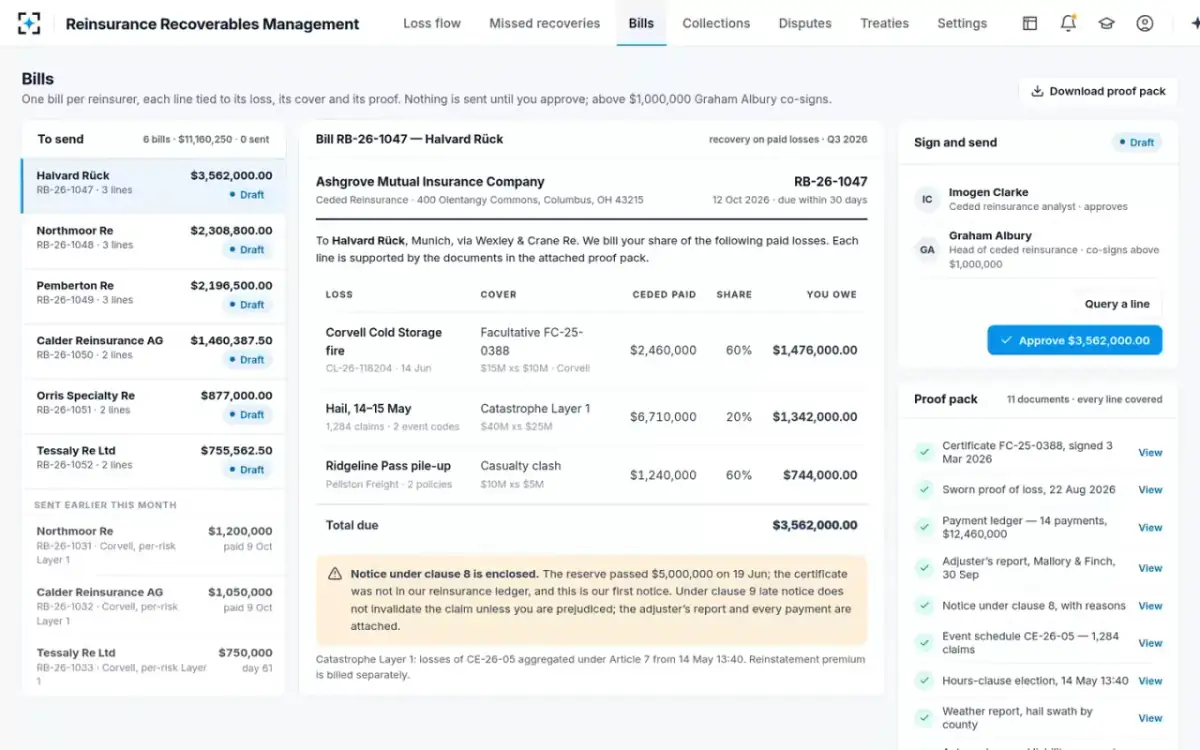
At the ceding insurer, the ceded reinsurance analyst approves each bill, and a second person signs above a threshold the company sets. In the sample program the threshold is $1,000,000, with $500,000 and $2,500,000 as the other settings, and the head of ceded reinsurance co-signs. Four of the six bills from the sample quarter needed his signature: the bills to Halvard Rück ($3,562,000), Northmoor Re ($2,308,800), Pemberton Re ($2,196,500) and Calder Reinsurance ($1,460,387.50). Both signatures are shown on the bill.
At the reinsurer, the approval is the claims department’s, and what it looks for is the same list the bill builder works from: is the loss inside the period and the cover, has the retention been met in the right order, is the share right, is the proof attached. A bill that answers those questions on its face is paid; one that does not is queried, and a query restarts the conversation.
One bill per reinsurer, and the proof behind every line
What is a proof of loss pack, and what goes in one?
A proof of loss pack is the set of documents that lets the reinsurer check each line of a bill without asking. What it holds depends on the cover, because each cover has a different trigger to prove. The table shows the documents the bill builder assembled for each kind of line on the sample quarter.
What each kind of recovery has to prove, and the documents that prove it
| Cover | What the reinsurer must see | Documents in the pack |
|---|---|---|
| Facultative certificate | The certificate was bound before the loss and covers this risk; the loss reached the attachment | Signed certificate, sworn proof of loss, payment history, adjuster’s report, notice |
| Per-risk excess of loss | One risk, one loss, paid above the retention | Payment history, adjuster’s report, calculation in inuring order |
| Catastrophe excess of loss | Every claim belongs to one loss occurrence inside the hours clause | Event schedule of claims, hours-clause election, weather report, calculation |
| Clash cover | Two or more policies hit by one occurrence, above the clash retention | Payments under each policy, the occurrence report, calculation |
| Quota share | The claim belongs to the ceded line | Policy form, claim payments, corrected coding |
Notice belongs in the pack when it was late. The Corvell certificate required notice within 30 days of the reserve passing $5 million, and nobody sent it because the certificate had not reached the ceded team. The notice went with the bill, with its reasons and the adjuster’s report. Reinsurance claim notification requirements follows that loss from the fire to the cash.
How are recoveries chased once billed?
By age, through the broker, with disputes kept apart. In the sample program the collections agent sends reminders at 30, 60 and 90 days through the placing broker, matches each morning’s remittances to bills, and escalates to the credit controller at 90 days. The broker’s own duties are set by statute in many states; the NAIC model act requires a reinsurance broker’s written authorization to oblige it to pass funds due to the insurer on within 30 days of receiving them, and to hold them meanwhile in a fiduciary capacity (NAIC Reinsurance Intermediary Model Act #790), which gives the controller a second clock to watch once the reinsurer has paid.
Disputes: each refused recovery with its clause, the drafted position and the next step
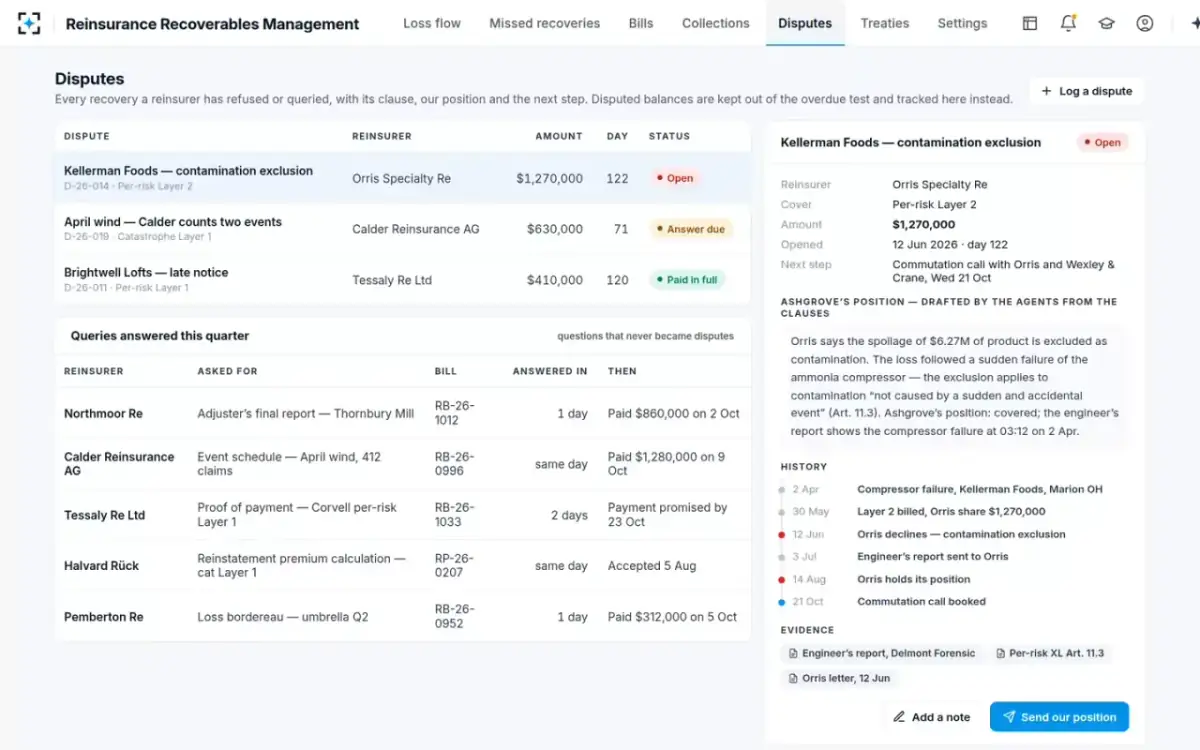
The disputes screen carries the most important limit in the design. The agents draft the insurer’s position from the clause and the evidence, but a person sends it, and only a person agrees a commutation or a write-off. What may be automated in a reinsurance recovery system sets those limits against what supervisors expect of AI governance.
What to ask before buying, and where this solution does not fit
A buyer should test three things: whether the system finds recoveries the team missed, whether every finding can be checked without the vendor in the room, and whether the limits are enforced by the software or by a policy. The checklist turns those into questions to ask in a demonstration.
Questions to put to any reinsurance claims management software
- Does it test every paid loss, or only the ones someone flags?
A system that waits for a large-loss flag reproduces the misses of the manual process. Ask how many losses it read last night.
- Can it see certificates that are not in the reinsurance system?
In the sample quarter the largest single miss was a certificate kept in an underwriting file.
- Does every finding cite the clause and show the arithmetic?
If the only evidence is a score, the analyst cannot defend the bill and the reinsurer will query it.
- Who chooses the hours-clause window, and can a merge happen without a person?
The election is the insurer’s right. The system should propose and wait.
- Can the software send a bill, offset or write off a balance on its own?
Ask to see it fail. A limit that exists only in a procedure manual is not a limit.
- Does it keep disputed balances apart from overdue ones?
The two are treated differently in the annual statement; mixing them hides a slow payer or overstates one.
- Will it run on a closed quarter of your own losses before you sign?
Comparing its bills with what was billed is the business case and the error rate in one number.
The solution fits a ceding insurer with excess of loss and facultative cover, where recoveries are claim by claim and the misses are matching and timing problems. It is a weaker fit where the program is mostly proportional and settled through periodic accounts; there the problem is reconciling statements, which is what Reinsurance Account Reconciliation is for. It is not a reinsurer’s claims system, it does not decide coverage disputes or commutations, and it does not assess a reinsurer’s credit, which belongs to Reinsurance Counterparty Risk Monitoring. The quickest way to see whether it fits is a pilot on last quarter’s paid losses, or start from Reinsurance Recoverables Management.
Questions people ask
What is reinsurance claims handling?
For a ceding insurer, it is reporting losses to reinsurers as each contract requires and collecting what they owe; for a reinsurer, it is reviewing those reports, setting its own reserves and paying. Excess contracts usually require individual case reports, while proportional treaties more often settle through summary accounts. The wording decides what is reported, when and with what proof.
Does AI replace the ceded reinsurance analyst?
No. In the sample program the agents read, match, calculate and draft, and the analyst accepts or dismisses each finding, loads any certificate found outside the program, confirms every catastrophe event and approves every bill. What changes is the starting point: a list of findings with clauses and arithmetic, not a paid-loss extract.
What happens when a reinsurer disputes a bill?
The line moves to a dispute log with the reinsurer’s reason, the insurer’s position drafted from the wording, and the next step. A reinsurer’s formal written denial of coverage is what turns a query into a dispute in the annual statement instructions NAIC Issue Paper No. 75 describes, and disputed amounts are kept out of the overdue figures and reported separately.
What should reinsurance claims software do?
At a minimum, test every paid loss against every cover in force, show the clause and calculation behind each recovery, assemble the proof for each line, age every balance and keep disputes apart. It should also refuse to act where the company has to decide: sending bills, electing hours-clause windows, offsetting and writing off.
How fast can a recovery be billed after a payment?
The solution’s design target is one day from a paid movement to a bill with its proof, against a quarter-end bill run in the manual process. The smallest amount worth a bill is a setting, $25,000 in the sample program; smaller amounts wait for the next paid movement on the same loss.