The reinsurance claims process at a ceding insurer runs from a paid loss to cash: identify every treaty layer and facultative certificate that responds, give notice where the contract requires it, calculate each reinsurer’s share in the right order, bill with proof, and collect. The usual way to audit it is to re-check the bills that went out, which measures the wrong thing: a process that bills accurately but misses a third of what it is owed passes. The useful test is the other way round. Take a closed quarter, plant ten known misses and decoys in a copy of its data, run the process, and count what it finds. Botminds’ Reinsurance Recoverables Management was built to pass that test: six agents check every paid loss against every cover each night and hand people a list of findings with the clause and the arithmetic. On its fictional sample quarter, the check found five recoveries nobody had billed, worth $11,160,250.
The sample quarter belongs to a fictional insurer, Ashgrove Mutual: 4,812 paid claims, $96.40 million paid, in the third quarter of 2026. The ten planted cases below are a test design, not sample findings; where the solution found a real example in the sample quarter, it is named.
Ten cases to plant in a closed quarter: seven misses to find, three decoys to refuse
- 1. A facultative certificate bound by email and never loaded
Put the signed certificate in an underwriting folder, not the reinsurance system, and pay a loss above its attachment. The process should find the cover, and a person should load it before it is billed.
- 2. One storm split across two event codes
Split a catastrophe’s claims into two codes, each below the retention, with every claim inside the hours clause. As one event the layer responds; as two, nothing does.
- 3. A loss that crosses the retention the day after the bill run
Post a payment that takes a large loss over the per-risk retention one day after the cut-off. A quarterly process will find it next quarter, if at all.
- 4. Two policies, one occurrence, under a clash cover
Pay an auto claim and a general liability claim for the same accident, each below the clash retention, together above it.
- 5. A claim coded to the wrong line of business
Book an umbrella claim as general liability so the umbrella quota share never sees it.
- 6. A reserve that passes the notice trigger
Raise a reserve past half of an excess attachment with nothing yet paid. The miss is a notice, not money, and it is the one that later costs money.
- 7. A loss inside a layer already used
Pay a loss into a layer whose limit is partly exhausted and reinstated. The process should bill what remains and flag the reinstatement premium.
- 8. Decoy: a catastrophe claim just outside the hours window
Add a claim from the same storm that falls after the window closes. It belongs to a separate loss occurrence with its own retention, and must not be merged.
- 9. Decoy: a loss before the treaty period
Pay a loss whose date falls before the inception of a losses-occurring treaty. The cover does not respond, however large the loss.
- 10. Decoy: the catastrophe cover billed gross of the per-risk recovery
Leave the per-risk recovery out of a catastrophe calculation. The right process bills the catastrophe layer net of what inures to it, and refuses the gross figure.
What is the reinsurance claims process?
It is the chain that turns a paid loss into a recovery, and it has five links: identify, notify, calculate, bill and collect. Identify means finding every cover in force on the loss date that the loss reaches. Notify means telling each reinsurer when its contract asks, often when a reserve, not a payment, crosses a threshold. Calculate means applying retentions, layers and shares in the order the contracts set. Bill means sending each reinsurer a demand with the proof it needs. Collect means following the balance until it is paid, queried or disputed.
Every link depends on the contract. The NAIC’s explainer of reinsurance makes the reinsurer’s obligation arise only once the insurer’s own liability has been incurred, and leaves its extent to the agreement’s terms (NAIC, Reinsurance). That is why a process audit has to start from the wordings, not from the bills: a bill can only show what someone thought to claim.
Why do reinsurance recoveries get missed?
Recoveries are missed when information needed to see them sits outside the place the process looks. A certificate bound by email is not in the list of covers. A storm coded by county is two events in the claims system and one in the treaty. A loss that crosses a retention after the bill run is invisible until the next run. Two claims under different policies are two files to the claims team and one occurrence to the clash cover. None of these is an arithmetic error, and none is visible from a paid-loss extract unless somebody already suspects it.
Reporting adds its own delay. A CAS text on reinsurance observes that a claim that ends up serious can sit for a long time below the reporting threshold, which is usually half the excess layer's attachment point (Patrik, "Reinsurance", CAS; reinsurance claim notification requirements quotes it). The claims that end up in an excess layer are the ones most likely to have been under-reserved early, so a process keyed to reserve thresholds sees them late. Case 6 in the test exists for that reason.
The same quarter, two processes: a quarter-end extract and a nightly check
Quarter-end extract, by hand: Paid losses above a size the team chooses
Nightly check by agents, decided by people: Every paid and reserve movement, every claim
Quarter-end extract, by hand: The covers in the reinsurance system
Nightly check by agents, decided by people: Every treaty layer and certificate, including certificates found in underwriting files and broker email
Quarter-end extract, by hand: As the claims system coded them
Nightly check by agents, decided by people: Regrouped under each treaty’s hours clause; merges proposed, never made
Quarter-end extract, by hand: Next quarter
Nightly check by agents, decided by people: The next night
Quarter-end extract, by hand: Taken from the claim
Nightly check by agents, decided by people: Checked against the policy form
Quarter-end extract, by hand: Bills for the recoveries someone looked for
Nightly check by agents, decided by people: Findings with clause and arithmetic, accepted or dismissed by the analyst
How do you audit reinsurance recoveries? Score what was found, not what was billed
Audit the process by its recall: of the recoveries that were owed, how many did it find, how fast, and how many things did it bill that were not owed. A bill-accuracy audit measures only the last of those. Planting cases gives a known answer key, so the test can be run on any process, human or software, and repeated each year on a new quarter.
The score sheet: five measures, and what each tells you
| Measure | How to compute it | What it tells you |
|---|---|---|
| Misses found | Planted misses found ÷ 7 | Recall: whether the process sees what nobody pointed it at |
| Decoys refused | Decoys not billed ÷ 3 | Precision: whether it bills only what the contracts support |
| Dollars found | Value of misses found ÷ value of all seven | Whether the large misses are found or only the easy ones |
| Days to bill | From the planted payment to a bill ready for approval | How long money sits on the insurer’s net line |
| Evidence | Findings a second person can verify from the clause and the arithmetic alone | Whether a bill will survive the reinsurer’s query |
Run it in a copy of the data, with the answer key held by someone outside the team. The temptation in any planted test is for the people being tested to know what was planted, which turns a measure of the process into a measure of the team’s memory. A good test also includes one or two cases that the planter believes are owed but that a careful reading of the wording says are not; arguing them out is how a team discovers which clauses it reads differently.
How are reinsurance recoveries identified? Cover by cover, in inuring order
Each paid loss is tested against every cover in force on the loss date, in the order the contracts set. For a property program the CAS study note describes the usual order: the catastrophe cover sits on the insurer’s retention after surplus share, per-risk excess treaties and facultative certificates have responded, so those covers inure to it (Clark, Basics of Reinsurance Pricing, CAS). So a large fire is tested first against any facultative certificate, then the per-risk layers, and only what the insurer still retains goes into the catastrophe calculation. Getting the order wrong does not lose money; it bills money that is not owed, which is decoy 10.
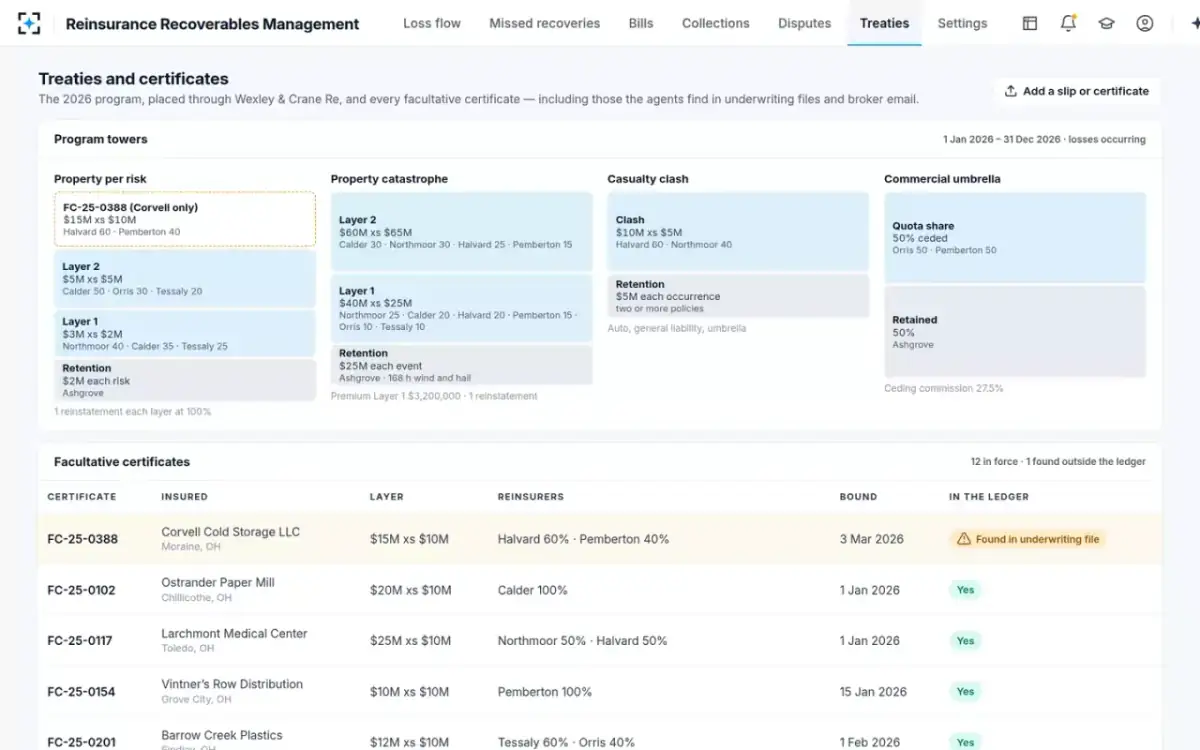
On the sample program the order mattered on the Corvell Cold Storage fire. The loss had $12,460,000 paid. The per-risk program covered $2 million to $10 million in two layers. Above $10 million, a certificate of $15 million excess of $10 million responded, and the treaty inures to the certificate, so $2,460,000 was owed: $1,476,000 by Halvard Rück and $984,000 by Pemberton Re. The certificate had been bound by email on 3 March and filed with underwriting, which is case 1 in the test.
The program as the agents see it, including the certificate found outside it
What is a facultative certificate, and why does one go missing?
A facultative certificate reinsures one named risk, placed separately from the treaties. New York’s highest court gave the distinction in a footnote: "a facultative reinsurance contract is one issued to cover a particular risk", as against treaty reinsurance, "which is obtained in advance of actual coverage and may cover any risk the primary insurer covers" (Unigard v North River, N.Y. Court of Appeals, 1992).
Certificates go missing because they are placed by underwriters, often late in a renewal, and the paperwork follows the underwriting file rather than the reinsurance team. A treaty is negotiated once a year by the ceded team itself; a certificate can be bound in an afternoon by an underwriter and a broker. A test that does not plant a certificate outside the reinsurance system has left out the most valuable miss on the sample quarter.
How are cat claims aggregated in a test?
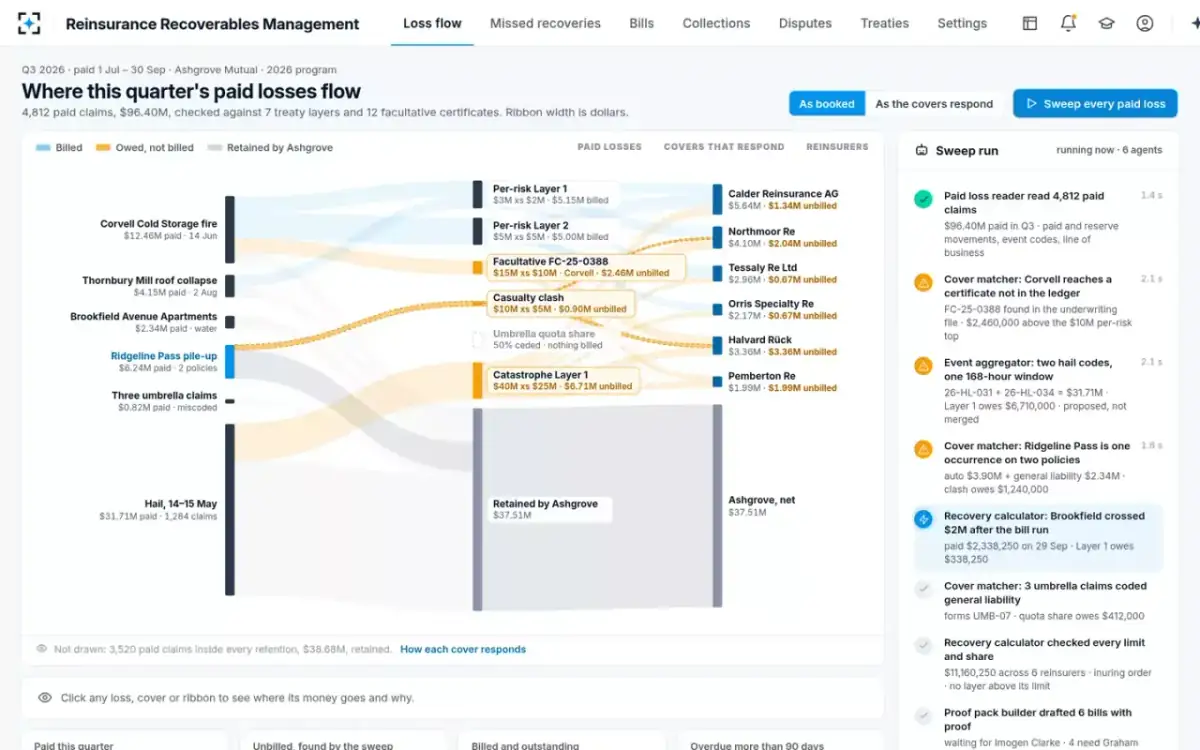
By loss time, under each treaty’s hours clause, regardless of how the claims system coded them. In the sample quarter a hailstorm produced two event codes when the storm crossed a county line: $18,930,000 over 782 claims and $12,780,000 over 502. Each sat under the $25 million retention. The first claims came at 13:40 on 14 May and the last on 18 May, 98 hours apart, inside one 168-hour window, so as one event the storm totalled $31,710,000 and the first catastrophe layer owed $6,710,000.
The decoy matters as much as the miss. In the 2024 English appeal on a catastrophe excess of loss, the arbitration tribunal’s findings, recorded by the Court of Appeal, held that individual losses outside the selected period of hours belong to a separate loss occurrence with its own deductible (Unipolsai v Covéa [2024] EWCA Civ 1110). A process that merges everything from one storm will overbill; one that follows the codes will underbill. Catastrophe aggregation, step by step, covers the window, the election and the arithmetic.
What the nightly check found on the sample quarter, by size
Reading the result: which misses matter most
Two of the five sample findings carried 82% of the money: the split storm and the missing certificate. Both are structural: they come from how the claims system codes events and how underwriting files certificates, and both will recur every quarter until the process looks outside its own system. The three smaller findings are timing and coding problems, which a faster cadence catches. A test result should be read the same way: a process that finds the small misses and not the large ones has the cadence right and the scope wrong.
The nightly check, step by step
Decoys deserve the same attention. A process that bills a decoy has a precision problem, and in reinsurance precision is not cosmetic: a bill the contract does not support invites a query on every other line of the same bill. That is why each finding in the solution carries the clause and the calculation, and why the analyst accepts or dismisses each one before anything is billed. The score sheet’s fifth measure, evidence, checks exactly that. For the people who own each step of the chain, the recoveries desk seat by seat shows where each of these misses usually falls. To run the test on your own closed quarter, start from Reinsurance Recoverables Management.
Questions people ask
What is the reinsurance claims process flow?
Paid loss, cover identification, notice where due, calculation in inuring order, bill with proof, collection. On an excess of loss program the flow runs claim by claim; on a proportional treaty it more often runs through a periodic account. The flow is the same whoever does it; what differs is how many losses are tested and how often.
How often should recoveries be checked?
Often enough that a loss crossing a retention is billed within days, not at the next quarter end. The solution checks every paid loss nightly, with a design target of one day from a paid movement to a bill with its proof; the cadence is a setting, from each paid movement to weekly.
Who should run a seeded test of recoveries?
Someone outside the team being tested: internal audit, or a head of ceded reinsurance working with a colleague from finance. The planter keeps the answer key and decides, case by case, whether each finding is right. The team being tested should not know which cases were planted.
What is inuring reinsurance in a recovery?
A cover that inures to another is applied first, so the second cover responds only to what remains. In a typical property program, facultative certificates and per-risk treaties inure to the catastrophe cover, which then applies to the insurer’s retained loss net of them. Billing the catastrophe layer gross of those recoveries overstates what it owes.
Can a test like this find recoveries from earlier years?
Yes, if the quarter tested includes payments on older losses. On a losses-occurring treaty the program in force on the loss date responds, not the one in force when the payment was made; a risks-attaching treaty follows the policy’s inception instead. A test on a closed quarter should therefore load the programs of every year whose losses were still being paid.