Catastrophe aggregation is the grouping of individual paid claims into one loss occurrence under a catastrophe excess of loss treaty, so that their total can be measured against the treaty’s retention and limit. It decides whether a layer pays at all: a storm whose claims are counted as two events can leave each half under the retention, while the same claims counted as one can reach deep into the layer. The rules are in each treaty’s wording: a definition of loss occurrence, an hours clause that caps how long one occurrence can last, and usually a right for the insurer to choose when the window starts. Claims systems group claims by event code, which is a claims-handling convenience, not the treaty’s test. Botminds’ Reinsurance Recoverables Management regroups every catastrophe claim by peril and loss time under each treaty’s hours clause, proposes the window and any merge across event codes, and leaves the choice to the ceded analyst.
The worked example is a hailstorm in the solution’s sample program: a fictional insurer, Ashgrove Mutual, in May 2026. The law comes from the Court of Appeal of England and Wales and the NAIC, linked where quoted.
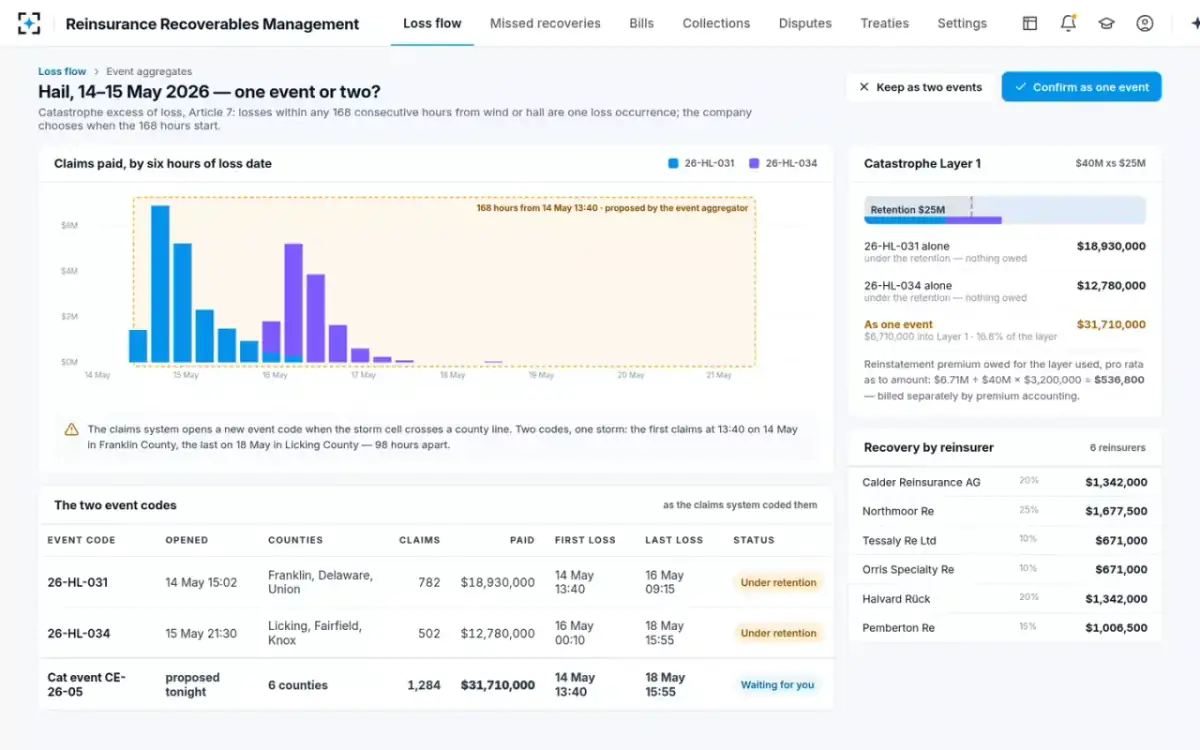
One storm, two event codes, one 168-hour window: every claim fits inside the hours elected
- Claims, 14 May 13:40 to 16 May 09:1543.6 h
- Rest of the window
- Before its first claim
- Claims, 16 May 00:10 to 18 May 15:5563.8 h
- Rest of the window
- First to last claim98 h
- Unused hours70 h
What is catastrophe aggregation?
It is the step that turns many policyholder claims into one reinsurance loss. A catastrophe treaty pays "each and every loss occurrence" above a retention, so the insurer must decide which claims belong to which occurrence before it can bill anything. Aggregation answers three questions in order: did the claims arise from one catastrophe, did each individual loss occur inside the hours the clause allows, and where does the insurer place the window? Only then is the total compared with the retention, and only then are the layers, shares and reinstatement premium worked out.
It is a billing decision, not a coding one. A claims system codes events to organise adjusters and reporting, and its codes may split one storm by county, by date or by line of business. The treaty does not care how claims were coded; it cares when each individual loss occurred and what caused it. A ceded team that bills by event code accepts the claims system’s choice as the treaty’s answer.
What is a loss occurrence, in a catastrophe treaty’s own words?
Wordings vary, but the one at the centre of the leading recent English case is typical. Its Condition 2 defined a loss occurrence as every individual loss arising out of, and directly occasioned by, one catastrophe; limited how long and how far one occurrence could run by an hours clause; and shut out any individual loss occurring outside those periods. The arbitration tribunal’s findings, recorded by the Court of Appeal, add the working rule: "'Individual losses' must be allocated to any Loss Occurrence according to when any such individual losses occur" (Unipolsai Assicurazioni v Covéa Insurance [2024] EWCA Civ 1110).
The definition has two tests, and both must be met. The losses must arise from one catastrophe, which is a question of cause. And each must occur inside the period, which is a question of time. The case shows how far the first test can stretch: the Court of Appeal upheld an arbitration award treating the Covid-19 outbreak in the United Kingdom as a catastrophe under a property catastrophe reinsurance, and dismissed the reinsurer’s appeal.
What is an hours clause, and how long are the windows?
An hours clause caps the length of one loss occurrence by peril: losses inside the window can be aggregated; losses outside it form a separate occurrence with its own retention. In the Covéa reinsurance, the arbitration tribunal found the clause’s purpose was to confine aggregation to individual losses "which occur within a specified period applicable to the peril in question", and that those outside "form part of a separate Loss Occurrence subject to a separate deductible" ([2024] EWCA Civ 1110).
Hours by peril in two catastrophe wordings
| Peril | Covéa reinsurance, as the tribunal recorded it | Sample program in the solution |
|---|---|---|
| Earthquake | 72 hours | Per treaty |
| Riot and civil commotion | 72 hours | 72 hours |
| Hurricane | 120 hours | Per treaty |
| Wind and hail | Not listed separately | 168 hours |
| Flood | 504 hours | Per treaty |
| Other unspecified perils | 168 hours | Per treaty |
Windows differ by treaty as well as by peril, and an insurer with several catastrophe layers bought from different markets may have different hours for the same storm on different layers. That is one reason the aggregation has to be worked per treaty, not once per event.
Who chooses the start of the hours window?
Usually the insurer. The Covéa wording let the reinsured choose the date and time at which each period of consecutive hours begins and ends, within the maximum the clause sets for the peril ([2024] EWCA Civ 1110). The choice is a right, and it has consequences: a window placed to capture the peak of one storm may leave its tail as a second occurrence with its own retention, and some wordings let the insurer divide a long event into several windows.
Because the election binds the bill to every reinsurer on the layer, the solution never makes it. The event aggregator shows every claim by loss time against every possible window, computes the recovery each one produces and proposes the best-supported, and the analyst confirms or keeps the codes apart. The election and its time travel with the bill as part of its proof.
The aggregator’s proposal: two codes, one window, waiting for a person
Can one storm be two events?
Yes, in two ways. It can be two loss occurrences if its losses outlast the hours clause, so that losses beyond the window form a second occurrence. And it can be argued to be two catastrophes if it is not one coherent happening. The High Court judge in the Covéa appeal, whose analysis the Court of Appeal upheld, set out what a catastrophe must be in that context, including that it must "fairly be regarded as a coherent, particular and readily identifiable happening, with an existence, identity and "catastrophic character" which arise from more than the mere fact that it causes substantial losses" ([2024] EWCA Civ 1110).
The sample program has a live example. Its disputes list carries an April windstorm that one reinsurer, Calder, counts as two events, with $630,000 turning on the answer. The opposite case is the May hail on this page: the claims system made it two, and the treaty’s test makes it one. In both, the evidence is the same kind: when each individual loss occurred, where, and from what weather.
When does an individual loss occur? The Court of Appeal’s answer
When it first occurs, not as its cost develops. The question in Covéa was whether business interruption losses that ran for months could be aggregated if they began inside the 168-hour window, or only the part suffered inside it. The court held that an individual loss occurs when it first occurs, and that it counts once, at the point the peril strikes or affects the insured premises, however long the financial loss runs on.
It encompasses the entirety of the loss sustained by the original insured as a result of the relevant catastrophe striking or affecting the premises, irrespective of whether the relevant "individual loss" comprises physical damage losses, BI losses or both.
Court of Appeal of England and Wales, Unipolsai Assicurazioni SpA v Covéa Insurance plc [2024] EWCA Civ 1110
For a property catastrophe recovery the practical rule is the one the case records as common ground for physical damage: where a peril damages a property that then suffers business interruption while it is repaired, the whole loss is treated "as having occurred on the day of the property damage". For a ceded team that means the loss time to aggregate on is the time of damage in the claim file, not the date of payment or of the last invoice. The solution reads loss date and time from each claim and groups on those.
Aggregation is a billing decision: the arithmetic of one window
The money turns on the retention. Each of the sample storm’s two codes sat under the $25 million retention of the first catastrophe layer, so as coded the layer owed nothing. As one occurrence the storm reached $31,710,000, and the layer, $40 million excess of $25 million, owed $6,710,000.
As coded, the layer owes nothing; as one loss occurrence, it owes $6.71 million
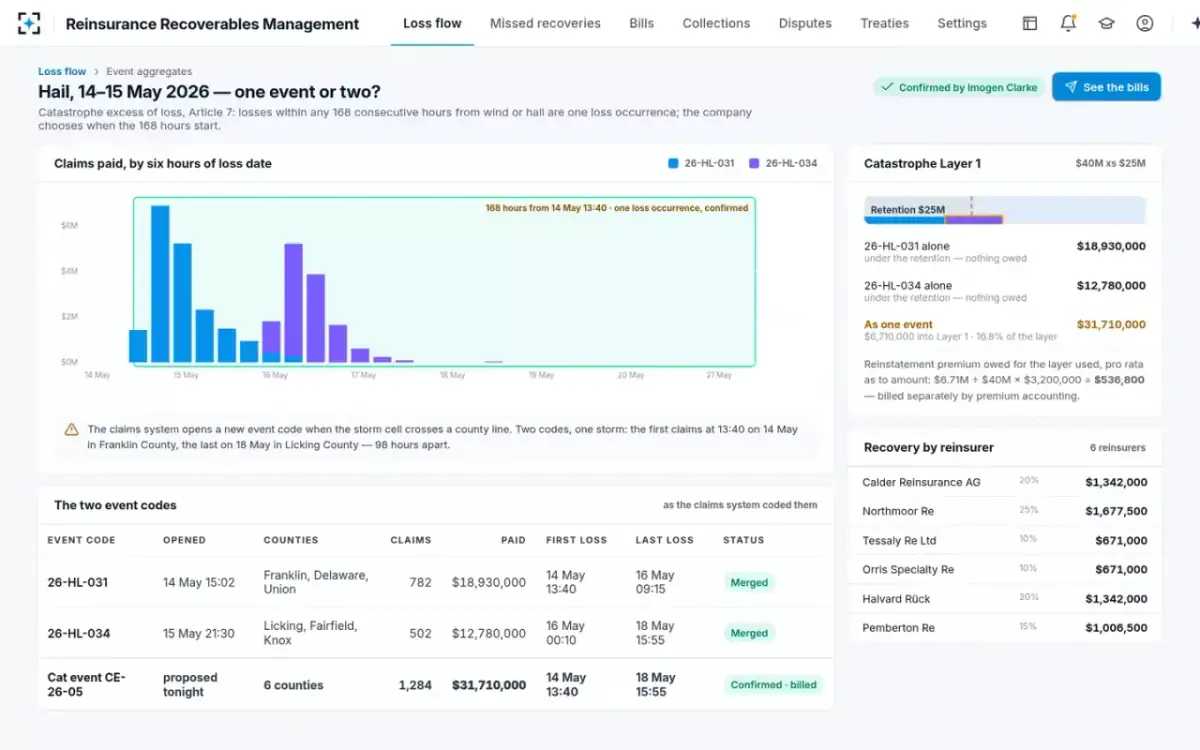
Aggregation also uses up cover. A catastrophe layer usually has a limited number of reinstatements, so a CAS study note’s rule of thumb applies: the layer’s total capacity for the year is its occurrence limit times one plus the number of reinstatements (Clark, Basics of Reinsurance Pricing, CAS). Using $6.71 million of a $40 million layer triggered a reinstatement premium in the sample program: $6.71 million ÷ $40 million × the layer’s $3,200,000 premium, or $536,800, pro rata as to amount, billed separately by premium accounting.
Confirmed by the analyst: both codes merged, the recovery split by reinsurer
What a reinsurer will ask to see before it pays an aggregated loss
Expect four questions: what was the catastrophe, when did each individual loss occur, where did the insurer place the window, and is each claim one the treaty covers. The proof that answers them is an event schedule listing every claim with its loss time, place and amount; the written hours-clause election; weather or hazard data that ties the losses to one happening; and the calculation, net of anything that inures to the catastrophe cover. In the sample program the bill to each reinsurer carried all four, and the event schedule listed all 1,284 claims.
Timing matters to collateral as well as to cash. Under the NAIC’s model regulation, a certified reinsurer need not post security for catastrophe recoverables for a year from the insurer’s first reserve entry for a catastrophe the commissioner recognises, on property lines including fire, allied lines, homeowners, commercial multiple peril, inland marine, earthquake and auto physical damage, for as long as the reinsurer keeps paying claims on time (NAIC Model Regulation 786). A catastrophe recovery billed late eats into that year. For how an aggregation error fits among the other ways recoveries are missed, see the planted-miss test; for who confirms the merge, the jobs and limits of agents. To see your own events regrouped under your own hours clauses, start from Reinsurance Recoverables Management.
Questions people ask
What is event aggregation in reinsurance?
The same thing as catastrophe aggregation: grouping individual losses into one event or loss occurrence under the contract’s definition, so the total can be measured against a per-event retention and limit. Casualty clash covers aggregate in a similar way, combining losses under several policies from one occurrence.
How are cat claims grouped for reinsurance?
By cause and by time: each claim must arise from the one catastrophe and must first occur inside the hours the clause allows for that peril, in a window the insurer usually chooses. Event codes from the claims system are a starting point, not the answer; claims are regrouped by loss time under each treaty’s own hours.
Is the hours clause measured in consecutive hours?
Usually yes. The Covéa wording set a maximum period of consecutive hours for each peril and let the reinsured place its start and end. Read each treaty, because hours, perils and election rules differ between wordings and layers.
Can the insurer use two windows for one long storm?
Where the wording allows, an insurer can treat a long event as more than one loss occurrence, each with its own window and retention, which can help or hurt depending on the layer structure. It is an election the insurer makes and has to evidence, which is why the solution proposes windows and a person chooses.
Who decides if a pandemic or a winter is a catastrophe?
The contract’s words as a tribunal or court reads them. In Covéa the Court of Appeal upheld an award that the Covid-19 outbreak in the UK was a catastrophe, while the judge below described a catastrophe as needing to be a coherent, particular and readily identifiable happening; the answer is likely to depend heavily on the commercial and contractual context.