Follow the fortunes and follow the settlements are two names for the same family of reinsurance clause: a promise by the reinsurer to accept the cedant's good-faith handling of the business and its claims, rather than relitigate each one. In loose usage, "follow the fortunes" speaks of sharing the cedant's underwriting fate and "follow the settlements" of accepting its claim settlements. In law the distinction matters less than the words: New York's highest court, faced with such a clause, said it was "often referred to as a 'follow the fortunes' or 'follow the settlements' clause" and chose the latter name (USF&G v American Re, 2013). What the clause binds the reinsurer to depends on what it says, and those words can change at any renewal. Botminds' Treaty Wording Comparison is an agentic solution that compares each treaty draft with the slip, last year's wording and the market clause, and routes any change to a follow clause to reinsurance counsel.
The clause New York's Court of Appeals read in 2013 is a good model of the type. Each part of it does a different job, and the court read meaning into each one. The table sets the words beside what the court took from them.
A follow the settlements clause, phrase by phrase, as New York's highest court read it
| The clause says | What the court took from it |
|---|---|
| “All claims in which this reinsurance is involved, when allowed by the Company, shall be binding upon the Reinsurers” | The words “when allowed” imply discretion in the cedant to decide which claims are allowed, and to what extent. |
| “which shall be bound to pay or allow, as the case may be, their proportion of such loss” | The reinsurers pay their share of what the cedant allows, within the contract’s terms. |
| “the Company will afford the Reinsurers an opportunity to be associated with the Company … in the defense” | A protection for reinsurers: they can take part in defending claims. |
| “the Company and the Reinsurers shall cooperate in every respect in the defense or control” | A second protection: a duty to cooperate on both sides. |
| “the Company shall have the right to defend, settle, or compromise any such claim … and such action … shall be binding upon the Reinsurers” | The cedant controls settlement, and its action binds the reinsurers. |
What is the difference between follow the fortunes and follow the settlements?
In practice, very little that a court will rely on. The 2013 decision used one name for a clause "often referred to" by both, and its analysis turned entirely on the clause's words. Where the phrases are distinguished, "fortunes" is the wider idea, that the reinsurer shares the cedant's underwriting results, and "settlements" the narrower, that the reinsurer accepts the cedant's decisions to pay claims. Neither phrase, on its own, tells you how far either goes.
That is why a comparison has to start from the wording, not the doctrine. Two treaties can both say "follow the settlements" and differ on whether ex gratia payments are included, whether settlements must be within the original policies' terms, how expenses are shared and whether they count towards the limit. Each of those is a phrase that can be added or deleted in a redraft, and each moves money in a large claim.
What does follow the fortunes mean?
Follow the fortunes describes a reinsurer tying its result to the cedant's: if the cedant's business does badly, so does the reinsurer's share. The Casualty Actuarial Society's pricing study note treats it as the theory behind proportional reinsurance and warns that it does not hold in practice: the reinsurer's results can differ from the cedant's, and reinsuring a profitable insurer does not guarantee the reinsurer a profit, which is why adjustable features such as sliding scale commissions are built into treaties (Clark, CAS).
In a wording, the idea usually appears as an obligation to follow the cedant's claim decisions within the contract's terms. The CAS textbook chapter adds the reason every follow clause has to be read individually: "A reinsurance contract is often a manuscript contract setting forth the unique agreement between the two parties" (Patrik, CAS). There is no single follow clause to compare against.
Does a reinsurer have to follow a settlement?
Under a follow the settlements clause, usually yes, on the decision to settle and the amount. The Court of Appeals called it "well established" that such a clause "ordinarily bars challenge by a reinsurer to the decision" of the cedant "to settle a case for a particular amount", and explained why that is usually fair: in deciding "whether and for how much to settle, the interests of cedent and reinsurer will normally be aligned; both will want the cheapest settlement possible" (USF&G v American Re, 2013).
The deference goes further than many readers expect. The court joined "almost all courts to consider the question" in holding that the clause also requires deference to the cedant's allocation of a settlement between claims, policies and years, because reviewing each allocation from scratch "would invite long litigation over complex issues that courts may not be well equipped to resolve". The protection the reinsurer gets is in the clause itself: association in the defence and a duty to cooperate.
The allocation problem: when the cedant's interest and the reinsurer's part
Allocation is where follow the settlements is tested hardest, because there the two parties' interests diverge. The court gave the arithmetic from the treaty before it: the cedant bore the first $100,000 of every loss and the reinsurers the second. "If the settlement were allocated entirely to losses amounting to $100,000 or less, the whole cost would be borne by USF&G and the reinsurers would pay nothing; but if it were allocated entirely to losses of $200,000 each, the reinsurers would bear half the cost."
One asbestos settlement, two ways of allocating it, and what the court allowed
The cedant's allocation: $975 million to resolve asbestos claims, plus $12.3 million in fees; about $391 million billed to reinsurers, of which about $262 million was still in dispute.
What the Court of Appeals said: A cedant may choose, among reasonable allocations, the one most favourable to itself; it is not the reinsurers’ fiduciary.
The cedant's allocation: Allocated nothing, although bad faith exposure was not covered by the reinsurance.
What the Court of Appeals said: An issue for trial: it was impossible to say as a matter of law that arm’s-length parties would have given those claims no value.
The cedant's allocation: Valued at $200,000 each, the policy maximum.
What the Court of Appeals said: An issue for trial: the claimants’ own expert had put each at $91,174.
The cedant's allocation: All losses placed in the 1959 policy year.
What the Court of Appeals said: Upheld: the court saw no evidence that it was unreasonable on the coverage rules parties could expect in 2002.
The standard the court set is objective. "In sum, under a follow the settlements clause like the one we have here, a cedent's allocation of a settlement for reinsurance purposes will be binding on a reinsurer if, but only if, it is a reasonable allocation", and agreeing the same allocation with the claimants "does not by itself establish reasonableness". Note the words "like the one we have here". The court was reading a clause, not announcing a doctrine for all clauses.
What limits follow the settlements?
Three things limit it: the contract's other terms, reasonableness, and the scope of the reinsured loss. On the first, the court restated its earlier holding that a follow the settlements clause "does not alter the terms or override the language of reinsurance policies", and recalled rejecting a cedant's attempt to allocate to treaties "losses that the treaties simply did not cover" (USF&G v American Re, 2013). The clause binds the reinsurer to the cedant's handling of covered loss; it does not create cover.
On the third, the 2013 treaty covered "loss in connection with each policy", which the court read to mean losses for which the cedant was liable under its policies, "not losses for which it became liable by failing in bad faith to observe the policies' terms". That is the territory of the extra-contractual obligations and excess-of-policy-limits clauses, ECO and XPL, which many casualty and property treaties address expressly; the CAS pricing note describes clash covers penetrated "when extra-contractual obligations (ECO) or rulings awarding damages in excess of policy limits (XPL) are determined in a settlement" (Clark, CAS). A change to the ECO percentage changes what follows.
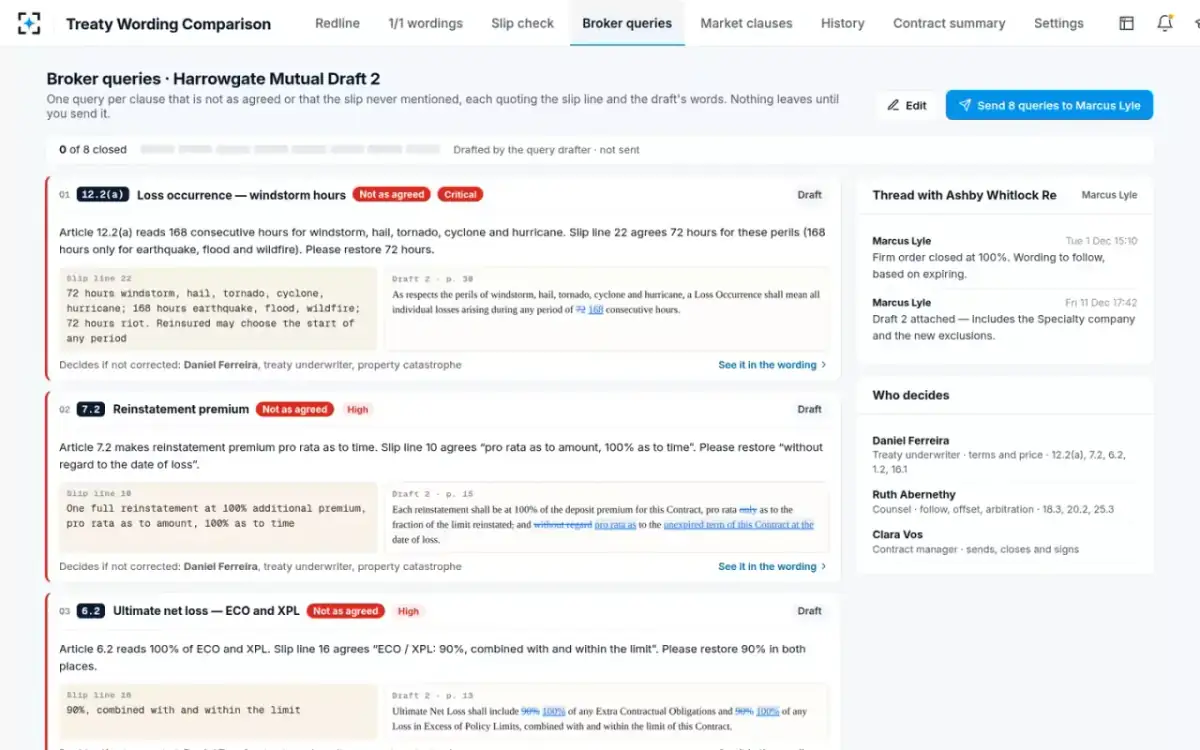
ECO and XPL at 100%, where the slip agreed 90%, queried with the slip line
What did Global Reinsurance v Century Indemnity decide?
It decided that New York has no rule or presumption that a reinsurance limit caps expenses as well as losses. The question came from the federal Second Circuit, which asked whether an earlier decision, Excess v Factory Mutual (2004), had created one. That earlier case involved a facultative certificate whose conditions said "Reinsurers agree to follow the settlements of the Reassured in all respects and to bear their proportion of any expenses incurred", under a "LIMIT" of $7 million. The insurer had spent about $35 million in loss adjustment expenses and sought $12 million; the court held the $7 million cap included expenses (Global Reinsurance v Century Indemnity, 2017, describing Excess).
In 2017 the Court of Appeals answered the certified question in the negative: Excess had read one certificate's words "in light of the entire agreement as an integrated whole", not set a rule. In the certificate before the court, the reinsurer had accepted $250,000 part of $500,000 excess of a $500,000 retention, and had been billed $327,149, of which $82,627 was loss and $244,522 expense. Whether expenses sat inside the $250,000 depended on that certificate's language. The court noted that it treated the question as one about facultative certificates, not treaties, which have no single underlying policy.
One $250,000 facultative certificate, billed $327,149
We did not read the limit clause in isolation, but in light of the entire agreement as an integrated whole.
Court of Appeals of New York, Global Reinsurance Corp. of America v Century Indemnity Co. (2017)
Does follow the settlements cover ex gratia payments?
Only if the wording says so, and that is exactly the kind of phrase redrafting adds. An ex gratia payment is one the cedant makes without accepting that the policy requires it. A clause that binds reinsurers to settlements "within the terms and conditions of the original policies" excludes them; a clause that binds them to "all loss settlements ... including ex gratia settlements" includes them. The difference is a few words.
In the fictional sample programme the solution runs on, the broker's Draft 2 did both at once: it added "including ex gratia settlements" to Article 18.3 and struck the condition that settlements be within the terms of the original policies. The slip said nothing about it. The three-way comparer marked it slip silent; counsel saw it beside last year's words and the redline; the query drafter asked the broker for the intent. The cedant asked to keep the extension, and counsel accepted it with a cap of 2% of each loss occurrence, with the reason kept on the file. Slip silent changes explains why this category is the easiest to sign by accident.
Article 18.3 redlined: ex gratia added, the original-policy condition struck

How to read a follow clause at renewal
Read it against last year's signed words, not against a memory of what follow clauses usually say, and give it to counsel with the redline. In the sample settings, follow, offset, law and arbitration clauses are rated medium and decided by counsel, and any change to them reaches counsel with the clause's drift over four wordings.
Seven checks on a follow the settlements clause
- What it follows
Settlements, decisions, fortunes, or “all claims … when allowed”: each wording sets its own reach.
- The original-policy condition
Whether settlements must be within the terms of the original policies, and of this contract.
- Ex gratia payments
Included, excluded or capped. A cap is a number; check it against the slip.
- Expenses and the limit
Whether loss adjustment and defence costs sit inside or outside the limit, in words, not by presumption.
- Association and cooperation
The reinsurer’s rights to take part in the defence: the court treated them as its protection.
- ECO and XPL
Which extra-contractual and excess-of-limits awards count as loss, and at what percentage.
- Offset and arbitration beside it
Changes to these usually travel with follow-clause changes. Read them together.
How the agents compare each clause, and what each is never allowed to do, is on the Treaty Wording Comparison page. Who signs off each clause covers counsel's place in the review.
Questions people ask
Can a reinsurer challenge a cedant's allocation of a settlement?
Yes, on reasonableness. Under New York law as stated in 2013, a follow the settlements clause requires deference to the cedant's allocation, but the allocation binds only if parties to the underlying settlement could reasonably have reached it at arm's length without the reinsurance. Matching the allocation agreed with claimants does not prove that by itself.
Does follow the settlements apply to defence costs?
It depends on the clause. In Excess (2004) a certificate's $7 million limit was read to include expenses; in 2017 the same court held there is no general rule or presumption either way, so the words of the limit and the follow clause, read together, decide.
Does follow the settlements cover bad faith awards against the cedant?
Not by itself. New York's highest court read "loss in connection with each policy" to exclude liability the cedant incurred by failing in bad faith to honour its policies. Treaties that cover such awards usually say so in an ECO clause, often at a stated percentage, which is why a change from 90% to 100% is a material finding.
Who should approve a change to a follow clause?
Reinsurance counsel, because the clause decides disputes, not price. In the sample settings, follow, offset, law and arbitration go to counsel; departures on terms or price go to the treaty underwriter; and the contract manager sends the queries and signs once nothing contradicts the slip.
Is a follow clause the same in a facultative certificate and a treaty?
The words can be similar, but the context differs. The 2017 decision was expressly about facultative certificates, which reinsure a single underlying policy; a treaty covers a whole book, so questions such as allocation between policies and years arise in a different form.