The 9 month rule in reinsurance is a U.S. statutory accounting presumption: if a reinsurance contract has not been finalized, reduced to a written form and signed by the parties within nine months after the start of the period it covers, it is presumed to be retroactive and must be accounted for as retroactive reinsurance. A multi-reinsurer treaty escapes the presumption if the lead reinsurer signs within the nine months. The rule turns a slow wording into an accounting problem on a fixed date, and wordings are slow because each broker draft has to be read against the slip, last year's contract and the market clause before anyone will sign. Botminds' Treaty Wording Comparison is an agentic solution for that reading: agents compare each draft three ways when it arrives and draft cited queries, so the time from slip to signature is spent deciding, not searching.
The rule's text comes from the NAIC's statutory accounting codification. The current statement, SSAP No. 62R,Property and Casualty Reinsurance, sits in the NAIC's Accounting Practices and Procedures Manual, which is sold rather than posted. The quotations on this page are from its public antecedent, NAIC Issue Paper No. 75, finalized in 1998, which carries the warning that it "may not be directly related to the current authoritative statement" (NAIC Issue Paper No. 75). Read the manual for the paragraph your auditors will cite; the calendar below is the same either way.
A 1 January treaty: signed before inception, or nine months on the clock
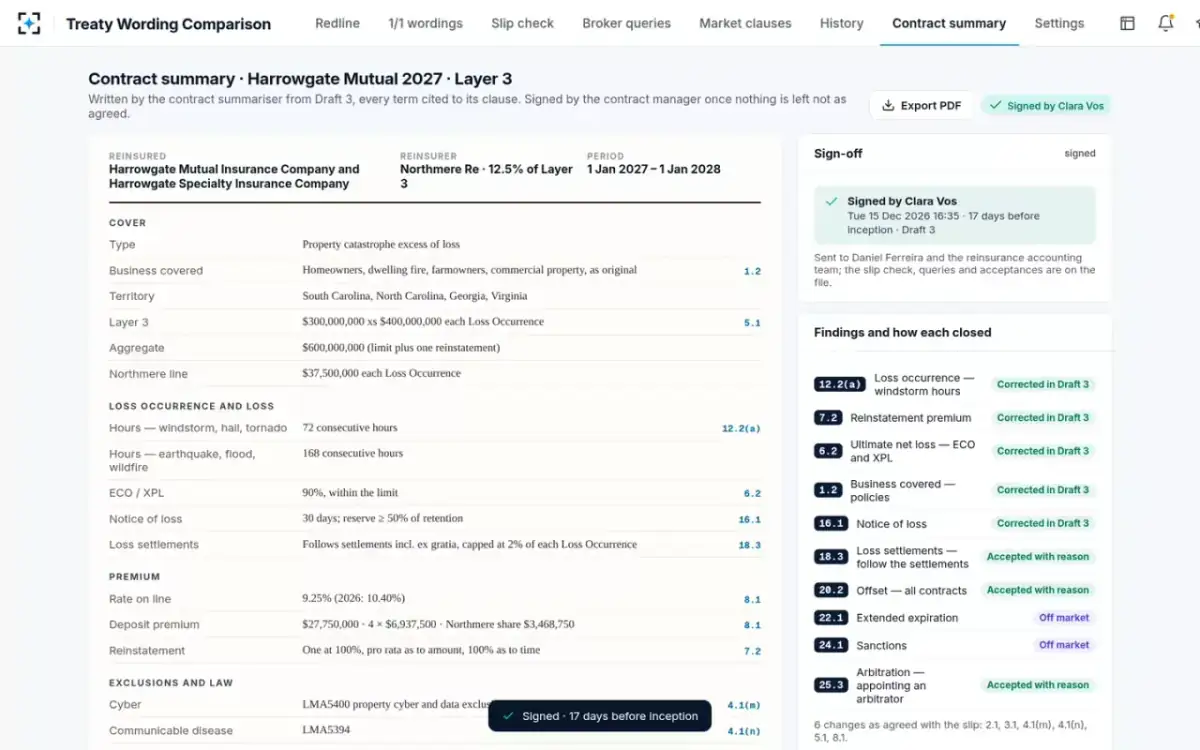
- Prospective from the first day: nothing left to finalizesigned 17 days before inception
- First quarterto 31 Mar
- Second quarterto 30 Jun
- Third quarterto 1 Oct
What is the nine month rule in reinsurance?
It is the presumption, in the statutory accounting text later carried into SSAP No. 62R, that a reinsurance contract not signed within nine months of inception is retroactive. The text reads: "if a contract entered into, renewed or amended on or after January 1, 1994 has not been finalized, reduced to a written form and signed by the parties within nine months after the commencement of the policy period covered by the reinsurance arrangement, then the arrangement is presumed to be retroactive and must be accounted for as a retroactive reinsurance contract" (NAIC Issue Paper No. 75).
Three conditions have to be met by the deadline, and each is a separate failure point. "Finalized" means the terms are settled, so a wording with open queries is not. "Reduced to a written form" means the contract document, not the slip alone, for any contract written after 1996. "Signed by the parties" means the signatures, which on a placed treaty are gathered by the broker. The rule applies to renewals and amendments as well as new contracts, so every annual treaty renewal starts a new clock.
The nine-month rule in four numbers
9
months after the start of the period covered, to finalize, write and sign
1994
contracts entered into, renewed or amended from 1 January 1994 onward are subject to it
3
kinds of contract the presumption does not apply to
>50%
of capacity on signed slips sufficed, but only for contracts written by 31 December 1996
What happens if a reinsurance contract is not signed in 9 months?
It is presumed retroactive, which changes how both parties account for it. Retroactive reinsurance gets "a special accounting treatment" because of "potential abuses involving the creation of surplus to policyholders, and the distortion of underwriting results" (NAIC Issue Paper No. 75). In practice the cedant loses the ordinary benefit of the cover on its balance sheet: it keeps its reserves gross, and any gain is walled off in special surplus.
What retroactive accounting does to a treaty that was meant to be prospective
| Item | Prospective treaty | Presumed retroactive |
|---|---|---|
| Cedant’s loss and loss expense reserves | Reported net of the reinsurance | Recorded gross, “without recognition of the retroactive reinsurance”, in the balance sheet and every schedule |
| Assuming reinsurer’s reserves | Includes the assumed business | Excludes the retroactive reinsurance from its reserves, schedules and exhibits |
| Balance sheet presentation | Ordinary reinsurance recoverables | A write-in “retroactive reinsurance reserve ceded or assumed”, a contra-liability for the cedant |
| Cedant’s surplus | Unrestricted | Any surplus gain restricted as “special surplus from retroactive reinsurance account” |
| When the gain counts as earned | As usual | Only when actual recoveries exceed the consideration paid |
| Income statement | Premiums and losses ceded | Initial gain reported as a write-in under other income, “Retroactive Reinsurance Gain” |
The effects reach other filings too. In the CAS's financial reporting text, retroactive reinsurance "does not flow through Schedule F", the annual statement schedule that reports each reinsurer, the amounts ceded and collateral (Odomirok et al., CAS, 2014 text). A treaty the reinsurance team thinks of as ordinary catastrophe cover can therefore appear in a different part of the statement, with a restricted surplus effect, because a wording was not signed in time.
What is retroactive reinsurance, and why is the accounting so strict?
Retroactive reinsurance covers losses from events that have already happened; prospective reinsurance covers losses from future events. The CAS text quotes SSAP No. 62R's definition directly: "Retroactive reinsurance is defined as reinsurance in which a reinsurer agrees to reimburse a ceding entity for liabilities incurred as a result of past insurable events covered under contracts subject to the reinsurance" (Odomirok et al., CAS, quoting SSAP No. 62R). Because a reinsurer pricing known losses can let a cedant swap reserves for surplus, statutory accounting fences it in.
The nine-month rule is a presumption about substance, not a finding of fact. The text recognizes that "It is not uncommon for a reinsurance arrangement to be initiated before the beginning of a policy period but not finalized until after the policy period begins", and that whether there was "agreement in principle at the beginning of the policy period and, therefore, the contract is substantively prospective must be determined based on the facts and circumstances" (NAIC Issue Paper No. 75). The nine months are the outer limit of that tolerance. After them, the burden flips.
Due to potential abuses involving the creation of surplus to policyholders, and the distortion of underwriting results, a special accounting treatment for such agreements is warranted.
NAIC Issue Paper No. 75, Property and Casualty Reinsurance (1998), quoting the pre-codification manual
Does the lead reinsurer's signature count?
Yes. For contracts with more than one reinsurer, the presumption does not apply where the contract is "signed by the lead reinsurer (i.e. the reinsurer setting the terms of the contract for the reinsurers) within nine months after the commencement of the policy period covered by the reinsurance contract" (NAIC Issue Paper No. 75). On a catastrophe programme with twenty reinsurers, the lead's signature on the finalized wording is what stops the clock.
That puts weight on the lead's review. The lead sets the terms, signs first and is the reinsurer whose signature the rule looks for, so a lead that holds its signature over open queries holds the whole contract's accounting with it. The follow market signs the same wording later, but the lead's reading has to be the one that settles it.
The exceptions to the nine-month rule, in plain words
The presumption has three listed exceptions and one carve-out by domicile, and each is narrow. Read them as the text states them; a contract that almost fits one does not.
When the nine-month presumption does not apply
| Exception | What the text says | In plain words |
|---|---|---|
| Facultative | “facultative reinsurance contracts” | Single-risk reinsurance is outside the presumption. |
| Lead signature | Multi-reinsurer contracts “signed by the lead reinsurer” within nine months | The lead’s signature on time is enough for the whole contract. |
| Old slip-based contracts | Multi-reinsurer contracts entered into, renewed or amended by 31 December 1996, not renewed or amended since, where over 50% of capacity signed “cover notes, placement slips or similar documents” | A historical exception: for later contracts a signed slip does not count. |
| Some cross-border business | Business assumed by a U.S. reinsurer from unaffiliated non-U.S. cedants, or where the lead or a majority of capacity is non-U.S. and unaffiliated | The presumption is not applied to that business. |
What is SSAP 62R, and where does the rule live now?
SSAP No. 62R, Property and Casualty Reinsurance, is the NAIC Statement of Statutory Accounting Principles that governs reinsurance accounting for U.S. property and casualty insurers: risk transfer, prospective and retroactive contracts, recoverables and the provision for reinsurance. It is the current authoritative guidance; Issue Paper No. 75 names it as such, and the NAIC's Statutory Accounting Principles Working Group still refers to "the guidance currently in SSAP No. 62R" in its 2025 agenda materials (NAIC SAPWG, Ref #2024-06).
The statement shares its accounting home with the annual attestation. Since the 2005 annual statement, a cedant's CEO and CFO have signed a reinsurance attestation that includes the absence of side agreements (New York DFS, Circular Letter 8 (2005), Supplement 1), and a 2009 CAS paper lists, among the officers' confirmations, compliance with the requirements of SSAP No. 62. A wording still unsigned in the autumn is a problem for the people who sign that page, not just for the reinsurance team. Who signs off each clause follows the chain from broker to officers.
Why wording delays become an accounting problem
A wording is late for ordinary reasons: drafts arrive after the slip (in the sample programme, Draft 2 came three weeks before inception); each needs a read against three references; queries go back and forth; and the same contract manager has a dozen programmes renewing on the same day. Each round trip that takes a week instead of a day eats into a deadline that looked distant at inception. Nothing in that list is unusual, which is why a rule that has applied since 1994 still bites.
The cure is to shorten the round trip, not to work longer hours in September. In the fictional sample programme the solution runs on, the broker's Draft 2 was compared three ways in 6 minutes 12 seconds; eight cited queries went out at 09:40; the broker replied with Draft 3 at 16:20; Draft 3 was compared in 3 minutes 13 seconds; counsel accepted three clauses with reasons, and the contract manager signed the summary the same day, 17 days before inception. Checking the slip against the wording explains what those queries contain.
Signed before inception, with every finding closed
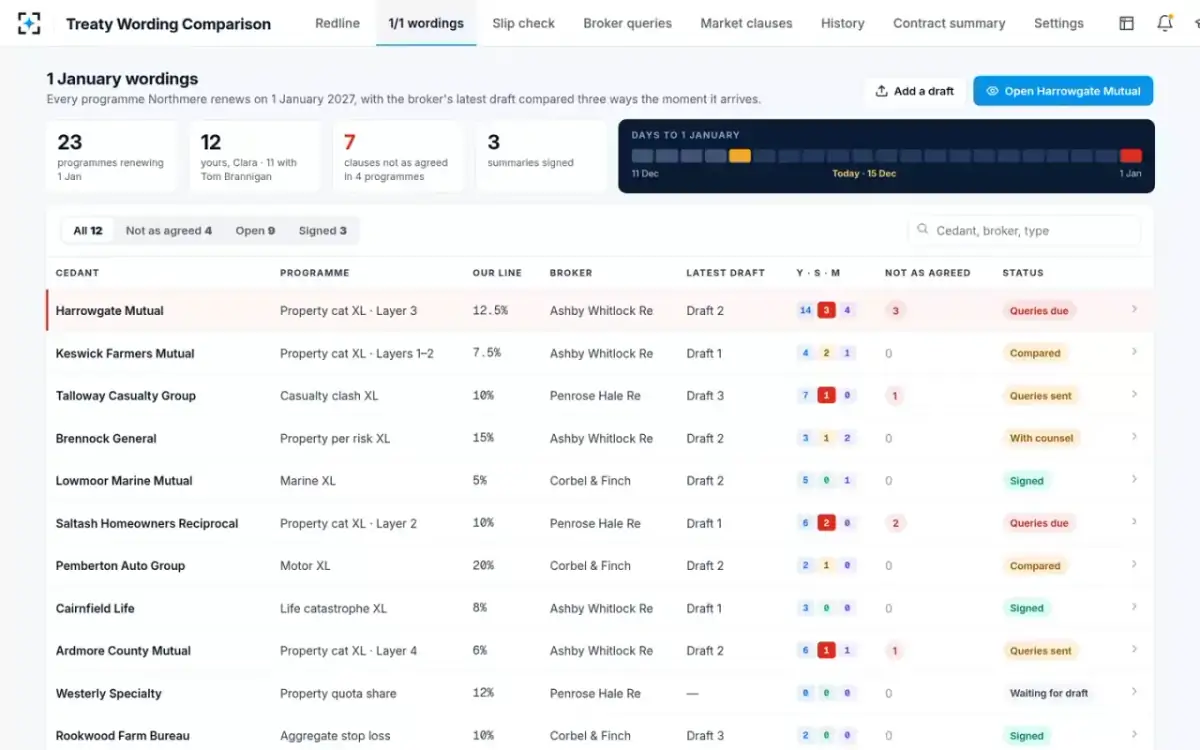
Every programme renewing on 1 January, with its latest draft and the days left
Keeping the nine-month clock: what to track per programme
A contract team that tracks the right dates rarely meets the rule. The checklist below is what to keep for each programme from slip to signature.
Eight things to track per treaty, from slip to signature
- Inception and the nine-month date
For a 1 January inception, nine months later is 1 October. Put both on the list the day the slip is agreed.
- Who the lead reinsurer is
The lead’s signature is the one the rule looks for on a multi-reinsurer treaty.
- The latest draft and its date
With how long the broker has had the last queries.
- Open findings by owner
Underwriter, counsel or contract manager. An open contradiction means the contract is not finalized.
- Signatures received
Lead first, then each following reinsurer, as the broker reports them.
- Amendments after inception
An amended contract is within the rule too; date each amendment and its signature.
- Facultative or cross-border status
Whether one of the exceptions applies, decided once and recorded.
- Alerts before inception
The sample team uses 21, 14 and 7 days before inception for any wording not signed.
The Treaty Wording Comparison page shows the 1 January list the sample team works from, with every programme's latest draft and the days to inception.
Questions people ask
Does the nine-month rule apply to facultative reinsurance?
No. Facultative reinsurance contracts are the first exception the text lists. The presumption is aimed at treaties, where a wording for a whole book can sit unsigned for months while losses emerge.
Is a signed slip enough to meet the nine-month rule?
Not for contracts written after 1996. Signed cover notes or placement slips from reinsurers representing more than 50% of capacity sufficed only for multi-reinsurer contracts entered into, renewed or amended on or before 31 December 1996 and not changed since. Later contracts need the finalized written contract, signed, or the lead reinsurer's signature on it.
What is contract certainty in reinsurance?
Contract certainty means the full terms are agreed and documented by the time cover starts, so nobody discovers the contract's meaning after a loss. Markets and regulators express it in different ways; in U.S. statutory accounting the nearest hard rule is the nine-month presumption. Botminds' approach for specialty policies is described on Contract Certainty Management.
When is the nine-month deadline for a 1 July treaty?
Nine months after a 1 July inception is 1 April of the following year, so the contract must be finalized, written and signed within that period. The year-end statement falls inside the window, which is one reason mid-year renewals are worth tracking as closely as 1 January ones.
Does the nine-month rule change risk transfer testing?
No; they are separate tests. A contract must transfer risk to get reinsurance accounting at all, and it must be signed in time to be treated as prospective. A late signature does not cure a contract that fails risk transfer, and a timely one does not rescue it; the reinsurance risk transfer test covers the wording that decides the first.