Reinsurance contracts are not, as a rule, publicly available. A treaty wording is a private agreement between an insurer and its reinsurers, negotiated through a broker, and there is no general requirement to publish it or file it for public inspection. But "private" is not "unseen". Regulators collect reinsurance programmes and can examine the contracts behind them; the annual statement reports each reinsurer and the amounts ceded; chief executives and finance officers attest that no side agreement changes the risk; brokers keep each contract's file for ten years after it expires; and courts print the clauses of any treaty that ends up in a dispute. Botminds' Treaty Wording Comparison is an agentic solution for the review that happens before signature, and it leaves the file each of those readers may later ask for: every clause cited, every query and every acceptance with its reason.
The matrix below sets out who can read which part of a treaty. It is a general picture for U.S. property and casualty business; what a particular regulator can require depends on its state's law.
Who can read which part of a reinsurance treaty
The full wording: No
Reinsurers and shares: Rarely
Premium and terms: No
Specific clauses: When a court prints them
The full wording: On request or examination
Reinsurers and shares: Yes, by data call and statement
Premium and terms: On request or examination
Specific clauses: Yes, including required clauses
The full wording: No
Reinsurers and shares: Each reinsurer, amounts ceded, collateral
Premium and terms: Amounts, not terms
Specific clauses: No
The full wording: Through the review file
Reinsurers and shares: Yes
Premium and terms: Yes
Specific clauses: Attest no side agreements
The full wording: Yes, kept ten years
Reinsurers and shares: Yes, with proof of placement
Premium and terms: Yes, rates and commissions
Specific clauses: Yes
The full wording: If disputed
Reinsurers and shares: If relevant
Premium and terms: If relevant
Specific clauses: Yes, often quoted in full
Are reinsurance contracts public?
No, with a few instructive exceptions. Reinsurance between private companies is lightly regulated as to form: "The form and wording of reinsurance contracts are not as closely regulated as are insurance contracts, and there is no rate regulation of reinsurance between private companies," and "A reinsurance contract is often a manuscript contract setting forth the unique agreement between the two parties" (Patrik, CAS). Unlike a personal lines policy form, which a state may require to be filed, a treaty wording has no public filing to look up.
The exceptions are public programmes and court records. A state catastrophe fund that reimburses insurers on contract terms may publish those terms, a federal programme may publish the structure of its placements, and a court deciding a reinsurance dispute usually quotes the clauses it is construing. Each is a real wording, and each is a better teaching document than any template.
Why are reinsurance contracts confidential?
Because they carry negotiated prices, retentions and shares that competitors and counterparties would value. Florida's insurance code, for example, defines proprietary business information to include "Information relating to bids or other contractual data, the disclosure of which would impair the efforts of the insurer or its affiliates to contract for goods or services on favorable terms", and lets the regulator release protected information "for the purpose of aggregating information on an industrywide basis" only "if the specific identities of the insurers ... are not revealed" (Florida Statutes s. 624.4212).
Confidentiality is also commercial habit. A treaty's terms tell the market what a cedant paid for a layer and which reinsurers carry how much of it. That is why industry price information about reinsurance is scarce and, where a regulator publishes it, aggregated.
Can regulators see reinsurance contracts?
Yes. The cedant's domiciliary regulator can examine its contracts, collect data on its programme, and in some states act on what it finds. In Florida, the Office of Insurance Regulation "shall examine the affairs, transactions, accounts, records, and assets of each authorized insurer", and the rules for examinations may provide for work by "reinsurance specialists" (Florida Statutes s. 624.316). Its annual reinsurance data call, run under that section, collects in stages what insurers plan to buy, what they bought, the participating reinsurers and the contracts placed, and the effect of storms on those contracts (Florida OIR, Property Insurance Stability Report, July 2026).
Regulators also shape the text. For a Reciprocal Jurisdiction reinsurer, the NAIC's Credit for Reinsurance Model Law says the commissioner "may require that consent for service of process be provided to the commissioner and included in each reinsurance agreement" (NAIC Model Law #785; each state's enacted version governs). And they read terms closely enough to act: Florida's July 2026 report lists a referral of an insurer for being party to a reinsurance agreement that does not create a meaningful transfer of risk. The reinsurance risk transfer test explains which clauses draw that attention.
What does Schedule F show about reinsurance?
Schedule F is the part of the U.S. statutory annual statement that reports a company's reinsurance by counterparty. In the CAS's description, written against the 2011 statement, its ceded part "provides the name of each of the company's reinsurers, a listing of liability amounts ceded to each reinsurer and the amount of collateral held by the insurance company in support of those liabilities", and another part "provides the aging of ceded reinsurance" (Odomirok et al., CAS, 2014 text; the schedule has since been restructured, so part numbers differ today).
Schedule F shows amounts and counterparties, not wordings. A reader learns who the reinsurers are and how much is recoverable from each, but not the hours clause, the reinstatement terms or the follow clause behind those amounts. It also leaves out retroactive reinsurance, which the CAS text notes "does not flow through Schedule F", a point that matters when a late signature makes a treaty presumed retroactive.
A reinsurance contract is often a manuscript contract setting forth the unique agreement between the two parties.
Patrik, “Reinsurance”, Foundations of Casualty Actuarial Science, Casualty Actuarial Society
What records must reinsurance brokers keep?
Under the NAIC Reinsurance Intermediary Model Act, a broker keeps a complete file on each contract for at least ten years after it expires, and the regulator can see it: "The commissioner shall have access to all books, bank accounts and records of the reinsurance intermediary in a form usable to the commissioner." The insurer the broker represents also has "access and the right to copy and audit all accounts and records maintained by the RB related to its business" (NAIC Model Act #790).
What a reinsurance broker's file holds for each contract, under the NAIC model act
| Item | Why a later reader wants it |
|---|---|
| Type of contract, limits, underwriting restrictions, classes of risk and territory | What was covered, in the broker’s own record |
| Period, effective and expiry dates, cancellation provisions and notice required | When cover ran and how it could end |
| Reporting and settlement requirements of balances | How money was meant to move |
| Rate used to compute the premium, and rates of all commissions | The price, including retrocession commissions |
| Names and addresses of the assuming reinsurers | Who is liable, and where to find them |
| Related correspondence and memoranda | Where wording queries and answers belong |
| Proof of placement, and evidence each reinsurer agreed to assume the risk | That the deal was in fact made |
| Retrocession details and financial records | Who carries the risk further on, and the accounts |
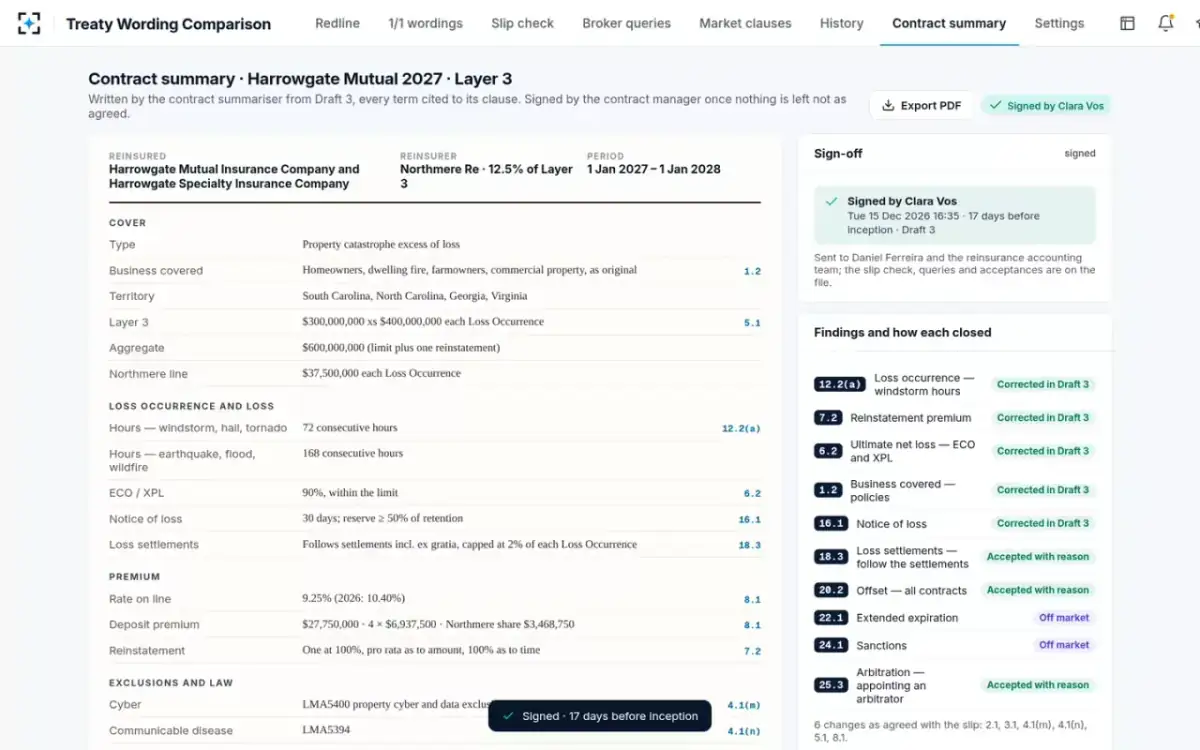
For a contract team, the useful reading of that list is item six. Queries about the wording and the broker's answers are correspondence, and they will sit in a file a regulator can examine for a decade. A query that quotes the slip line and the clause, sent and answered in writing, is better evidence than a phone call. In the fictional sample programme Treaty Wording Comparison runs on, each of eight queries quotes the slip line and the draft's words, the broker's reply is kept beside them, and the signed summary lists how each finding closed.
The file a later reader will ask for: every finding and how it closed
Do courts publish reinsurance clauses?
Yes, and court opinions are the best public source of real treaty language. The English Court of Appeal's 2024 judgment in Unipolsai v Covéa sets out the loss occurrence and hours clause of a property catastrophe excess of loss reinsurance, including the right of the reinsured to "choose the date and time when any such period of consecutive hours commences" ([2024] EWCA Civ 1110). New York's Court of Appeals printed a treaty's whole follow the settlements clause in 2013 (USF&G v American Re) and, in 2017, the items of a facultative certificate down to "$250,000. part of $500,000. each occurrence as original" (Global Reinsurance v Century Indemnity).
Read them for what they are: clauses that someone thought worth fighting over, quoted because the outcome turned on the words. That makes them better guides to what to check than to what is typical. The hours clause in reinsurance and follow the fortunes and follow the settlements walk through two of these cases clause by clause.
Where can I find a sample reinsurance treaty?
The most complete public example in the United States is a state contract, not a private treaty. The Florida Hurricane Catastrophe Fund publishes its reimbursement contract each year as a form adopted by rule; the 2026 contract runs to 35 pages and has articles that any treaty reader will recognize, among them definitions of ultimate net loss and covered event, exclusions, reports and remittances, commutation, inspection of records, offsets, insolvency of the company and termination (FHCF reimbursement contract, Form FHCF-2026K). Strictly it is a reimbursement contract between the state fund and each insurer, but its structure is close to a catastrophe excess of loss treaty.
One public reimbursement contract, by the numbers
35
pages in the FHCF’s 2026 reimbursement contract, Form FHCF-2026K
3
coverage levels an insurer can elect: 90%, 75% or 45%
1
hurricane per covered event, through any later downgrades
12
month contract year, 1 June 2026 to 31 May 2027
The federal flood programme publishes its reinsurance programme's structure rather than its wording: FEMA posts a public notice and a summary for each placement, and explains that "Reinsurance agreements are between FEMA and reinsurers, and do not impact the NFIP's contracts with its policyholders" (FEMA, NFIP reinsurance). Templates on commercial websites are the weakest source: they show a form, not an agreement anyone signed.
What is a reinsurance treaty wording?
A treaty wording is the full written contract of a reinsurance treaty: the document that states, in articles and clauses, everything the slip summarized and everything the slip left to "as expiring". A typical property catastrophe wording runs to dozens of pages. The fictional sample programme's draft wording has 64 pages, 38 articles and 162 clauses, from business covered and exclusions through ultimate net loss, reinstatement and loss occurrence to claims, loss settlements, offset, extended expiration, sanctions and arbitration.
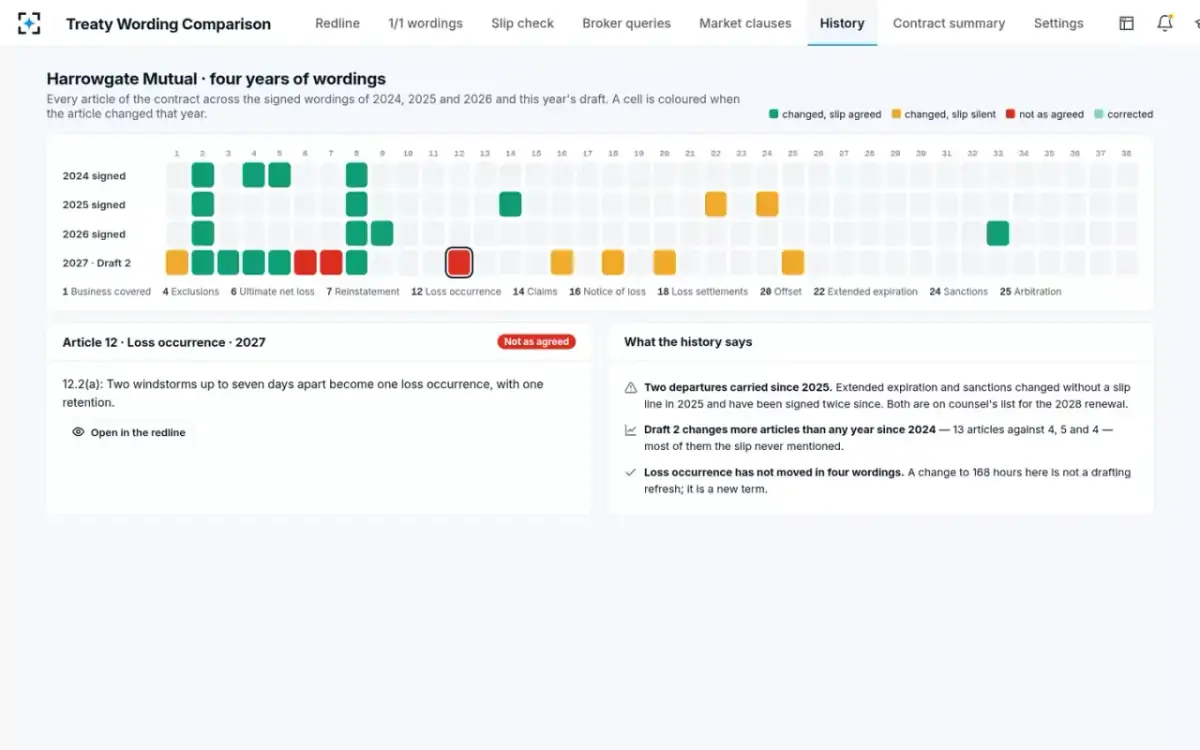
Each year's wording is usually drafted from the last, which is why the archive matters as much as the current draft. A clause changed once and carried forward becomes the new normal without anyone choosing it again; in the sample, two clauses that departed from the reinsurer's house wording in 2025 had been signed twice since. A team that keeps every year's signed wording side by side can see that drift; a team that keeps only the latest cannot.
Four years of one programme's wordings, side by side
What this means for a contract team
Because the wording is private, the parties' own file is the evidence of what was agreed and why, and it is the file a regulator, an auditor, an arbitrator or the officers' attestation will rely on. Since 2005 the CEO and CFO of a U.S. property and casualty insurer have attested in the annual statement to the absence of side agreements (New York DFS, Circular Letter 8 (2005), Supplement 1). They can only do that safely if each signed wording is complete and the reasons for every accepted departure are written down.
That is the practical case for doing the review in writing, step by step. In Treaty Wording Comparison, every finding cites the draft's page and line, the slip line, last year's words and the library clause; nothing leaves without a person; and each draft, comparison, query, reply, acceptance and signature is on the activity trail with who, what and when. The Treaty Wording Comparison page follows one wording from draft to signature.
Questions people ask
Do insurers have to file reinsurance contracts with the state?
Not as a general public filing, but regulators can require them. Florida, for example, examines insurers' records, collects reinsurance programme and contract information through its annual data call, and treats contractual data of this kind as proprietary. Other states' rules differ; the cedant's domiciliary regulator is the one that matters.
Can the public get a reinsurance contract through a records request?
Usually not the contract itself. Florida's statute, for instance, protects proprietary business information held by the regulator, including contractual data whose disclosure would harm an insurer's ability to contract on favourable terms, and allows release of protected information for industry-wide aggregates only without insurer identities.
Do reinsurers publish their treaty wordings?
Not as a rule. Market model clauses and some house clauses circulate within the market, but a programme's signed wording stays with the parties and the broker. The public examples are state programmes such as the Florida Hurricane Catastrophe Fund's reimbursement contract and the clauses quoted in court decisions.
How long are reinsurance records kept?
Under the NAIC Reinsurance Intermediary Model Act, a broker keeps a complete file on each contract for at least ten years after it expires, and the commissioner has access to it. Cedants and reinsurers keep their own files under their record-retention rules and the needs of claims, which on long-tail casualty business can run for many years.
Is a reinsurance slip public?
No more than the wording. The slip records the terms and each reinsurer's line, so it carries the same commercial information; it sits in the parties' and the broker's files, and a regulator or court may see it, but it is not published. By the time the wording is signed, the two documents should say the same thing.