Contract redline software compares two versions of a document and marks every insertion and deletion, so a reader can see what changed. For a reinsurance treaty that is necessary and not enough. The work is checking each broker draft against three references at once: the agreed slip, last year's signed wording and the market or house clause. The hard part is that the expensive changes look like ordinary drafting until someone holds the slip beside them. Botminds' Treaty Wording Comparison is an agentic solution for that three-way check. It does not replace the broker's drafting, the contract file or the people who sign; it reads each draft the moment it arrives and hands each finding, cited, to the person who decides it.
That makes the buying question practical: what does it need from you, where do its results go, and what keeps working exactly as it does today? The map below answers the three in one picture, using the documents a treaty team already has.
Where treaty comparison plugs in, and what stays where it is
Comes in
Treaty Wording Comparison
Agents read, compare, rate and draft. People send, accept and sign.
Goes out
- The broker drafts and keeps the placement file
- Your document store keeps the signed contracts
- Accounting and claims systems read the summary
What is contract redline software?
Contract redline software takes an earlier and a later version of a contract and produces a third document showing every deletion struck through and every insertion underlined. Word processors include a basic version; legal-tech products add better handling of PDFs, tables and moved text. Its virtue is completeness at the character level: done deterministically, it shows every change, every time, and has no opinion about any of them.
That neutrality is also its limit. A redline answers "what changed since the last version?" A treaty review has to answer "is this what we agreed?" and "what does it cost?" New York's highest court, in a reinsurance case, warned that small differences in a written agreement's wording can change what a critical term means (Global Reinsurance v Century Indemnity, 2017; its words are quoted further down). A redline shows the variation. It cannot say whether it is one the parties chose.
What does a redline not show?
Four things, each of which a treaty reviewer needs. It does not show agreement: a change the slip agreed and a change it contradicts are both just red. It does not show silence: a change on a subject the slip never mentioned looks like any other edit. It does not show meaning across renumbering: when articles move, a redline paired by position fills with false changes. And it does not show materiality: a two-character edit to an hours clause and a two-character edit to a defined spelling get the same colour.
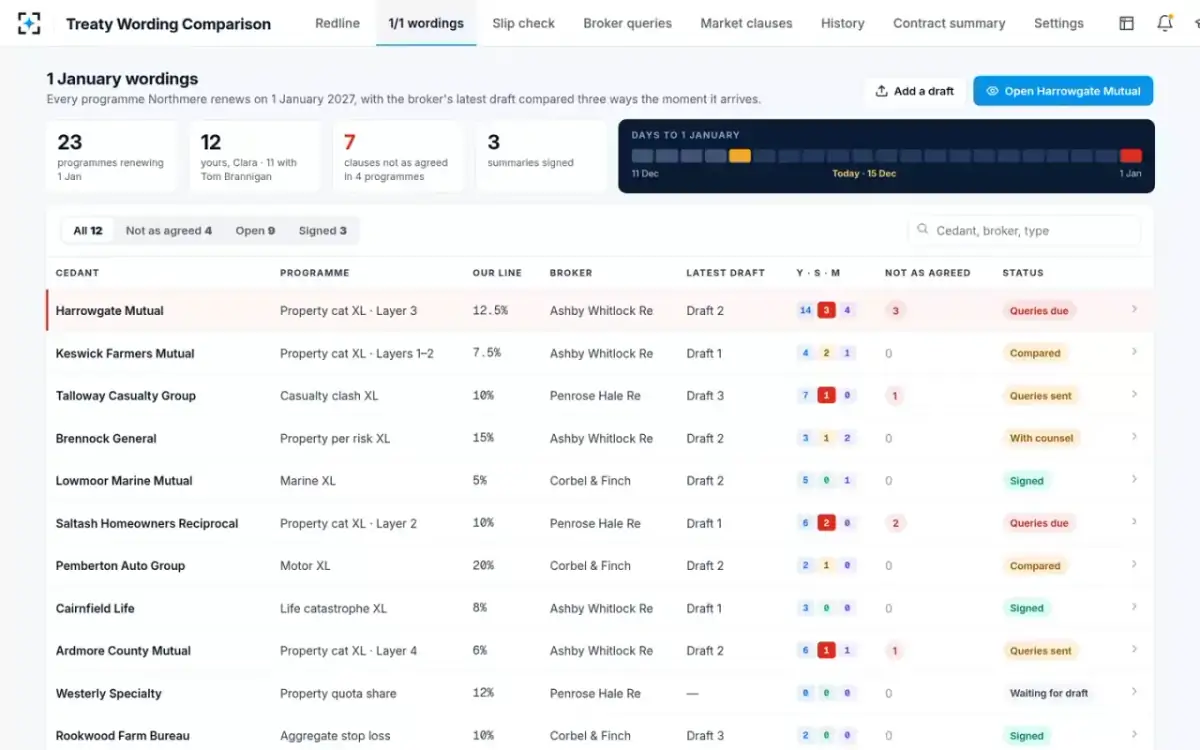
In the fictional sample programme the solution runs on, a reinsurer's contract manager had 23 programmes renewing on 1 January. Each draft, read by hand, meant reading 60 pages or more against last year's signed wording, the slip and the LMA and house clauses, by eye, across two or three PDFs. A redline on its own reduces the first of those reads and leaves the other two, and the judgement, exactly where they were.
How do you redline a reinsurance contract?
You redline it three times, against three references, and read the three results together. Against last year's signed wording, to see what changed. Against the firm-order slip, to see whether each change was agreed, and whether every slip line is still carried. Against the market or house clause, to see where the draft departs from the version the team accepts by default, including departures accepted in earlier years and carried since.
A reinsurance wording needs all three because, as the Casualty Actuarial Society's textbook chapter notes, a reinsurance contract is often written from scratch for the two parties' own deal (Patrik, CAS; why reinsurance contracts are rarely public quotes it). There is no standard form whose redline would tell you everything. The slip against the wording explains why the slip, not last year, has to be the judge of whether a change was agreed.
What is a three-way contract comparison?
A three-way contract comparison tests each clause of a draft against two earlier documents and an agreed standard at once, and classifies the result rather than just marking it. In Treaty Wording Comparison each clause gets one of three readings against its slip line: as agreed, where the slip states the term in so many words; not as agreed, where the clause contradicts it; or slip silent, where the slip says nothing. The same clause is redlined word by word against last year and against the clause library, and the three readings appear together.
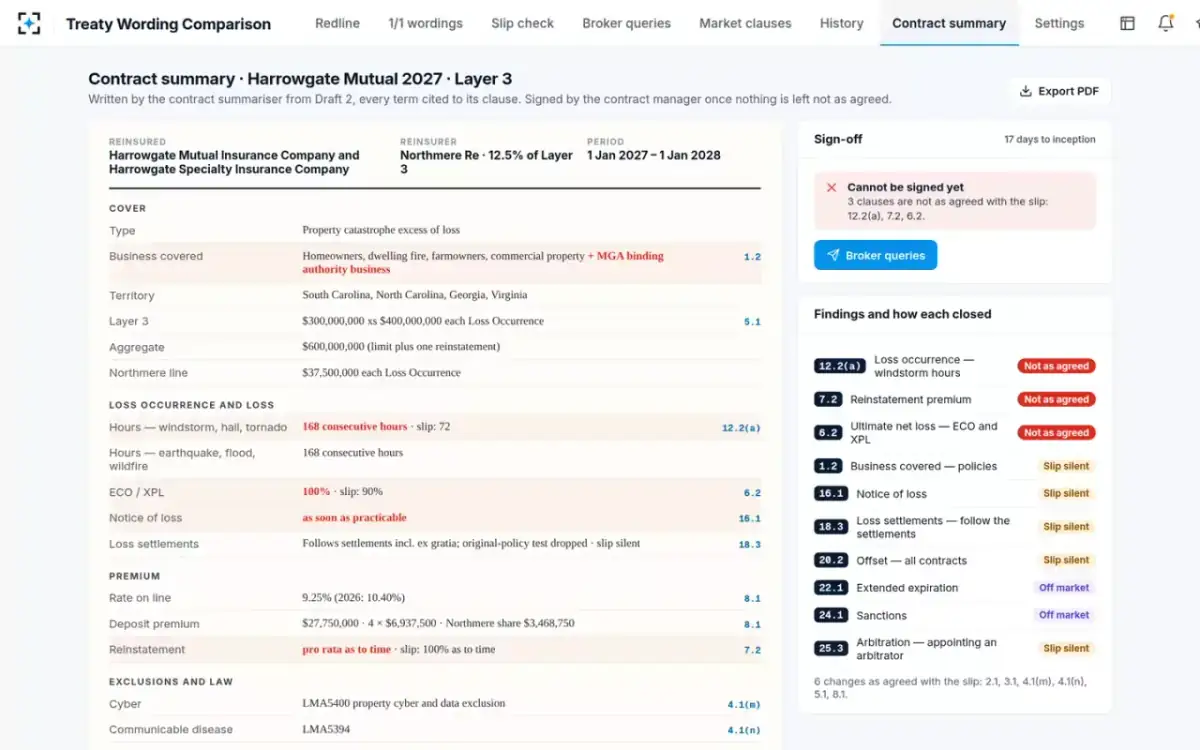
The classification is what lets a team stop reading what does not matter. In the sample Draft 2, 146 of 162 clauses were the same in all three comparisons and folded away; the contract manager read 16. Of those, three contradicted the slip, five were changes the slip never mentioned, six were agreed and two were departures from the house clause carried since 2025.
Every 1 January wording, on one list
Can redline software read PDF wordings?
Most can extract text from a PDF, and that is where treaty-specific problems begin. A broker's draft arrives as a PDF or a Word file; last year's signed wording is often a scanned or locked PDF; articles move; schedules and layer tables sit in tables, not prose. To compare clause with clause, software first has to split each document into the same units and pair them by meaning when the numbers change.
That is the job of the wording reader in Treaty Wording Comparison: it splits each draft and last year's signed wording into articles and clauses, keeps the page and line of every clause, and pairs renumbered clauses by meaning. In the sample it read Draft 2's 64 pages into 38 articles and 162 clauses in 48 seconds, and paired them with last year's 61-page wording, finding 9 renumbered. It never edits a source document. Ask any vendor to show the same on your own scanned wording, not on a clean sample.
Does contract software work with broker drafts?
It has to, because the broker is the drafter and stays the drafter. Under the NAIC Reinsurance Intermediary Model Act, a broker acts for an insurer only "pursuant to a written authorization, specifying the responsibilities of each party", and keeps a full file on each contract for at least ten years after it expires, including proof of placement (NAIC Model Act #790). Those duties do not move to the cedant's or reinsurer's software. What changes is how the other side responds to each draft.
In the sample, drafts arrive from the broker portal and by email and are compared on arrival. The query drafter writes one query per finding, quoting the slip line and the draft's words, and the contract manager sends the set in one go. The sample broker answered eight queries the same afternoon with Draft 3, which was compared in 3 minutes 13 seconds. Nothing is written into the broker's document; the broker corrects its own draft.
What a treaty team keeps doing, and what the comparison takes over
| Task | Today | With Treaty Wording Comparison |
|---|---|---|
| Drafting the wording | Broker | Broker, unchanged |
| Keeping the placement file | Broker, at least ten years after expiry under the NAIC model act | Broker, unchanged; queries and replies now quote slip lines and clauses |
| Reading each draft against last year, the slip and the clause library | Contract manager, by eye | Agents, on arrival, with page and line for every clause |
| Deciding departures on terms or price | Underwriter, if told | Underwriter, told on every hours change and every price-moving finding |
| Deciding follow, offset, law and arbitration | Counsel, often late | Counsel, with last year’s text, the redline and four years of drift |
| Signing the contract summary | Contract manager | Contract manager; refused while any clause is not as agreed |
What to ask any contract redline software before buying it for treaties
A demonstration on the vendor's sample proves little. Ask to see each of the following on one of your own past renewals: the drafts you received, last year's signed wording and the slip. EIOPA's opinion on AI governance is clear on who owns the outcome: "Undertakings are ultimately responsible for the AI systems that they use, regardless of whether the AI systems are developed in-house or in collaboration with third party service providers" (EIOPA, Opinion on AI governance, 2025).
Nine questions for contract redline software on treaty wordings
- Does it hold the slip as a reference?
If not, it cannot say whether a change was agreed. Every finding will be “changed”.
- Does it pair renumbered clauses by meaning?
Ask how many false changes it reports when articles move.
- Does it read “as expiring” against last year’s signed words?
Not against a summary or the market clause.
- Does it compare against your clause library, by version?
Including clauses retired or replaced since last renewal.
- Does every finding cite page and line in each source?
Draft, slip line, last year and library clause, each one click away.
- Can you set materiality?
Hours clauses critical, reinstatements and ECO/XPL high, and so on, by your rules.
- Who decides, and is it recorded?
Routing to the underwriter or counsel, with each acceptance and reason kept.
- Does it ever edit or send?
It should never change a source document or send a query without a person.
- What does it find on a seeded test?
Plant known changes in last year’s wording and count; see the test design linked below.
The last question is the one that turns a demonstration into evidence; the design is in the ten-change seeded test.
How long does it take to set up?
Setup is mostly gathering documents and agreeing rules, not integration. To run Treaty Wording Comparison on your book you provide a sample of past drafts, the signed wordings and slips that go with them, your house clauses and the version of the LMA clauses you use, and your contract summary template. You then set the materiality ratings, who decides each kind of clause, the inception alerts and how long the broker has to reply. Drafts can arrive by the channels they already use, the broker portal or email.
The sensible first step is a back-test: run it on one renewal you have already signed, with your own findings held back, and compare what it finds with what your team found. That is the offer on the Treaty Wording Comparison page, and it doubles as the acceptance test for go-live. Statutory accounting also sets a hard outer date for the work: the text carried into SSAP No. 62R presumes a contract retroactive if it is not finalized, written and signed within nine months of inception (NAIC Issue Paper No. 75; the 9 month rule), so a tool is worth most when it is in place before the season's drafts arrive.
The contract summary refuses to be signed while a clause contradicts the slip
What is contract redline software for treaties worth?
List prices are rarely published, so the useful comparison is with the hours it takes over, priced at your own rates. Botminds' estimate for one property catastrophe draft is about 12.5 hours by hand and 2.25 hours with the agents doing the reading, a saving of roughly ten hours per draft. Multiply by the drafts a season brings and subtract the cost of the tool; the formula below sets out the terms. The larger term is usually the one no timesheet shows: a contradiction signed by mistake.
What a season of treaty comparison is worth, term by term
Hours saved per draft
≈ 10.25 h
12.5 h by hand against 2.25 h with the agents reading, for one property catastrophe draft.
Botminds’ estimate, not a measured result
Drafts in a season
programmes × drafts each
The sample reinsurer had 23 programmes renewing on 1 January, and the sample programme reached Draft 3.
Your own renewal calendar
Cost of a missed contradiction
+ what the clause moves
In the sample, a reinstatement change worth $2.31M to a 12.5% line on one full-limit loss.
Your pricing file
The tool’s own cost
− your quote
Subscription and the time your team spends on the back-test and settings.
Even modest variations on the face of a written agreement can alter the meaning of a critical term.
Court of Appeals of New York, Global Reinsurance Corp. of America v Century Indemnity Co. (2017)
Questions people ask
What is redlining in a contract?
Redlining is marking the changes between two versions of a contract, traditionally in red: deletions struck through, insertions underlined. It is how parties see what the other side changed in a draft. For reinsurance treaties a redline against last year is one of three comparisons; the other two are against the slip and the market clause.
Can a word processor compare two treaty wordings?
Yes, at the character level, and its result is deterministic. It cannot pair renumbered clauses by meaning, hold the slip as a reference or rate materiality, so on a 64-page treaty with moved articles it produces a long redline that a person must still read against the slip by hand.
Does treaty comparison replace the broker's wording service?
No. The broker keeps drafting, placing and keeping the placement file, as the NAIC model act requires. Treaty comparison changes the response to each draft: cited queries in one set instead of a read-through by email, so the broker can correct the words in one pass.
Can cedants use contract redline software on outwards treaties?
Yes. A head of ceded reinsurance compares the same three things, the draft, last year's signed wording and the slip, and checks the wording every reinsurer on the programme will sign. The roles change sides; the method does not.
What should a back-test measure?
What the tool found that your team found, what it found that your team missed, and what it missed, on a renewal you have already signed. Add the reviewer's time to confirm each finding: a tool that finds everything but cites nothing has moved the work, not removed it.