Reinsurance contract review is the check that a treaty's wording says what the parties agreed, made before anyone signs it. It is hard because the wording is long, redrafted at every renewal and written for this one deal, and because five different people put their names to it: the broker who drafts it, the contract manager who reads it, the treaty underwriter who priced it, reinsurance counsel who owns its legal clauses, and, once a year, the chief executive and finance officer who attest that nothing outside it changes the risk. Botminds' Treaty Wording Comparison is an agentic solution built for that review: agents read each broker draft against the firm-order slip, last year's signed wording and the market clause, and the people in the chain decide what is theirs to decide.
The reason the chain matters is that a reinsurance wording is not a form. "A reinsurance contract is often a manuscript contract setting forth the unique agreement between the two parties," as the Casualty Actuarial Society's textbook chapter on reinsurance puts it, and "the form and wording of reinsurance contracts are not as closely regulated as are insurance contracts" (Patrik, CAS). The NAIC's statutory accounting text says the same in five words: "Each reinsurance contract may be individually drafted" (NAIC Issue Paper No. 75). No regulator approves the words in advance. The review is the only control there is.
Five signatures on one treaty wording, and what each one vouches for
A person decides
BrokerDrafts the slip and then the wording, places the lines and keeps the placement file, including proof of placement, for years after the contract expires.
Never: Does not decide whether a departure from the slip is acceptable to either side.
Agent
Wording reader and slip mapperSplit each draft into clauses with page and line, and link every slip line to the clause that must carry it.
Never: Never edit a source document or infer a term the slip does not state.
A person decides
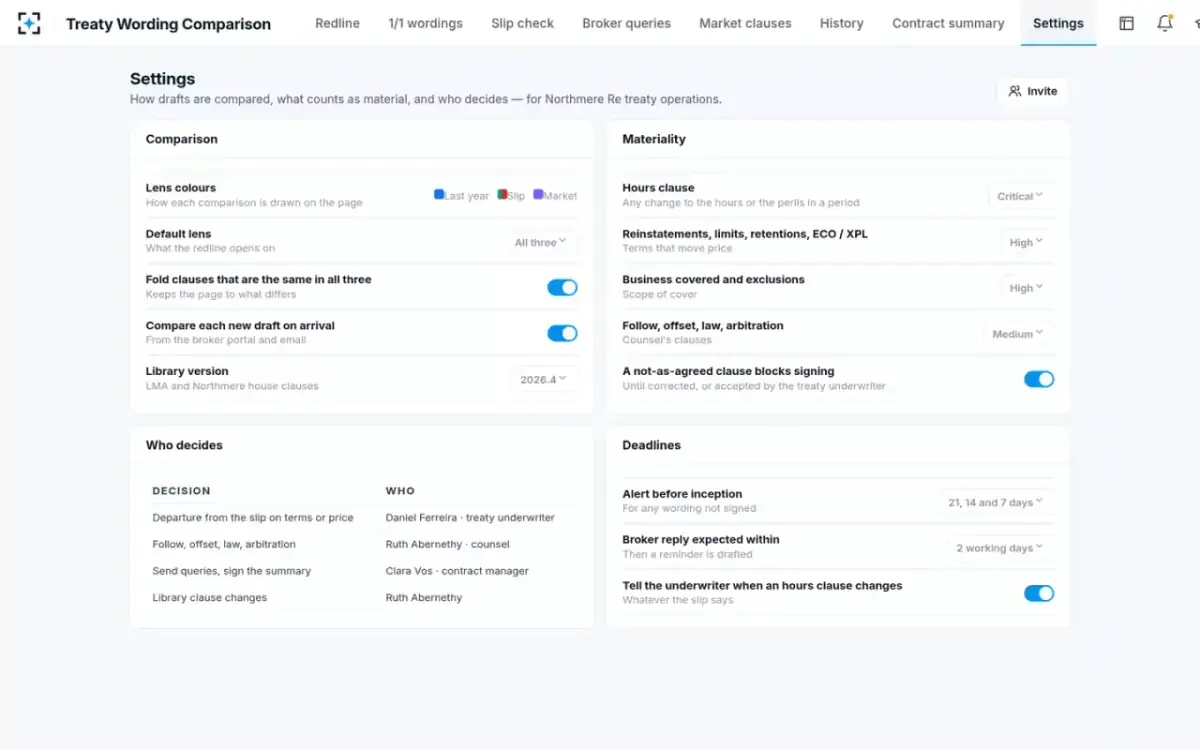
Contract managerReads the findings, sends the queries, and signs the contract summary once nothing contradicts the slip.
A person decides
Treaty underwriterDecides any departure from the slip on terms or price: hours, reinstatements, limits, retentions, ECO and XPL.
A person decides
Reinsurance counselDecides the follow, offset, law and arbitration clauses, and the clauses a regulator requires.
A person decides
CEO and CFOAttest each year, in the annual statement, that no side agreement changes the risk the contracts transfer.
What is reinsurance contract review?
Reinsurance contract review is reading a draft treaty wording clause by clause to confirm three things: that it carries every term of the agreed slip, that anything changed since last year's signed wording was meant to change, and that it departs from the market or house clause only where someone chose to. A review that answers only the second question, the one a document compare answers, misses the case that does the damage: a clause that changed in a way the slip never agreed.
The work is distinct from pricing and from claims. The underwriter has already priced the layer on the slip's terms; the claims team will later read the wording when a loss arrives. Review is the moment between the two when the words can still be fixed cheaply. After signature, the treaty is what it says. New York's highest court, asked to rescue reinsurers from a settlement clause they disliked, answered that "if reinsurers think that they are not adequately protected by this language, their remedy is to negotiate better terms" (USF&G v American Re, 2013). Negotiation happens before the signature, which is why the review does too.
A regulator also cares what is in the document. In the statutory accounting text later carried into SSAP No. 62R, no credit is allowed for reinsurance recoverable unless the contract meets required terms: "The contract must contain an acceptable insolvency clause," and "The agreement shall constitute the entire contract between the parties and must provide no guarantee of profit, directly or indirectly, from the reinsurer to the ceding company or from the ceding company to the reinsurer" (NAIC Issue Paper No. 75, quoting the pre-codification manual). A clause dropped in redrafting can cost the cedant its credit, not just its argument.
Who reviews a reinsurance contract? Five people, five different promises
Five roles touch a treaty wording, and their signatures mean different things. The broker vouches that the deal was placed as recorded. The contract manager vouches that the document matches the deal. The treaty underwriter vouches for the price of any term that moved. Counsel vouches for the clauses a court or regulator will read. The CEO and CFO vouch, once a year and for every contract at once, that there is no other deal.
The confusion in many teams is that the contract manager is expected to vouch for all five. A contract manager who reads a 64-page draft against three references, for a dozen programmes renewing on the same day, ends up deciding by default things that belong to the underwriter or to counsel. The People figure below sets out who keeps what once agents take the mechanical reading. The roles are from the fictional sample programme the solution runs on; the split of decisions is a setting each team chooses.
Treaty Wording Comparison and the four people around one wording
Today
Reads each 60-page draft against last year, the slip and the clause library by eye, in two or three PDFs, while a dozen programmes renew the same day.
With agents
Opens each draft already compared three ways, sends cited queries in one go and signs a summary where every term points to its clause.
Still theirs: the queries to the broker and the signature on the contract summary
Today
Learns that the hours clause moved after pricing the layer, or after the first storm season.
With agents
Is told whenever an hours clause changes and decides any departure from the slip on terms or price.
Still theirs: every acceptance of a term that moves price
Today
Gets follow, offset, law and arbitration changes late, mixed in with drafting noise.
With agents
Gets only counsel’s clauses, each with last year’s text, the redline and its drift over four wordings.
Still theirs: acceptance or refusal of each legal clause, with a reason
Today
Drafts and redrafts wordings for many cedants against the same 1 January deadline, and receives queries as loose emails.
With agents
Receives one query per clause, quoting the slip line and the draft’s words, and turns the next draft round faster.
Still theirs: the drafting, the placement and the placement file
What the broker vouches for: the placement and its file
The broker's signature is about the placement, and its proof outlives the contract. Under the NAIC's Reinsurance Intermediary Model Act, a broker deals with the insurer it represents only under "a written authorization, specifying the responsibilities of each party" (NAIC Model Act #790). The same act requires the broker to keep, for at least ten years after each contract expires, a file on the transaction: the type of contract, limits and territory; the period, cancellation provisions and notice; the rate and commissions; the names and addresses of the reinsurers; related correspondence; and proof of placement.
Two things follow for a reviewer. First, the broker is the drafter of both the slip and the wording, so the broker cannot also be the independent check that one matches the other; why the drafter can't be the checker takes that argument through line by line. Second, the broker's file will be the place a regulator or a court looks for what was agreed, so the review's queries and the broker's answers belong in it, quoting the slip line and the clause, not paraphrasing either.
What is a contract manager in reinsurance, and what do they check?
The reinsurance contract manager is the person who reads the wording against the deal and signs that it matches. In practice the job is three comparisons at once. Against the slip: is every agreed term carried, in words that mean the same thing? Against last year's signed wording: what changed, and was each change agreed? Against the market or house clause: where does the draft depart from the version the team accepts by default?
Take a fictional sample programme as it runs through Botminds' Treaty Wording Comparison. Harrowgate Mutual's property catastrophe treaty renews on 1 January 2027; the sample reinsurer, Northmere Re, writes 12.5% of Layer 3, $300 million excess of $400 million. The firm-order slip, agreed on 1 December, has 34 lines. The broker's Draft 2 runs to 64 pages, 38 articles and 162 clauses. Of those clauses, 146 read the same in all three comparisons and fold away. The other 16 are where the review happens: six changes the slip agreed, three that contradict it, five the slip never mentioned, and two departures from the house clause that were accepted at the 2025 renewal and have been carried ever since.
The contract manager's view: one clause read three ways
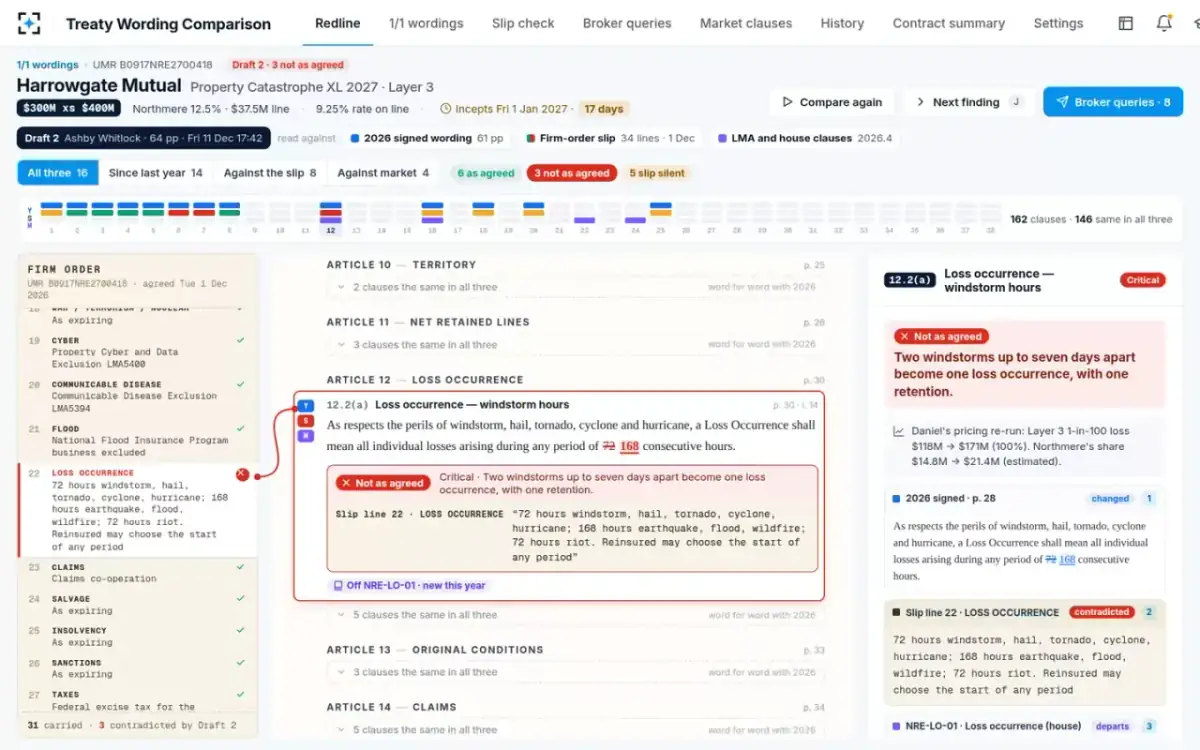
The counts across the top — since last year 14, against the slip 8, against market 4 — tell the contract manager where the 16 differing clauses sit before she reads any of them.
What the treaty underwriter decides: departures on terms or price
The underwriter priced the layer on the slip, so any wording that moves a priced term is the underwriter's decision, not the contract manager's. The terms that move price are the ones that define how much the reinsurer pays and how often: the hours in a loss occurrence, reinstatement provisions, limits, retentions, and how extra-contractual obligations and losses in excess of policy limits (ECO and XPL) count towards the limit.
Reinstatement wording shows why. The CAS study note on reinsurance pricing describes reinstatement premium as usually pro rata as to amount, and pro rata as to time as the less common form, because catastrophes such as hurricanes are seasonal (Clark, CAS). In the sample Draft 2, Article 7.2 made reinstatement premium pro rata as to time where slip line 10 agreed 100% as to time. For a full-limit loss on 1 September, with 122 of 365 days left, that is $9.28 million of reinstatement premium instead of $27.75 million, and Northmere's 12.5% share of the gap is $2.31 million. The words "unexpired term" read like drafting. They are a price change.
The hours clause is the larger case. The same draft moved windstorm from 72 to 168 consecutive hours, which lets two storms up to a week apart count as one loss occurrence with one retention. The sample underwriter's own re-run took the layer's 1-in-100 loss from $118 million to $171 million. What one changed number in an hours clause costs works the arithmetic through a full scenario.
What does reinsurance counsel check?
Counsel checks the clauses that a court, an arbitrator or a regulator will read word for word: follow the settlements, offset, governing law, arbitration, insolvency and the clauses the credit-for-reinsurance rules require. These change rarely and matter most when something has gone wrong, which is exactly why a two-way redline full of renumbering and formatting is the worst place to find them.
Some of those clauses are required, not negotiated. For a reinsurer qualifying under the Reciprocal Jurisdiction rules, the NAIC's Credit for Reinsurance Model Law says "Each reinsurance agreement must include a provision requiring the assuming insurer to provide security in an amount equal to one hundred percent (100%) of the assuming insurer's liabilities attributable to reinsurance ceded pursuant to that agreement if the assuming insurer resists enforcement of a final judgment", and the commissioner "may require that consent for service of process be provided to the commissioner and included in each reinsurance agreement" (NAIC Model Law #785; each state's enacted text governs). A redraft that loses one of those sentences is a credit problem, not a drafting one.
In the sample, five of Draft 2's changes were ones the slip never mentioned, and three of them were counsel's: a follow-the-settlements clause extended to ex gratia payments, offset across all contracts between the parties, and a change to the days allowed to appoint an arbitrator. The broker's reply restored two of the five and asked to keep the other three; counsel accepted them, the ex gratia extension with a 2% cap, and the reasons went on the file. How far a follow clause binds a reinsurer depends on exactly those words.
If reinsurers think that they are not adequately protected by this language, their remedy is to negotiate better terms.
Court of Appeals of New York, United States Fidelity & Guaranty Co. v American Re-Insurance Co. (2013)
What is the reinsurance attestation the CEO and CFO sign?
The attestation is an annual statement signed by the chief executive and chief financial officer that no side agreement changes the risk the company's reinsurance contracts transfer. It dates from 2005, when New York's Insurance Department acted "because of concern about the improper use of finite reinsurance to manipulate financial reporting results". The Department required that, on examination, the CEO attest that "no side agreements exist that would reduce, limit, mitigate or otherwise affect the risk being transferred under a reinsurance agreement", and the NAIC then "adopted additional disclosures regarding finite reinsurance for the annual statement of property/casualty insurers, including a CEO and CFO attestation" (New York DFS, Circular Letter 8 (2005), Supplement 1).
A 2009 paper in the Casualty Actuarial Society's E-Forum lists what the Reinsurance Attestation Supplement asks the two officers to confirm, starting with "There are no separate written or oral agreements between the reporting entity and assuming reinsurer", and adds documentation for every contract whose risk transfer is not "reasonably self-evident" (Freihaut and Vendetti, CAS E-Forum, 2009; the supplement's current wording should be read in the latest annual statement blank). The link to wording review is direct: the officers sign for a whole book of contracts they cannot each read in full, so the evidence that each wording is complete, and that nothing outside it was agreed, has to sit in the file the review leaves behind. The clauses that most often weaken risk transfer are the subject of the reinsurance risk transfer test.
How long does reinsurance contract review take?
By hand, a single property catastrophe draft takes most of two working days to review properly, and a renewal usually brings more than one draft. Botminds' own estimate for one such draft, read by a contract manager without help, is about 12.5 hours: four on the read against last year, two on checking every slip line, an hour and a half each on the market clauses, the queries and the contract summary, and two more when the next draft arrives. With the agents doing the reading, the same estimate falls to about two and a quarter hours, nearly all of it spent deciding.
Where the hours on one draft go, by hand and with the agents reading
- Against last year4 h
- Slip lines2 h
- Market clauses1.5 h
- Queries1.5 h
- Next draft2 h
- Sign-off1.5 h
- Read0.75 h
- Decide1.5 h
The calendar matters more than the hours. In the sample programme the slip was agreed on 1 December, Draft 2 arrived on 11 December, and inception was 1 January. Under U.S. statutory accounting, a contract not finalized, put in writing and signed within nine months of inception is presumed retroactive, with harsh accounting consequences; the nine-month rule in plain words sets out the clock and its exceptions. The sample team had 23 programmes renewing on the same day. A review that can only start when someone finds two free days will finish late on most of them.
Who decides what is a setting, not a habit
A reinsurance contract review checklist
A good review leaves evidence that each signer did their part. The checklist below is the minimum a cedant or a reinsurer can ask of every treaty wording, whatever tools it uses, and it is the reinsurance wording review process the solution's settings encode.
Ten checks before a treaty wording is signed
- Every slip line is carried
Each line of the firm-order slip points to the clause that carries it, in words that mean the same thing. A line with no clause goes to a person.
- Every change since last year is explained
Each difference from last year’s signed wording is either agreed on the slip or queried with the broker.
- Changes the slip never mentioned are found
Slip-silent changes are the ones a two-way compare marks as ordinary drafting. Ask for the intent of each.
- Hours and loss occurrence are read by the underwriter
Any change to the hours or the perils in a period goes to whoever priced the layer.
- Reinstatements, limits, retentions and ECO/XPL match the price
Pro rata as to time, a percentage of ECO or a changed retention is a price change.
- Counsel sees follow, offset, law and arbitration
With last year’s text and the redline, not buried in a full-document compare.
- Required clauses are present
Insolvency, entire agreement, quarterly reporting and any clause the credit-for-reinsurance rules require.
- Departures from the house clause are recorded
A departure accepted once tends to be carried for years. Keep its date and reason.
- Queries quote the slip line and the clause
So the broker can fix the words in one pass, and the placement file shows what was asked.
- The signed summary cites its clauses
Every term on the summary points to the clause that carries it, so accounting and claims read the same contract.
How the agents divide the reading, and what each one is never allowed to do, is set out on the Treaty Wording Comparison page. What the review cannot do is replace the judgement of the people above: it finds and cites; the underwriter, counsel and the contract manager decide, and the officers attest.
Questions people ask
Who signs a reinsurance treaty?
The ceding insurer and each reinsurer sign the contract; for a placed treaty the broker collects signatures and keeps proof of placement in its file. Inside each company, the signature usually follows a review by the contract manager, with the underwriter and counsel deciding the clauses that are theirs. For U.S. statutory accounting, a multi-reinsurer treaty signed by the lead reinsurer within nine months of inception escapes the retroactive presumption even if the other signatures arrive later.
What is a contract manager in reinsurance?
A reinsurance contract manager, sometimes advertised as a reinsurance wording specialist, checks that each treaty wording matches the agreed slip and the team's standard clauses, queries the broker and signs off a contract summary. The role sits between underwriting, legal and reinsurance accounting, and it peaks in the weeks before 1 January, 1 April, 1 June and 1 July renewals.
Is a cedant's review different from a reinsurer's?
The comparison is the same three references, read from the other side. A head of ceded reinsurance checks the wording every reinsurer on the programme will sign; a reinsurer's contract manager checks the share it writes. Both are exposed to the same drafting error, and both need the slip as the reference, because last year's wording alone cannot show whether a change was agreed.
What happens if a required clause is missing?
Under the statutory accounting text carried into SSAP No. 62R, no credit is allowed for reinsurance recoverable unless the agreement contains required terms such as an acceptable insolvency clause and an entire-contract provision with no guarantee of profit. A missing clause can therefore affect the cedant's balance sheet, which is why counsel's checks include the clauses regulators require, not only those the parties negotiated.
Can a reinsurance contract review be done after signing?
It can, but its findings are then disputes rather than queries. Once signed, the treaty is read as written, and New York's highest court has told reinsurers unhappy with a clause that their remedy is to negotiate better terms. A post-signing review is still worth doing on carried-forward clauses, which can drift for years without anyone choosing them.