A reinsurance slip is the short document that records the terms of a placement: the parties, the period, the layers, the premium, the key clauses and each reinsurer's line. The wording is the full contract, drafted afterwards, usually by the same broker, that is meant to carry every one of those terms in legal language. The hard part is the gap between the two. A slip line takes one sentence; the clause that carries it may be a paragraph on page 30 of a draft that has also changed in a dozen other places since last year. Botminds' Treaty Wording Comparison is an agentic solution for that gap: agents link every line of the firm-order slip to the clause that must carry it and flag any clause that says something else, and the contract manager decides what to query before anyone signs.
The broker writing both documents is normal, not a fault. The Casualty Actuarial Society's textbook chapter on reinsurance estimated that "more than half of U.S. reinsurance is placed via intermediaries" (Patrik, CAS), and drafting is part of the service. But it settles one design question: the check that the wording carries the slip cannot sit with the person who wrote both. That is ordinary maker-checker discipline, and it is where most treaty wording errors are caught or missed.
A reinsurance slip and a treaty wording are different documents with different jobs
The slip: The broker, from the cedant’s submission and the negotiation with the lead reinsurer.
The wording: Usually the same broker, starting from last year’s signed wording and the slip.
The slip: At placement. In the sample programme the firm order was closed at 100% on Tuesday 1 December.
The wording: After placement, often in several drafts. The sample’s Draft 2 arrived on Friday 11 December, three weeks before inception.
The slip: A few pages. The sample slip has 34 lines.
The wording: Sixty pages or more. The sample Draft 2 runs to 64 pages, 38 articles and 162 clauses.
The slip: Terms of art and references: “as expiring”, “100% as to time”, a market clause number.
The wording: Full clauses, definitions and cross-references, renumbered as articles move.
The slip: What was agreed, and who took which share.
The wording: The whole contract that accounting, claims, auditors and, if it comes to it, a court will read.
What is a reinsurance slip?
A reinsurance slip is the placing document: a structured summary of the risk and the terms on which reinsurers agree to take it, which each reinsurer marks with the share it writes. It is short by design. New York's highest court, describing the facultative certificates that play a similar role for single-risk reinsurance, noted that such documents are "short and concise, using terms of art rather than lengthy, legalistic explications to define the obligations of the parties" (Global Reinsurance v Century Indemnity, 2017, quoting a reinsurance treatise).
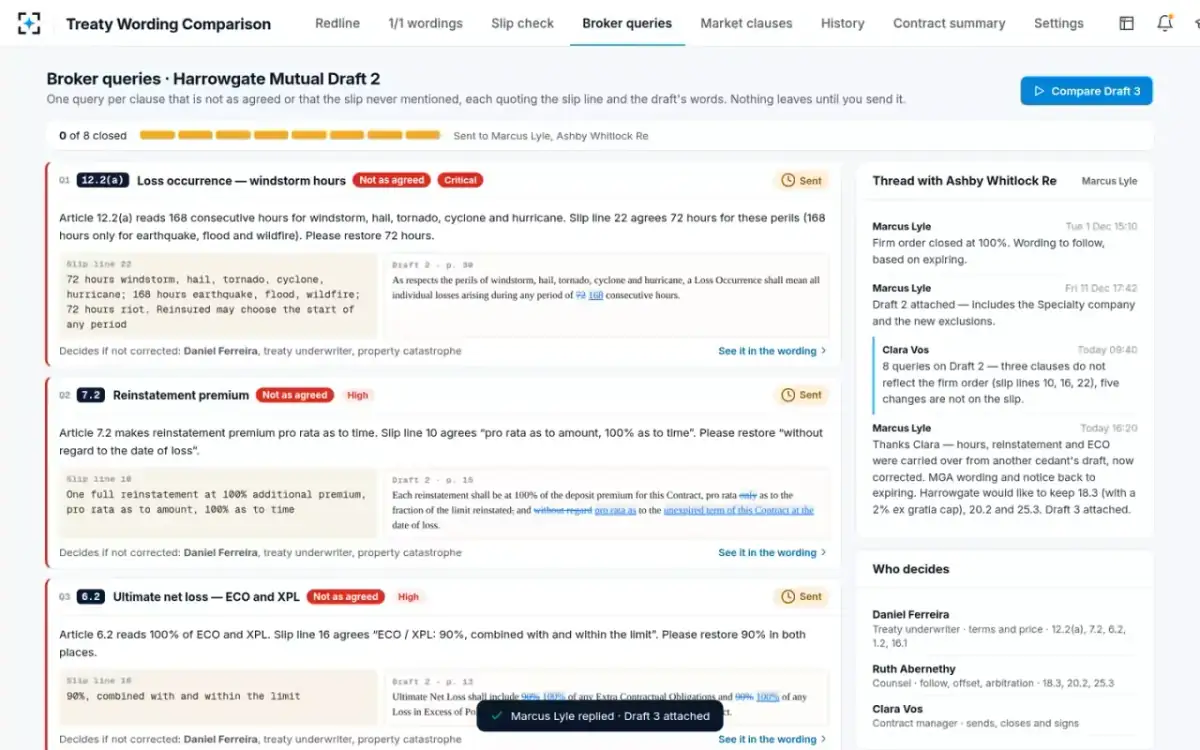
A reinsurance slip example shows what that brevity hides. Line 10 of the sample slip reads "One full reinstatement at 100% additional premium, pro rata as to amount, 100% as to time." Line 16 reads "90%, combined with and within the limit", under the heading ECO / XPL. Line 22 sets the hours in a loss occurrence: 72 for windstorm, hail, tornado, cyclone and hurricane; 168 for earthquake, flood and wildfire; 72 for riot; and the reinsured may choose when each period starts. Each of those lines becomes a clause of a hundred words or more, and each can be carried wrongly in a way that still reads like a reasonable clause.
What is the difference between a slip and a wording?
The slip records the agreement; the wording is the contract that is meant to state it completely. The difference matters most when they disagree, because each side will reach for the one that suits it. The NAIC's statutory accounting text for property and casualty reinsurance, later carried into SSAP No. 62R, requires that for credit "The agreement shall constitute the entire contract between the parties" (NAIC Issue Paper No. 75). Once a wording that says it is the entire agreement is signed, it is the document everyone else works from.
The accounting rules used to accept the slip itself, and then stopped. Under the nine-month rule, a treaty must be finalized, written and signed within nine months of inception or be presumed retroactive. For multi-reinsurer contracts entered into, renewed or amended on or before 31 December 1996, and not renewed or amended since, the rule let it suffice that reinsurers "representing more than 50% of the capacity on the contract have signed cover notes, placement slips or similar documents describing the essential terms of coverage and exclusions" (NAIC Issue Paper No. 75). For anything later, the signed slip is not enough: the nine-month rule wants the contract itself.
What is a firm order slip?
A firm order slip is the slip once the placement is complete: the terms are agreed and the lines written add up to the whole order. In the sample, the broker's message on 1 December reads "Firm order closed at 100%. Wording to follow, based on expiring." Both halves of that sentence matter to a reviewer. "Closed at 100%" fixes the deal. "Based on expiring" means the drafter will start from last year's wording, so anything the slip changed has to be written into an old document, and anything the slip did not change has to survive the redraft.
"As expiring" is the phrase that makes a slip check a three-way job. A slip line that says only "as expiring" points at last year's signed words, not at a market clause or a summary. The slip mapper in Treaty Wording Comparison is built on that rule: "as expiring" means last year's signed words, and it never infers a term the slip does not state. A check that compares the draft with the slip alone cannot tell whether an "as expiring" clause was carried faithfully; a check against last year alone cannot tell whether a change was agreed.
Who drafts the reinsurance wording, and why that rules them out as the checker
The broker usually drafts the wording, and its drafting is shaped by its own duties. Under the NAIC Reinsurance Intermediary Model Act, a broker acts for an insurer only under a written authorization specifying each party's responsibilities, and keeps a file on each contract for at least ten years after it expires, including the limits, period, cancellation terms, rates, commissions, the reinsurers' names and addresses, correspondence and proof of placement (NAIC Model Act #790). The broker is accountable for the placement. It is not, and cannot be, the independent reader of its own draft.
That is the maker-checker principle every finance team applies to payments, and it applies here for the same reason: the person who made an error is the person least likely to see it. A broker drafting wordings for dozens of cedants against one deadline is working from templates and earlier drafts. In the sample, the broker's own explanation of three wrong clauses was that they "were carried over from another cedant's draft". Nobody did anything unusual. The check simply has to sit somewhere else.
The slip check, with the drafter on one side and the checkers on the other
A person decides
BrokerDrafts the wording from the slip and last year’s signed wording, and sends each draft.
Agent
Slip mapperReads the firm-order slip line by line and links each line to the clause that must carry it, recording the words that carry it.
Never: Never infers a term the slip does not state; a slip line with no clause goes to a person.
Agent
Three-way comparerTests each clause against its slip line, last year’s wording and the market clause: as agreed, not as agreed, or slip silent.
Never: Marks a change as agreed only where the slip says so in terms.
Agent
Query drafterDrafts one query per finding, quoting the slip line and the draft’s words.
Never: Never sends, and never proposes a term outside the slip.
A person decides
Contract managerReviews the findings, sends the queries and signs the contract summary once nothing contradicts the slip.
A person decides
Treaty underwriter or counselDecides any departure the broker does not correct: terms and price for the underwriter; follow, offset, law and arbitration for counsel.
What happens if the wording differs from the slip?
If the difference is found before signature, the broker corrects the wording or the treaty underwriter accepts the change and the slip is endorsed to match. If it is found after, it becomes a dispute about which document reflects the deal, usually at the moment a claim makes the difference worth money. The rest of this page is about making sure it is the first.
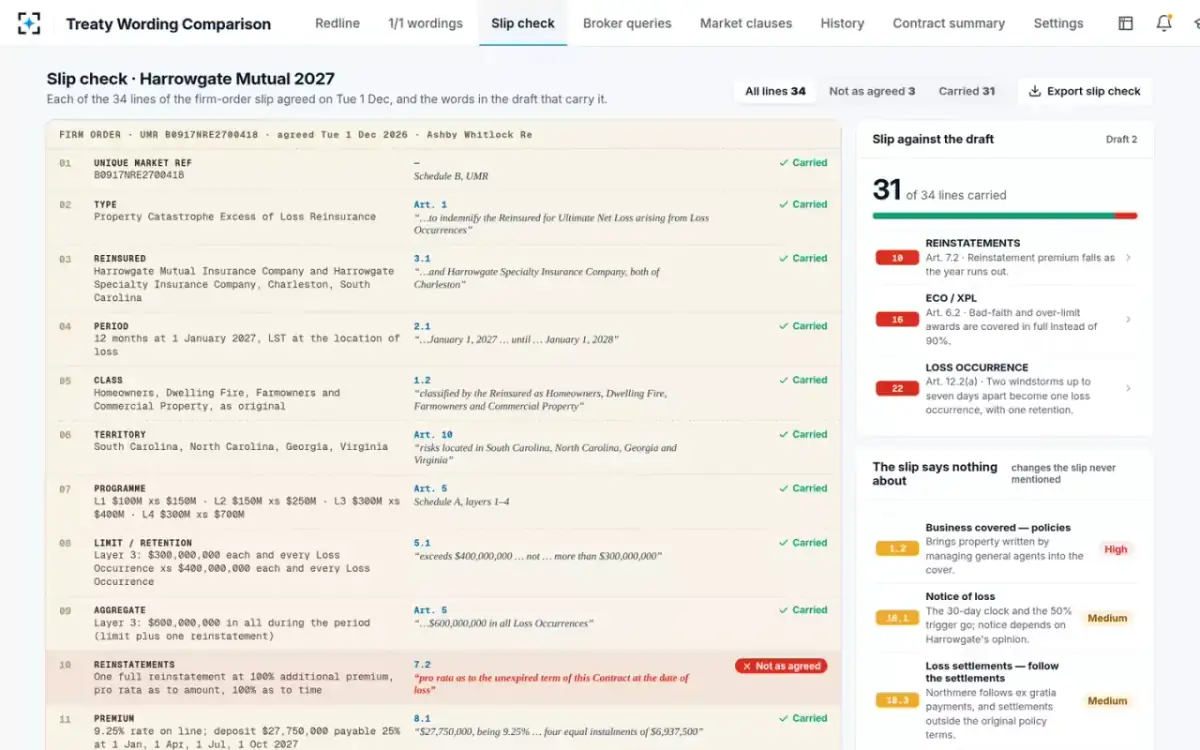
The sample shows the scale of the problem on one ordinary draft. Of the 34 slip lines, 31 were carried. Three were not: Article 7.2 made reinstatement premium pro rata as to time against line 10's "100% as to time"; Article 6.2 put ECO and XPL at 100% against line 16's 90%; and Article 12.2(a) set 168 hours for windstorm against line 22's 72. Each of the three looks like a normal clause to anyone not holding the slip open beside it.
Draft 2 against its 34-line slip, in the fictional sample programme
The slip, checked line by line against the draft
Does the slip or the wording prevail?
Neither prevails automatically. A court reads the agreement as the parties made it, and the documents are evidence of that. New York's highest court put the rule plainly in a reinsurance case: "Reinsurance, like any other contract, depends upon the intention of the parties, to be gathered from the words used, taking into account, when the meaning is doubtful, the surrounding circumstances." The same court warned that a certificate, "while serving as written confirmation of a contract, might not in and of itself constitute the fully integrated agreement" (Global Reinsurance v Century Indemnity, 2017).
For a reviewer, the practical answer is that the question should never arise. Which document wins depends on the governing law, the entire-agreement wording and the facts, and finding out costs an arbitration. A slip line that the wording contradicts is cheap to fix in December and expensive to argue in September, which is why the sample team's settings refuse to let a contract summary be signed while any clause is not as agreed. The same reasoning is behind who signs off each clause in a treaty review.
Reinsurance, like any other contract, depends upon the intention of the parties, to be gathered from the words used.
Court of Appeals of New York, Global Reinsurance Corp. of America v Century Indemnity Co. (2017), quoting London Assurance Corp. v Thompson (1902)
Slip silent: the changes nobody agreed and nobody refused
The most dangerous category is neither carried nor contradicted. A slip silent change is one the wording makes on a subject the slip does not mention. It cannot be "not as agreed", because nothing was agreed, and a slip check that only asks "is each line carried?" will pass it. In the sample, Draft 2 brought business written by managing general agents into the business covered, replaced a 30-day, 50%-of-retention notice trigger with "as soon as practicable", extended follow the settlements to ex gratia payments, extended offset to all contracts between the parties and changed the days to appoint an arbitrator.
The right response is a question, not a correction: what is this change for? The query drafter in Treaty Wording Comparison writes exactly that for each slip-silent change, quoting the clause and asking for the intent, and leaves the decision with the person who owns that kind of clause. In the sample, the broker restored the business covered and notice wording to expiring and the cedant asked to keep the other three; counsel accepted them, the ex gratia extension only with a 2% cap, and recorded why.
Queries sent, and the broker's reply the same afternoon
How to check a reinsurance slip against the wording, line by line
The method is the same with or without software: hold the slip as the reference, read every clause the slip touches, and keep a list of everything the slip does not touch. What changes with agents is that the mechanical part, finding the clause for each line and the changes outside the slip, is done before a person starts reading.
A slip-to-wording check that does not depend on the drafter
- Use the firm-order slip, not the quote
The version closed at 100%, with its date and reference, is the deal.
- Map every line to a clause
Record the article, page and the words that carry it. A line with no clause is a finding.
- Read “as expiring” against last year’s signed words
Not against memory or the market clause.
- Mark contradictions with the slip line beside them
So the broker and the underwriter see the agreed words and the drafted words together.
- List every change the slip does not mention
Ask the broker for the intent of each; do not mark them agreed by default.
- Route each finding to its owner
Terms and price to the underwriter; follow, offset, law and arbitration to counsel.
- Re-check every new draft in full
Corrections in one place can move clauses in another; renumbering hides it.
- Block the signature while a contradiction is open
Correct the wording, or accept the change and endorse the slip to match.
The Treaty Wording Comparison page shows the full Harrowgate story, from Draft 2 to a signed summary 17 days before inception. Whether a general-purpose chatbot can do the same check is tested in can ChatGPT compare two contracts.
Questions people ask
Is a reinsurance slip a contract?
A slip records an agreement, and New York's highest court has noted that a formal certificate of reinsurance is "technically unnecessary for a binding agreement", so the parties can be bound before the wording exists. What the slip is not, for U.S. statutory accounting on contracts written after 1996, is a substitute for the finalized, written and signed contract the nine-month rule requires.
What does "as expiring" mean on a reinsurance slip?
It means the term is unchanged from the contract that is expiring, so the new wording must carry last year's signed words for that subject. It is efficient for the negotiation and risky for the redraft, because the reviewer has to hold last year's wording open to check it; a slip-only check cannot.
Who keeps the slip after placement?
Each party keeps its copy, and under the NAIC Reinsurance Intermediary Model Act the broker must keep a complete file on each contract, including proof of placement, for at least ten years after the contract expires. Queries and the broker's answers about the wording belong in the same file.
What is a UMR on a reinsurance slip?
A UMR, or unique market reference, is the identifier given to a placement so that the slip, the wording and the accounts can be matched across systems. The sample slip carries UMR B0917NRE2700418, and the sample wording carries it in its schedule; checking that the reference on the draft matches the slip is the first and easiest line of a slip check.
Can the slip be changed after the firm order?
Yes, by agreement, usually through an endorsement. That is the second way to close a contradiction: instead of the broker correcting the wording, the treaty underwriter accepts the drafted term and the slip is endorsed to match. Either way, the slip and the signed wording should say the same thing before signature.