An hours clause in reinsurance sets the longest period, counted in consecutive hours, over which a catastrophe's individual losses can be added together and treated as one loss occurrence. A property catastrophe treaty pays per loss occurrence, above a retention, so the clause decides how many retentions the cedant bears for a run of storms and how high up the programme the combined loss reaches. Clauses give different perils different periods: the sample slip on this page agrees 72 hours for windstorm and 168 for flood. The difficulty is that the clause sits deep in a long wording, reads like boilerplate, and is redrafted every renewal. Botminds' Treaty Wording Comparison is an agentic solution that compares each new draft with the slip, last year's wording and the market clause, and treats any change to the hours or perils as critical by default.
The stakes are easiest to see with numbers. The table below takes the four layers of a fictional sample property catastrophe programme and runs one pair of windstorms, four days apart, through two versions of the same clause. The storms and losses are invented for the example; the layers are the sample programme's.
Two windstorms four days apart, under a 72-hour and a 168-hour clause
| Who pays | 72 hours: two loss occurrences | 168 hours: one loss occurrence | Change |
|---|---|---|---|
| Cedant’s own retention, $150M | $150M + $150M = $300M | $150M | −$150M |
| Layer 1, $100M xs $150M | $100M + $100M = $200M | $100M | −$100M |
| Layer 2, $150M xs $250M | $150M + $130M = $280M | $150M | −$130M |
| Layer 3, $300M xs $400M | $120M + $0 = $120M | $300M, the full limit | +$180M |
| Layer 4, $300M xs $700M | $0 | $200M | +$200M |
What is an hours clause in reinsurance?
An hours clause is the part of a loss occurrence definition that limits its duration. A per-occurrence catastrophe treaty needs a way to say which of thousands of individual claims belong to "one" event, and for perils that unfold over days, such as a hurricane, a flood or a riot, the answer is a period of consecutive hours. The CAS textbook describes the underlying idea: for a per-occurrence excess treaty, "a subject loss is defined to be the sum of all claims arising from one covered loss event or occurrence for all subject policies" (Patrik, CAS). The hours clause puts a ceiling on how long that sum can keep growing.
The clause litigated in the English Court of Appeal in 2024 shows the usual shape. It defined a loss occurrence as "all individual losses arising out of and directly occasioned by one catastrophe", limited its duration by peril, gave "168 consecutive hours for any Loss Occurrence of whatsoever nature" not listed elsewhere, and closed with the sentence that does the work: "no individual loss from whatever insured peril, which occurs outside these periods or areas, shall be included in that 'Loss Occurrence'" (Unipolsai v Covéa [2024] EWCA Civ 1110). A loss outside the window is not lost; it becomes part of another loss occurrence, with another retention.
How does a 72 hours clause work?
A 72 hours clause lets the cedant add together all individual losses from one catastrophe that occur within any period of 72 consecutive hours, and treat everything outside that window as a separate occurrence. Two windstorms that strike four days apart cannot share one 72-hour period, so they are two loss occurrences, each above its own retention. Under 168 hours the same two storms fit in one week and can be one occurrence, as long as they are one catastrophe.
In the table above, Storm A's $520 million and Storm B's $380 million are two occurrences under 72 hours. The cedant retains $150 million twice. The two lower layers pay twice. Layer 3, attaching at $400 million, pays $120 million on Storm A and nothing on Storm B, which never reaches it. Under 168 hours the same $900 million is one occurrence: one retention, one payment from each lower layer, the full $300 million from Layer 3 and $200 million from Layer 4. The total paid by reinsurers rises from $600 million to $750 million, and almost all of the increase lands on the top two layers.
Who carries the same $900M of storm losses, under each hours clause
72 hours: two loss occurrences
- Cedant · 33%
- Layer 1 · 22%
- Layer 2 · 31%
- Layer 3 · 13%
168 hours: one loss occurrence
- Cedant · 17%
- Layer 1 · 11%
- Layer 2 · 17%
- Layer 3 · 33%
- Layer 4 · 22%
Does a longer hours clause favour the cedant or the reinsurer?
It depends on which layer you write. A longer period merges losses into fewer, larger occurrences, which saves the cedant retentions and pushes loss up the programme. Reinsurers on the upper layers pay more; reinsurers on the lower layers, which would have been hit twice, can pay less. In the example, Layer 2 pays $130 million less under 168 hours and Layer 4 pays $200 million more. A clause change is therefore not a single-direction "pro-cedant" edit: each reinsurer has to read it against its own layer.
That is why the change has to reach the person who priced the layer. The sample reinsurer, Northmere Re, writes 12.5% of Layer 3. In the example its share of the recovery goes from $15 million to $37.5 million. Its treaty underwriter's own modelled re-run of the 168-hour wording, in the sample, took the layer's 1-in-100 loss from $118 million to $171 million, and Northmere's share from $14.8 million to $21.4 million (the sample underwriter's estimate). Whether that is acceptable is a pricing decision, not a drafting one.
What is a loss occurrence?
A loss occurrence is the unit a catastrophe treaty pays on: in the litigated wording, "all individual losses arising out of and directly occasioned by one catastrophe", limited in time by the hours clause and, often, in area. It has two parts that can each be changed: the causal test (one catastrophe, one event, one occurrence) and the time limit. Neither part has a fixed market meaning. In the Covéa arbitration it was "expressly agreed between the experts" that "there is not a common market-wide understanding or definition of what constitutes a catastrophe", and the courts read "Loss Occurrence" as the term the contract itself defined (Unipolsai v Covéa). The words of the definition are the definition.
That gives a reviewer a short list of what can move between drafts: the causal words, the list of perils and their hours, the closing sentence that excludes losses outside the window, any area limit, and the clause that says who chooses when a period starts. In the sample programme, the loss occurrence article had not changed across three signed wordings and Draft 2 changed it, which the solution's history view flags as a new term rather than a drafting refresh.
Why do hours clauses differ by peril?
Perils unfold at different speeds, and the hours are chosen to match a typical event's duration. In the Covéa arbitration, as counsel summarised the tribunal's findings, the clause's periods ran from 72 hours for earthquake and riot to 120 for hurricane and 504 for flood, with 168 hours for perils not listed (Unipolsai v Covéa). The sample slip in Treaty Wording Comparison agrees a different split: 72 hours for windstorm, hail, tornado, cyclone and hurricane; 168 for earthquake, flood and wildfire; 72 for riot. There is no single standard; each programme agrees its own.
Some contracts avoid hours altogether. The Florida Hurricane Catastrophe Fund's public reimbursement contract defines its covered event by the storm: "any one storm declared to be a hurricane by the National Hurricane Center which causes insured losses in Florida", continuing "throughout any subsequent downgrades in storm status" (FHCF reimbursement contract, 2026). A private treaty that sits beside the fund's layer may define its occurrence in hours, which is one more reason the hours clause deserves its own line on the review.
Can the reinsured choose when the hours start?
Usually yes, and the choice is worth money. The Covéa wording said "the Reinsured may choose the date and time when any such period of consecutive hours commences and the date and time when it ends, subject always to the maximum period of consecutive hours set out hereinbefore" (Unipolsai v Covéa). The sample slip agrees the same right in eight words: "Reinsured may choose the start of any period". A cedant facing a long event places its windows to capture the largest clusters of loss; a reviewer checks that the right survives redrafting, and that no draft quietly adds one where the slip did not.
Related clauses use the same dates. As Covéa's counsel pointed out, in a submission recorded in the judgment, the reinstatement and extended expiration provisions both "require a specific date to be ascribed to an individual loss". In the sample, the extended expiration clause had lost its 168-hour cap at the 2025 renewal without a slip line, and was flagged as off the house clause and carried since: a change to how long an occurrence in progress at expiry can keep running.
What did the court decide in Unipol v Covéa?
The Court of Appeal held that business interruption losses could be aggregated under a 168-hour clause by the date each insured's loss first occurred, not sliced into the days on which it was suffered. Covéa had insured children's nurseries; when they closed under the COVID-19 orders of March 2020, its paid losses reached £69.3 million plus £3.2 million of loss adjusters' fees, and it claimed under a property catastrophe excess of loss reinsurance written by Unipol. The reinsurer argued the losses occurred day by day, so only one week's interruption could ever fall in a 168-hour period.
The court disagreed. Each nursery's loss occurred once, when the closure order took effect, and the whole of it could be aggregated even though the interruption ran on for months. On the reinsurer's reading, the court said, a programme whose lowest layer was £20 million excess of £10 million "would hardly ever respond to BI losses (whether damage or non-damage) since those BI losses would have to be divided into small periods of time, here no more than 168 hours" (Unipolsai v Covéa [2024] EWCA Civ 1110, 30 September 2024). The appeal was dismissed.
Two details matter for wording review. A second tribunal, deciding a similar clause between Markel and Gen Re, had reached the opposite conclusion on the hours clause; that appeal settled before it was heard. And the reinsurer's counsel argued that the hours clause "is there to delineate and limit reinsurers' exposure". Both sides agreed what the clause was for and disagreed, through two arbitrations and two courts, on what its words did.
Two readings of a 168-hour clause in the COVID business interruption disputes
The reinsurers' reading (Markel tribunal): Day by day, for as long as the business is interrupted.
The reading upheld (Covéa tribunal, High Court, Court of Appeal): Once, when the peril first strikes or affects the insured premises.
The reinsurers' reading (Markel tribunal): Only the interruption suffered inside the week.
The reading upheld (Covéa tribunal, High Court, Court of Appeal): Every individual loss that first occurred inside the week, in full.
The reinsurers' reading (Markel tribunal): Losses sliced into weeks would rarely reach the layer.
The reading upheld (Covéa tribunal, High Court, Court of Appeal): The nurseries’ losses could be aggregated to reach it.
An "individual loss" only occurs once for the purposes of the Hours Clause, irrespective of how long the financial loss suffered continues for.
Court of Appeal of England and Wales, Unipolsai Assicurazioni SpA v Covéa Insurance plc [2024] EWCA Civ 1110
What one changed number cost in the sample draft
In the fictional sample programme, the broker's Draft 2 changed Article 12.2(a) from 72 to 168 consecutive hours for windstorm, hail, tornado, cyclone and hurricane. Slip line 22 agreed 72. Last year's wording said 72, and so did the house clause. Read against last year alone, the change is a two-character edit on page 30 of 64. Read against the slip, it is a term nobody agreed: "Two windstorms up to seven days apart become one loss occurrence, with one retention." The broker's explanation, the same afternoon, was that the hours wording had been carried over from another cedant's draft.
The hours clause against the house clause, with four years of drift
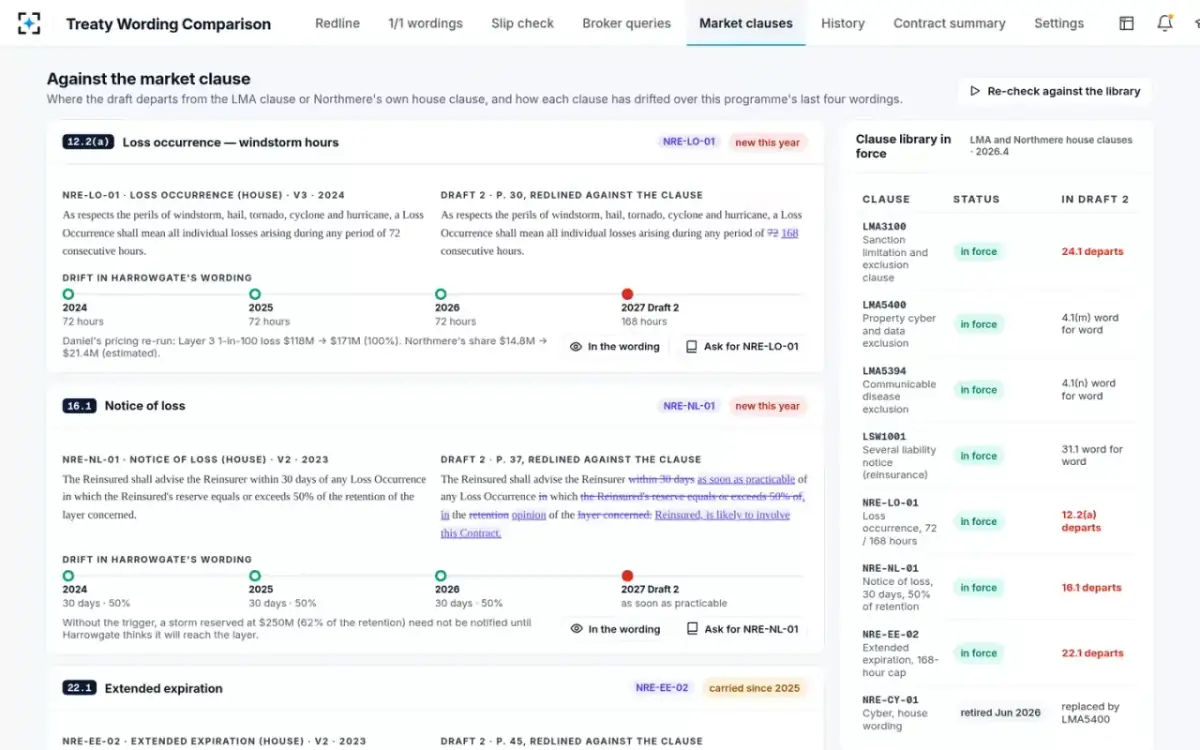
The same draft changed the notice of loss clause the hours interact with. The house clause required notice within 30 days of any loss occurrence reserved at 50% or more of the layer's retention; the draft replaced that with notice "as soon as practicable" when the cedant judged the layer likely to be involved. A storm reserved at $250 million, 62% of the $400 million retention, would no longer have to be reported. On a longer hours clause, more storms combine to reach the layer, and the reinsurer would learn later that they had.
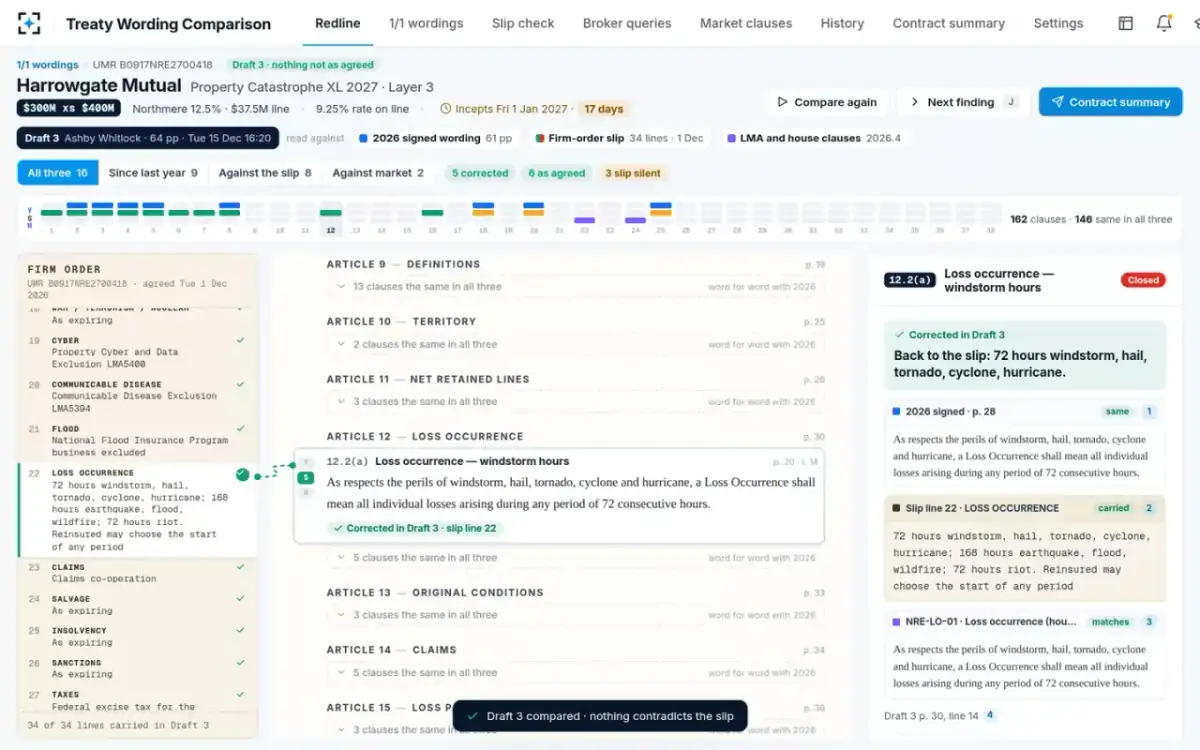
Draft 3: back to 72 hours, the words of slip line 22
How to check an hours clause at renewal
An hours clause review takes minutes if the reviewer knows what to look for, and it is the clause most worth reading first. Treaty Wording Comparison rates any change to the hours or the perils in a period as critical by default and tells the treaty underwriter whenever it changes, whatever the slip says. The checks below apply with or without it. How the same review fits the wider wording is set out in who signs off each clause, and how to test any tool on exactly this kind of change in the ten-change seeded test.
Eight checks on an hours clause before signing
- Hours per peril match the slip
Every peril, every number. A peril moved between lists is a change even when no number changed.
- The catch-all period is stated
The period for perils not listed (168 hours in the Covéa wording) decides novel events such as a pandemic.
- The causal words are unchanged
“Arising out of and directly occasioned by one catastrophe” is not the same test as “one event”.
- The exclusion of losses outside the window survives
Without it, the period limits nothing.
- The right to choose the start matches the slip
Neither added nor removed in redrafting.
- Area limits, if any, are carried
Some clauses limit an occurrence by geography as well as time.
- Extended expiration has its cap
An occurrence running past expiry should be limited to the same hours.
- Notice of loss still bites
A longer period with a looser notice trigger means larger occurrences reported later.
Reinstatement terms interact with all of this: each occurrence that hits a layer uses limit, and the CAS pricing study note explains that a layer's total capacity for the year is its occurrence limit multiplied by one plus the number of reinstatements (Clark, CAS). More, smaller occurrences use reinstatements on lower layers; fewer, larger ones exhaust upper layers. The Treaty Wording Comparison page follows the sample draft from the hours clause to a signed contract summary.
Questions people ask
What happens to losses outside the hours window?
They are not excluded from the treaty; they form a separate loss occurrence, subject to its own retention. In the litigated Covéa wording, no individual loss occurring outside the period "shall be included in that 'Loss Occurrence'". Whether the separate occurrence reaches the layer depends on its size, which is why the period's length moves recoveries so much.
Can business interruption losses be aggregated under an hours clause?
In Unipol v Covéa, England's Court of Appeal held that they can: an insured's business interruption loss occurs once, when the peril first affects the premises, and the whole of it can fall in the period even if the financial loss continues afterwards. Another tribunal had reached the opposite view on a similar clause, so the exact words still matter.
Is a 72 hours clause the same in property insurance and reinsurance?
The idea is the same, a time limit on what counts as one event, but the job differs. In a direct property policy it groups damage to one insured's property; in a catastrophe treaty it groups thousands of the cedant's claims into loss occurrences, each above a retention. A treaty's periods are set per peril on the slip and must be read against it.
Who should approve a change to the hours clause?
The treaty underwriter who priced the layer, because the change alters expected losses and the shape of the tail. In the sample settings, any change to the hours or perils is rated critical, a clause that contradicts the slip blocks the contract summary, and only the underwriter can accept it, with the slip endorsed to match.
Does a longer hours clause always cost the reinsurer more?
No. It merges losses into fewer, larger occurrences, which costs upper layers more and can cost lower layers less. In the illustrative example on this page, moving from 72 to 168 hours added $200 million to Layer 4 and took $130 million off Layer 2.