The reinsurance risk transfer test asks whether a contract moves enough insurance risk to the reinsurer to be accounted for as reinsurance. Under the statutory accounting text carried into SSAP No. 62R it has two conditions: the reinsurer must assume significant insurance risk, and it must be reasonably possible that the reinsurer realizes a significant loss. Actuaries test the second with cash-flow models and benchmarks such as the "10-10" rule. But a contract usually fails through its clauses, the refunds, caps, cancellation terms and payment schedules that limit what the reinsurer can lose, and those clauses change between drafts. Botminds' Treaty Wording Comparison is an agentic solution that compares each broker draft with the slip, last year's wording and the market clause, so a clause that narrows risk transfer reaches the right person before anyone models the contract or signs it.
The accounting text names the features to look for. Judging risk transfer needs "a complete understanding of that contract and other contracts or agreements between the ceding company and related reinsurers", including every feature that limits the reinsurer's risk or delays its payments (NAIC Issue Paper No. 75, quoting the pre-codification manual). The table maps each named feature to the condition it threatens.
The clauses that limit risk transfer, and the test each one threatens
| Clause or feature | Condition it threatens | What a wording review should flag |
|---|---|---|
| Experience refunds | A reasonable possibility of significant loss | Any return of premium or profit to the cedant based on the treaty’s results |
| Cancellation provisions | Significant insurance risk | Rights to cancel or commute, especially one-sided or fee-based ones |
| Adjustable features | A reasonable possibility of significant loss | Sliding scale commissions, swing-rated premiums, additional premiums triggered by losses |
| Additions of profitable lines of business | Significant insurance risk | A widening of business covered that the slip did not price |
| Payment schedules | Timing risk: timely reimbursement | Fixed dates for paying claims instead of paying as the cedant pays |
| Accumulating retentions from multiple years | Timing risk: timely reimbursement | Retentions that carry across years before the reinsurer pays |
| Loss ratio caps and low aggregate limits | A reasonable possibility of significant loss | A cap or aggregate that stops the reinsurer’s loss early |
| Other agreements with the same reinsurer | The whole test, across contracts | Side letters, linked contracts, profit-sharing that refers to other treaties |
What is the risk transfer test in reinsurance?
It is the accounting condition a contract must meet before any credit is taken for it as reinsurance. The text is blunt: "Unless the so-called reinsurance contract contains this essential element of risk transfer, no credit whatsoever shall be allowed on account thereof in any accounting or financial statement of the ceding insurer" (NAIC Issue Paper No. 75). Both conditions must hold. The reinsurer assumes significant insurance risk only if "the probability of a significant variation in either the amount or timing of payments by the reinsurer" is more than remote, and the significance of a possible loss is judged on "the present value of all cash flows between the ceding and assuming companies under reasonably possible outcomes, without regard to how the individual cash flows are described or characterized".
Insurance risk has two parts in the text, underwriting risk and timing risk, and the second is where wording does most of its damage. "Payment schedules and accumulating retentions from multiple years are contractual features inherently designed to delay the timing of reimbursement to the ceding company." There is a narrow exemption: where the reinsurer takes on "substantially all of the insurance risk" on the reinsured portions, such as a straight quota share with no risk-limiting features, the significant-loss condition need not be shown.
What is the 10 10 rule?
The 10-10 rule is a benchmark, not a rule in the accounting text: a contract is said to transfer risk "if there is at least a 10% chance of a 10% or greater loss for the reinsurer". It was developed because, as a 2009 paper in the Casualty Actuarial Society's E-Forum puts it, "Neither SSAP 62 nor FAS 113 provide a clear numeric trigger of when risk transfer fails" (Freihaut and Vendetti, CAS E-Forum, 2009). The two tens were "loosely derived" from the standard's "reasonable chance of a significant loss": a 10% chance taken as reasonable, a 10% loss taken as significant.
Its weakness is that it looks at one point of the loss distribution. A contract with a 9% chance of losing half its premium fails the 10-10 rule; one with a 10% chance of losing exactly 10% passes. That is why actuaries moved to a measure that uses the whole tail.
What is expected reinsurer deficit?
Expected reinsurer deficit, ERD, is the probability of a net present value underwriting loss for the reinsurer multiplied by the net present value of the average severity of those losses, expressed against premium. "A treaty is typically considered to exhibit risk transfer if ERD is greater than 1%", which matches the 10-10 rule's corner (10% times 10%), but "ERD has not been explicitly endorsed by any professional body" (Freihaut and Vendetti, CAS E-Forum, 2009). Treat 1% as the common benchmark, not the law.
Expected reinsurer deficit, term by term
Probability of a reinsurer loss
P(NPV loss)
Share of simulated outcomes in which the present value of payments to the cedant exceeds the present value of premium received.
The actuary’s cash-flow model
Average severity of those losses
× E[loss | loss] ÷ premium
The average NPV loss in those outcomes, as a share of premium. Every cash flow between the parties counts; broker and reinsurer expenses do not.
Same model, constant interest rate
Expected reinsurer deficit
= ERD
The 2009 paper’s two worked examples came to 2.85% and 2.09%; both above the common 1% benchmark.
Freihaut and Vendetti, CAS E-Forum 2009
Clauses that cut the tail
− caps, refunds, commutations
Each limits the losses that drive ERD. They are found in the wording before they are found in the model.
The wording review
Which clauses limit risk transfer?
The ones in the table at the top, and anything that does the same work under another name. The accounting text closes off relabelling: "Regardless of what a particular feature might be called, any feature that can delay timely reimbursement violates the conditions for reinsurance accounting", and any feature that may affect the timing of reimbursement "should be closely scrutinized" (NAIC Issue Paper No. 75). A clause called a "claims cooperation" provision that sets payment dates is a payment schedule.
The 2009 CAS paper's examples show how ordinary the features look. Its first contract was a workers compensation quota share with an 80% cession, a 25% ceding commission, a profit commission paid if the loss ratio was 66% or less and a 100% loss ratio cap; its second, an excess of loss contract swing-rated at a provisional 8.5% that could move by 2.5 points, and automatically commuted after five years unless the cedant paid a $50,000 maintenance fee. For both, the authors wrote, it was not reasonably “self-evident” that risk transfer existed, “due to the presence of such features as low loss ratio caps and swing-rated premiums” (Freihaut and Vendetti, CAS E-Forum, 2009). Both passed when modelled. Neither could have been judged without reading the clauses.
Why a contract's boundary is part of the test
Risk transfer is judged across everything the parties agreed, not one document. SSAP No. 62R's implementation guidance, as the NAIC quoted it in 2025, says a contract "is not defined, but is essentially a question of substance", and requires that "features of the contract or other contracts or agreements that directly or indirectly compensate the reinsurer or related reinsurers for losses be considered in evaluating whether a particular contract transfers risk" (NAIC SAPWG, Ref #2024-06, quoting SSAP No. 62R, Exhibit A, question 10). If the agreements together do not transfer risk, none of them does, "regardless of how they are structured".
That is the accounting reason for the annual attestation. After 2005, New York required the CEO to attest that "no side agreements exist that would reduce, limit, mitigate or otherwise affect the risk being transferred under a reinsurance agreement" (New York DFS, Circular Letter 8 (2005), Supplement 1), and the NAIC added a CEO and CFO attestation to the property and casualty annual statement. A wording review cannot see an undisclosed side letter. It can make sure the signed wording is the whole of what the review saw, and that the entire-agreement clause is there.
Regardless of what a particular feature might be called, any feature that can delay timely reimbursement violates the conditions for reinsurance accounting.
NAIC Issue Paper No. 75, quoting the pre-codification statutory accounting manual
What happens if a reinsurance contract fails risk transfer?
The cedant gets no reinsurance credit for it, and regulators can act. Florida's statute is direct: "No credit shall be allowed for reinsurance with regard to which the reinsurance agreement does not create a meaningful transfer of risk of loss to the reinsurer", and where an agreement "creates a substantial risk of insolvency to either insurer", the Office of Insurance Regulation "may by order require a cancellation of the reinsurance agreement" (Florida Statutes s. 624.610(13)–(14)).
It happens in practice. Being party to a reinsurance agreement without meaningful risk transfer is one of the events that triggers a referral to Florida's Property Insurer Stability Unit, and the regulator's July 2026 report lists one such referral among those made between 3 December 2025 and 11 June 2026 (Florida OIR, Property Insurance Stability Report, July 2026).
Florida referred 19 insurers for enhanced monitoring; one referral was for a contract without meaningful risk transfer
What is finite reinsurance?
Finite reinsurance is a contract designed to transfer a limited, often small, amount of insurance risk, usually alongside financing or timing benefits. It is legitimate when accounted for as what it is; the abuse is booking it as reinsurance when it transfers too little risk. New York acted in 2005 "because of concern about the improper use of finite reinsurance to manipulate financial reporting results" (New York DFS, Circular Letter 8 (2005), Supplement 1), and the 2009 CAS paper opens by citing "the abuses of the past several years in the use of finite reinsurance contracts" as the reason documentation and quantification of risk transfer became standard.
The features that make a contract finite are the ones in the table above: caps, refunds, commutations and adjustable premiums that bound the reinsurer's loss. None is wrong in itself. Each is a reason to model the contract and keep the result on the file.
Why a redline should flag these clauses before the actuary models them
The actuary models the contract as written in the draft the actuary is given. If a cap, a refund or a widened scope arrives in Draft 3 after the model was run on Draft 2, nobody re-runs it unless someone notices. That is a wording review's job: flag the clause the moment it appears, tell the person who owns the test, and keep the answer with the contract.
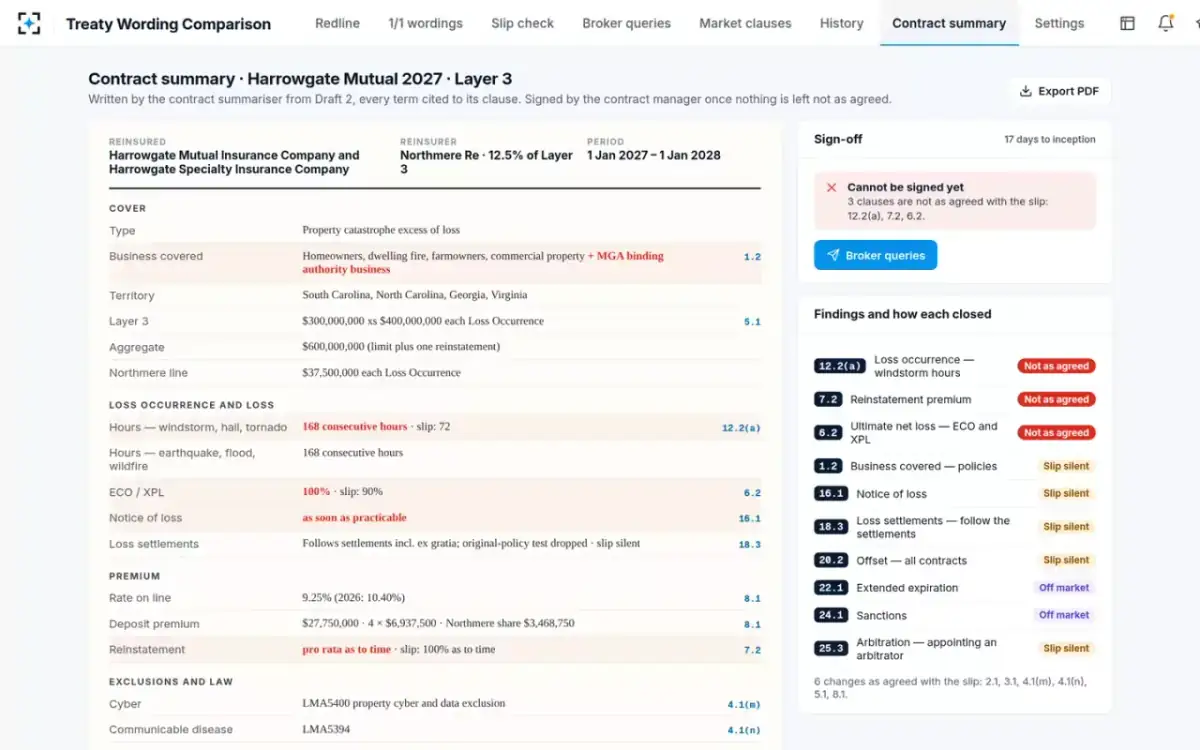
Take the fictional sample programme in Treaty Wording Comparison. The broker's Draft 2 brought business written by managing general agents into the treaty's business covered, a change the slip never mentioned. On that property catastrophe treaty it was an exposure question for the underwriter, and the broker restored the expiring wording. On a quota share, the same kind of edit is one of the features the accounting text names: "additions of profitable lines of business to the reinsurance contract". The comparison does not decide which; it makes sure the change cannot be signed without someone deciding.
A change the slip never mentioned, rated before anyone signs

Do profit commissions affect risk transfer?
Usually not directly, but they can indirectly. The 2009 CAS paper advises that "Profit commissions generally should not be considered in risk transfer analysis", because the test looks at scenarios where the reinsurer loses and a profit commission is rarely paid in those. It adds two cautions: a profit commission raises the premium a reinsurer needs, which changes the test, and carryforwards in multi-year contracts can move losses between years and "would need to be incorporated into the model" (Freihaut and Vendetti, CAS E-Forum, 2009).
For a wording reviewer, that makes the carryforward language the clause to watch. A one-year profit commission with no carryforward is unlikely to matter; a deficit carried into next year's commission can. A change from one to the other between drafts is a finding for the actuary, not just for the accountant who will calculate it.
The contract summary shows business covered as drafted, and blocks the signature
Who decides risk transfer, and what goes on the file
The actuary measures; the officers decide. The 2009 CAS paper is explicit: "the final decision belongs to the CEO or CFO of the company. Risk transfer analysis, and more specifically ERD, is a tool to aid them in that decision." It also recommends documenting every contract reviewed for risk transfer, not only those whose risk transfer is not "reasonably self-evident", the class for which the Reinsurance Attestation Supplement requires documentation. The wording review supplies the first page of that file: the clauses that could limit risk, as signed. How the officers' attestation fits the wider chain is set out in who signs off each clause, and the timing rule that sits beside risk transfer in the nine-month rule.
Eight things a wording review should hand the risk transfer tester
- Every experience refund and profit-sharing clause
With any carryforward language, quoted as signed.
- Cancellation and commutation rights
Who can exercise them, when, and any fee to avoid a forced commutation.
- Adjustable premium and commission terms
Sliding scales, swing ratings and loss-triggered additional premiums, with their ranges.
- Caps and aggregate limits
Loss ratio caps, annual aggregates and their relation to premium.
- Payment terms
Anything that sets payment dates or delays reimbursement beyond the cedant’s own payments.
- Retentions across years
Any retention or deductible that accumulates over more than one period.
- Changes to business covered
Lines added or removed since the version that was modelled.
- The entire-agreement clause
So the tested wording is the whole agreement the officers attest to.
The Treaty Wording Comparison page shows how each finding is cited to its clause and routed to the person who owns it.
Questions people ask
Does a quota share need risk transfer testing?
Not always. Where the reinsurer assumes substantially all of the insurance risk on the reinsured portions, as in a straight quota share with no risk-limiting features, the reasonable-possibility-of-significant-loss condition need not be shown. Add a loss ratio cap, a sliding commission or a profit-sharing carryforward and the contract may need modelling.
Is the 10-10 rule required by SSAP 62R?
No. The accounting text sets the two conditions but no numeric threshold; the 10-10 rule and the 1% ERD threshold are actuarial benchmarks that grew up to give the words "significant" and "reasonably possible" a number. Auditors and regulators may expect to see one of them, but neither is the rule itself.
Does a commutation clause fail risk transfer?
Not necessarily. The 2009 CAS paper says contracts with commutation clauses "may still meet risk transfer requirements", but any effect on cash flows, such as a fee to avoid early commutation, has to be modelled, and a commutation at a predetermined date returns some risk to the cedant.
How often should reinsurance contracts be tested for risk transfer?
At least whenever the terms are set or changed, which for an annual treaty means each renewal and each amendment. Multi-year contracts and those with carryforwards need testing over the whole period, and the CAS paper notes that year-by-year renewals with carryforwards "may require a specific analysis" each time.
Can a reinsurance agreement be cancelled for failing risk transfer?
In Florida, the regulator can order cancellation where an agreement creates a substantial risk of insolvency, and the statute denies credit for an agreement without meaningful risk transfer. Other states' credit-for-reinsurance laws and regulations should be checked for the cedant's domicile.