An AI contract comparison tool reads two versions of a contract and reports the differences, usually with a summary of what each change means. For most commercial agreements that is the job. A reinsurance treaty wording asks a different question of each difference: was it agreed on the slip, does it depart from the market or house clause, and what does it do to the money? A general tool has no slip, no clause library and no pricing file to answer with. Botminds' Treaty Wording Comparison is an agentic solution built around those references: agents compare each broker draft three ways at once, rate each finding by the team's own materiality rules and draft a cited query, and people decide. The figure below sets the two kinds of tool side by side.
A general AI contract comparison tool and a treaty comparison answer different questions
General AI contract comparison tool: The earlier version you upload.
Treaty Wording Comparison: Last year’s signed wording, the firm-order slip and the LMA or house clause, at once.
General AI contract comparison tool: What changed?
Treaty Wording Comparison: Is this what we agreed, and if not, who decides?
General AI contract comparison tool: Varies; often paired by position.
Treaty Wording Comparison: Paired by meaning, with page and line kept for each.
General AI contract comparison tool: Shown as a change, like any other.
Treaty Wording Comparison: Marked not as agreed, with the slip line printed beside it.
General AI contract comparison tool: Shown as a change, like any other.
Treaty Wording Comparison: Marked slip silent; a query asks the broker for its intent.
General AI contract comparison tool: Not known: no pricing data.
Treaty Wording Comparison: Described in plain words, with numbers only from your pricing file.
General AI contract comparison tool: Whoever reads the output.
Treaty Wording Comparison: Underwriter for terms and price, counsel for follow, offset, law and arbitration.
What does an AI contract comparison tool do?
An AI contract comparison tool aligns two versions of a document, finds the textual differences and uses a language model to describe them, often grouping them by clause type and flagging those it considers risky. The best combine a deterministic text comparison, which finds every change, with the model's explanation, which helps a reader decide what to look at first. The weaker ones let the model do the finding, which is where omissions and invented changes creep in.
The research behind these tools was built mostly on commercial contracts. CUAD, the expert-annotated dataset most contract review models are measured on, was assembled from contracts filed with the U.S. Securities and Exchange Commission, and its 41 clause categories run from governing law and cap on liability to licence grants, non-compete and most favoured nation (Hendrycks et al., NeurIPS 2021). An hours clause, a reinstatement provision and a follow-the-settlements clause are not among them.
What is the best AI contract comparison tool for reinsurance treaties?
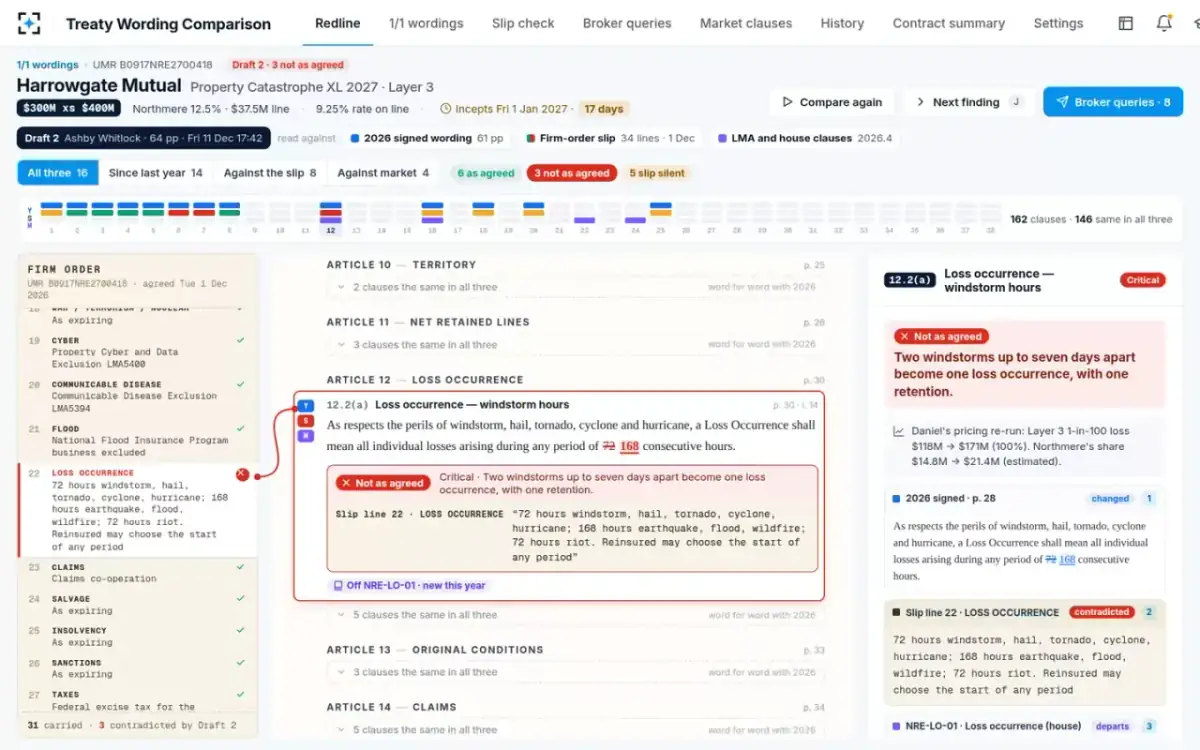
The best tool is the one that holds the references your decision depends on. For a commercial lease, that is the previous draft. For a reinsurance treaty it is at least three documents: the slip that records the deal, last year's signed wording that "as expiring" points to, and the market or house clause the team accepts by default. A tool that compares only two documents, however clever its model, can tell you a clause changed and cannot tell you whether anyone agreed to it.
One draft, three comparisons: what a two-document tool sees and what it doesn't
The second test is whether the tool keeps the decision with the right person. The Bank of England and FCA's 2026 survey of UK financial firms found that 80% of respondents had AI agents in production that provide decision support, where the agent recommends and people decide and act, and only 2% had deployed agents with broad autonomy (Bank of England and FCA, 2026). For a treaty wording, decision support means the tool can rate and explain a change but never accept it.
The same clause read three ways: last year, the slip and the house clause
Can AI compare two contracts reliably?
It can, when the design does not ask the model to be the only detector. Finding every character that changed is a solved problem for deterministic comparison. What language models add is pairing clauses that moved, reading a slip line and the clause that should carry it as the same term in different words, and explaining a change in plain language. Those are judgement-shaped tasks, and they should be checked.
Supervisors describe the same split. EIOPA's 2025 survey of insurers defines "Semi-Autonomous" generative AI as "systems capable of generating complete outputs, such as draft contracts or next-best-action recommendations, with a certain degree of automation, while still requiring human validation before implementation", and reports that assisted and semi-autonomous systems were 83% of the use cases insurers reported (EIOPA, 2025). How to measure reliability on your own wordings, by planting known changes, is set out in can ChatGPT compare two contracts.
What is the difference between redlining and contract review?
Redlining shows what changed; contract review decides whether the change is acceptable. The first is mechanical and can be complete. The second needs a reference for what was agreed, a view of what the change does, and authority to accept it. In a reinsurance team those three sit with different people: the slip with the contract manager, the price with the treaty underwriter, the legal clauses with counsel.
The courts take the review side seriously because the words are what get enforced. New York's highest court has held that a follow-the-settlements clause "does not alter the terms or override the language of reinsurance policies", quoting its own earlier decision (USF&G v American Re, 2013). A redline that shows a change to a follow clause is the start; deciding whether the changed words still say what the parties meant is the review. Contract redline software for treaties covers where each step sits in a team's tools.
Why do treaty wordings need special review?
Three reasons put treaty wordings outside what a general tool is tuned for. They are manuscript documents: "A reinsurance contract is often a manuscript contract setting forth the unique agreement between the two parties", and the CAS textbook warns that "this heterogeneity of contract wordings" means anyone "comparing various reinsurance data" must check "that the reinsurance coverages producing the data are reasonably similar" (Patrik, CAS). There is no standard form against which a model can learn what normal looks like.
They carry regulatory clauses that have nothing to do with the commercial bargain. Credit for reinsurance under the NAIC's model law can depend on the agreement including a provision for 100% security if a Reciprocal Jurisdiction reinsurer "resists enforcement of a final judgment" (NAIC Model Law #785), and the statutory accounting text carried into SSAP No. 62R requires an insolvency clause and an entire-contract provision (NAIC Issue Paper No. 75). And they are shared: one wording is signed by every reinsurer on a layer, so a single drafting error is carried into every line.
The form and wording of reinsurance contracts are not as closely regulated as are insurance contracts, and there is no rate regulation of reinsurance between private companies.
Patrik, “Reinsurance”, Foundations of Casualty Actuarial Science, Casualty Actuarial Society
Does a generic tool know LMA clauses?
Only if you give it the library, with versions, and it knows which clause each part of the draft should be compared with. Market model clauses are revised and replaced; house clauses are a team's own accepted wording; and a departure accepted at one renewal tends to be carried into the next without anyone choosing it again. A tool needs all of that history to say "this departs from the clause in force" rather than "this differs from something".
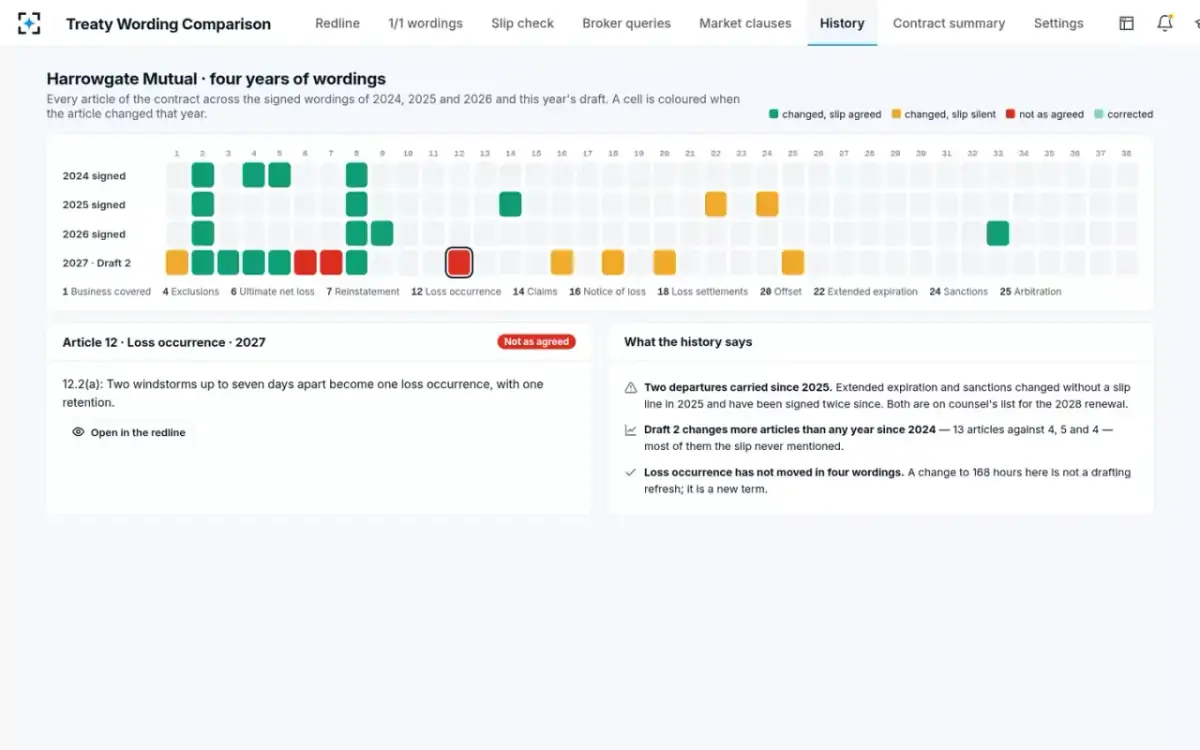
In the fictional sample programme, the clause library is version 2026.4 of the LMA and the sample reinsurer's house clauses; one house cyber clause was retired in June 2026 and replaced by an LMA clause. Draft 2 departed from four library clauses. Two departures were new: the hours clause against the house loss occurrence clause, and notice of loss against the house notice clause. Two had been accepted at the 2025 renewal and carried twice since: extended expiration without a 168-hour cap, and a sanctions clause naming only U.S. law. A two-document comparison against last year would show neither of those two, because last year's wording already had them.
Four years of one programme's wordings, article by article
What is materiality in contract review?
Materiality is the rule for which differences need whose attention, and how fast. In a treaty review it is set by the team, not by the tool: what makes a change critical is what it does to price, cover or enforceability for that book. The sample settings below show one team's choice. The impact rater in Treaty Wording Comparison applies them, says in plain words what a change does to the cover and pulls the exposure note from the pricing file; it never says a change is acceptable.
One team's materiality settings for treaty wording changes
| Kind of change | Rating | Why it matters | Decided by |
|---|---|---|---|
| Hours or perils in a loss occurrence period | Critical | Changes how many retentions apply and which layers pay | Treaty underwriter |
| Reinstatements, limits, retentions, ECO / XPL | High | Moves price and capacity directly | Treaty underwriter |
| Business covered and exclusions | High | Changes what the treaty covers at all | Treaty underwriter |
| Follow, offset, law, arbitration | Medium | Decides disputes and recoveries when something goes wrong | Reinsurance counsel |
| A clause that contradicts the slip | Blocks signing | Until corrected, or accepted and the slip endorsed | Treaty underwriter |
Ratings are not the same as prices, and the solution keeps the two apart. In the sample, the impact rater describes the hours change in a sentence (two windstorms as much as a week apart now count as one loss occurrence with one retention) and shows the underwriter's own re-run beside it; it does not compute a price of its own. The numbers on a finding come only from the pricing file. What one changed number in an hours clause costs works that example in full.
Is there a free AI contract comparison tool?
Yes: general chatbots will compare two pasted contracts, and word processors include a free deterministic compare. For a treaty team the licence is the small cost. The large ones are the hours a person still spends holding the slip and the clause library beside the output, and the risk of a missed contradiction. A free tool that leaves the three-way read to a person has not reduced the work that matters.
There is also the question of where a wording goes. Treaty wordings carry negotiated prices, retentions and shares, and EIOPA's survey found insurers' reliance on third-party AI providers high, "making vendor risk management crucial" (EIOPA, 2025). Whatever the price, the terms on which a tool handles confidential contracts belong in the evaluation.
Where treaty wording comparison does not fit
Treaty Wording Comparison is built for reinsurance treaty wordings read against a slip, earlier wordings and a clause library. It is not a general contract tool for leases, supply agreements or employment contracts, where a general AI comparison tool is the right category. It does not draft or negotiate wording; the broker does. For specialty and excess and surplus policy wordings, where a broker's manuscript is set against an insurer's form, Botminds has a separate solution, Policy Wording Comparison.
Five questions that sort a general tool from a treaty tool
- Can it hold the slip and say “as agreed” only where the slip says so?
Without that, every change is just a change.
- Does it compare against a versioned clause library?
Including departures accepted in earlier years and carried since.
- Does it pair renumbered clauses by meaning, with page and line?
Treaties are redrafted from last year; articles move.
- Can you set materiality and routing?
Hours to the underwriter, legal clauses to counsel, your ratings.
- Does it ever accept, edit or send?
It should describe and draft; people accept, correct and send.
Each answer can be checked on a past renewal of your own; the Treaty Wording Comparison page describes that run and the six agents involved.
Questions people ask
What is the difference between AI contract review and AI contract comparison?
Comparison finds the differences between versions; review judges a document, or a difference, against what it should say. Most products marketed for contract review extract and flag clauses in a single document. A treaty needs both: a comparison across versions and a review of each difference against the slip and the clause library.
Can an AI contract comparison tool read a slip?
A general tool can read a slip as text, but it does not know that the slip is the reference for whether a change was agreed, or that "as expiring" points to last year's signed words. In Treaty Wording Comparison the slip mapper links each slip line to the clause that must carry it and sends any line with no clause to a person.
Can AI rate how much a wording change costs?
It can describe what a change does, but a number needs a pricing model. In the sample settings, the impact rater takes numbers only from the pricing file: the reinstatement change is shown as $9.28 million of reinstatement premium instead of $27.75 million for a full-limit loss on 1 September, because that is what the file's terms produce.
Does a treaty comparison tool learn our house clauses?
It should compare against them, by version, rather than learn them loosely. In the sample, the library version is a setting, retired clauses are marked with their replacements, and counsel decides library changes.
Should an AI comparison tool keep a record of each comparison?
Yes. EIOPA's opinion on AI governance expects insurers, on a risk-based basis, to keep records of the data and methods behind their AI systems so that results are reproducible and traceable. In the sample, each draft, comparison, query, broker reply, acceptance and signature is on the activity trail with who, what and when, so a later reader can see why a clause was signed.