A reinsurance statement of account is the periodic statement of what is owed on one reinsurance contract for one period: premium ceded, less ceding commission, brokerage and taxes, less losses paid, plus or minus cash already exchanged, ending in a balance due to one side or the other. On a brokered treaty the same account usually exists three times, as the cedant's ceded account from its own books, the broker's statement of account to each reinsurer and the reinsurer's technical account, and the cash moves only when all three agree. The hard part is not the arithmetic but the order: each party waits on another, so a late or wrong statement at one handoff delays every party after it. Botminds' Reinsurance Account Reconciliation exists for that quarter, reading all three versions as they arrive, ticking what agrees and explaining what does not, so the accountant spends the weeks on decisions rather than on finding the line.
The examples below come from the solution's fictional sample data: Calder Ridge Mutual, its 2026 commercial property quota share placed by Ashgrove Re Partners, and its reinsurer Northfold Re, which writes 30% of the cession. The rules come from state statute and NAIC texts, linked where they appear.
Five people carry one quarterly account, at three companies
Today
Renders the quarterly account from the company’s books, then ticks the broker's and the reinsurer's versions against it by hand and works out why the totals differ.
With agents
Opens each account with the matching items already ticked and each difference given a cause, the lines in each statement and an owner.
Still theirs: agreeing the account and every query that leaves the building
Today
Builds a statement of account per reinsurer from the cedant's account, then hears weeks later that a total is wrong, without being told which line.
With agents
Gets one query naming each wrong line on the statement, the figure it should be and the treaty clause behind it.
Still theirs: reissuing the statement and remitting the cash
Today
Books the reinsurer's share from the statement and the cedant's data, and is told the technical account is wrong without the rate or date behind it.
With agents
Sees the two figures side by side with the clause quoted, and corrects or answers in one reply.
Still theirs: the reinsurer's own books and its view of what is owed
Today
Learns which paid-loss recoveries are old when the year-end provision is worked out.
With agents
Sees every balance by counterparty and age each day, with chasers drafted for approval.
Still theirs: which reinsurer to chase, and how hard
Today
Co-signs large settlements on figures that cannot be traced back to the three statements.
With agents
Signs with the three statements, the open breaks and their owners in front of them.
Still theirs: the second signature on large payments
What is a reinsurance statement of account?
A statement of account is the account for one contract, one reinsurer and one period, set out so that the balance can be paid. On a quota share the items are familiar: gross premium ceded, ceding commission, brokerage, any premium tax or excise tax allowance, paid losses and loss expenses, cash calls already paid, and the balance. On an excess of loss contract there are fewer items per quarter, usually deposit premium instalments, adjustment premium, reinstatement premium and paid recoveries, but the same logic applies.
The name changes with the writer. The cedant usually calls its version the ceded account or ceded technical account, because it comes out of the company's ceded reinsurance accounts. The broker issues a statement of account to each reinsurer showing that reinsurer's share. The reinsurer books what it receives into its own technical account, its running account of premium and claims on the business it has assumed. "Reinsurance technical accounting" is the name for the whole cycle, not one document.
At Calder Ridge, the sample treaty's wording sets the rhythm: the company renders quarterly accounts within 45 days of the end of each quarter, each loss is shown once, and balances are settled within 30 days of agreement of the account. Those three clauses decide most of what follows.
Three versions of one account, written by three parties
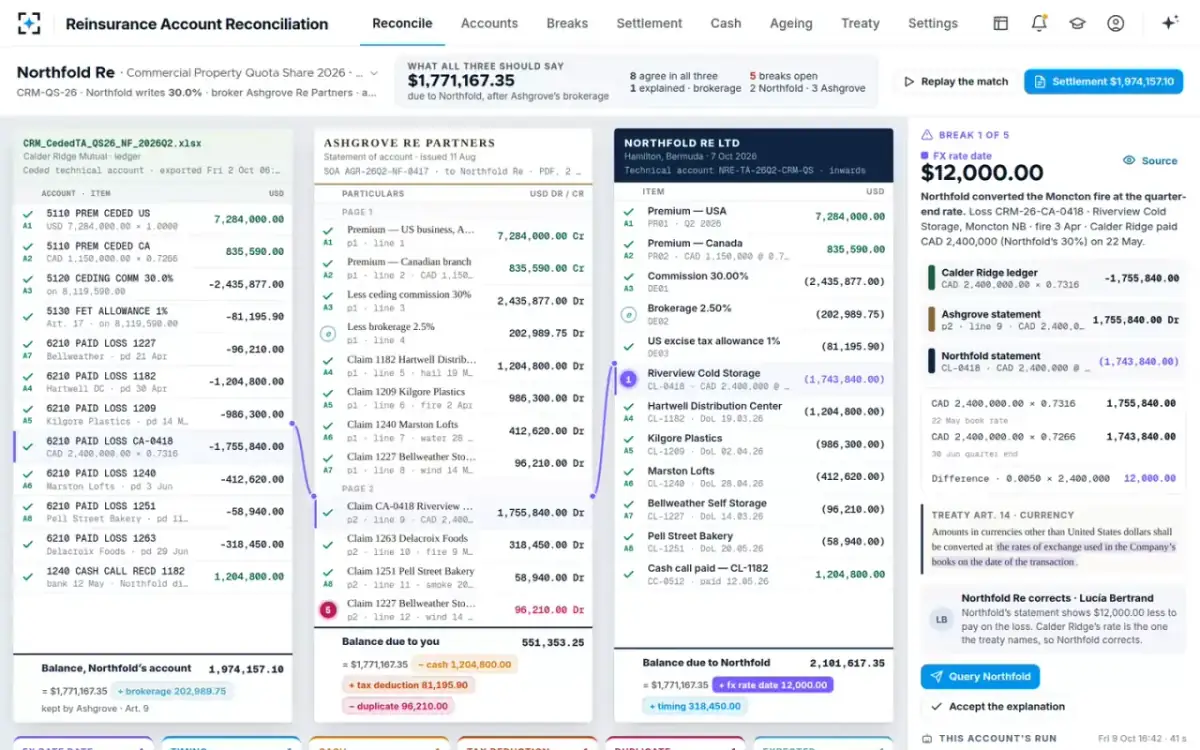
The same quarter arrives in three shapes, in three orders, from three systems. Calder Ridge's version is a spreadsheet export from its general ledger, with account codes. Ashgrove's statement of account SOA AGR-26Q2-NF-0417, issued on 11 August, is a two-page PDF of particulars with debit and credit columns. Northfold's technical account, dated 7 October, lists premium, commission, brokerage, tax and each claim with its own reference.
In the sample quarter the three balances were $1,974,157.10 (the cedant, before the broker's brokerage), $551,353.25 (the broker) and $2,101,617.35 (the reinsurer). The figure all three should have shown, once brokerage of $202,989.75 is taken by the broker, was $1,771,167.35 due to Northfold. Each statement added up correctly to its own total. Two of them were still wrong, each in a different way, which is why matching three statements is a different job from checking one.
Three statements of one quarterly account in Reinsurance Account Reconciliation
Who prepares the statement of account, and who waits on whom?
On a brokered treaty the cedant prepares the account, the broker prepares the statements of account from it, and the reinsurer books and checks. Each step waits on the one before, and the cash waits on all of them. The chain has five handoffs, and a day lost at any of them is a day lost for every party after it.
The first wait is the cedant's own close. The books have to be closed for the quarter, losses paid in the last days of the quarter posted, and foreign-currency items converted under the treaty's currency clause, before an account can be rendered. The second is the broker, who cannot issue a statement until the cedant's account arrives and who, on a panel of five reinsurers, issues five statements. The third is the reinsurer, whose technical account follows the broker's statement and its own claims data. The fourth is agreement: the cedant cannot agree the account while any version differs. The fifth is the cash, which moves from cedant to broker to reinsurer, or back, only after agreement.
One quarter on the sample treaty: the clock from quarter end to cash
- Quarter end to broker statement30 Jun–11 Aug
- Broker statement to reinsurer account11 Aug–7 Oct
- Agree the account: 5-day target
- Settle after agreementup to 30 days
The longest bar is not anyone's work. It is the gap between the broker's statement and the reinsurer's technical account, when two parties held different versions of the same quarter and neither knew which lines were in question. That is where a reconciliation that names the line, the figure and the clause shortens the quarter, and it is the subject of how the settlement itself is prepared and released.
How often are reinsurance accounts rendered, and when is premium due?
As often as the treaty says, and quarterly is the rhythm of the sample wording; the timetable comes from the contract, not from statute. A proportional wording typically fixes a number of days after period end for the account (45 in the sample) and a number of days after agreement for settlement (30 in the sample). Excess of loss programs run on deposit instalments, adjustments and reinstatements instead, which excess of loss reinsurance accounting follows minute by minute.
Where a contract is silent, U.S. statutory accounting supplies a default. In the rule carried into SSAP No. 62R, quoted here from NAIC Issue Paper No. 75, "Reinsurance premiums are due pursuant to the original contract terms (as the contract stood on the date of execution); in the absence of a specific contract date, reinsurance premiums will be deemed due thirty (30) days after the date on which (1) notice or demand of premium due is provided to the ceding insurer or (2) the assuming insurer books the premium" (NAIC Issue Paper No. 75). The date matters because overdue balances count against the party carrying them at year end, which reinsurance balances receivable works through.
How long does a reinsurance broker have to remit funds?
Thirty days from receipt, for money a broker collects for the cedant, in states that follow the NAIC Reinsurance Intermediary Model Act. Florida's enacted version requires the broker's written authorization to provide that the broker "must render accounts to the insurer accurately detailing all material transactions, including information necessary to support all commissions, charges, and other fees received by, or owing to, the reinsurance intermediary broker and must remit all funds due to the insurer within 30 days after receipt" (Florida Statutes s. 626.7492(4)(b)). The model act's wording is the same in substance (NAIC Model #790).
All funds collected for the insurer's account will be held by the reinsurance intermediary broker in a fiduciary capacity in a bank which is a qualified United States financial institution.
Florida Statutes s. 626.7492(4)(c)
Two details matter for the statement of account. The duty runs to the insurer the broker represents, so it governs claim recoveries and returns flowing back to the cedant; premium flowing out to reinsurers is timed by the treaty and the broker's terms with the market. And the duty to account accurately for every material transaction is the legal hook for asking a broker to show its workings, line by line, when its statement does not agree. The sample arrangement sets the outward leg itself: the broker remits the reinsurer's share within five business days of receiving Calder Ridge's payment.
Why do reinsurance statements of account disagree?
Because each party builds its version from different data at a different time, and the solution sorts every difference into one of seven causes: an exchange rate taken on the wrong date, an item booked in a different quarter, a deduction left off, cash that moved outside the account, a duplicate, the wrong share, and an item missing altogether. In the sample book all 30 open breaks fell into one of the seven. All of them survive a check that each statement adds up, because each statement does add up.
Thirty open breaks on one quarter's book, by cause
Northfold's account shows five of the seven in one quarter. Northfold converted a Canadian fire loss of CAD 2,400,000 at the 30 June quarter-end rate of 0.7266 rather than Calder Ridge's book rate of 0.7316 on the 22 May payment date, a $12,000.00 difference that the treaty's currency clause settles in the cedant's favour. Northfold booked a $318,450.00 loss paid on 29 June in the third quarter. Ashgrove left off Northfold's $1,204,800.00 cash call, which Northfold had wired straight to Calder Ridge; left off the 1% federal excise tax allowance of $81,195.90; and showed one $96,210.00 loss on page 1 and again on page 2. The brokerage difference is the sixth, and it is expected: the broker keeps it.
Where the weeks go when the account is ticked by hand
Most of a quarterly account's elapsed time is waiting and chasing, not checking. By our estimate for one treaty account carried by hand across cedant, broker and reinsurer, about 28 days pass between collecting the statements and settling, and ten of them are spent chasing the broker and the reinsurer for answers to questions that did not name the line.
Where a quarterly account's days go, by hand and with Reinsurance Account Reconciliation
By hand · 28 days
- Collect and key · 14.3%
- Tick · 17.9%
- Explain · 21.4%
- Chase · 35.7%
- Agree and settle · 10.7%
With the solution · 5 days
- Collect and key · 10%
- Tick · 10%
- Explain · 20%
- Chase · 40%
- Agree and settle · 20%
Chasing shrinks most because the question changes. "Your total does not agree with ours" invites a week of searching at the other end. "Page 2, line 12 repeats claim 1227 from page 1, line 8; Article 11 says each loss is shown once" can be answered the same day. In the sample, the query to Ashgrove carried all three of the broker's breaks in one letter, with Calder Ridge's figure, the broker's figure and the clause for each, and the corrected balance.
Statement of account vs technical account: which one is right?
Neither is right by default; the treaty is. When the broker's statement and the reinsurer's technical account differ, the question is which one follows the wording, and the answer can cut either way. In the sample quarter the broker was wrong three times and the reinsurer twice, and the cedant's own figures were the one version that matched the wording on every item.
That is why the solution checks each version against the contract, not against the cedant's figures alone. Its treaty terms checker recomputes the 30.0% ceding commission, the 2.5% brokerage and the 1% excise tax allowance on $8,119,590.00 of ceded premium from the wording and the panel, and each explanation quotes the article that decides who is right. A cedant's books can be wrong too; the agents report a cedant's line that disagrees with the treaty the same way they report a broker's.
Every account on the panel this quarter, with a square for each party's statement
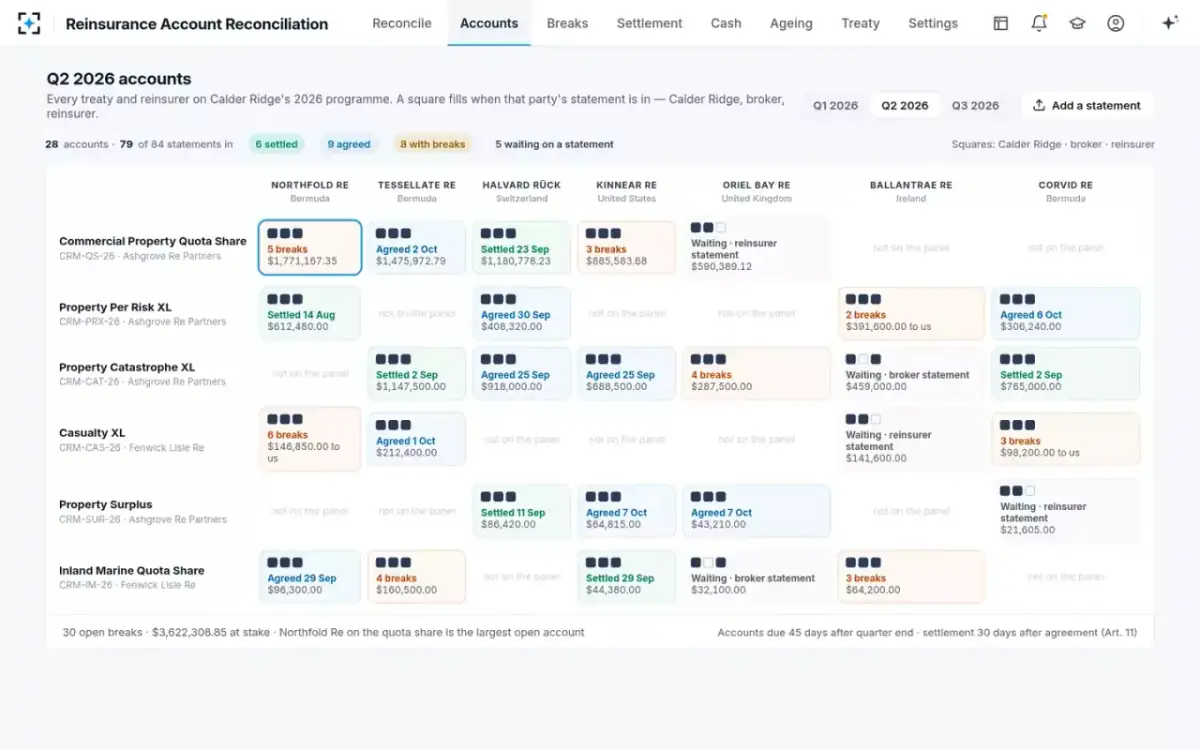
Once the accountant agrees the account, the settlement and its signatures follow; for the most common single cause of a large difference, a cash call that moves between accounts is followed through one disputed quarter. To see the three statements, the breaks and the queries together, start from Reinsurance Account Reconciliation.
Questions people ask
What is a technical account in reinsurance?
It is a party's account of the premium, commission, claims and other underwriting items on a reinsurance contract, as distinct from its investment or general accounts. The reinsurer's technical account for a quarter is its booked view of what it is owed or owes on that treaty, and it should agree with the cedant's ceded account and the broker's statement once all three are corrected.
Is a statement of account the same as an invoice?
Not quite. An invoice demands a sum; a statement of account sets out the movements on a contract over a period and the resulting balance, which can be due to either party. On a quota share in a heavy loss quarter the balance can run from the reinsurer to the cedant, so the same statement is a bill one quarter and a remittance advice the next.
Who signs off a reinsurance statement of account?
The cedant's reinsurance accountant agrees the account once its version, the broker's and the reinsurer's say the same thing, and the cedant's internal approval rules decide who releases the payment. In the sample, the accountant agrees each account and a finance controller co-signs any settlement above $1,000,000.
Can a cedant pay before the statements agree?
It can, on its own figures, if its approval rules allow it, and the open differences then stay with the parties that own them. In the sample quarter Calder Ridge paid $1,974,157.10 to the broker on its own figures with five breaks still open, because its figures matched the treaty and the breaks were the broker's and the reinsurer's to correct.
How long should a broker keep statements of account?
Under the NAIC Reinsurance Intermediary Model Act, a broker keeps a complete file on each transaction for at least ten years after the contract expires, including its premium and loss accounts, and the cedant has the right to audit and copy them. A drafting note invites states to shorten the period for first-party property business and lengthen it for some liability lines.