Excess of loss reinsurance accounting books, for each loss that reaches a layer, three things on the ceding insurer's side: the part of the loss the reinsurers owe, as a ceded reserve and then a recoverable when it is paid; any reinstatement premium the loss triggers, accrued in the period the loss occurs and billed when the wording makes it due; and the limit left on the layer. Each reinsurer then gets a statement for its share. It is precise work because the reserve, the payment and the quarter-end fall on different dates, and each has its own rule. Botminds' Ceded Reinsurance Accounting is software that reads the wording and does the payment-day part as the loss is paid: matching, pricing, limit and statements, with the accountant approving and the controller signing.
This case is fictional and built for this guide: Wyndhurst Mutual, its people, its four reinsurers (called A to D) and the fire are invented, and the arithmetic is ours. Where screens appear, they come from the solution's own sample programme and show the same steps on a different layer.
3 November, 10:41 to 11:24: one payment through Ceded Reinsurance Accounting
- 10:41Claims systemGross paid
Pays $2,900,000 on the paper-converting plant fire of 11 August, the first payment on the claim.
- 10:41Paid loss watcher$1,900,000 to the layer
Matches the payment to the risk and to Property Per Risk XL 2026. The first $1,000,000 is the insurer’s retention; $1,900,000 goes to the layer.
- 10:42Paid loss watcherNo split
Paid loss to the layer this year moves from $2,000,000 (the March fire) to $3,900,000: still inside the band the reinstatement puts back, which ends at $4,000,000.
- 10:42Wording readerTerms confirmed
Reinstatement at 100% of the annual premium, pro rata as to amount only, due as and when losses are paid; accounts within 30 days of each payment.
- 10:43Reinstatement calculator$855,000
1,800,000 × 100% × 1.9 ÷ 4.0. Of the $900,000 accrued at 30 September, $855,000 is now billable; $45,000 stays accrued.
- 10:44Limit position$2.6M left
Incurred loss to the layer $5,400,000 of the $8,000,000 aggregate. The reinstatement is used in full on the reserve; $2,600,000 of last limit is left.
- 10:46Statement drafter4 statements
Recovery $1,900,000 less reinstatement premium $855,000: $1,045,000 due to the insurer, split 35 / 30 / 20 / 15.
- 10:58Senior reinsurance accountantApproved
Reads each step against its clause and approves the calculation and the four statements.
- 11:20Finance controllerSigned
Signs the two statements over $250,000, to reinsurers A and B, with the meaning of the signature recorded.
- 11:24SentDay 0
All four statements go to the broker, 43 minutes after the payment.
What is a per risk excess of loss treaty, and what does it put on the books?
A per risk excess of loss treaty pays, for each risk, the part of a loss above the insurer's retention up to a limit. The CAS textbook chapter on reinsurance defines its unit of loss as all the claims from one loss event on a single policy, and notes that per-risk cover is used mainly for property. A catastrophe treaty adds up losses across every policy hit by one event; a per-risk treaty looks at one risk at a time.
On the books, the treaty produces premium paid to the reinsurers, a ceded share of each loss that reaches the layer, reinstatement premium where the wording charges it, and a running position of limit used and left. Wyndhurst Mutual's layer is $4,000,000 excess of $1,000,000 each risk, losses occurring in 2026, for a flat annual premium of $1,800,000. It has one reinstatement at 100% of the annual premium, pro rata as to amount only, so the layer can pay $8,000,000 in the year. Reinstatement premium is due as and when losses are paid, and accounts go through the broker within 30 days of each payment.
The case: one layer, two fires, one payment
The layer's year had one loss before the one in this case. A printing-works fire on 14 March put $2,000,000 into the layer, paid in full on 20 May. That used half the occurrence limit, so the reinstatement premium was 1,800,000 × 100% × 2.0 ÷ 4.0 = $900,000, billed with the May account.
The second fire came on 11 August, at a paper-converting plant. On 26 August the claims team set a gross case reserve of $4,400,000. Above the $1,000,000 retention, $3,400,000 falls to the layer, taking the loss to the layer on an incurred basis to $5,400,000. Only the first $4,000,000 of losses is put back by the reinstatement, so $2,000,000 of the August loss is reinstated and the other $1,400,000 uses the last limit. The first payment on the claim, $2,900,000 gross, was made at 10:41 on 3 November.
The August fire on Wyndhurst Mutual's per-risk layer
$3.4M
of the $4.4M reserve falls to the layer, above the $1M retention
$900K
reinstatement premium accrued at 30 September, the quarter of the loss
$855K
of it billed on 3 November, as the first $1.9M is paid
$2.6M
of last limit left on the layer, none of it reinstated
How is reinstatement premium booked? Accrued at the loss, billed at the payment
Reinstatement premium is booked as a liability in the accounting period in which the loss happens, at the amount the current loss estimate triggers, and billed when the wording makes it due. That is the rule NAIC Issue Paper No. 75 set for property and casualty reinsurance, carried into SSAP No. 62R: where a treaty obliges the cedant to pay additional premium because of losses, the cedant recognises a liability for it in the accounting period in which the loss events that create the obligation occur, and the reinsurer books the matching asset.
For Wyndhurst that means the third quarter. The fire happened on 11 August, so the 30 September close carries a liability for the reinstatement premium the August reserve triggers: $2,000,000 reinstated, times $1,800,000 ÷ $4,000,000, is $900,000. Nothing is billed yet, because the wording makes the premium due as losses are paid. On 3 November the first payment puts $1,900,000 into the layer and makes $855,000 of that premium billable; the remaining $45,000 stays accrued until the next payment carries paid losses past $4,000,000.
A process that only prices reinstatements at quarter end on paid losses gets both halves wrong. It carries nothing at 30 September, because nothing was paid, and it bills nothing until the December close, weeks after the wording made the premium due. The solution keeps the two apart: the reinstatement calculator prices each payment the day it posts, and the accrual follows the loss estimate the claims team sets.
When is an excess of loss recovery booked?
The recovery is booked in two stages: as a reduction of the loss reserve as soon as the gross loss is reserved, and as an asset, a recoverable on paid losses, when the cedant pays. For the reserve stage Issue Paper No. 75 is specific: "Reinsurance recoverables on unpaid case-basis and incurred but not reported losses and loss adjustment expenses shall be presented as a contra-liability netted against the liability for gross losses and loss adjustment expenses" (IP 75).
So on 26 August Wyndhurst's gross reserve of $4,400,000 carries a ceded reserve of $3,400,000 against it, and its net reserve is the $1,000,000 retention. On 3 November the $2,900,000 payment moves $1,900,000 from the ceded reserve into a recoverable on paid losses, an asset until the reinsurers settle. Gross and ceded reserves fall to $1,500,000 each; the net reserve falls to nothing, because the payment exhausted the retention.
Excess of loss reinsurance accounting entries, from reserve to statement
The entries follow the dates, and each date has one rule. The table lays out what Wyndhurst's books show at each step, in plain terms rather than a chart of accounts, since account names differ from insurer to insurer.
Excess of loss reinsurance accounting entries for one fire, in order
| When | What happens | Amounts | On the books |
|---|---|---|---|
| 26 Aug · reserve set | Gross case reserve; the layer’s share ceded | $4,400,000 gross; $3,400,000 ceded | Ceded reserve netted against the gross reserve; net reserve $1,000,000 |
| 30 Sep · quarter close | Additional premium the loss triggers, at the current estimate | $900,000 | Liability for reinstatement premium, recognised in the quarter of the loss |
| 3 Nov · payment | Gross loss paid; the layer’s share becomes due from reinsurers | $2,900,000 gross; $1,900,000 ceded | Recoverable on paid losses $1,900,000; gross and ceded reserves $1,500,000 each |
| 3 Nov · premium billed | Part of the accrual becomes due under the wording | $855,000 of $900,000 | Ceded premium payable $855,000; $45,000 stays accrued |
| 3 Nov · statements | Recovery less premium, netted as the wording allows | $1,045,000 to the insurer | Split 35 / 30 / 20 / 15 across reinsurers A to D |
| On settlement | Reinsurers pay the net balances | $1,045,000 | Recoverable and payable cleared together |
The fourth row rests on a point the 1998 paper made explicit: "Ceded reinsurance premiums payable are no longer deducted from agents’ balances and uncollected premiums because this payable meets the definition of a liability" (IP 75). The reinstatement premium is a payable in its own right, even when the wording lets it be deducted from the recovery on the statement. Netting decides what cash moves; it does not merge the two on the balance sheet unless the offset rules allow it.
What happens when an excess of loss layer is exhausted?
Once losses use every reinstatement, what is left of the aggregate is last limit: it pays, but it is not put back, and no premium is charged on it. When that is used up too, the layer is exhausted and further losses stay with the insurer or fall to whatever cover sits above or behind it. Two caps apply on a per-risk layer and they are easy to confuse: no single risk can take more than the $4,000,000 occurrence limit, and all risks together cannot take more than the $8,000,000 aggregate.
Wyndhurst's layer has $2,600,000 left after the August fire is reserved, and all of it is last limit. That changes what the head of ceded reinsurance should be asking before the year ends: a third large fire on a different risk could be paid only up to $2,600,000, with no reinstatement available. The solution's limit screen shows the position after every payment, so the question is asked in November rather than discovered in February.
How are statements sent to reinsurers?
Each reinsurer receives its own statement for its signed share, often through the broker, with each line tied to the clause it rests on. Wyndhurst's four reinsurers hold 35%, 30%, 20% and 15%, so the $1,045,000 net balance becomes $365,750, $313,500, $209,000 and $156,750. The two over $250,000 wait for the finance controller's signature; all four go to the broker together, inside the 30 days the wording allows.
The same step on the solution's sample programme: one statement per reinsurer, by signed share
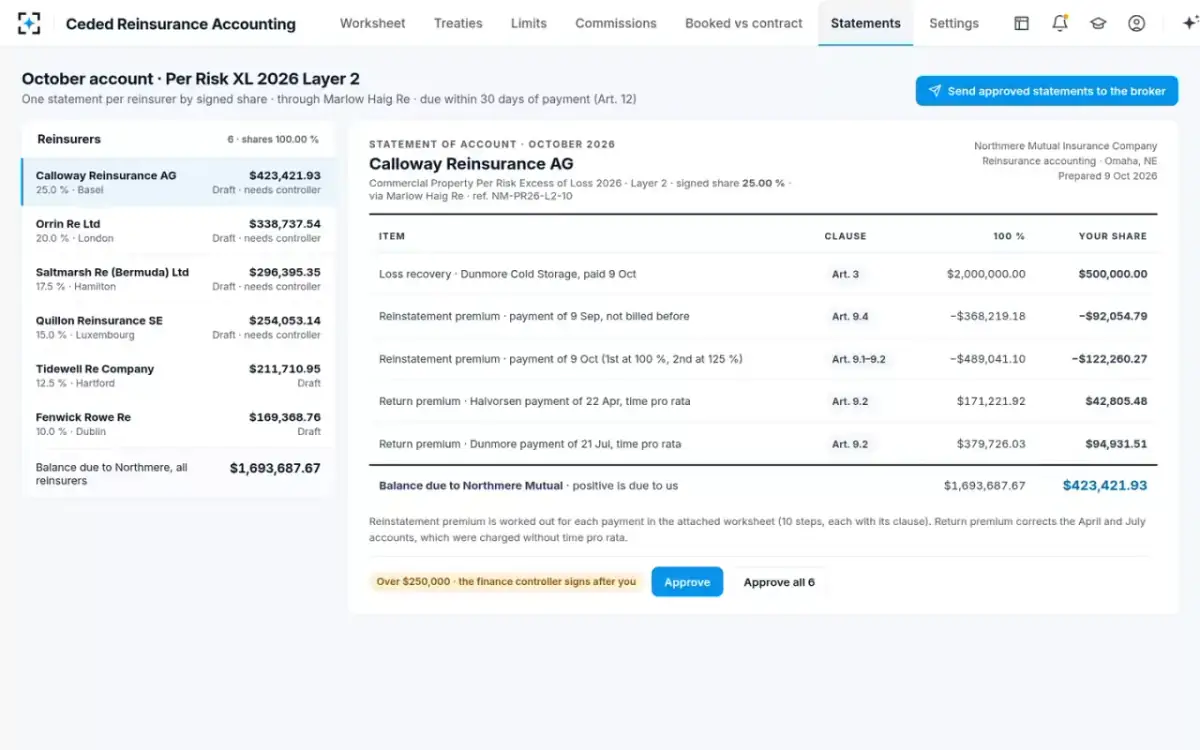
Shares must add up to 100% before anything can be approved, and the cents must add up too. When a balance is split by share, each line is rounded and any remaining cents go to the largest remainders, so the four statements add back exactly to the account. A statement that is a cent out is a statement a reinsurer's accounts team sends back.
The controller's signature, with its meaning, on each large statement
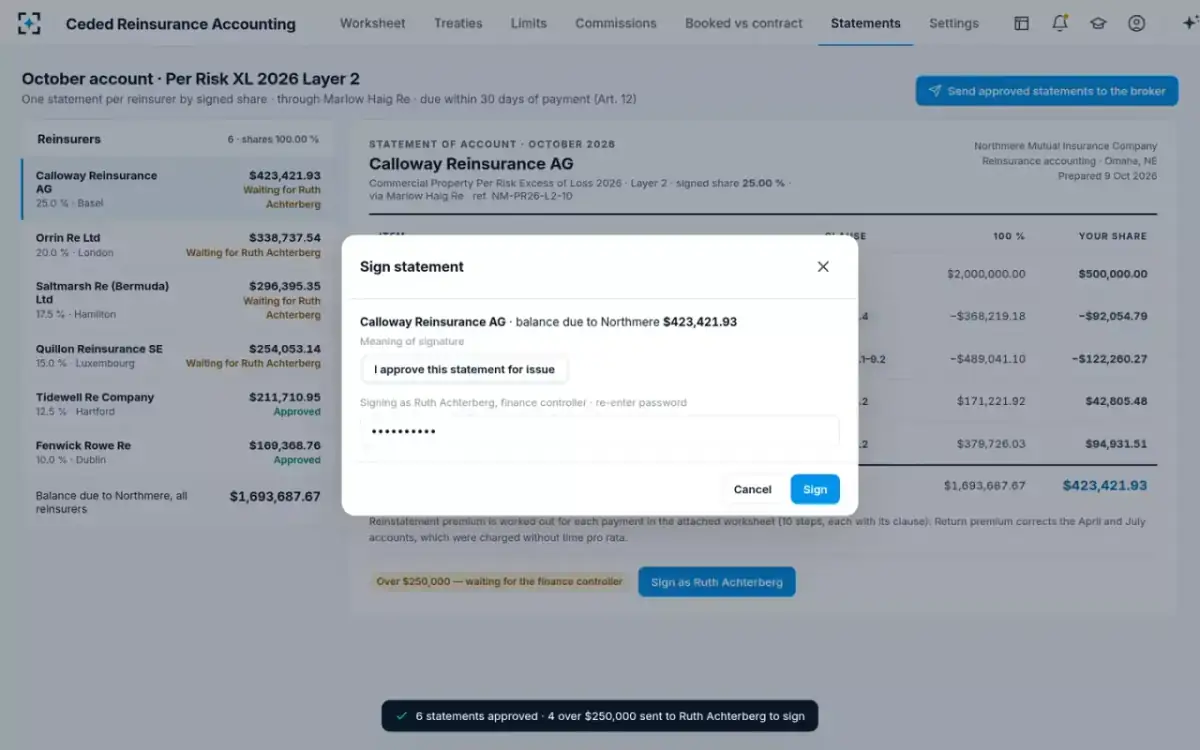
Minutes or weeks: what waiting for quarter end costs
Done on the day of payment, Wyndhurst's account is with the broker in 43 minutes. Done at quarter end, the same account waits for the December close and goes out in mid-January, more than two months after the payment and well outside the 30 days the wording allows.
From the 3 November payment to the statements: Ceded Reinsurance Accounting or quarter end
- Priced, approved, signed and sent43 min
- Wording allows for accounts30 days
- Payment waits for the December close58 days
- Close prepared, statements built14 days
The delay costs more than the time value of $1,045,000. A late account breaches the wording, the reinsurers close their own quarter without it, and the reinstatement premium arrives as a surprise. And the paid-only process has already made the bigger error: it carried no accrual at 30 September for a fire that happened in August. For the arithmetic when a payment does cross from one reinstatement band into the next, see pro rata reinstatement premium in ten steps; for a payment that runs into the last limit, see three worked cases. To run your own layers this way, start from Ceded Reinsurance Accounting.
Questions people ask
Is reinstatement premium ceded premium or a deduction from the recovery?
It is additional premium, and Issue Paper No. 75 treats it as a liability of the cedant from the period of the loss. Some wordings, Wyndhurst's among them, let it be deducted from the loss settlement on the statement, but the deduction settles a payable; it does not turn premium into a smaller recovery.
What if the loss estimate changes after the accrual?
The accrual follows the estimate. If Wyndhurst's reserve fell to $2,500,000 gross, the layer's share would be $1,500,000, all of it reinstated, and the accrual would drop from $900,000 to $675,000. If the reserve rose, the accrual would stay at $900,000, because the reinstated band is already used in full.
How is excess of loss accounting different for a catastrophe treaty?
The unit of loss is the event, not the risk. The same CAS chapter defines a per-occurrence loss as all the claims from one event across every policy it covers, so payments on many policies are coded to one event before they reach the layer, and most catastrophe wordings reinstate at 100% as to time.
When does the reinsurer actually owe the recovery?
Under the treaty's terms, once the insurer's own liability on the loss has been incurred, as the NAIC's explainer on reinsurance puts it, and in cash on the settlement terms the wording sets. Wyndhurst's wording requires accounts within 30 days of each payment, so the recoverable on paid losses is billed on the day and settled on the account.
Should the retention be tracked per risk or for the year?
Per risk on a per-risk layer: each risk's loss first uses the insurer's $1,000,000 retention, and only the excess reaches the layer. An aggregate retention, as on an aggregate excess treaty, is a different term and is eroded by every loss in the year.