A senior reinsurance accountant keeps a ceding insurer's side of every reinsurance treaty: the premium ceded, the losses recovered, the adjustments the wordings make after the fact, such as reinstatement premiums and sliding-scale and profit commissions, and the statement of account each reinsurer receives. The work is hard not because the formulas are hard, but because every treaty states its terms a little differently, each adjustment falls due on its own clock, and the figures often sit in spreadsheets that one or two people maintain and rebuild every quarter. Botminds' Ceded Reinsurance Accounting is software for that seat: agents read the adjustable terms from each wording, work out every adjustment with the clause beside each step, and leave the approval to the accountant and the large statements to the controller.
The examples on this page come from the solution's sample programme: Northmere Mutual, a fictional insurer with 14 treaties, whose senior reinsurance accountant, Elena Vasquez, is also invented. Its figures are sample data, not a customer's results. Research figures are linked where they appear.
Five people carry one ceded account, and one of them holds the arithmetic
Today
Books cessions, recoveries and adjustments for 14 treaties from her own spreadsheets, and cannot be sure each one follows the wording.
With agents
Approves a worksheet in which every row cites its clause, worked out the day the loss is paid.
Still theirs: the approval, and confirming any unusual term before it is used
Today
Sees a paid loss hit the claims system on a Tuesday; the spreadsheet finds out at quarter end.
With agents
Sees each payment matched to its layer as it posts, with the cumulative loss and the reinstatement band beside it.
Still theirs: chasing claims for any payment without a risk or event reference
Today
Signs large statements and the quarterly ceded journal without the arithmetic or the clause in front of her.
With agents
Signs each statement over $250,000 with the steps and clauses attached and the meaning of her signature recorded.
Still theirs: the signature, and the threshold above which it is needed
Today
Cannot see unbilled commission or overpaid reinstatement premium until someone rebuilds the spreadsheets.
With agents
Sees every booked adjustment checked against the wording, with each difference and its clause.
Still theirs: disputes with reinsurers and the terms negotiated at renewal
Today
Turns the cedant’s figures into statements for six reinsurers by hand.
With agents
Receives one approved statement per reinsurer, split by signed share, with the clause on every line.
Still theirs: placement, and collecting from the market
What does a senior reinsurance accountant do?
A senior reinsurance accountant turns treaty wordings into money that moves on time and into statutory figures a regulator can read. The work runs on three clocks. On each paid loss, an excess of loss layer produces a recovery and, where the wording charges for it, a reinstatement premium. Every quarter, proportional treaties produce an account of ceded premium, ceding commission and losses, and any sliding scale is reviewed. Once a year or on a set date, profit commissions are calculated, deposit premiums are adjusted to the final premium, and the annual statement's reinsurance schedules are filled.
The volume behind the seat is large. U.S. property and casualty insurers ceded $1.0 trillion of premium in 2025, according to the NAIC's full-year analysis, though most of it moves inside groups: intercompany pooling was 58.9% of reinsured business and other affiliated business 28.3%. The third-party treaties that carry reinstatements, slides and profit commissions are the smaller share by premium and the larger share of the work, because each one has its own wording.
Even the year-end notes need every treaty's terms. An annual statement instruction reproduced in NAIC Issue Paper No. 75, the 1998 paper behind today's SSAP No. 62R, tells the insurer to "Report the maximum amount of return commission which would have been due reinsurers if they or you had canceled all of your company’s reinsurance", and adds that "Equity amounts should be computed by applying the fixed or provisional commission rate for each contract to the unearned premium reserve" (IP 75). Each contract's provisional rate has to be known, current and right.
What is technical accounting in reinsurance, and how does it differ from the books?
Technical accounting is the treaty-by-treaty arithmetic the wording requires; financial accounting is how those amounts reach the general ledger and the statutory statement. The technical account for a period lists, for one treaty, the premium ceded, the commission allowed, the losses recovered and any adjustment, and splits the balance by each reinsurer's signed share. The financial side then books the same amounts as ceded premium, recoverables, payables and accruals.
The two can disagree without anyone noticing. A reinstatement premium booked with the wrong formula is a correct journal entry of a wrong number; a sliding-scale adjustment that was never run leaves both sides silent. That is why the senior accountant's real control is not the trial balance but whether each technical figure follows its wording, and why the solution re-works every booked adjustment of the last 24 months from the wording rather than from the books. Re-running two years of bookings shows what that finds.
A quarter from the senior reinsurance accountant's chair
On a spreadsheet, a quarter's ceded close for a mid-size programme takes about two and a half working weeks, by our estimate, and most of it is gathering and re-checking rather than calculating. Paid losses and quarterly figures have to be pulled from claims and finance; each adjustable term has to be checked against the wording because the spreadsheet does not hold it; every payment into an excess layer needs its own reinstatement calculation; and each reinsurer needs its own statement.
Where a quarter's ceded close goes, by spreadsheet and with Ceded Reinsurance Accounting
- Collect paid losses and quarterly figures3 d
- Check terms against the wording2 d
- Reinstatement premium per payment3 d
- Sliding-scale and profit commissions2 d
- Statements per reinsurer2 d
- Review and sign-off1 d
- Collect, check, calculate and draft: half a day each2.5 d
- Review and sign-off1 d
The timeline hides the worse problem: payments do not wait for quarter end. In the sample programme a $1.6 million payment into a per-risk layer on 9 September was in the claims system for a month and never reached an account, because the spreadsheet only looked at paid losses at the close. Its $368,219.18 of reinstatement premium was found when the solution worked the layer again. Review and sign-off keeps its full day in both lanes on purpose: the agents shorten the gathering and the arithmetic, not the judgement.
Why the key-person risk sits in the adjustable terms
The risk in a one-person ceded book is concentrated in the terms that adjust after the fact, because each is a date or a condition someone has to remember. Cessions and recoveries on a quota share follow the business; a sliding scale only moves if someone runs it, and a profit commission only arrives if someone claims it. Statutory accounting does not let the books wait: Issue Paper No. 75 requires an accrual for these adjustable features based on the experience recorded for the period, and additional premium triggered by losses belongs in the period the loss event occurs. One per-risk loss, followed from reserve to payment, shows what that means in practice.
Every adjustable term in a wording is a date that someone has to remember, and a spreadsheet does not remember dates.
The sample programme shows each failure once. Two reinstatement payments were charged with the catastrophe formula, 100% as to time, on a layer whose wording pro-rates by time as well: $550,947.95 paid too much. A quarterly sliding-scale adjustment had not been run since December 2025: $322,000 of commission due to the insurer and not billed. A profit commission fell due on 30 June and was not claimed for 101 days: $393,300. None of them is an arithmetic mistake. Each is a term that lived in one person's head.
How many treaties can one reinsurance accountant manage?
There is no published measure, and no official statistic counts reinsurance accountants at all. A more useful question is how many adjustable terms one person can keep on time, because treaties differ far more in that than in size. A per-risk layer with free reinstatements needs its limit tracked and nothing billed; a layer with paid reinstatements pro rata as to time needs a calculation on every payment; a quota share with a sliding scale and a carried-forward loss needs a review every quarter.
What makes a treaty heavy: the adjustable term, its clock, and what one slip cost
| Treaty in the sample programme | Term that adjusts | When it moves | What one slip cost |
|---|---|---|---|
| Per risk XL 2026, layer 2 | Two paid reinstatements, 100% then 125%, pro rata as to amount and time | Every payment into the layer | $550,947.95 overpaid on two payments; $368,219.18 never billed |
| Per risk XL 2026, layer 1 | Three free reinstatements | Every payment, limit only | Nothing to bill; the limit still has to be tracked |
| Property catastrophe XL 2026, layer 1 | One reinstatement at 100%, 100% as to time | Every event | Agreed to the cent |
| Property catastrophe aggregate XL 2026 | Aggregate retention eroded by each event | Every event | $46.6M of the $60M retention used; the next event attaches at $13.4M |
| Workers’ compensation XL 2026 | Adjustable rate on final subject premium | Once, at the final premium | Due 31 March 2027 |
| Homeowners quota share 2025 | Sliding scale 25–40% with a loss carried forward | Every quarter | $322,000 due to the insurer, not billed |
| Commercial property surplus 2024 | Profit commission with a deficit brought forward | 30 months after inception, then yearly | $393,300 due since 30 June, not claimed |
Read that way, a 14-treaty programme carries at least seven separate clocks, and two of them, the per-payment reinstatement and the quarterly slide, fire many times a year. One experienced accountant can carry it, and many do. What breaks is cover: holidays, a resignation in the second quarter, or a new treaty with a term the spreadsheet was never built for.
What skills does a reinsurance accountant need? The rules decide most of them
A reinsurance accountant needs to read a wording as precisely as a lawyer, keep statutory accounts as precisely as an auditor, and keep data from claims and finance in step. Most of the specific knowledge comes from the rules that govern ceded reinsurance in the United States.
- Wordings. Which premium a reinstatement is charged on, whether it is pro rata as to time, how a sliding scale defines its loss ratio, and how long a deficit is carried. The pro rata reinstatement premium clause alone has three separate decisions in it.
- Statutory accounting. SSAP No. 62R governs property and casualty reinsurance: no credit without risk transfer, accruals for adjustable features, and a contract not signed within nine months of inception presumed retroactive and accounted for that way. A late signature is an accounting problem, not only a legal one.
- The annual statement. Schedule F reports each reinsurer, what is ceded to and recoverable from it, the collateral held and how old the balances are; overdue paid-loss recoverables drive a statutory provision.
- Tax. Premium paid to a foreign reinsurer carries a federal excise tax of 1 cent on each dollar under 26 U.S.C. § 4371, which the accounts have to show and someone has to file.
- Attestation. Since the 2005 annual statement the NAIC has required a reinsurance attestation from the chief executive and chief financial officers, after New York's 2005 circular required chief executives to attest that no side agreements reduce the risk a reinsurance agreement transfers. The accountant's files are what that signature rests on.
Senior reinsurance accountant salary and career: what official data shows
No government series isolates reinsurance accountants, so the closest official figures are for accountants and auditors as a whole. The Bureau of Labor Statistics puts their median annual wage at $83,680 in May 2025, and at $93,290 for those working in finance and insurance, one of the best-paid industries for the occupation. The top tenth earned more than $144,090.
Accountants and auditors, by the Bureau of Labor Statistics
$83,680
median annual wage, May 2025
$93,290
median in finance and insurance
1.6M
jobs in 2025; finance and insurance employ 8%
+5%
projected employment growth, 2025–2035
The outlook is steady rather than scarce: employment is projected to grow 5% from 2025 to 2035, with about 115,300 openings a year, many of them replacing people who retire or change occupation (BLS). For a ceded reinsurance team the arithmetic of that is uncomfortable. When the one person who knows which layer pro-rates by time leaves, the replacement inherits a spreadsheet, not the reasons behind it.
Where Ceded Reinsurance Accounting takes the arithmetic, and what the accountant keeps
Ceded Reinsurance Accounting moves the reading and the arithmetic out of one person's spreadsheets and into cited worksheets that anyone on the team can follow. Six agents divide the work: a wording reader turns each term that moves money into a rule with its clause and page; a paid loss watcher matches payments from claims to their layer every 15 minutes; a reinstatement calculator and a commission calculator work out each adjustment; a booked-figure checker re-works the last 24 months; and a statement drafter splits each account by signed share.
The senior accountant's worksheet: a payment arrives, and the layer's limit track updates
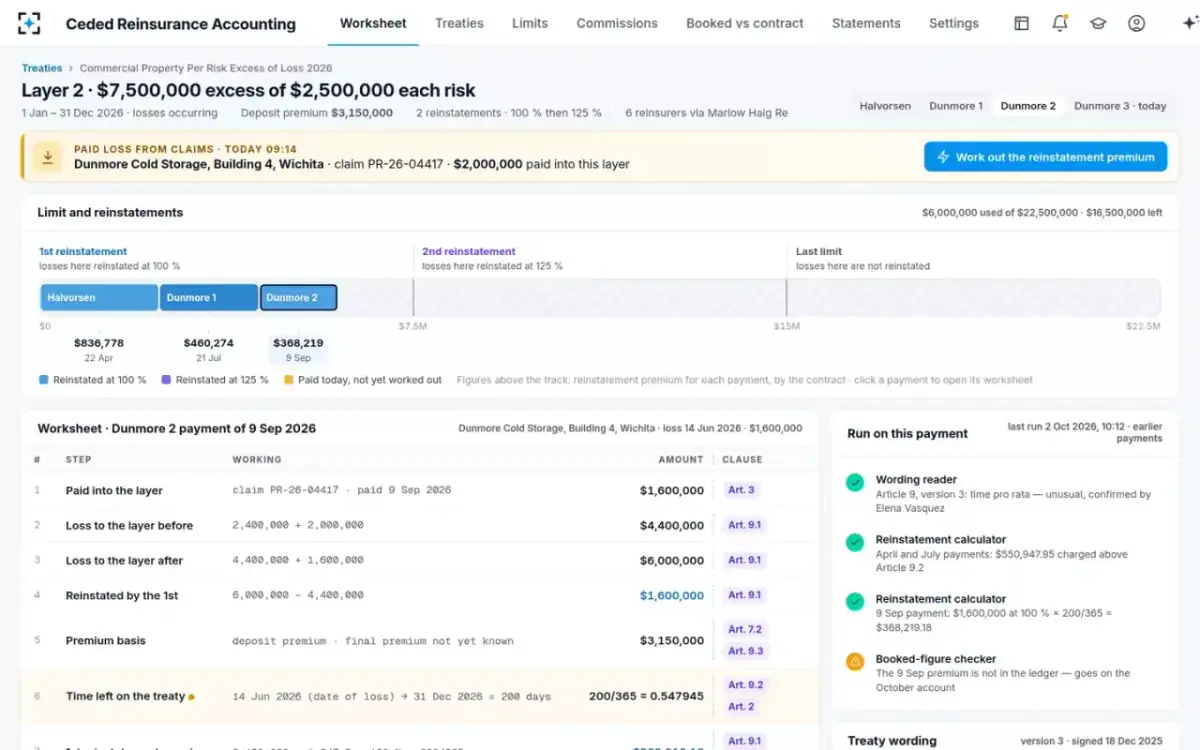
What the accountant keeps is everything that needs judgement. Nothing is booked until she approves a calculation; any term that differs from the rest of the programme, such as time pro rata on a reinstatement, waits for her to confirm it; the controller signs statements above the threshold the insurer sets; and booked entries are never changed, because each difference becomes a new line on the next account. The agents can draft; they cannot book or send.
Every treaty, with the terms that adjust and where each one stands
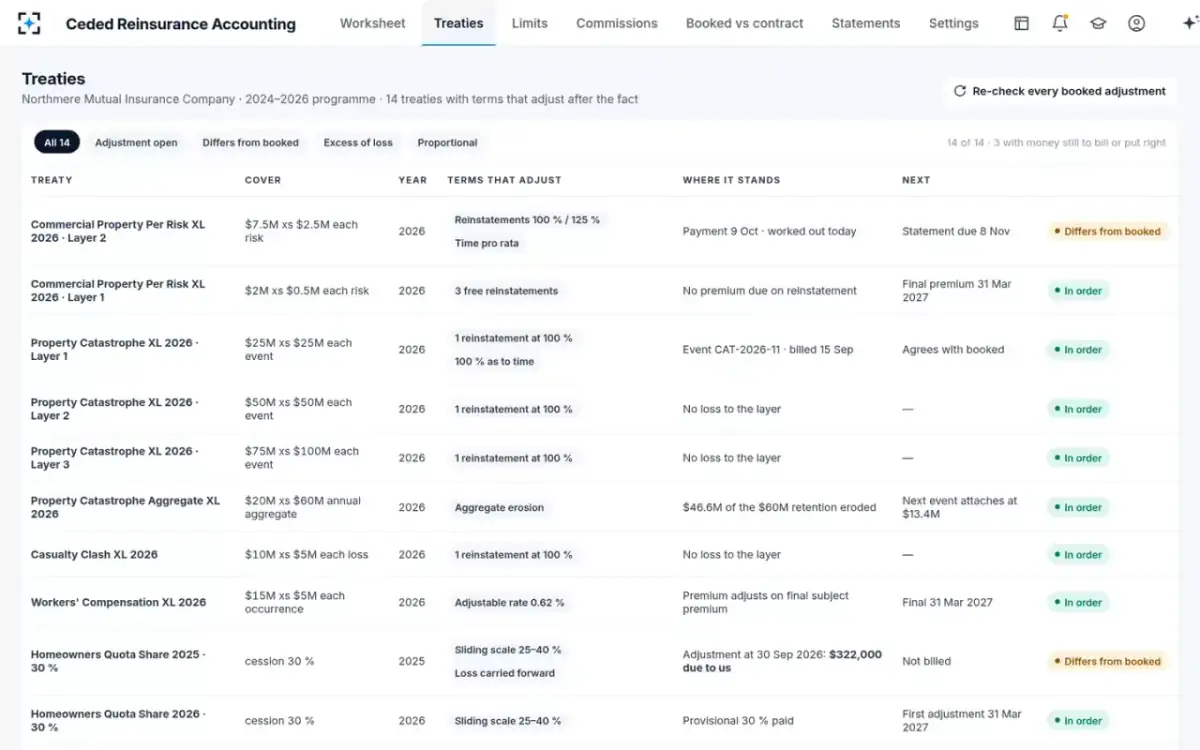
For a team planning the move, going live inside one quarter-end sets out the order: wordings first, then the opening position, then one quarter in parallel. To see the worksheet, the commission screens and the statements together, start from Ceded Reinsurance Accounting.
Questions people ask
What is a reinsurance statement of account?
It is the periodic account for one treaty that shows premium, commission, losses and adjustments and the balance due, split by each reinsurer's share. In the sample programme the wording requires an account through the broker within 30 days of each loss payment, and the October account for one layer produced six statements, one per reinsurer, netting a $2,000,000 recovery against two reinstatement premiums and adding back two return premiums.
Do reinsurance accountants need a CPA?
Not as a rule. The BLS says accountants typically need at least a bachelor's degree in accounting or a related field, and that certification such as the CPA "may improve job prospects". Statutory insurance accounting and treaty wordings are usually learned on the job.
Is reinsurance accounting done by the ceding insurer or the reinsurer?
Both, from opposite sides: the cedant keeps the ceded accounts and the reinsurer the assumed ones, and each books the mirror of the other's adjustments. Issue Paper No. 75 expects reinsurers to estimate premiums the cedant has not yet reported where the lag would distort their loss development.
Can a reinsurance accountant work remotely?
Often, at least in part. The BLS notes that most accountants and auditors work in offices but some work from home. Ceded work depends on access to wordings, claims payments and the general ledger, so what decides it is whether those are reachable from outside the office.
Who signs off a ceded reinsurance account?
The accountant prepares and approves the calculation, and a controller or finance director often signs above a set amount; in the sample programme the line is $250,000 per reinsurer. At year end, the chief executive and chief financial officers sign a reinsurance attestation in the annual statement, a requirement that dates from 2005.