Reinsurance accounting software keeps a ceding insurer's reinsurance accounts: cessions and recoveries, the adjustments treaty wordings make after the fact, such as reinstatement premiums and sliding-scale and profit commissions, and the statement of account each reinsurer receives. The way to bring it live is around the quarter-end, not a software release: load and confirm the wordings, reconcile the opening position of every layer and commission, run one quarter's payments and close in parallel with the current process, and switch when every difference between the two has been explained. The hard part is that the knowledge sits in wordings and spreadsheets rather than in a system, so most of the plan is reading and reconciling. Botminds' Ceded Reinsurance Accounting is built that way: agents read the terms from the wordings and work out each adjustment with its clause, and the accountant approves what is booked.
Ceded Reinsurance Accounting live in one quarter: each week, and what runs beside it
- Wordings read, unusual terms confirmedwk 1–3
- Feeds and opening positionwk 4–5
- 24-month replaywk 6–7
- Live payments in parallelwk 8–13
- Quarter-end close, both wayswk 14–15
- Runs as today; its figures are the ones bookedwk 1–13
- Close, compared line by linewk 14–15
What is reinsurance accounting software, and what should it do?
Reinsurance accounting software is the system a ceding insurer uses to turn its treaty wordings into the money and statutory figures each treaty produces. On the ceded side that means holding each treaty's terms, applying them to every loss and quarterly account, working out the adjustments, drafting a statement per reinsurer and keeping the working for audit. Many insurers run part of this in a policy or finance system and the adjustable terms in spreadsheets, which is where the errors gather.
The test of any such software is whether it reads the terms that move money and shows its working. In the sample programme of Ceded Reinsurance Accounting, a fictional insurer with 14 treaties, the old spreadsheet charged two reinstatement payments with the wrong formula, missed a quarterly slide and left a profit commission unclaimed for 101 days. All figures from it are sample data. Testing a system by replaying 24 months of bookings is the way to find out whether a candidate would have caught them.
Why the go-live follows the quarter-end calendar
The calendar is set by the accounts, not the software. Sliding scales and profit commissions are accrued from the experience recorded in each period, reinstatement premiums triggered by a loss belong to the period of the loss, and statements go to reinsurers on each treaty's accounting cycle. Switching method in the middle of a quarter splits one period across two methods, and nobody can then say which produced the quarter-end figure.
A plan built around the close avoids that. The new system shadows a whole quarter, its close is compared with the current process line by line, and the switch happens at a boundary the auditors already understand. Fifteen weeks is our estimate for a programme of about a dozen treaties; the variable is the number of wordings and how many of their terms are unusual, not the software.
Weeks 1 to 3: load the wordings and confirm the unusual terms
The first three weeks belong to the wordings, because every later figure depends on them. Every slip, wording and endorsement for each treaty in force, and for expired treaties still adjusting, is loaded with its date. The wording reader turns each term that moves money into a rule with its clause and page: cover, period, premium basis, deposit, reinstatements and their pro rata rules, commission scales, carryforwards, deficits and due dates.
Terms read from one wording, with the unusual one confirmed by the accountant
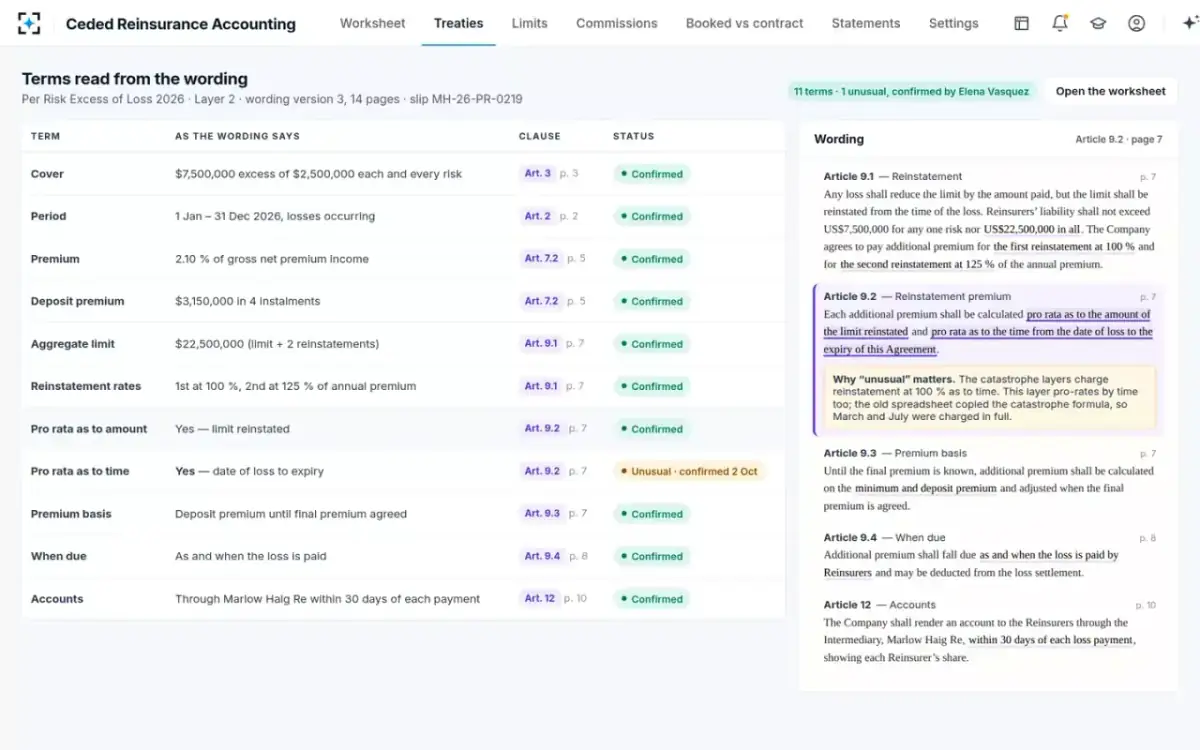
Two things slow this phase down, and both are worth finding early. The first is a wording that is not signed: under statutory accounting a contract not finalised and signed within nine months of the start of its period is presumed retroactive, so an unsigned wording is an accounting question as well as a legal one. The second is a term the rest of the programme does not have. Each one is confirmed by the accountant before first use; in the sample, a time pro rata clause on one per-risk layer was confirmed a week before the first payment it priced. Comparing a new wording with the slip or last year's version is a separate job, the work of Treaty Wording Comparison; the slip against the wording explains it.
What data do you need to start reinsurance accounting software?
Less than most projects assume, and none of it new. The data a ceded accounting go-live needs already exists in wordings, the claims system, the quarterly accounts and the general ledger; the work is pulling it together once.
Eight things to gather before the first week
- Every wording, slip and endorsement
For treaties in force and for expired years still adjusting, with signature dates.
- Signed shares and the broker for each treaty
Statements split by signed share; shares must total 100%.
- Paid losses with references
Claim, risk or event reference, loss date, payment date and amount, for 24 months and then live.
- Event and aggregate loss data
Catastrophe event codes and how far each aggregate retention has eroded.
- Quarterly premium and loss accounts
Earned premium, paid and outstanding losses, per proportional treaty and year.
- Adjustments booked in the last 24 months
Reinstatements, slides, profit commissions and premium adjustments, from the general ledger.
- Subject premium estimates and finals
For excess layers rated on subject premium and paid by deposit.
- Your statement format and signing limits
The broker’s technical account, a spreadsheet or a PDF, and who signs above what amount.
The fifth and sixth items are the ones teams most often leave late, because they sit with finance rather than the ceded team. Without the booked adjustments there is no replay and no opening position, and the parallel run has nothing to be compared with.
Weeks 4 to 7: reconcile the opening position, then replay 24 months
The opening position is where every adjustable term stands on the day the new system starts: limit used and reinstatements left on each excess layer, aggregate retentions eroded, carryforwards and deficits brought into each year, deposit premiums still to be adjusted, and the next due date of each profit commission. It is reconciled from the wordings and the losses, not copied from the spreadsheet, because the spreadsheet's position is what is being tested.
The opening position of every excess layer: used, left, reinstatements remaining
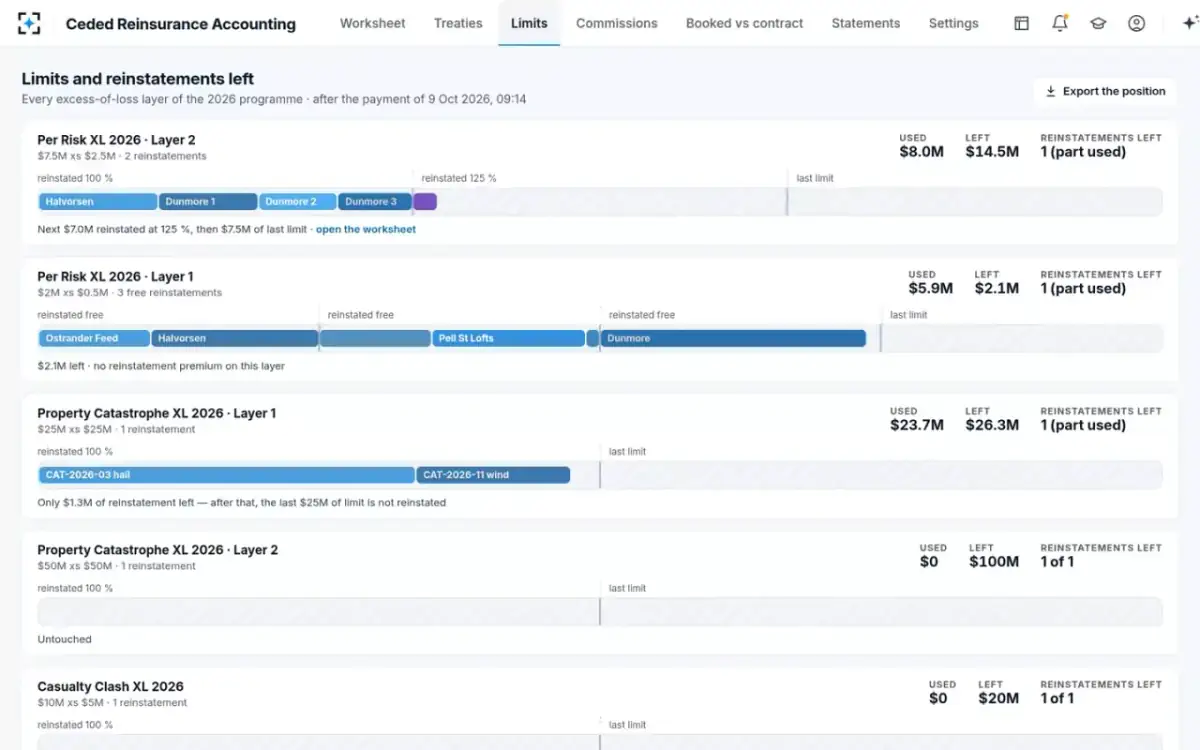
Once the position agrees, the replay runs: every adjustment booked in the last 24 months is worked out again from the wordings and each difference is listed with the booked figure, the figure by the wording and the clause. On the sample programme 36 of 41 agreed to the cent. The five that did not are the first evidence of what the parallel run will be checking for, and each becomes a line on the next account if the accountant agrees.
Can you run reinsurance accounting in parallel? Weeks 8 to 15, one quarter, two methods
Yes, and a parallel quarter is the safest switch: the current process keeps producing the figures that are booked while the new system prices every live payment and prepares the same close. The value is in the comparison. Every difference falls into one of three groups: the new system is wrong, the old method was wrong, or the wording is ambiguous. Each group needs a different person to settle it.
The same quarter, run two ways
Current process: Picked up at the close, if it is picked up.
Ceded Reinsurance Accounting: Matched to its risk or event and layer within 15 minutes of posting.
Current process: Worked in a spreadsheet at quarter end.
Ceded Reinsurance Accounting: Worked the day the loss is paid, ten cited steps, approved by the accountant.
Current process: Run when someone remembers the date.
Ceded Reinsurance Accounting: Run every quarter from the wording’s own loss ratio, carryforward and deficit.
Current process: Built by hand per reinsurer.
Ceded Reinsurance Accounting: Drafted per reinsurer by signed share, to the cent; large ones signed by the controller.
Current process: Totals checked against last quarter.
Ceded Reinsurance Accounting: Each row read against its clause.
Current process: The figures that are booked.
Ceded Reinsurance Accounting: Compared line by line; every difference explained before the switch.
We suggest three conditions for the switch: every difference from the parallel quarter explained in writing, no open error traced to the new system, and the finance controller's signature on the comparison. If a condition fails, run the next quarter in parallel too; a second parallel quarter costs weeks, and a wrong switch costs a year of corrections.
Does reinsurance accounting software change booked figures?
It should not, and Ceded Reinsurance Accounting does not. Booked entries stay as they are; a difference between what was booked and what the wording says becomes a new line on the next account, proposed with the clause and approved by a person. Claims and premium data are read, never written. That is what lets a go-live include a 24-month replay without anyone fearing what it will do to closed periods.
Which systems does reinsurance accounting software connect to?
Five sources and one destination cover the ceded side. The solution reads from all five, writes to none of them, and sends its statements only after a person approves them.
What the solution reads, and what it sends
| System | What it provides | How the solution uses it |
|---|---|---|
| Treaty wordings and slips | Every wording, slip and endorsement of the programme | Read once and on each change; every term tied to its clause and version |
| Claims system | Paid losses with claim, risk and event references | Read only, every 15 minutes by default, hourly or daily if set |
| Quarterly premium and loss accounts | Earned premium, paid and outstanding losses | Inputs to each sliding scale and profit commission |
| General ledger | Adjustments already booked | Checked against the wording; never changed |
| Event and aggregate loss data | Catastrophe events and aggregate erosion | Limit and retention position per layer |
| Your broker | Receives the accounts | A technical account, spreadsheet or PDF statement per reinsurer, after approval |
What controls will auditors ask about at go-live?
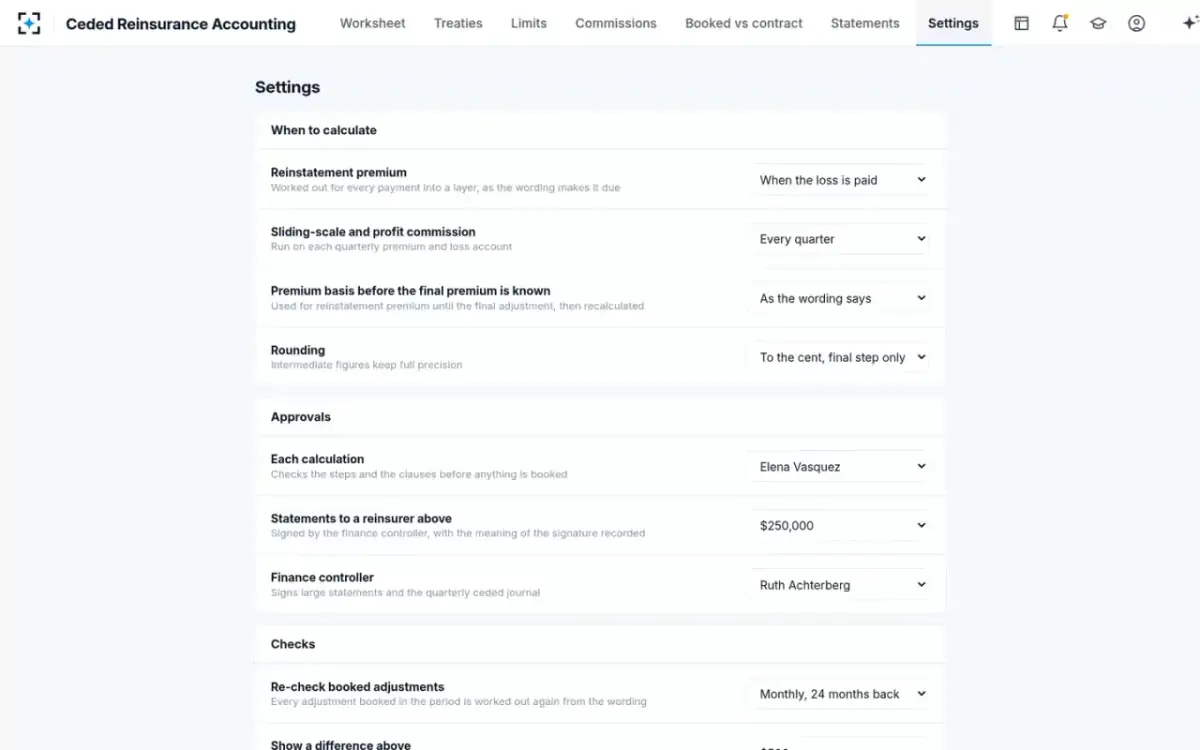
Auditors will ask who approves each figure, who signs what goes out, what the system may never do, and whether all of it can be reconstructed later. The answers should be settings and evidence, not assurances. In the solution, the agents read, calculate and draft but never book or send; an accountant approves every calculation; a statement over the insurer's threshold to one reinsurer waits for the finance controller, who signs with her password and the meaning of her signature recorded; and each agent run, approval, signature and sending is kept with who, what and when.
The controls as settings: when to calculate, who approves, what gets re-checked
Supervisors' expectations point the same way. EIOPA's opinion on AI governance asks insurers to "put in place effective internal control systems during the entire lifecycle of the AI system", with roles and escalation defined in policy (EIOPA-BoS-25-360). Practice is moving in that direction too: in the Bank of England and FCA's 2026 survey, 80% of respondents had AI agents in production for decision support, where agents recommend and humans decide and execute, and only 2% had deployed agents with broad autonomy (Bank of England and FCA). Ceded accounting suits that pattern well: the arithmetic is mechanical, and the approval is a person's.
What the go-live covers in Ceded Reinsurance Accounting, and what it leaves to other systems
The solution covers the part of reinsurance accounting software that reads wordings and works out adjustments: reinstatement premium on each payment, sliding scales and profit commissions each quarter, a 24-month re-check of what was booked, and statements per reinsurer. It sits beside the general ledger and the claims system rather than replacing them. It does not match the insurer's accounts against what reinsurers and brokers send back, which is reconciliation, and it does not chase recoverables or measure contracts under IFRS 17.
Its limits shape the go-live. It cannot match a payment that arrives without a risk or event reference, so the claims extract has to carry one. It never fills a term the wording does not state, so a gap in a wording stays a gap until a person resolves it. And it waits on any unusual term, so the first weeks need the accountant's time. For the role this changes most, see the senior reinsurance accountant's quarter; to plan a go-live on your own wordings, start from Ceded Reinsurance Accounting.
Questions people ask
How long does reinsurance accounting software take to implement?
There is no published benchmark. Our suggested plan for about a dozen treaties takes one quarter plus its close, roughly 15 weeks, and the length depends mainly on the number of wordings and how many of their terms are unusual. The switch should wait for a clean parallel close however long that takes.
Should expired treaties be loaded?
Yes, if they are still adjusting. In the sample programme a 2024 surplus treaty's first profit commission fell due 30 months after inception, and a 2025 quota share was still being adjusted at 30 September 2026. Both would be missed by a go-live that loaded only the current year.
What happens if a reinsurer disputes a figure during the parallel run?
The disputed figure stays on the current process, whose figures are still the ones booked, and the new system's worksheet goes to the head of ceded reinsurance with each step and clause. A dispute is useful evidence: it shows which terms need the clearest working before the switch.
Can we start with the excess of loss layers only?
Yes. Reinstatement premium on paid losses is self-contained and often where the largest single errors sit; in the sample, two payments on one layer were overcharged by $550,947.95. Proportional treaties with slides and profit commissions can follow in the next quarter.
Who should own the go-live?
The head of ceded reinsurance, with the senior reinsurance accountant doing most of the confirming and the finance controller signing the switch. The wordings, opening position and parallel close are accounting judgements, and they should stay with the people who will approve and sign the figures afterwards.