Pro rata reinstatement premium is the additional premium a ceding insurer pays to restore an excess of loss limit after a loss, charged in proportion to the share of the limit reinstated (pro rata as to amount) and, where the wording says so, to the share of the contract period still to run (pro rata as to time). The arithmetic is short. The difficulty is that three decisions hide in one clause: which reinstatement a payment falls in, whether time counts and from when, and which premium the rate applies to. Botminds' Ceded Reinsurance Accounting gives the calculation to one agent, the reinstatement calculator, which reads those decisions from the wording, works each payment in ten cited steps, and stops for a person to approve.
The example is from the solution's sample programme, on a fictional insurer, Northmere Mutual: its commercial property per-risk excess of loss layer of $7.5 million excess of $2.5 million, with two reinstatements, at 100% and then 125%, and a deposit premium of $3,150,000. At 09:14 on 9 October, claims paid another $2,000,000 into the layer. All figures from it are sample data.
The reinstatement calculator in Ceded Reinsurance Accounting: ten steps, and the one a person keeps
Agent
Paid into the layer$2,000,000 on claim PR-26-04417, matched to its risk and this layer (Art. 3).
Never: assign a payment without a risk reference
Agent
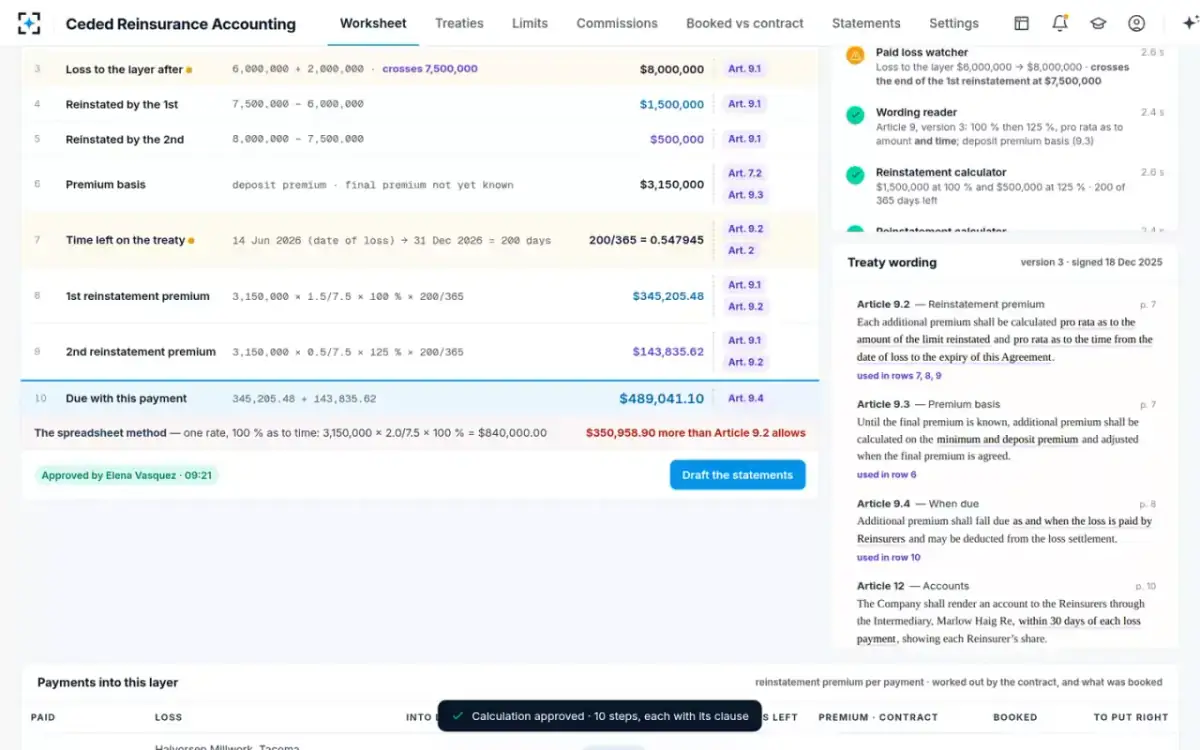
Loss to the layer before$6,000,000 from three earlier payments (Art. 9.1).
Agent
Loss to the layer after$8,000,000, crossing the end of the first reinstatement at $7,500,000 (Art. 9.1).
Agent
Reinstated by the first$1,500,000, at 100% (Art. 9.1).
Agent
Reinstated by the second$500,000, at 125% (Art. 9.1).
Agent
Premium basisDeposit premium $3,150,000, the final premium not yet known (Art. 7.2, 9.3).
Agent
Time left14 June loss to 31 December expiry: 200 of 365 days (Art. 2, 9.2).
Agent
First reinstatement premium3,150,000 × 1.5/7.5 × 100% × 200/365 = $345,205.48.
Never: round before the last step
Agent
Second reinstatement premium3,150,000 × 0.5/7.5 × 125% × 200/365 = $143,835.62.
Agent
Due with this payment$489,041.10, billed as the loss is paid (Art. 9.4).
Never: book or send
A person decides
The accountant approvesReads each row against its clause; nothing is booked until she does.
What is pro rata reinstatement premium? Amount, time, or both
Pro rata reinstatement premium is a reinstatement premium scaled by one or two fractions. As to amount, the premium is the share of the occurrence limit that is reinstated: reinstating $1.5 million of a $7.5 million limit costs one fifth of the reinstatement rate times the premium. As to time, it is further scaled by the share of the period left after the loss. A wording can use the first alone, both, or neither, and the result can differ by hundreds of thousands of dollars on one payment.
The amount factor is close to universal on paid reinstatements, because it is what makes a partial loss cost part of a reinstatement. The CAS study note on reinsurance pricing describes it as reinstatement "for premium proportional to the amount reinstated" (Clark). The time factor is the one that varies, and the one spreadsheets most often get wrong, because it is a property of the individual wording, not of the treaty type.
Four sentences of the wording decide every number in the calculation
Article 9.1Reinstatement
The limit is reinstated from the time of the loss; the Company pays additional premium for the first reinstatement at 100% and for the second at 125% of the annual premium.
DecidesWhich band a loss falls in, and the rate for each band
Article 9.2Reinstatement premium
Each additional premium is calculated pro rata as to the amount of the limit reinstated and pro rata as to the time from the date of loss to the expiry of the Agreement.
DecidesBoth pro rata factors, and the date the time factor counts from
Article 9.3Premium basis
Until the final premium is known, additional premium is calculated on the minimum and deposit premium and adjusted when the final premium is agreed.
DecidesWhich premium the rates apply to, and when it is recalculated
Article 9.4When due
Additional premium falls due as and when the loss is paid by reinsurers and may be deducted from the loss settlement.
DecidesWhen it is billed, and whether it nets against the recovery
Pro rata as to amount: the share of the limit put back
Pro rata as to amount means the reinstatement premium follows the dollars reinstated, not the number of losses. Two losses that each use half the limit cost the same as one loss that uses all of it. For a payment into a layer, the amount reinstated is the part of the payment that falls inside a reinstated band, divided by the occurrence limit.
On the sample payment, the loss to the layer moves from $6,000,000 to $8,000,000. The first reinstatement puts back losses up to $7,500,000, so $1,500,000 of the payment is reinstated by it: one fifth of the limit. The remaining $500,000 is reinstated by the second: one fifteenth. Each fraction is multiplied by its own rate, 100% and 125%, and by the premium the wording names.
Pro rata as to time: why few treaties use it
Pro rata as to time scales the premium by the share of the contract period left after the loss, and it is the exception, not the rule. The CAS study note puts the reason in one sentence: "Given the seasonal nature of some types of catastrophes (e.g., hurricanes), relatively few contracts include reinstatements pro-rata as to time" (Clark). A hurricane layer hit in early October has three months of the year left but most of its season behind it, so a time factor of one quarter would charge little for a reinstatement the cedant may well need again. Most catastrophe wordings therefore charge the full rate whatever the date of loss, which the market calls 100% as to time.
Where it does appear is on covers whose exposure runs evenly through the year, such as a per-risk property layer, and that is exactly where a spreadsheet built for the catastrophe programme fails. In the sample, the catastrophe layers reinstate at 100% as to time and the per-risk layer pro-rates by time from the date of loss. The old spreadsheet applied the catastrophe formula to both.
The same $2,000,000 payment, by the catastrophe formula and by Article 9.2
Catastrophe formula, 100% as to time: One rate, 100%, on the whole $2,000,000.
Article 9.2, amount and time: $1,500,000 at 100% and $500,000 at 125%.
Catastrophe formula, 100% as to time: 2.0 ÷ 7.5 of the limit.
Article 9.2, amount and time: 1.5 ÷ 7.5 and 0.5 ÷ 7.5.
Catastrophe formula, 100% as to time: None.
Article 9.2, amount and time: 200 of 365 days, from the 14 June loss to 31 December.
Catastrophe formula, 100% as to time: 3,150,000 × 2.0/7.5 × 100% = $840,000.00
Article 9.2, amount and time: $345,205.48 + $143,835.62 = $489,041.10
Catastrophe formula, 100% as to time: $350,958.90 more than the wording allows.
Article 9.2, amount and time: What the reinsurers are owed with this payment.
How is a loss split across two reinstatements?
A payment is split at each boundary between reinstatement bands, and each part is charged at its own band's rate. The bands are cumulative: on a layer with an occurrence limit L and two reinstatements, losses from 0 to L are put back by the first reinstatement, from L to 2L by the second, and from 2L to 3L sit in the last limit, which is not reinstated. The question for every payment is where the cumulative loss to the layer stood before it and where it stands after.
The actuarial literature treats the crossing payment exactly this way. In Ana Mata's worked example in the ASTIN Bulletin, a layer of 150 is used up by three claims, and "the fourth claim goes beyond the limit and is considered the second loss or first reinstatement" (Mata, 2000). A claim that straddles a boundary belongs to two bands at once.
On the sample layer the boundary is $7,500,000 and the payment straddles it, which is why the calculator writes steps 4 and 5 separately. A spreadsheet with one cell for "this payment's reinstatement" cannot express a split, so it charges the whole payment at the rate of whichever band the person typing chose. The limits screen then shows what is left: after this payment, $7.0 million more can be reinstated at 125%, then $7.5 million of last limit.
What the wording reader must find before the first step
Before the calculator can run, the wording reader has to have turned the reinstatement clause into rules: the rates by band, both pro rata factors, the date the time factor counts from, the premium basis and when the premium falls due. From the layer 2 wording it read eleven terms, each with its clause and page, and marked one as unusual because it differs from the rest of the programme: pro rata as to time, from the date of loss to expiry.
Eleven terms read from the wording, and the one a person confirmed
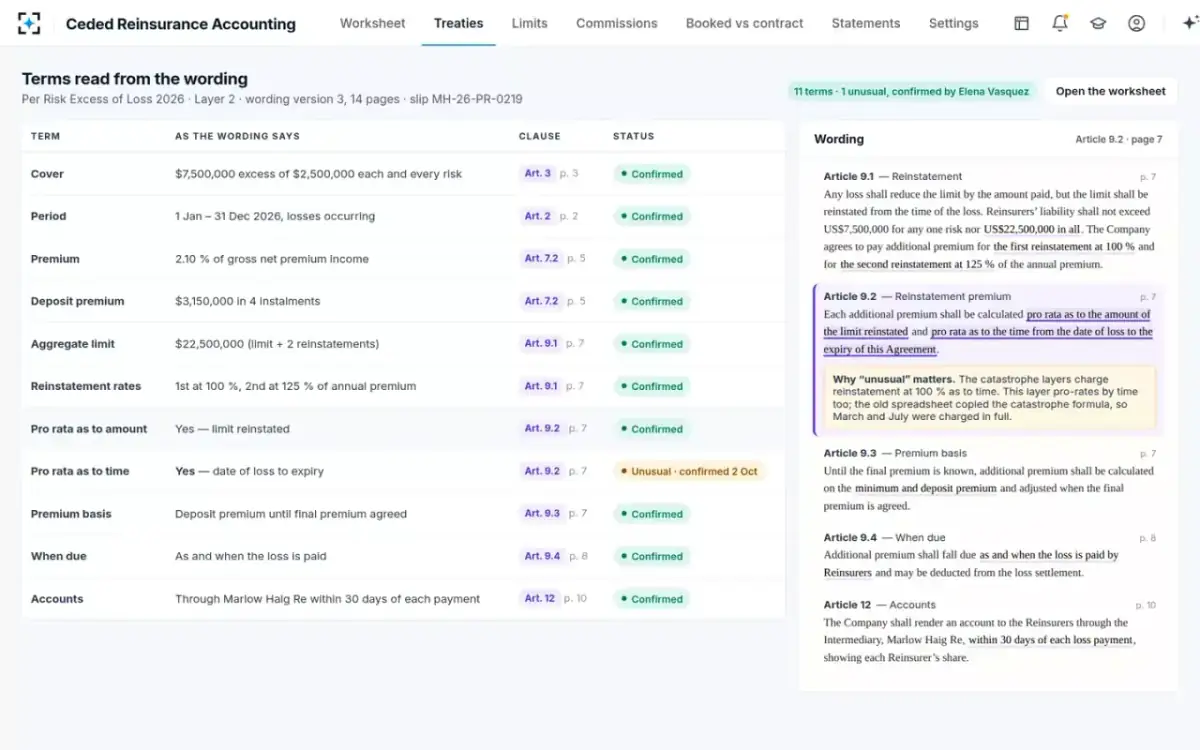
That confirmation is the control that matters most. The reader never fills a term the wording does not state, and every term carries its clause and page, so a reviewer can see why the calculator pro-rated by time. A term that has been confirmed once is applied the same way to every payment that follows, which is what a spreadsheet copied from another layer cannot promise.
When is reinstatement premium due?
Reinstatement premium is due when the wording says, and a common choice is as losses are paid. The sample's Article 9.4 makes it payable "as and when the loss is paid" and lets it be deducted from the loss settlement, so the October statement nets the premium against the $2,000,000 recovery. Where a contract gives no date, statutory accounting fills the gap. Issue Paper No. 75 treats reinsurance premiums as due under the contract's original terms, and, where the contract names no date, as due 30 days after the premium is notified or demanded, or booked by the reinsurer, which starts the clock for treating it as overdue.
Billing and accrual are different questions, though. The same paper requires additional premium triggered by a loss to be recognised in the period the loss event occurs, which can be a quarter earlier than the payment that makes it billable. Excess of loss reinsurance accounting for one loss follows the accrual from the reserve to the bill.
Who approves reinstatement premium in Ceded Reinsurance Accounting, and what they check
A person approves every reinstatement premium before it is booked: in the solution, the reinsurance accountant, row by row against the clause. The calculator never books; it writes the worksheet and waits. What the accountant checks is not the multiplication but the decisions behind it: the band boundaries, the rates, the time factor's start date and the premium basis.
Approved at 09:21: ten rows, each with its article
Above the calculation sits the statement. The sample insurer sends one statement per reinsurer by signed share; any statement over $250,000 to one reinsurer waits for the finance controller, who signs with her password and the meaning of her signature recorded. On the October account four of the six were over the line.
Five ways a spreadsheet gets pro rata reinstatement premium wrong
Most reinstatement errors are not arithmetic but structure: the spreadsheet has no place to hold a term, so the term is lost. The five below each appear in the sample programme or follow from its numbers, and each has a step in the calculator that prevents it.
Five reinstatement premium errors, what each cost on the sample layer, and the step that stops it
| Error | What it looks like | Effect on the sample layer | The step that stops it |
|---|---|---|---|
| Catastrophe formula copied | Time pro rata left out on a layer whose wording includes it | April and July payments charged $550,947.95 too much | 7 · time left, read from Art. 9.2 |
| No split at a boundary | One rate on a payment that crosses into the next band | On 9 October, $52,500 too little before the time factor | 3 to 5 · cumulative loss, then each band |
| Rounding early | Time factor rounded to 0.55 before multiplying | $1,833.90 too much on one payment | 8 and 9 · round once, at step 10 |
| Wrong premium basis | Final premium used before it is agreed, or deposit kept after | At a $3.36M final premium the same payment is $521,643.84 | 6 · premium basis, Art. 9.3 |
| Payment never picked up | A payment between closes that no account reaches | 9 September: $368,219.18 never billed | 1 · paid losses read every 15 minutes |
The fourth row is the reason the premium basis is a step, not an assumption. The deposit premium is provisional, so every reinstatement priced on it is provisional too; minimum and deposit premium sets out when that changes. For the same arithmetic on cases without the agent, including a payment that runs into the last limit, see how to calculate reinstatement premium, worked three ways. To see the reinstatement calculator run on your own wordings, start from Ceded Reinsurance Accounting.
Questions people ask
Does time pro rata count from the date of loss or the date of payment?
Whichever the wording says, and the difference is large. The sample wording counts from the date of loss to expiry: a 3 March loss leaves 303 of 365 days, so a $2.4 million payment costs $836,778.08. Counted from the 22 April payment date it would leave 253 days and cost $698,695.89.
Can reinstatement premium be deducted from the loss recovery?
Where the wording allows it, yes. The sample's Article 9.4 says the additional premium "may be deducted from the loss settlement", so the October account shows the $2,000,000 recovery less the reinstatement premiums due, and one net balance per reinsurer.
What happens when a payment runs past the last reinstatement?
The part of the payment beyond the last reinstated band falls in the last limit, which is paid but not reinstated, so no premium is charged on it. On the sample layer that last limit starts once losses pass $15 million and ends at the $22.5 million aggregate.
Do free reinstatements need any calculation?
No premium, but the limit still has to be tracked. The sample's first per-risk layer has three free reinstatements: each payment reduces and reinstates the limit at no cost until the last limit is reached, and the limits screen shows $2.1 million left on it.
Is the reinstatement premium recalculated when the final premium is known?
If the wording prices reinstatements on the deposit premium until the final premium is agreed, as the sample's Article 9.3 does, yes. A final premium higher than the deposit raises every reinstatement premium in proportion, and the difference goes on the next account.