A sliding scale commission calculator works out the ceding commission a quota share reinsurer owes for a period from the loss ratio: it divides incurred losses, plus any loss carried forward from earlier years, by earned premium, reads the commission rate for that loss ratio off the scale in the wording, and compares the commission earned with the provisional commission already allowed. The difference is the adjustment, due to the ceding insurer if it is positive and back to the reinsurer if it is negative. The calculator below does exactly that, set to a quarter from the sample programme of Ceded Reinsurance Accounting, Botminds' software that runs every sliding scale in a ceded programme each quarter with the clause beside each step. Change any input to run your own treaty.
Sliding scale commission calculator
How do you calculate a sliding scale commission? Loss ratio, band, rate, adjustment
You calculate a sliding scale commission in four steps: the loss ratio the wording defines, the band of the scale it falls in, the commission rate for that point, and the adjustment against the provisional commission. The CAS study note on reinsurance pricing defines the feature as "a percent of premium paid by the reinsurer to the ceding company which 'slides' with the actual loss experience, subject to set minimum and maximum amounts" (Clark). Each of the four steps is one or two lines of working.
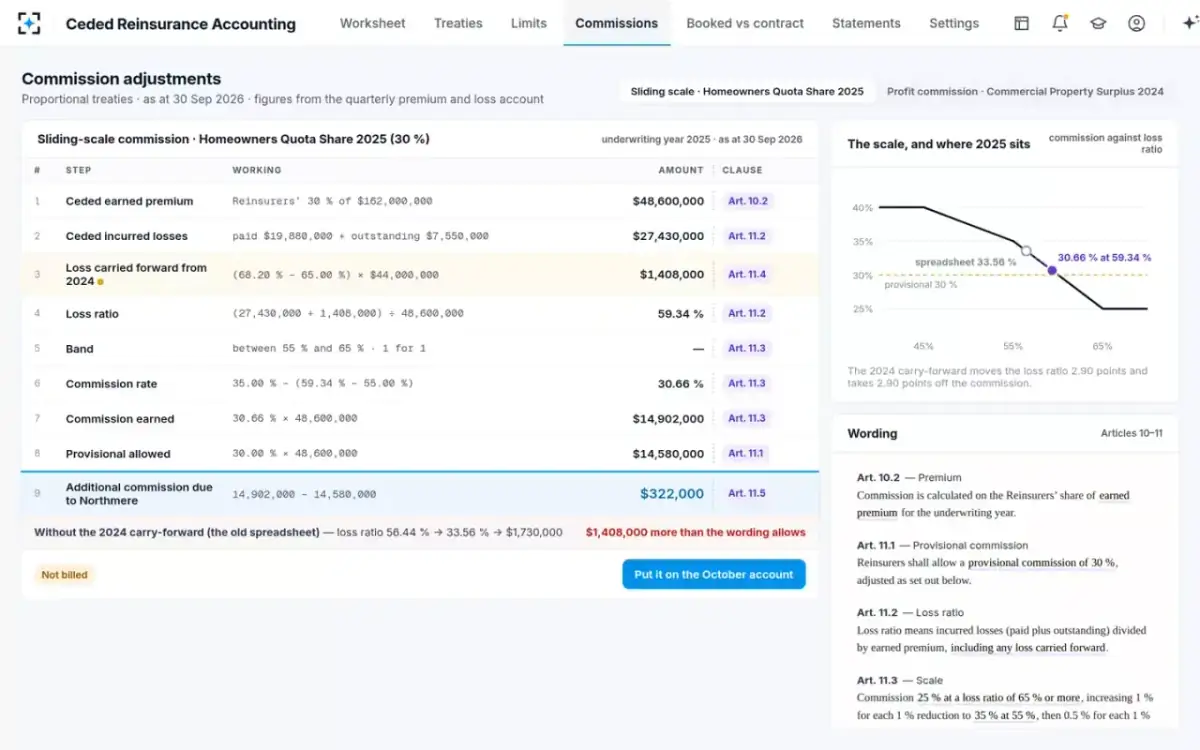
Take a quarter from the sample programme of Ceded Reinsurance Accounting, a fictional insurer's homeowners quota share for underwriting year 2025, 30% ceded, at 30 September 2026. Its scale pays 25% at a loss ratio of 65% or more, rising one point per point to 35% at 55%, then half a point per point to 40%. All figures from the programme are sample data.
A sliding scale commission, calculated in nine lines
| Line | Working | Amount |
|---|---|---|
| 1 · Ceded earned premium | Reinsurers’ 30% of $162,000,000 | $48,600,000 |
| 2 · Ceded incurred losses | Paid $19,880,000 + outstanding $7,550,000 | $27,430,000 |
| 3 · Loss carried forward from 2024 | (68.20% − 65.00%) × $44,000,000 | $1,408,000 |
| 4 · Loss ratio | ($27,430,000 + $1,408,000) ÷ $48,600,000 | 59.34% |
| 5 · Band | Between 55% and 65%: one point of commission per point | 1:1 |
| 6 · Commission rate | 35% − (59.34% − 55%) | 30.66% |
| 7 · Commission earned | 90% × $48,600,000 − $28,838,000 | $14,902,000 |
| 8 · Provisional allowed | 30% × $48,600,000 | $14,580,000 |
| 9 · Adjustment | Line 7 − line 8, due to the insurer | $322,000 |
In dollars the band makes the arithmetic simpler than the rate suggests. Inside a 1:1 band, commission plus losses is a constant share of premium, here 90%, so the commission earned is 90% of $48,600,000 less $28,838,000: $14,902,000. The provisional 30% allowed $14,580,000, so $322,000 of additional commission is due to the insurer. Computing it through the rounded rate, 30.66%, would give $14,900,760, which is why a calculator should round only what it displays.
The sliding scale commission formula in Excel
In Excel a sliding scale is a nested IF over the bands, with the loss ratio in one cell. For a scale paying 25% at a 65% loss ratio, sliding 1:1 to 35% at 55% and 0.5:1 to a 45% maximum, with the loss ratio in B1 as a decimal: =IF(B1>=0.65,0.25,IF(B1>=0.55,0.35-(B1-0.55),MIN(0.45,0.35+0.5*(0.55-B1)))). For the sample scale, replace the last term's cap of 0.45 with 0.40. Multiply the result by earned premium for the commission earned, and subtract the provisional commission for the adjustment.
The formula is the easy part, and three inputs around it are where spreadsheets fail. The loss ratio cell must be built exactly as the wording defines it, which in the sample means incurred losses, paid plus outstanding, divided by earned premium, including any loss carried forward. The scale must be the one in the wording in force for that underwriting year, because scales change at renewal. And the carryforward must come from the prior year's own calculation, not be retyped each quarter.
What is a deficit carryforward, and why does it decide the answer?
A deficit carryforward adds a past year's excess losses to the current year's loss ratio, so a bad year keeps costing the cedant commission after it ends. The CAS study note's definition: "A carryforward provision allows that if the past loss ratios have been above the loss ratio corresponding to the minimum commission, then the excess loss amount can be included with the current year’s loss in the estimate of the current year's commission" (Clark).
The sample shows how much rides on it. The 2024 year ran at a 68.20% loss ratio against a 65% minimum-commission point on $44,000,000 of premium, so it carries $1,408,000 of excess loss into 2025. That moves the 2025 loss ratio by 2.90 points and, in a 1:1 band, takes 2.90 points off the commission. Left out, the calculation would claim $1,730,000 instead of $322,000. Inside a 1:1 band every dollar of carried-forward loss is a dollar of commission, so the whole $1,408,000 would have been an overclaim the reinsurers could reverse.
Ceded Reinsurance Accounting works the slide from the wording, carryforward on its own row
How often is a sliding scale adjusted?
As often as the wording says, and often quarterly. The CAS textbook chapter on reinsurance describes the reinsurer paying a provisional commission as premium is ceded and reviewing the cumulative experience at set dates, often quarterly, then paying more commission if the treaty is profitable or taking some back if it is not (Patrik). Some wordings adjust annually, and a slide can keep adjusting after its underwriting year has closed: the sample programme's 2025 quota share was still being adjusted at 30 September 2026.
The statutory statements need the slide's position too. The annual statement note that shows what cancelling all reinsurance would do to surplus has to count these features: guidance reproduced in NAIC Issue Paper No. 75 says that "The effect of return commissions, sliding scale commissions, as well as minimum and maximum commissions, is required to be calculated and then measured as factors reducing surplus" (IP 75). A team that does not know where each slide stands cannot fill that note with confidence either.
A sliding scale commission example across four quarters
Because each review recalculates the whole period to date, the adjustment booked in a quarter is the change in the cumulative figure, not a fresh calculation. The illustration below runs one underwriting year on the sample scale, with losses developing as the year goes on. Early quarters read a low loss ratio and pay commission above the provisional rate; later quarters take it back.
One treaty year on the sample scale: cumulative commission, and what each quarter books
| Quarter end | Earned premium to date | Incurred losses to date | Loss ratio and rate | Cumulative adjustment | Booked this quarter |
|---|---|---|---|---|---|
| 31 March | $12,000,000 | $6,000,000 | 50.00% → 37.50% | +$900,000 | +$900,000 |
| 30 June | $24,000,000 | $13,800,000 | 57.50% → 32.50% | +$600,000 | −$300,000 |
| 30 September | $36,000,000 | $22,500,000 | 62.50% → 27.50% | −$900,000 | −$1,500,000 |
| 31 December | $48,000,000 | $30,240,000 | 63.00% → 27.00% | −$1,440,000 | −$540,000 |
Two lessons follow. A quarter that is skipped does not lose its adjustment; the next review catches it up, provided someone runs it and books the full change. And a quarter not run is not always money left with the reinsurer: had the June and September reviews been skipped here, the cedant would have held $900,000 of first-quarter commission it later had to return, and booked as income a figure the treaty had already taken back.
What a missed quarter leaves on the table
A missed quarter leaves the adjustment unbilled; a quarter run without the carryforward bills too much. Both are worth more than the calculation's cost by orders of magnitude. In the sample programme the homeowners quota share's quarterly adjustment had not been run since December 2025, so $322,000 due to the insurer sat unbilled at 30 September. Had the quarter been run on the old spreadsheet, the claim would have been $1,730,000, and the reinsurers would have been right to send $1,408,000 of it back.
Of the $1,730,000 a spreadsheet without the carryforward would claim, the wording allows $322,000
Additional commission claimed for 2025, above the provisional $14,580,000
- Allowed by the wording · $322,000 · 18.6%
- Overclaim from the missing carryforward · $1,408,000 · 81.4%
One quota share, one quarter: the figures that matter
$322,000
due to the insurer, not billed, because the slide was not run
2.90pts
added to the loss ratio by the 2024 carryforward
$1.41M
overclaim the carryforward prevents
The cash cost of a late adjustment is small; the real cost is that it may never be billed at all, or billed wrong and argued over for a year. That is the case for treating the run itself as the thing to measure.
Why an early slide can pay too much commission: loss development
Early in an underwriting year, incurred losses are low because they have not developed, so a slide run on them reads a low loss ratio and pays a high commission. The CAS textbook warns about exactly this: "Loss development is an issue to be aware of in these types of formulas. If it is not accounted for in the loss evaluation that determines the loss ratio, the formula will compute too high a commission" (Patrik). The commission then has to come back at later adjustments.
For the ceded accountant, the practical point is to use the loss definition the wording gives and nothing looser. The sample wording uses paid plus outstanding losses. If a wording includes incurred but not reported losses, or a development factor, the calculation has to include them too; if it does not, the accountant cannot add them on her own judgement. The quarterly re-run is what corrects the early overpayment.
What KPIs should a ceded reinsurance team track, and how do you price them?
Track the runs, the differences and the days. A sliding scale or profit commission that is run on time, from the right inputs, and billed promptly is worth exactly what the wording says; every failure mode has a measurable cost. The table sets out the measures we suggest, how to put a dollar figure on each, and what the sample programme shows.
KPIs for a ceded accounting team, and how to put a dollar figure on each
| KPI | How to measure it | How to price it | Sample programme |
|---|---|---|---|
| Adjustments run on time | Scheduled slides, profit commissions and premium adjustments run by their due date, out of all due | The amount of each one not run: it is unbilled or unpaid until someone runs it | Slide not run since Dec 2025: $322,000 |
| Days from due date to bill | Calendar days from the adjustment date to the statement | Amount × days × the insurer’s cost of funds | Profit commission unclaimed for 101 days: $393,300 |
| Differences found per re-check | Booked adjustments that differ from the wording, by size and direction | The difference itself, both ways | 5 of 41, $1.63M in total |
| Carryforwards and deficits confirmed | Balances carried into the year, checked against the prior year’s calculation | The carryforward × the slope of the band it lands in | $1,408,000 at 1:1 |
| Unusual terms confirmed before use | Terms differing from the programme, confirmed by a person before the first calculation | The error the term would cause if missed | Time pro rata: $550,947.95 on two payments |
The pricing column is deliberately plain. Most of these KPIs are worth the full amount at stake, not an interest charge, because the failure is not lateness but absence: a slide nobody runs is never billed. The second row is the exception, and the only one where a cost-of-funds figure belongs.
Where a calculator stops and Ceded Reinsurance Accounting starts
A calculator answers one quarter for one treaty when someone remembers to open it. Ceded Reinsurance Accounting's commission calculator runs every slide and profit commission in the programme each quarter, takes the loss ratio exactly as each wording defines it, applies the scale band by band, and carries losses and deficits forward from the prior year's own figures. The wording reader supplies the terms with clause and page, and holds any carryforward longer than the programme's usual for a person to confirm.
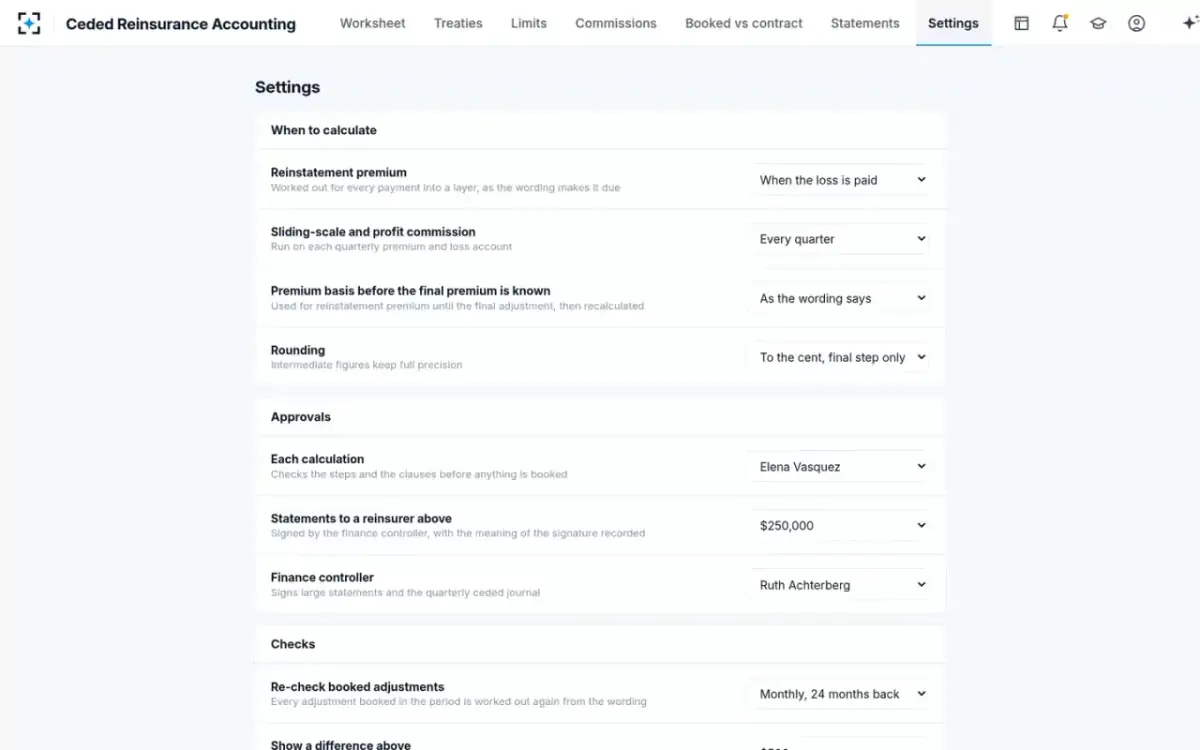
The programme's rules, set once: when commissions run and who approves
What it does not do is decide disputes. If a reinsurer reads the loss ratio definition differently, the worksheet shows both readings with the clause, and the head of ceded reinsurance settles it. For the definitions behind each element of a scale, see what a sliding scale commission is; for the commission that comes after expenses and deficits, see profit commission calculation in reinsurance. To run every slide in your programme from its wording, start from Ceded Reinsurance Accounting.
Questions people ask
What is a loss corridor in reinsurance?
It is a different feature from the slide. The CAS study note says a loss corridor "provides that the ceding company will reassume a portion of the reinsurer's liability if the loss ratio exceeds a certain amount"; in its example the cedant takes back 75% of the losses between an 80% and a 90% loss ratio, so a reinsurer at 100% before the corridor ends at 92.5%.
Can a sliding scale adjustment go against the cedant?
Yes. If the loss ratio is worse than the one the provisional rate assumes, the commission earned is less than the provisional commission allowed, and the cedant returns the difference. On the sample scale, with a 30% provisional rate, the cedant starts returning commission once the loss ratio passes 60%, and gives back five points of it at 65% or worse.
Is the slide calculated on written or earned premium?
On whatever the wording names. The provisional commission is often paid on written premium as it is ceded, while the sample wording calculates the adjusted commission on the reinsurers' share of earned premium for the underwriting year. Mixing the two bases in one calculation overstates or understates the loss ratio.
Can the same calculator work out a profit commission?
No. A profit commission starts from premium and deducts the ceding commission, incurred losses, an expense margin and any deficit brought forward, then pays a percentage of what is left; in the sample programme, 15% of $2,622,000 gave $393,300. It needs different inputs, and a deficit history the slide does not.
Does a sliding scale commission calculator need the treaty wording?
Yes, for three inputs no calculator can guess: how the loss ratio is defined, the scale in force for that underwriting year, and whether and for how long losses are carried forward. Every other input is in the quarterly account.