In reinsurance, a minimum and deposit premium is the premium an excess of loss treaty collects at the start, often in instalments, before the final premium can be known; it is also the least the reinsurers will keep for the year. The final premium is the treaty's rate times the subject premium the ceding insurer actually writes, which is only known after the period ends. If that comes in higher than the deposit, the cedant pays the difference; if lower, the reinsurers keep the minimum. The accountant's difficulty is that a deposit looks like a bill and is not, and that reinstatement premiums priced on it are provisional too. Botminds' Ceded Reinsurance Accounting reads the premium basis from each wording, prices reinstatements on the basis the wording names, and re-prices them when the final premium is agreed.
From deposit to final premium on one layer in Ceded Reinsurance Accounting
- Deposit of $3,150,000 paid in four instalmentsJan–Dec 2026
- Subject premium final; premium adjustedto 31 Mar 2027
- No payment into the layer yetJan–Apr
- Four payments priced on the depositApr–Dec
- Re-priced on the final premiumJan–Mar 2027
What is minimum and deposit premium in reinsurance?
Minimum and deposit premium, sometimes shortened to M&D, is a single figure doing two jobs: it is the deposit the cedant pays during the year on account of a premium not yet known, and it is the minimum the reinsurers retain whatever the final figure turns out to be. Statutory accounting treats a deposit as provisional. NAIC Issue Paper No. 75, whose conclusions now sit in SSAP No. 62R, describes treaties under which "The initial provisional or deposit premium is recalculated retrospectively, based on loss experience under the treaty during a specified period of time" (IP 75). Layers rated on subject premium are recalculated on exposure instead; either way the deposit is not the final premium.
The sample layer shows the arithmetic. Commercial property per-risk excess of loss layer 2 in the sample programme, a fictional insurer's $7.5 million excess of $2.5 million layer, is rated at 2.10% of gross net premium income. The deposit is $3,150,000, which is 2.10% of $150 million, the insurer's estimate of its income for the year. All figures from the programme are sample data.
What is subject premium, and how does it set the final premium?
Subject premium is the premium the ceding insurer writes on the business the treaty covers, and the final reinsurance premium is the treaty rate times it. The CAS textbook chapter on reinsurance states the convention for excess treaties: "The reinsurance premium is usually calculated via a reinsurance rate times subject premium" (Patrik). The sample's subject premium is gross net premium income, a measure of the cedant's premium on the covered business that the wording defines.
The definition is a clause, and it moves money. Whether subject premium is written or earned, gross or net of other cessions, and before or after cancellations decides the final premium as surely as the rate does. A ceded accountant adjusting a deposit needs the definition from the wording and the figure from the insurer's own books, not from the estimate the broker used at placement.
When is the deposit premium adjusted?
After the period ends, once the subject premium for it is final, on the date the wording sets. In the sample programme the per-risk layer 1 and the workers' compensation layer settle their 2026 final premium on 31 March 2027, and the timeline above assumes the same date for layer 2. Until then the deposit is what has been paid, and every figure built on it, reinstatement premium included, is provisional.
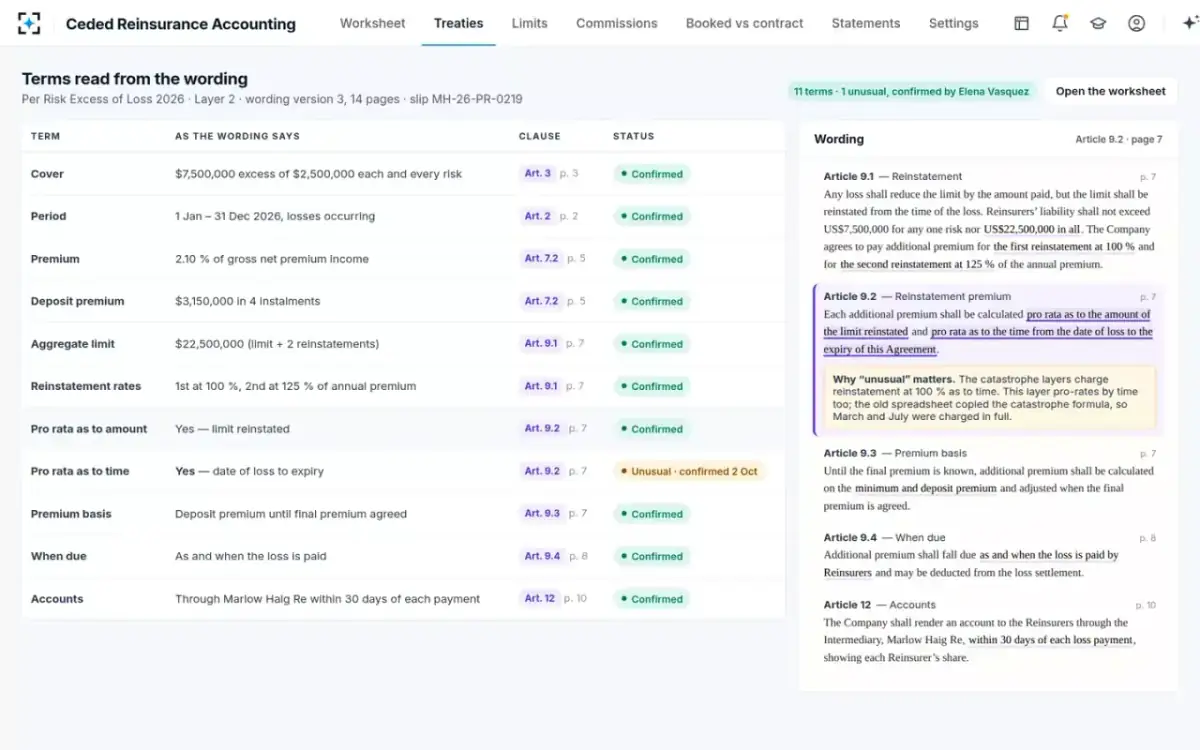
The premium basis, read from the wording: deposit until the final premium is agreed
A public example shows the same mechanism in statute. Florida's Hurricane Catastrophe Fund collects premium from insurers on a provisional basis and corrects it once exposures are reported: the board "shall provide for payment of reimbursement premium in periodic installments and for the adjustment of provisional premium installments collected prior to submission of the exposure report to reflect data in the exposure report" (Fla. Stat. § 215.555(5)(c)). Insurers report their insured values as of 30 June by 1 September each year, so the provisional instalments are adjusted after the report.
When the deposit isn't the bill: three outcomes on one layer
The deposit is the bill only if the final subject premium lands exactly on the estimate. Above it, the cedant owes more; below it, the minimum holds and nothing comes back. The three outcomes below take the sample layer through a final gross net premium income of $130 million, $150 million and $170 million.
One deposit, three final premiums
Final GNPI $130 million
2.10% × $130M = $2,730,000
Below the minimum. The reinsurers keep $3,150,000; no adjustment.
Final GNPI $150 million
2.10% × $150M = $3,150,000
Equal to the deposit. No adjustment either way.
Final GNPI $170 million
2.10% × $170M = $3,570,000
$420,000 more premium due, and every reinstatement re-priced: $287,241.64 more.
The first outcome is the one the minimum exists for. The reinsurers priced the layer on an expected premium; if the insurer writes less, they still carry the same limit, so the minimum stops the premium falling with the volume. The third is the one an accountant must plan for, because the adjustment is not only on the premium: each reinstatement priced on the deposit rises in the same proportion.
Is reinstatement premium based on the deposit or the final premium?
On whichever the wording names, and a wording can name both in turn: the deposit until the final premium is known, then the final premium. The sample's Article 9.3 does exactly that, so each of the layer's four 2026 reinstatement premiums, $2,154,312.33 in all, is priced on $3,150,000 and re-priced when the final premium is agreed. At a $170 million final income they become $2,441,553.97, $287,241.64 more.
At a $170 million final income, 11.8% of the layer's 2026 money arrives only at the adjustment
| On the deposit | At the final premium | Due at the adjustment | |
|---|---|---|---|
| Premium | $3,150,000 | $3,570,000 | $420,000 |
| Reinstatement premium, four 2026 payments | $2,154,312.33 | $2,441,553.97 | $287,241.64 |
| Together | $5,304,312.33 | $6,011,553.97 | $707,241.64 |
Where the final premium falls below the minimum, a second reading question appears. If the wording re-prices reinstatements on the final premium, does "final" mean the adjusted premium or the premium the reinsurers actually keep, which is the minimum? Read literally, the sample wording points to the second, so the reinstatements stay priced on $3,150,000. That is the kind of term the solution's wording reader marks for a person to confirm rather than guess.
A reinstatement priced on a deposit is a provisional number, however many decimal places it has.
What is an adjustable premium? Exposure, experience, or both
An adjustable premium is any reinsurance premium that is set provisionally and recalculated later, and there are two kinds. Exposure-adjusted premium follows the volume of business: the deposit becomes the rate times the final subject premium, as on the sample layer. Experience-adjusted premium follows the losses: the premium rises or falls with the treaty's own loss experience within a minimum and a maximum. The CAS chapter notes that excess layers with frequent claims are often rated this way: "So working covers are often retrospectively rated, with the final reinsurance premium partially determined by the treaty’s loss experience" (Patrik).
Two textbook adjustable premiums, with their provisional, minimum and maximum
| Plan | How the final premium is set | Provisional | Minimum | Maximum |
|---|---|---|---|---|
| Retrospective rate plan (Patrik) | Reinsurance charge of $500,000 plus 1.00 × reinsured losses | $4,000,000 | $2,000,000 | $8,000,000 |
| Swing plan (Clark) | Layer losses × 100/80, as a rate on subject premium | 15% of subject premium | 10% | 30% |
Clark's swing plan carries a lesson for the deposit. With the provisional rate at 15% and an expected final rate of 22.9%, the study note observes that "the provisional rate of 15% is well below the expected ultimate swing plan premium rate of 22.9%; this difference is an added cash flow advantage for the ceding company which must be included in the final pricing evaluation" (Clark). A low deposit is cash in the cedant's hands for a year and a liability on its books for the same year. Statutory accounting treats the experience-based kind as an adjustable feature: Issue Paper No. 75 requires its effect to be recognised in the period of the losses that cause it.
What does 100% minimum and deposit premium mean?
It means the deposit and the minimum are the same figure, so the cedant pays it in full during the year and gets none of it back if the subject premium comes in lower. That is how the sample layer works: $3,150,000 is both paid and kept. In a wording that expresses its minimum and deposit premium as 90%, the deposit and the floor are 90% of whatever figure the wording names, such as the estimated annual premium, and the reinsurers collect the rest at the adjustment if the estimate holds. The percentage is only half the term; what it is a percentage of is the other half.
The minimum also matters for statutory figures that use the deposit as their yardstick. Where a treaty's coverage adjusts with experience, Issue Paper No. 75 measures the resulting asset or liability against the premium the reinsurer receives, and defines it: "The term “consideration” shall mean, for this purpose, the annualized deposit premium for the period used as the basis for calculating the adjustment in the amount of coverage" (IP 75). Get the deposit wrong and that figure is wrong too.
Seven questions every premium clause should answer
A deposit is easy to book and easy to misread. Before the first instalment, the ceded accountant needs seven answers from the wording, because each one changes a figure later in the year.
Read these from the wording before the first instalment
- What is the rate, and on what subject premium?
The definition of subject premium decides the final premium as much as the rate does.
- How much is the deposit, and when is each instalment due?
The sample layer pays $3,150,000 in four instalments.
- Is the deposit also the minimum, and in full or in part?
A 100% minimum and deposit premium keeps all of it; a lower percentage keeps less.
- When is the final premium agreed, and who reports the figure?
The adjustment date sets when the last money moves.
- Which premium do reinstatements use, before and after?
Deposit, estimate or final; the sample uses the deposit until the final premium is agreed.
- Does the premium also adjust with losses?
A retrospective or swing-rated premium has its own minimum and maximum.
- What happens if the treaty ends early?
Whether the minimum is kept, earned pro rata, or returned in part.
A public example: the Florida Hurricane Catastrophe Fund's provisional premium
Florida's state catastrophe fund runs the deposit-and-adjustment cycle in law, and it shows how far a provisional figure can reach. The insurer's retention under the fund is itself computed from premium: an insurer "shall determine its provisional retention by multiplying its provisional reimbursement premium by the applicable adjusted retention multiple and shall determine its actual retention by multiplying its actual reimbursement premium by the applicable adjusted retention multiple" (Fla. Stat. § 215.555(2)(e)). When the premium is adjusted, the point at which the cover attaches moves with it.
The same statute settles how the premium is accounted for: "All premiums paid to the fund under reimbursement contracts shall be treated as premium for approved reinsurance for all accounting and regulatory purposes" (§ 215.555(5)(d)). For a Florida insurer's ceded accountant, the fund is one more adjustable treaty: a provisional premium, an exposure report, an actual premium and a retention that follows it.
Which treaties still have a final premium to come, in Ceded Reinsurance Accounting
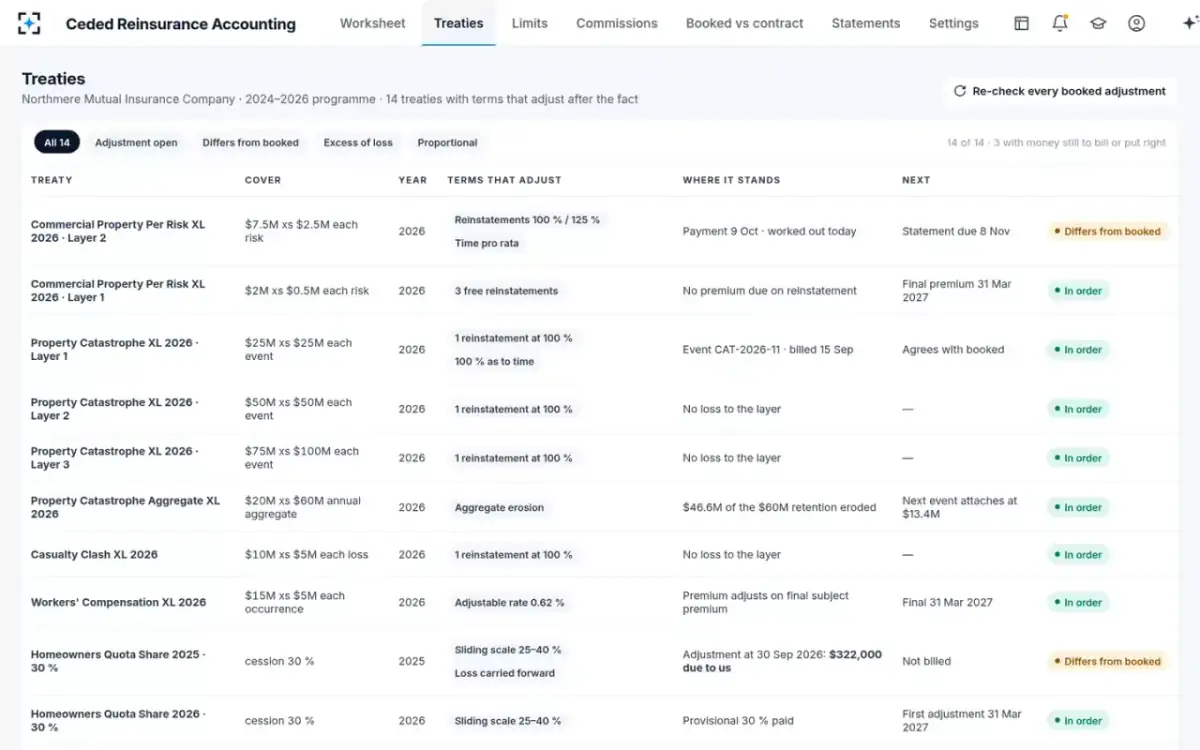
In the solution, the wording reader takes the premium, deposit and premium basis from each wording with clause and page, the reinstatement calculator prices on the deposit or the final premium as the wording says, and when the final premium is agreed every reinstatement priced on the deposit is worked out again and the difference goes on the next account. For the reinstatement arithmetic itself, see how to calculate reinstatement premium; for the payment-by-payment view, pro rata reinstatement premium in ten steps. To see your own layers' deposits and final premiums together, start from Ceded Reinsurance Accounting.
Questions people ask
Is a deposit premium the same as a provisional premium?
In substance, yes: both are paid on account of a premium that will be recalculated. Issue Paper No. 75 uses the two words together, "The initial provisional or deposit premium". The word "minimum" is what adds the floor.
Is a minimum and deposit premium refundable?
Not below the minimum. On a 100% minimum and deposit premium the whole deposit is the minimum, so none of it comes back however low the subject premium falls; on the sample layer a final income of $130 million would still cost $3,150,000.
Who reports the subject premium, and who checks it?
The ceding insurer reports it from its own books, and the reinsurers rely on it. Florida's statute gives the Hurricane Catastrophe Fund's board the right to examine insurers' records to check the exposures they report, which is a reminder that the figure behind a deposit adjustment is auditable.
How does a minimum and deposit premium work on a quota share?
A quota share cedes a share of each premium as it is written, so there is no subject premium to estimate in advance and no deposit to adjust. Its provisional element is the ceding commission, adjusted by a sliding scale where the wording has one. Deposits belong to layers rated on subject premium, such as the sample's excess of loss layers.
When should the cedant book the premium adjustment?
Our suggestion: as soon as the final subject premium is known, and no later than the wording's adjustment date, without waiting for the reinsurers to ask. In the sample programme the adjustment and the re-priced reinstatements are proposed as lines on the account for the accountant to approve.