A ceded reinsurance system keeps an insurer's outward reinsurance: the treaties and their terms, cessions and recoveries, the adjustments the wordings make after losses, such as reinstatement premiums and sliding-scale and profit commissions, and the statements sent to reinsurers. The best test before buying one is not a demonstration but a replay. Give the system your wordings and the last 24 months of paid losses and quarterly accounts, let it recompute every adjustment you booked, and count where it disagrees with your books and why. Ceded reinsurance work is hard because each wording states its adjustable terms differently and the figures often live in spreadsheets, so a replay tests exactly the part that goes wrong. Botminds' Ceded Reinsurance Accounting runs this replay as a standing monthly check, and this guide uses its sample programme to show what one finds.
The sample programme belongs to a fictional insurer, Northmere Mutual, with 14 treaties; its figures are sample data, not a customer's results.
What a 24-month replay in Ceded Reinsurance Accounting found on one sample programme
What should a ceded reinsurance system do?
A ceded reinsurance system should turn each wording into rules, apply them to every loss and account as it arrives, and show its working well enough that an accountant can approve it and an auditor can follow it. That is a narrower and harder job than holding treaty data. Most of the money that goes astray in ceded reinsurance goes through the terms that adjust after the fact, so the questions that separate systems are about those terms.
- Read the terms. Premium basis, deposit, reinstatement rates and pro rata rules, commission scales, carry-forwards, deficits and due dates, each with the clause and page it came from and the wording version in force.
- Follow the losses. Take payments from the claims system as they post, match each to its risk or event and its layer, and keep the cumulative loss per layer.
- Work out each adjustment. Split payments at reinstatement boundaries, pro-rate by time only where the wording does, carry losses and deficits forward as the wording defines them, and round once.
- Check what was booked. Re-work past adjustments from the wording and list each difference with the clause, without touching the booked entry.
- Draft, never send. Split each account by signed share into one statement per reinsurer, and wait for the approvals and signatures the insurer sets.
Why the last 24 months are a fair test
The past makes a fair test because statutory accounting says which period every adjustment belongs to, and the inputs for each period are fixed and dated. For adjustable commission and premium features, the rule NAIC Issue Paper No. 75 set down for property and casualty reinsurance, now carried in SSAP No. 62R, is direct: "An accrual shall be maintained for these adjustable features based upon the experience recorded for the period" (IP 75). Given the wordings and the experience recorded in each period, there is one right figure per period, and a system either produces it or does not.
Twenty-four months is long enough to matter. It covers two renewals, eight quarterly reviews of every sliding scale, every payment into every excess layer and, in the sample programme, a profit commission whose first calculation fell due 30 months after inception. It is also short enough that the people who booked the figures are still there to explain them, and that a difference can still go on an account rather than into a dispute about a closed year.
When should reinstatement premium be booked? Billing and accrual are two answers
Reinstatement premium is billed when the wording makes it due, often as the loss is paid, but under statutory accounting it is recognised in the period the loss event occurs, which can be a quarter or more earlier. A replay has to test both. The billing test asks whether each payment produced the premium the wording charges; the accrual test asks whether each quarter-end carried the additional premium that the period's losses had already triggered.
The two tests catch different failures. A payment that no account ever reached, like the sample's 9 September payment, fails the billing test. A large loss reserved in one quarter and paid in the next fails the accrual test if nothing was carried at the first quarter-end. One per-risk loss, followed from reserve to payment, shows both entries.
The replay, step by step
A replay needs no integration to run as a trial. Files are enough: the wordings and endorsements, a paid-loss extract with dates and references, the quarterly premium and loss accounts, and the adjustments booked. What matters is that the period, the inputs and the scoring are agreed before the system sees them.
Run a 24-month replay on any ceded reinsurance system
- Fix the window and the treaties
Every adjustable treaty in force in the last 24 months, including expired years still adjusting.
- Hand over the wordings as signed
Slips, wordings and every endorsement, with dates, so the system has to pick the version in force.
- Give it the raw losses, not your workings
Paid losses by date, claim, risk or event reference, and the quarterly premium and loss accounts.
- Keep the booked figures back
Compare only after the system has produced its own figures, so it cannot fit to yours.
- Ask for the working on every line
Each figure with its steps and the clause each step rests on; a total without steps is not a result.
- Classify every difference
System wrong, booking wrong, or wording ambiguous; settle each with the clause in front of you.
- Count both directions
Money due to you and money you owe. A test that only finds the first is not a test.
- Agree what happens to the findings
New lines on the next account, approved by a person; booked entries are not reversed by the trial.
The order of the third and fourth steps is the one most often broken in vendor trials. A system that sees your booked figures first can reproduce them, errors included, and look accurate. The replay is only informative if the system's figures are produced from the wordings and the raw losses alone.
What errors happen in reinstatement premium and commission? Where the money hides
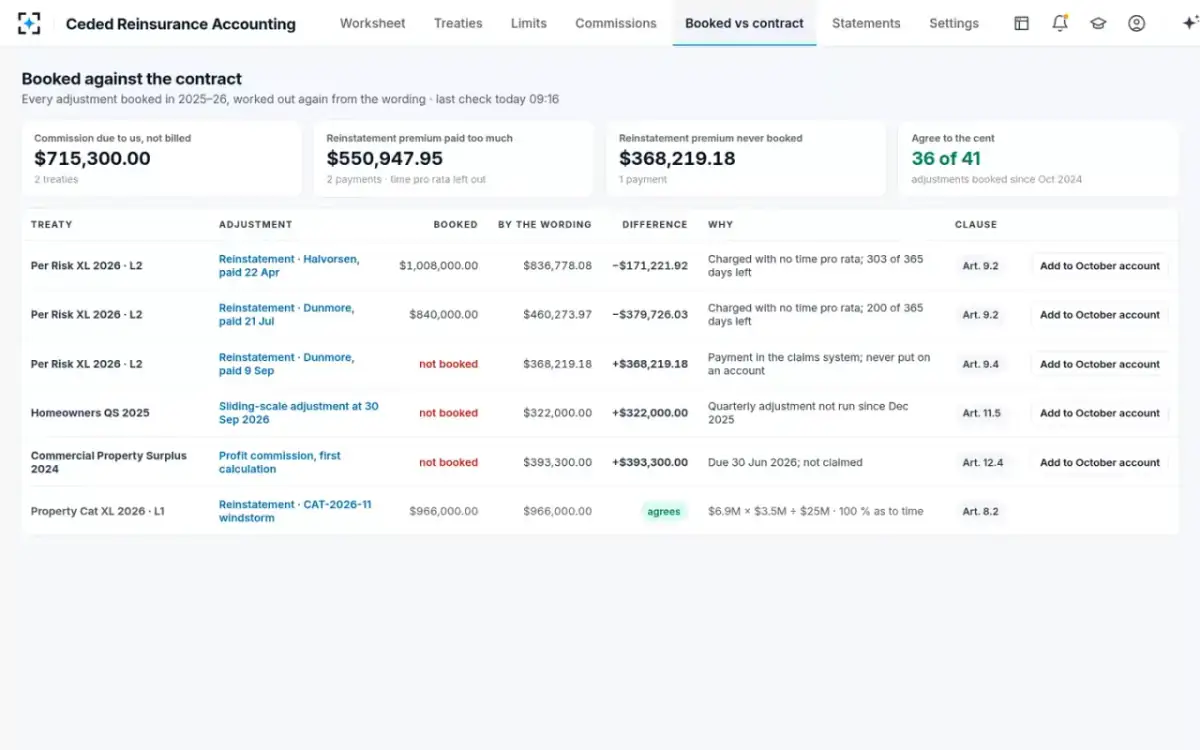
On the sample programme the differences fell into four kinds, and none of them was a wrong multiplication. A time factor left out on two payments, a payment no account reached, a quarterly slide not run since December 2025 and a profit commission that fell due on 30 June and was never claimed. Each is a term or a date that a spreadsheet had no place to hold.
$1.63 million of differences on the sample programme, by cause
Share of the $1,634,467.13 in differences
- Time pro rata left out (overcharged) · 33.7%
- Profit commission not claimed · 24.1%
- Payment never billed · 22.5%
- Sliding scale not run · 19.7%
The direction matters as much as the size. Two of the four kinds favour the insurer and one favours the reinsurers. A replay that surfaces only money due to the cedant should worry a controller, because it suggests the system was tuned to find recoveries. The sample run found $368,219.18 the insurer owed and had never billed, and put it on the next account like everything else.
Booked against the contract: each difference, the reason and the clause
Can a booked reinstatement premium be recalculated, and who changes the books?
Yes, it can always be recalculated, because the wording and the dated losses do not change; whether and how the books change is a person's decision, not the system's. In the solution the booked-figure checker never reverses an entry. It proposes each difference as a new line on the next account, with the booked amount, the amount by the wording and the clause, and the accountant decides whether to add it.
That design is deliberate. A correction to a closed period has consequences beyond the ceded account: statements already sent, reinsurers' own books, and the insurer's policy on prior-period adjustments. A system that silently rewrites a booked reinstatement premium leaves the accountant explaining a number she did not post. A system that drafts the correcting line leaves her deciding it.
How do you audit reinstatement premiums and commissions? Score the trial the same way
Internal audit tests ceded adjustments the way the replay does: take a booked figure, recompute it from the wording and the losses, and ask for the evidence behind each input. The same scorecard works for a vendor trial, and it should separate the system's mistakes from the insurer's, because only the first say anything about the system.
A scorecard for a ceded reinsurance system trial
| Measure | What it shows | How to count it | Sample programme |
|---|---|---|---|
| Adjustments recomputed | Coverage of the trial | Booked adjustments in the window that the system worked out again | 41 |
| Agree to the cent | Where the books were already right | Recomputed figures equal to the booked figure | 36 of 41 |
| Differences explained with a clause | Whether each finding is checkable | Differences whose working cites the wording that decides them | 5 of 5 |
| System errors | The system’s own accuracy | Differences the review traces to the system, not the booking | Counted by the reviewer, not the vendor |
| Unusual terms flagged | Whether it knows what it does not know | Terms held for a person to confirm before first use | 1 (time pro rata) |
| Threshold | Noise kept out of the review | Smallest difference listed | $500 |
Who checks booked commissions after go-live is a separate question with the same answer: someone who did not book them, with the working in front of them. In the solution the check runs monthly over 24 months, by default, and the head of ceded reinsurance sees every difference, so the review no longer depends on someone rebuilding the spreadsheets.
What to ask a ceded reinsurance system vendor
Ask questions whose answers you can test in the replay. Answers about connectors, dashboards and roadmaps can wait; answers about how the system reads a wording and what it does when it is unsure cannot.
Ten questions for any ceded reinsurance system
- Show me the clause behind this number.
Every adjustment should open the wording at the clause it used, in the version in force.
- What do you do with a term you have not seen before?
The right answer is to hold it for a person, not to apply the programme’s usual rule.
- How do you split a payment that crosses a reinstatement?
Ask for the working on a real crossing payment from your own losses.
- Where does the time factor count from?
Date of loss or payment, and how the system knows which.
- Which premium do reinstatements use before the final premium is known?
And what happens to every earlier reinstatement when it is.
- How is a loss carried forward into a slide, and for how long?
As the wording defines it; ask to see a carry-forward that has expired.
- Do you ever change a booked entry?
The answer should be no; differences become new lines for a person to approve.
- Who can approve, and who must sign?
Approvals by person and by amount, with the meaning of each signature kept.
- How do statements split by share?
Shares must total 100%, and each line must add up to the cent.
- What does the replay find on our last 24 months?
The only answer that settles the others.
Where Ceded Reinsurance Accounting fits in a ceded reinsurance system, and where it does not
Ceded Reinsurance Accounting is the reading-and-calculating layer of a ceded reinsurance system, not the whole of it. It reads wordings, watches paid losses, works out reinstatements and commissions, re-checks what was booked and drafts statements, and it keeps a person at every decision. It does not replace the general ledger, which keeps the booked entries, or the claims system, which it reads but never writes to.
Agents at work on one payment: matched, split, read, then calculated
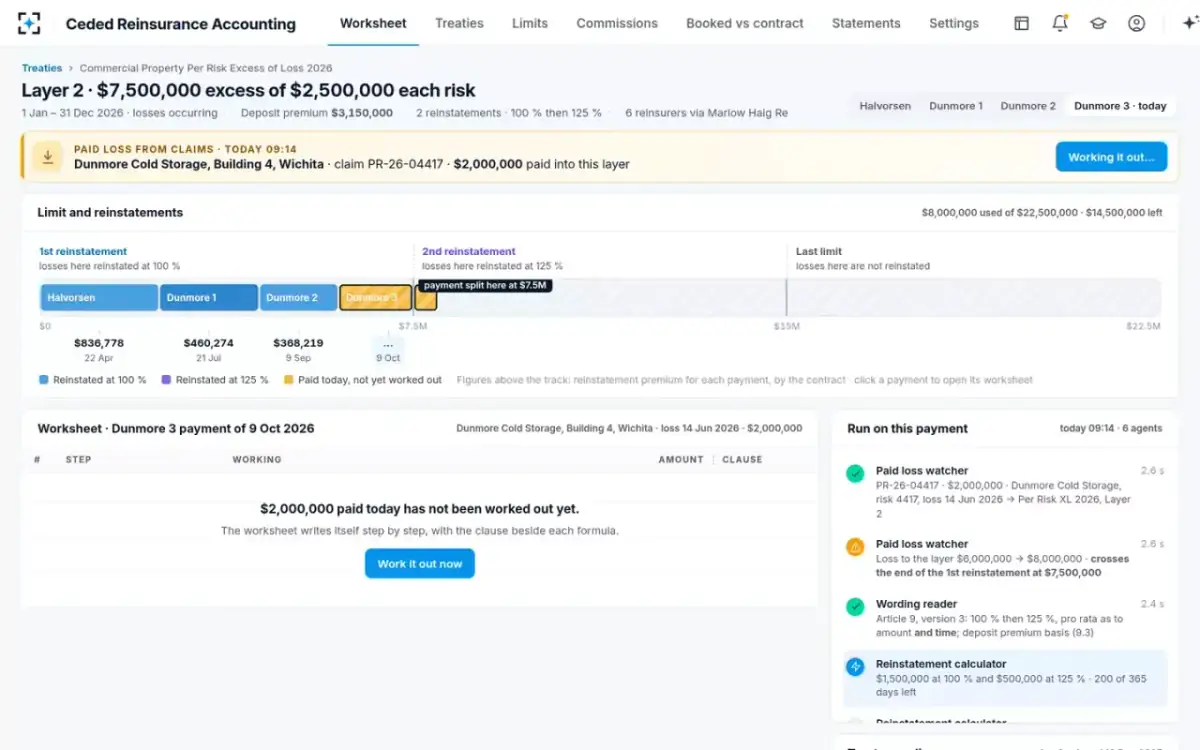
Several neighbouring jobs belong to other tools. Matching the insurer's accounts to the statements reinsurers and brokers send back is reconciliation, the work of Reinsurance Account Reconciliation. Chasing what reinsurers owe on paid losses belongs to Reinsurance Recoverables Management, and measuring contracts under IFRS 17 or reconciling statutory and GAAP figures to Statutory, GAAP & IFRS 17 Reconciliation. The solution's limits are worth knowing too: it cannot assign a payment that arrives without a risk or event reference, it will not fill a term the wording does not state, and it waits for a person on any term that differs from the rest of the programme.
For the go-live that follows a good replay, reinsurance accounting software, live inside one quarter-end sets out the order. For the reinstatement arithmetic the replay leans on, see three worked cases. To run the replay on your own last 24 months, start from Ceded Reinsurance Accounting.
Questions people ask
What is a good match rate in a replay?
There is no standard, and the rate matters less than the explanations. On the sample programme 36 of 41 booked adjustments agreed to the cent; what made the other five useful was that each came with the booked figure, the figure by the wording, the reason and the clause.
Does a replay need the reinsurers' statements?
No. A replay tests the insurer's own figures against its wordings. Comparing those figures with what reinsurers and brokers report back is a different job, account reconciliation, and it is easier once the insurer's side is right.
Can AI read reinsurance wordings reliably enough for this?
Only with its working shown. In EIOPA's 2026 survey of European insurers, inaccurate outputs were the most-cited risk of generative AI, and 64% of the reported uses were internal back-office ones. That is why every figure in a replay should cite its clause, and why a term the system has not seen before should wait for a person.
How often should booked adjustments be re-checked after go-live?
Often enough that a missed term is found while it can still go on an account. The solution's default is monthly, 24 months back, listing any difference above $500; an insurer can choose quarterly over 36 months instead.
What if the wording and the slip disagree?
The difference is itself a finding. The solution reads the wording, the slip and every endorsement, ties each term to the version it came from, and holds anything that conflicts or departs from the rest of the programme for a person to confirm before it is used.