You calculate reinstatement premium by multiplying the premium the wording names by the reinstatement rate and by the share of the occurrence limit that the loss uses and the reinstatement puts back, and then, only if the wording says so, by the share of the contract period left after the loss. Written out: premium × rate × (amount reinstated ÷ limit) × (days left ÷ days in the period). It is the price an excess of loss treaty charges for restoring its limit after a loss, and the ceding insurer's reinsurance accountant bills it, often as the loss is paid where the wording says so. Every treaty states the inputs a little differently, so the formula is easy and the reading is not. Botminds' Ceded Reinsurance Accounting is software that reads those inputs from each wording and works the formula on every payment, with the clause beside each step and a person approving the result.
Reinstatement premium, worked three ways
Case 1 · CAS study note example
Amount only
- Occurrence limit
- $10,000,000
- Annual premium
- $2,000,000
- Rate
- 110%, pro rata as to amount
- Loss to the layer
- $4,500,000
- Share reinstated
- 4.5 ÷ 10 = 0.45
- Time factor
- none
2,000,000 × 1.10 × 0.45
$990,000
Case 2 · Sample programme, 22 April
Amount and time
- Occurrence limit
- $7,500,000
- Deposit premium
- $3,150,000
- Rate
- 100%, first reinstatement
- Paid into the layer
- $2,400,000
- Share reinstated
- 2.4 ÷ 7.5 = 0.32
- Time factor
- 3 March loss: 303 ÷ 365
3,150,000 × 1.00 × 0.32 × 303/365
$836,778.08
Case 3 · Illustration, our numbers
Into the last limit
- Occurrence limit
- $10,000,000, one reinstatement
- Annual premium
- $1,500,000
- Rate
- 100%, pro rata as to amount
- Loss to the layer
- $8,000,000 → $13,000,000
- Share reinstated
- only $2,000,000: 2 ÷ 10 = 0.2
- Last limit
- $3,000,000, no premium
1,500,000 × 1.00 × 0.2
$300,000
How do you calculate reinstatement premium? The formula in one line
Reinstatement premium = premium × reinstatement rate × (amount reinstated ÷ occurrence limit) × (time left ÷ contract period, where the wording pro-rates by time). Each of the four inputs is a reading of the wording, not a number in the claims system.
- Premium. The premium the rate applies to: the annual premium, the deposit premium until the final premium is known, or the adjusted premium. The wording says which.
- Rate. The percentage of that premium each reinstatement costs. It can differ by reinstatement, as in a wording that charges 100% for the first and 125% for the second, and it is 0% for a free reinstatement.
- Amount reinstated. The part of the loss that falls inside a band the next reinstatement puts back, divided by the occurrence limit. A payment that straddles two bands is split, and each part takes its own rate.
- Time. Days from the date the wording names, in the sample wording the date of loss, to expiry, over the days in the period. Most catastrophe wordings leave it out.
A reinstatement premium is the layer premium put to work again; everything else on this page is about reading those four inputs correctly. For how one agent handles them on a payment that straddles two bands, see pro rata reinstatement premium, step by step.
Case 1: pro rata as to amount only, the CAS textbook example
The standard teaching example comes from the Casualty Actuarial Society's study note on reinsurance pricing, and it uses the amount factor alone. A catastrophe cover with a $10,000,000 occurrence limit and an annual premium of $2,000,000 reinstates at 110% pro rata as to amount. A $4,500,000 loss to the layer uses 45% of the limit, so the note gives the reinstatement premium as "$990,000 (= $2,000,000 X 1.10 X 4.5/10)" (Clark).
Three things in the example are worth copying into any spreadsheet. The rate is applied to the annual premium, not the loss. The share is the loss over the occurrence limit, not over the aggregate. And there is no time factor, because the wording has none: the cedant pays the same $990,000 whether the loss happens in February or November. That last point is why the same arithmetic gives a very different answer on a wording that does pro-rate by time.
Case 2: amount and time, on a sample per-risk payment
Add the time factor and the date of loss starts to matter as much as the amount. Take a payment from the solution's sample programme, on a fictional insurer, Northmere Mutual. Its commercial property per-risk layer of $7.5 million excess of $2.5 million has a deposit premium of $3,150,000 and a first reinstatement at 100%, pro rata as to amount and as to time from the date of loss to expiry on 31 December. On 22 April, claims paid $2,400,000 into the layer for a mill fire that happened on 3 March.
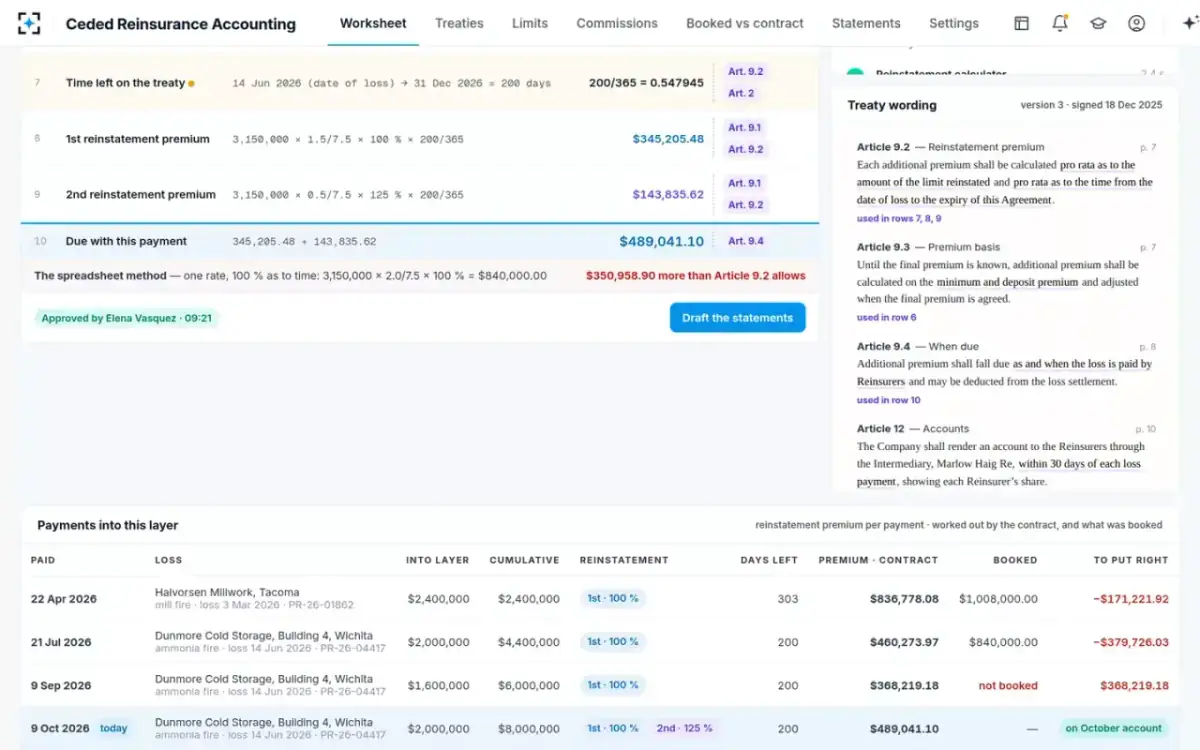
The share reinstated is 2.4 ÷ 7.5, or 0.32. From 3 March to 31 December is 303 days of 365. The premium is 3,150,000 × 1.00 × 0.32 × 303/365 = $836,778.08. The sample insurer's spreadsheet billed $1,008,000, the same calculation without the time factor, because it had been built for the catastrophe layers. On one payment the difference was $171,221.92, and a second payment in July repeated the mistake.
Ceded Reinsurance Accounting's payments table: what the wording charges, and what was billed
Case 3: is reinstatement premium charged when the last limit is used?
No. The last limit is paid but not reinstated, so a payment that runs into it is only charged for the part that a reinstatement puts back. This is the case spreadsheets most often overcharge, because the payment is larger than the premium-bearing part of it.
Take an illustrative catastrophe layer of $10,000,000 excess of $10,000,000 with one reinstatement at 100%, pro rata as to amount only, and an annual premium of $1,500,000. Earlier events have put $8,000,000 into the layer, all of it reinstated. A new payment of $5,000,000 takes the loss to the layer to $13,000,000. Only the first $2,000,000 of it, up to $10,000,000, is put back by the reinstatement; the other $3,000,000 uses the last limit. The premium is 1,500,000 × 1.00 × 2/10 = $300,000. Charging on the whole payment would bill $750,000.
The ASTIN literature describes the same end of the cover. In Ana Mata's example of a layer with one reinstatement at 100%, the claims that use the first limit carry reinstatement premiums that add up to the full initial premium, and after that "The fourth claim is paid in full by the reinsurer and the contract finishes" (Mata, 2000). Once the reinstatements are used up, the cover has no limit left to sell.
What is a free reinstatement, and what is 100% reinstatement premium?
A free reinstatement restores the limit at no premium; a paid one costs a stated percentage of the premium, and a 100% reinstatement charges the full premium for a full limit, pro rata to the amount reinstated. Mata's paper sets out the distinction plainly: "There are two kinds of reinstatements, free and paid reinstatements. For paid reinstatements, every time a claim hits the layer there is an extra premium charged at a pre-determined rate, pro rata to the claim size" (Mata, 2000).
Free and paid reinstatements, on the same sample programme
Free reinstatement: None. The limit comes back at no cost.
Paid reinstatement: A stated rate of the premium: 100%, 125% or another figure, by reinstatement.
Free reinstatement: Per-risk layer 1, $2M excess of $0.5M: three free reinstatements.
Paid reinstatement: Per-risk layer 2: 100% then 125%. Catastrophe layer 1: one at 100%.
Free reinstatement: The limit used and left, so the last limit is not mistaken for a reinstated one.
Paid reinstatement: The limit, the band each payment falls in, the time factor and the premium basis.
Free reinstatement: Into the upfront premium, which is higher for the same layer.
Paid reinstatement: Partly upfront and partly through the reinstatement premiums after losses.
Mata also notes which rates were customary: citing a 1981 text by Carter, the paper says these rates "are usually 100% or 50%". That is a historical observation, and modern wordings vary; the sample programme's 125% second reinstatement is one example of a rate above 100%. The rate is a term to read, not a default to assume.
What is the aggregate limit with one reinstatement?
Twice the occurrence limit. A layer's aggregate limit is the occurrence limit times one plus the number of reinstatements, the rule the CAS study note gives, so one reinstatement doubles the cover for the year and two reinstatements triple it. The rule holds however the losses arrive: one reinstatement buys the same total whether it is used by two full-limit losses or four half-limit ones.
Occurrence limit × (1 + reinstatements) = what a layer can pay in a year
$22.5M
per-risk layer 2: $7.5M limit, two paid reinstatements
$50M
catastrophe layer 1: $25M limit, one reinstatement
$8M
per-risk layer 1: $2M limit, three free reinstatements
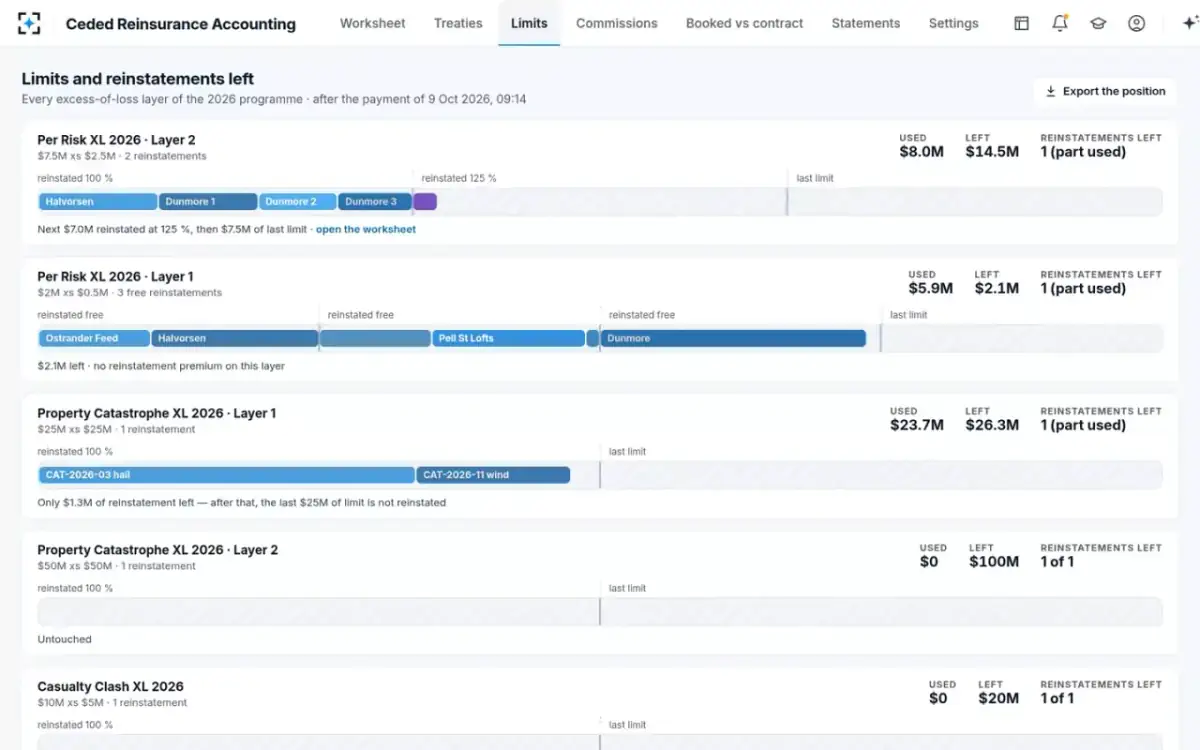
How many reinstatements a catastrophe treaty has is a matter of negotiation, and no official statistic counts them. Clark's note describes the catastrophe contract as providing "a limited number of reinstatements" because the limit is usually large. In the sample programme each property catastrophe layer has one; the per-risk layers have two and three.
Limit used, limit left and reinstatements left, layer by layer, in Ceded Reinsurance Accounting
Which premium does the reinstatement rate apply to?
The premium the wording names, which is not always the premium already paid. Clark's example applies the rate to the annual premium. Many excess of loss layers are rated on subject premium and paid by a deposit that is adjusted when the subject premium is final, and their wordings then have to say whether reinstatements are priced on the deposit, the estimate or the final figure. The sample layer prices them on the minimum and deposit premium until the final premium is agreed, and then recalculates.
That makes every reinstatement premium on such a layer provisional. If the sample layer's final premium came in at $3,360,000 instead of the $3,150,000 deposit, each reinstatement premium would rise by the same 6.7%, and the difference would go on the next account. When the deposit is not the bill works through that adjustment.
Rounding, and the order the steps are done in
Round once, at the end. The time factor 200/365 is 0.547945 to six places; a spreadsheet that rounds it to 0.55 before multiplying adds $1,833.90 to a single sample payment. The error is small on one line and not small across a year of payments and six reinsurers' shares.
Order matters too. Find the cumulative loss to the layer before and after the payment first, then split the payment at each band boundary, then apply each band's rate, then the time factor, then sum and round. Splitting after applying a single rate gives the wrong answer whenever the bands have different rates, as they do on the sample layer, 100% then 125%. When the total is shared among reinsurers, each line is rounded to the cent and the remaining cents go to the largest remainders, so the shares add back exactly to the total.
A checklist for any reinstatement premium figure
Whether the number comes from a broker's statement, a spreadsheet or software, the same eight questions test it. Each is a reading of the wording that the figure should be able to show.
Eight checks before a reinstatement premium is billed or paid
- Which premium does the rate apply to?
Annual, deposit until final, or adjusted. Check the premium basis clause, not the invoice.
- What rate applies in each band?
First, second and later reinstatements can differ; a free reinstatement is 0%.
- Where did the cumulative loss stand before and after?
The band is decided by the cumulative loss to the layer, not by the size of the payment.
- Does the payment cross a boundary?
If it does, split it and charge each part at its own rate.
- Does any of it fall in the last limit?
That part is paid but not reinstated, and carries no premium.
- Does the wording pro-rate by time, and from which date?
Date of loss and date of payment can be months apart; most catastrophe wordings do not pro-rate at all.
- Was anything rounded before the last step?
Round once; share the cents by largest remainder.
- When is it due, and can it be netted?
Some wordings make it due as the loss is paid and allow it to be deducted from the recovery.
In the solution these checks are the steps of the reinstatement calculator, and each cites its clause. The booked-figure checker then runs them again on every adjustment booked in the last 24 months. For the bookkeeping that follows a payment, see excess of loss reinsurance accounting after one loss; to run the calculation on your own wordings, start from Ceded Reinsurance Accounting.
Questions people ask
Can I calculate reinstatement premium in Excel?
Yes, one band at a time. For a band from S to E of cumulative loss, the reinstated amount is MAX(0, MIN(after, E) − MAX(before, S)), and the premium is premium × rate × that amount ÷ limit × days left ÷ days in the period; sum the bands and round once. The hard part is keeping each treaty's rates, basis and time rule current, not the formula.
What is reinstatement premium protection?
It is a separate cover a ceding insurer can buy that pays the reinstatement premiums due under its excess of loss programme after a loss. It moves the cost of reinstating to another reinsurer; the premiums still have to be calculated exactly as on this page, because the protection pays what the original wording charges.
Can a reinstatement premium be returned?
Yes, when it was overcharged. In the sample programme two payments were billed without the time factor, and the October statement carries return premiums of $171,221.92 and $379,726.03 to put them right, each with its clause.
Does paying a reinstatement premium increase the aggregate limit?
No. The premium restores limit that a loss used, up to the aggregate the wording sets. The aggregate is fixed at the occurrence limit times one plus the number of reinstatements; on the sample per-risk layer that is $22.5 million.
Is reinstatement premium charged on a loss or on a payment?
Often billed on payments and priced on the loss. The sample wording reinstates the limit from the time of the loss but makes the premium due as the loss is paid, so it is billed payment by payment, each priced on the cumulative loss to the layer. Statutory accounting looks at the loss itself: the liability belongs to the period in which the loss event occurs.