Sliding scale commission is a ceding commission on a proportional reinsurance treaty that the reinsurer pays at a provisional rate as premium is ceded and then adjusts with the treaty's loss ratio: the better the loss ratio, the higher the commission, between a minimum and a maximum the wording sets. Adjustments are often made quarterly, and some wordings carry a bad year's excess losses forward into later years' calculations. The definition is short; the difficulty is that each element is a separate clause with its own accounting consequence, and a quota share can keep adjusting for years. Botminds' Ceded Reinsurance Accounting is software that reads those clauses from each wording and runs every slide in a ceded programme each quarter, with the clause beside every step and an accountant approving the result.
Sliding scale commission and profit commission, side by side
Sliding scale commission: The ceding commission rate itself, up or down with the loss ratio.
Profit commission: An extra commission: a share of the reinsurer’s profit, if there is one.
Sliding scale commission: A provisional rate paid as premium is ceded.
Profit commission: Nothing is paid until the profit is calculated.
Sliding scale commission: Yes: above a set loss ratio the cedant returns provisional commission.
Profit commission: No: a loss year pays nothing, though its deficit may be carried forward.
Sliding scale commission: A minimum and a maximum rate, with one or more slopes between.
Profit commission: A percentage of profit after losses, commission and an expense margin.
Sliding scale commission: Often reviewed quarterly, cumulatively.
Profit commission: Set by the wording; in the sample, first 30 months after inception, then yearly.
Sliding scale commission: Past excess losses can be added to the current loss ratio.
Profit commission: Past deficits can be deducted from the current profit.
What is sliding scale commission? The regulators' definition
The statutory definition is one sentence. NAIC Issue Paper No. 75, the 1998 paper on property and casualty reinsurance whose conclusions now sit in SSAP No. 62R, lists it among the commission adjustments a treaty may contain: "Sliding Scale—A provisional rate of commission is paid over the course of the treaty, with a final adjustment based on the experience of the business ceded under the treaty" (IP 75).
Three elements are in that sentence: a provisional rate, a period over which it is paid, and an adjustment based on experience. Wordings add the rest: the scale that turns experience into a rate, the definition of the loss ratio, the dates of each adjustment, and whether past losses are carried forward. A sliding-scale commission moves with the loss ratio, but only the loss ratio the wording defines, measured over the period the wording names.
How does a sliding scale commission work across a treaty year?
The reinsurer pays the provisional commission as premium is ceded, then reviews the cumulative experience at set dates and pays more or takes some back. The CAS textbook chapter on reinsurance describes the cycle: "the reinsurer pays the cedant a provisional commission on the reinsurance gross written premium as it is transferred to the reinsurer. At suitable dates (often quarterly), the cumulative experience on the treaty (usually from the beginning if there is a deficit carryforward, or over some period such as three years) is reviewed. If it is profitable, the reinsurer pays the cedant an additional commission; if it is unprofitable, the cedant returns some of the provisional commission to the reinsurer" (Patrik).
Two words in that passage carry the accounting. "Cumulative" means each quarter's review recalculates the whole period to date and books only the change since the last review, so a missed quarter is caught up at the next one if anyone runs it. "Returns" means the adjustment can go against the cedant, so a cedant that books only the favourable adjustments overstates its commission income.
What is a provisional commission?
A provisional commission is the rate paid on ceded premium before anyone knows the loss ratio, set by negotiation somewhere inside the scale: 30% in the CAS study note's example, between a 25% minimum and a 45% maximum. The CAS chapter explains why it matters for pricing: proportional treaties "are usually priced by evaluating the amount of the commission to be paid ultimately to the cedant. The ultimate commission is comprised of a provisional commission paid at the time of the cession, plus any later adjustments specified by the terms of the treaty" (Patrik).
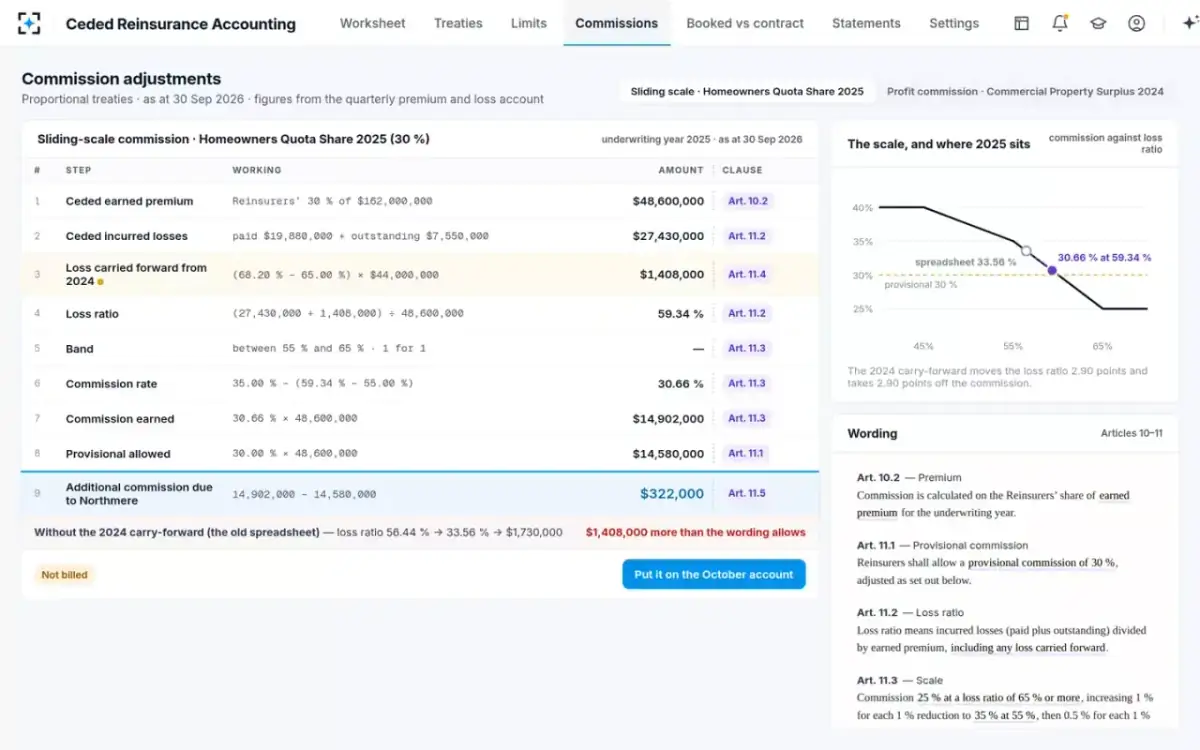
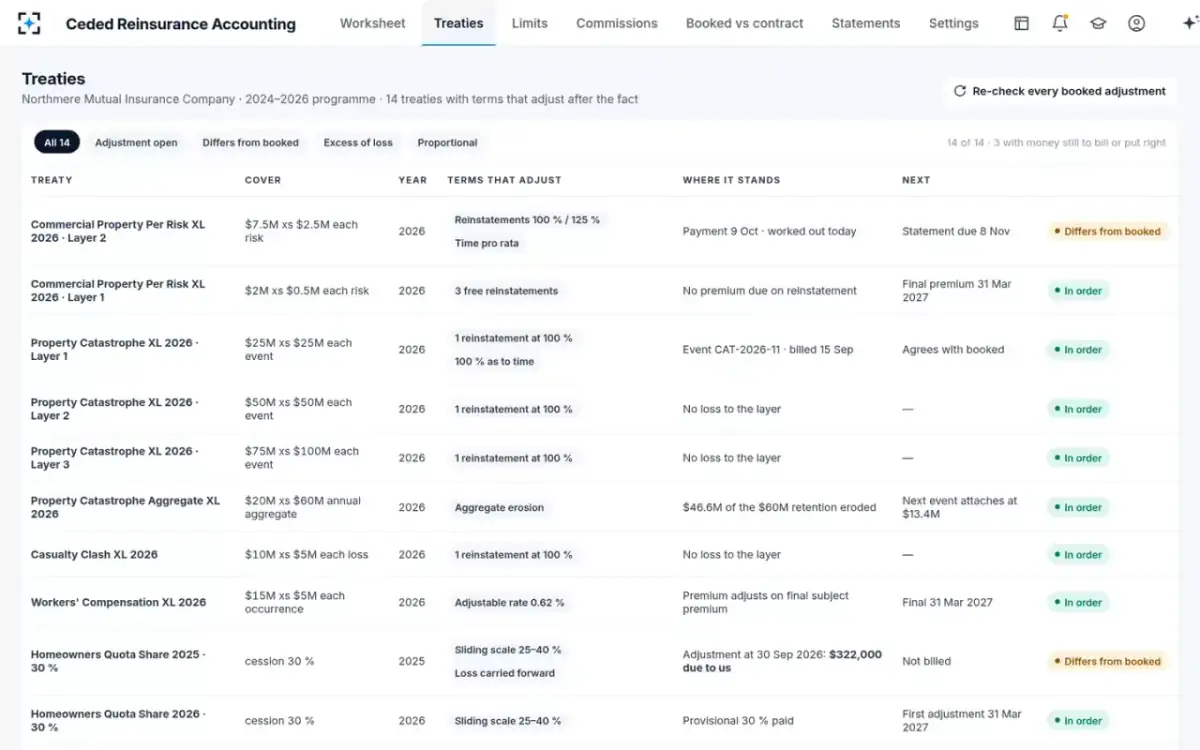
For the ceded accountant the provisional rate is the starting entry, not the answer. In the sample programme of Ceded Reinsurance Accounting, a fictional insurer's homeowners quota share pays 30% provisionally; at 30 September 2026 the scale gave 30.66% on the loss ratio including a carried-forward loss, so $322,000 more was due to the insurer and had not been billed. All figures from that programme are sample data.
The range and the slide: minimum, maximum and the rate between
The range is the band of loss ratios over which the commission moves, from the loss ratio that earns the maximum to the one that earns the minimum; the slide is how far the commission moves for each point of loss ratio inside it. A 1:1 slide moves the commission one point for each point of loss ratio, a 0.5:1 slide half a point. The CAS textbook's worked example sets the terms differently, as a formula: a provisional rate of 33%, a slide factor of 50%, a reinsurer's margin of 5%, and a minimum and maximum of 25% and 35%. In the chapter's words, "This ceding commission formula varies the commission one half point with each loss ratio point, with a minimum of 25% and a maximum of 35%" (Patrik).
The CAS textbook's sliding scale, read as a table
50%
Commission35% (maximum)
WhyCapped: any loss ratio below 58% earns the maximum
58%
Commission35%
WhyThe maximum is reached
62%
Commission33%
WhyThe provisional rate: 33% + 62% + 5% margin = 100%
66%
Commission31%
WhyHalf a point off for each point of loss ratio
70%
Commission29%
WhyHalf a point off for each point
78%
Commission25% (minimum)
WhyThe minimum is reached
85% or worse
Commission25%
WhyFloored
Read that way, the formula has a pivot: at a 62% loss ratio the provisional 33% is exactly right, and the slide runs from 58% to 78%: four points below the pivot before the 35% cap, and sixteen above it before the 25% floor. The sample programme's scale is written the other way, as points: 25% at a loss ratio of 65% or more, rising one point per point to 35% at 55%, then half a point per point to 40%.
The sample programme's scale: commission at each loss ratio
What is a commission corridor?
A commission corridor is the band of loss ratios inside which the commission slides; outside it, the commission sits at the minimum or the maximum and stops moving. On the sample scale the corridor runs from 45% to 65%, with two slopes inside it; on the CAS formula it runs from 58% to 78%, with one. In both the CAS study note's example and the sample, the steeper slope sits nearer the minimum, where the reinsurer's margin is thinnest.
The term is sometimes confused with a loss corridor, which is a different feature: a band of losses the cedant takes back from the reinsurer, rather than a band of commission. The sliding scale commission calculator sets out the difference with the CAS example of each, and lets you run a scale with any corridor.
The carryforward: last year's loss inside this year's commission
A carryforward adds the excess losses of past years, the part above the loss ratio that earns the minimum commission, to the current year's loss ratio, so one bad year keeps lowering commission until it is used up or expires. The CAS study note puts the effect on the scale simply: including the carryforward "amounts to shifting the slide by the amount of the carryforward" (Clark).
In the sample programme the 2024 year ran at 68.20% against a minimum-commission point of 65%, on $44,000,000 of premium, so $1,408,000 was carried into 2025. That shifted the 2025 loss ratio by 2.90 points. Inside the 1:1 band it took 2.90 points off the commission, and leaving it out would have claimed $1,408,000 more than the wording allows.
This issue is further complicated when a commission deficit can be carried forward but not a credit. There is no standard method for handling these questions so far as this author is aware.
Clark, Basics of Reinsurance Pricing (CAS)
That absence of a standard is the accountant's problem as much as the actuary's. A carryforward can run for a fixed number of years or until used, can apply to deficits only or to credits too, and can restart at renewal or survive it. None of that can be assumed from the programme's other treaties; each wording has to be read, and any unusual period should be confirmed by a person before it is first applied.
A sliding scale worked from its wording, the carryforward on its own row
What is the difference between sliding scale and profit commission?
A sliding scale changes the commission rate both ways with the loss ratio; a profit commission pays an extra share of the reinsurer's profit only when there is one. The sliding scale starts from a provisional payment and can claw some of it back; the profit commission starts from nothing and cannot go below it, though a loss year's deficit may be deducted from later profits. Issue Paper No. 75 lists them as separate commission adjustments, and the annual statement accrues them on separate lines.
The calculation differs too. A slide needs only the loss ratio and the scale. A profit commission needs premium, the ceding commission paid, incurred losses, an expense margin and any deficit brought forward, and then a percentage. The deficit is where profit commissions most often go wrong, and profit commission calculation in reinsurance follows one through several years.
Why use a sliding scale commission?
Because the cedant and the reinsurer rarely agree on the loss ratio a quota share will produce, and a slide lets them stop arguing about it at signing. The CAS study note makes the point in its section on proportional treaties: cedant and reinsurer often still disagree about the loss ratio and the right commission when the treaty is negotiated, and adjustable features are often built into the treaty to settle it.
The slide splits the uncertainty. If the business runs better than the reinsurer feared, the cedant earns it back in commission; if worse, the reinsurer recovers part through a lower rate. For the cedant the price is administrative: every adjustment date is an obligation to calculate, bill or refund, and an adjustment nobody runs is money left with the other side.
Each element of a sliding scale, its clause and what it does to the books
Reading a sliding scale clause means finding six things and knowing what each does to the accounts. The table uses the sample programme's homeowners quota share as the example wording.
Six elements of a sliding scale, as Ceded Reinsurance Accounting reads them from the wording
| Element | In the sample wording | What it does to the books |
|---|---|---|
| Provisional commission | Art. 11.1: 30% allowed provisionally | Booked as ceding commission when premium is ceded |
| Premium base | Art. 10.2: reinsurers’ share of earned premium for the underwriting year | Sets the denominator of the loss ratio and the base for the adjusted commission |
| Loss ratio | Art. 11.2: incurred losses, paid plus outstanding, over earned premium, including any loss carried forward | The only loss ratio the adjustment may use; nothing looser, nothing stricter |
| Scale | Art. 11.3: 25% at 65% or more, 1:1 to 35% at 55%, then 0.5:1 to the maximum | Converts the loss ratio into the commission earned to date |
| Carryforward | Art. 11.4: the excess of a prior year’s loss ratio over 65%, times that year’s premium | Raises the current loss ratio; must come from the prior year’s own calculation |
| Adjustment | Art. 11.5: the difference between commission earned and provisional, settled each quarter | An accrual each period, and a line on the quarterly account |
In the solution, the wording reader turns each of those six into a rule with its clause and page, the commission calculator runs the scale on every quarterly account, and the booked-figure checker re-works every adjustment of the last 24 months to find the quarters that were never run. The sample programme's quota share is listed on the treaties screen with its terms and where it stands.
Every sliding scale in Ceded Reinsurance Accounting's sample programme, and where it stands
To work a slide of your own, use the sliding scale commission calculator; to see every slide in a programme run from its wording, start from Ceded Reinsurance Accounting.
Questions people ask
Is a sliding scale commission the same as a ceding commission?
It is one kind of ceding commission: the kind whose rate depends on the loss ratio. A flat ceding commission stays at the agreed rate whatever happens; a sliding scale starts at a provisional rate and is adjusted, in the sample programme every quarter, between 25% and 40%.
Why does commission plus loss ratio stay constant in part of the scale?
Because a 1:1 slide moves the commission down one point for every point the loss ratio rises. On the sample scale between 55% and 65%, commission plus loss ratio is always 90%, which is why the commission in dollars there is simply 90% of premium less losses: $14,902,000 at 30 September 2026.
Are sliding scales used on excess of loss treaties?
Rarely; they belong to proportional treaties, where the reinsurer pays a commission in the first place. The CAS chapter notes that "Proportional treaties often have sliding-scale or contingent commissions". The excess of loss equivalent is a premium that adjusts with losses, such as a retrospectively rated or swing-rated premium.
How long does a sliding scale keep adjusting?
As long as the wording says; there is no standard period. The sample's 2025 quota share was still being adjusted at 30 September 2026, nine months after its underwriting year ended, and the CAS chapter describes reviews over the treaty's whole life where there is a deficit carryforward, or over a set period such as three years.
Does the cedant always gain from a sliding scale?
No. It gains when the business runs better than the provisional rate assumed and pays back when it runs worse. In the CAS formula example, every point of loss ratio above 62% costs the cedant half a point of commission until the 25% minimum at 78%.