A profit commission calculation in reinsurance takes the premium ceded for the period, subtracts the ceding commission already allowed, the incurred losses, the reinsurer's expense margin and any deficit brought forward from earlier periods, and pays the ceding insurer the agreed percentage of what is left, if anything is left. It rewards a cedant whose business runs profitably for the reinsurer, and it is calculated after the year ends, once losses have had time to develop. The step that goes wrong is not the subtraction but the deficit: a loss year's deficit has to be carried into the next years' calculations, sometimes for a fixed number of years, and a spreadsheet rebuilt for each year forgets it. Botminds' Ceded Reinsurance Accounting is software that reads each profit commission clause from the wording, carries deficits forward as the wording defines them, and calculates on the due date, with the clause beside every step.
From premium to profit commission, line by line, in Ceded Reinsurance Accounting's sample
How is profit commission calculated in reinsurance?
Profit commission = percentage × (premium − ceding commission − incurred losses − expense margin − deficit brought forward), paid only if the result is positive. The CAS study note on reinsurance pricing defines it in one sentence: "A profit commission subtracts the actual loss ratio, ceding commission and a 'margin' for expenses from the treaty premium and returns a percent of this as additional commission" (Clark).
The CAS study note's profit commission, in ratios
| Line | As a share of premium | How it is reached |
|---|---|---|
| Actual loss ratio | 55% | Incurred losses over premium |
| Ceding commission | 25% | As allowed under the treaty |
| Margin | 10% | The reinsurer’s allowance for expenses |
| Reinsurer’s profit | 10% | 100% − 55% − 25% − 10% |
| Percent returned | 50% | Of the reinsurer’s profit |
| Profit commission | 5% | 10% profit × 50% |
In dollars the same structure gives the sample programme's figure. Commercial Property Surplus 2024, a treaty of the fictional insurer in Ceded Reinsurance Accounting's sample programme, had $21,400,000 of ceded earned premium for underwriting year 2024. Less the 32% ceding commission of $6,848,000, incurred losses of $9,620,000, a management expense of 5% of premium, $1,070,000, and a 2023 deficit of $1,240,000, the profit is $2,622,000. At 15%, the profit commission is $393,300.
What is a deficit carried forward in a profit commission?
A deficit carried forward is a loss year's negative result, deducted from the profit of later years before any profit commission is paid on them. Without it, a cedant could take profit commission on every good year while the reinsurer absorbed every bad one. The sample wording states the rule in one line: a deficit is carried forward for three years, or until extinguished.
Each part of that line is a decision. "Three years" has to be counted from somewhere, and a reader has to decide whether the deficit year itself counts. "Until extinguished" means a deficit is used up by later profits and then stops. And a wording has to say whether a profitable year's surplus offsets a later deficit too, which this one does not. The CAS study note is candid that practice varies: "Also like the sliding scale commission, there is some ambiguity concerning the handling of carryforward provisions" (Clark).
The deficit nobody carried: how a profit commission gets overclaimed
When a spreadsheet calculates each year's profit commission from that year's figures alone, every deficit from an earlier year disappears, and every later profit commission is too high. Nothing in the year's own numbers looks wrong, which is why the error survives review. The illustration below follows one deficit through five years, and the right-hand column shows what a spreadsheet that forgot it would have claimed.
One deficit over five underwriting years, carried and forgotten
Year 1A deficit year: 1,800 to carry
Profit before deficit−1,800
Deficit brought in—
Profit after−1,800
Commission0
Spreadsheet that forgot0
Year 21,200 of the deficit left
Profit before deficit600
Deficit brought in−1,800
Profit after−1,200
Commission0
Spreadsheet that forgot90
Year 3700 left
Profit before deficit500
Deficit brought in−1,200
Profit after−700
Commission0
Spreadsheet that forgot75
Year 4300 left, now in its third year
Profit before deficit400
Deficit brought in−700
Profit after−300
Commission0
Spreadsheet that forgot60
Year 5The remaining 300 has lapsed
Profit before deficit900
Deficit brought inexpired
Profit after900
Commission135
Spreadsheet that forgot135
The error runs both ways. Forgetting the deficit pays the cedant $225,000 of commission it was not owed, which the reinsurer's audit will eventually reclaim. Carrying it a year too long, into year 5, would have cost the cedant $45,000 it was owed. On the sample treaty the same mistake would be larger: without the 2023 deficit the profit would be $3,862,000 and the commission $579,300, an overclaim of $186,000.
A deficit lives in last year's spreadsheet; the profit commission is calculated in this year's.
What is the reinsurer's margin, and how is it different from a management expense?
The margin is the share of premium the reinsurer keeps for its expenses and profit before any profit is shared; a management expense is one way a wording expresses it. In the CAS example the margin is 10% of premium, "a 'margin' for expenses" in the study note's words. The sample wording deducts a management expense of 5% of premium. Both work the same way in the arithmetic, as a fixed percentage of premium taken off before the profit is shared.
The margin is often where negotiation happens, because it moves the point at which profit commission starts. With the sample's 32% commission and 5% expense, the treaty earns profit commission once incurred losses plus any deficit fall below 63% of premium; at a 10% margin that point drops to 58%. A wording that defines the margin on written rather than earned premium, or on gross rather than net, changes the result again.
When is profit commission paid?
On the dates the wording sets, after the underwriting year ends, and then again as losses develop. The sample wording first calculates its profit commission 30 months after inception, then yearly; for underwriting year 2024 the first calculation fell due on 30 June 2026. Issue Paper No. 75's description allows for any period: "Profit may be calculated for any specified period of time, but the calculation is often based on an average over a period of years" (IP 75).
The profit commission worked from Article 12, with the deficit marked
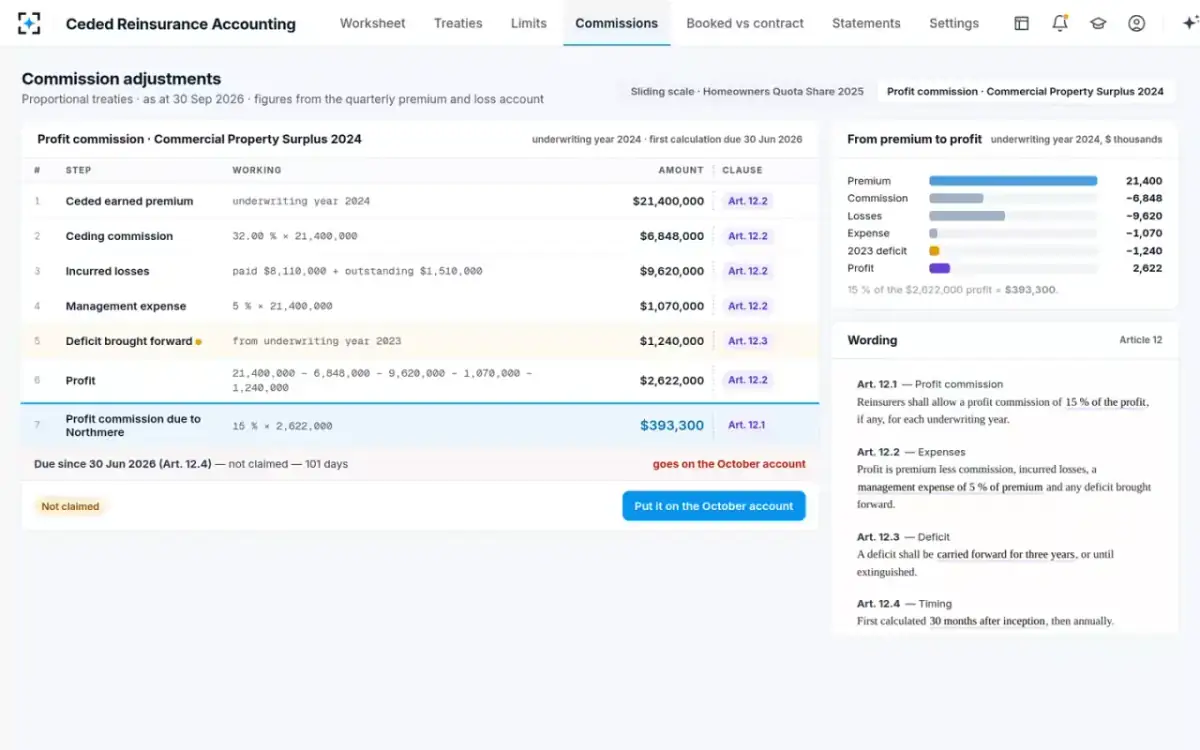
Between the due dates, the accounts still carry it. Statutory accounting accrues adjustable features from experience to date and refuses to anticipate an early end to the contract: "Statutory accounting requires the calculation related to adjustable features to be computed based on experience to date because, from a regulatory standpoint, it is improper to recognize the favorable impact of early termination of the contract until such time as the contract is actually terminated" (IP 75). A cedant expecting a profit commission accrues what experience to date supports, and revises it as the losses move.
What is a contingent commission?
In reinsurance accounting a contingent commission is a profit commission: a share of the reinsurer's profit on the business ceded, contingent on there being one. Issue Paper No. 75 treats the two names as one feature: "Contingent or Straight Profit—The reinsurer returns to the ceding company a stipulated percentage of the profit produced by the business assumed from the ceding insurer" (IP 75).
The annual statement keeps them apart from sliding scales all the same. The accrual instruction reproduced in the paper lists three separate lines for "Additional or return commission predicated on loss experience or on any other form of profit sharing arrangements": contingent commission, sliding scale adjustments, and other profit commission arrangements. A ceded team that books all three in one account will have to unpick them at year end.
How do you audit a profit commission?
Recompute it from the wording and the losses, and spend most of the time on the deficit. A reviewer who checks only that the subtraction is right will pass an overclaim every time the deficit was dropped. The ten checks below follow the clause, line by line.
Ten checks on any reinsurance profit commission
- The wording version in force for that underwriting year
Terms can change at renewal, and each year follows its own.
- The premium base
Earned or written, ceded or gross, for the underwriting year or the accounting year: as the clause says.
- The ceding commission actually allowed
Including any sliding-scale adjustment, not the provisional rate.
- Incurred losses at the calculation date
Paid plus outstanding, and IBNR only if the wording includes it.
- The expense margin
Its rate and its base.
- Every deficit brought forward
Which years, how much each, and whether any has expired or been used up.
- Whether surpluses carry too
Some wordings carry deficits only; some offset both ways.
- The percentage
And whether it steps with the size of the profit.
- Earlier payments for the same year
Later calculations are cumulative: pay or refund the difference.
- The due date, and whether it was claimed
In the sample, a correct $393,300 went unclaimed for 101 days.
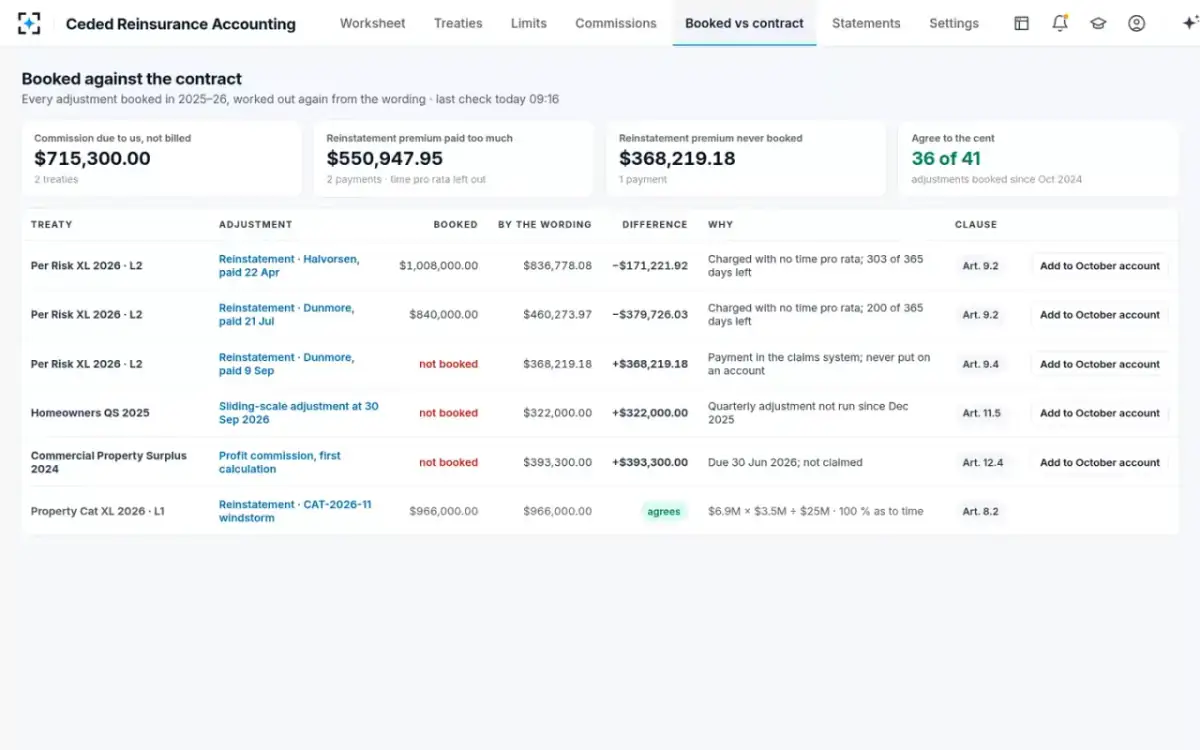
The solution runs those checks every month over 24 months of booked adjustments. On the sample programme it found two commissions due to the insurer and never billed, $715,300 together: this profit commission and a quarterly sliding-scale adjustment. Re-running 24 months of bookings shows the full result.
Ceded Reinsurance Accounting's re-check of every booked adjustment: two commissions never billed
Why some profit commissions return most of the premium
On some treaties the profit commission is not a bonus at the margin but the main economic term, and the arithmetic is the same. The CAS study note's discussion of finite risk covers gives the pattern: a profit commission "which returns, say, 75% of premium if the contract is loss free for three years", and, "In exchange for the profit commission, a relatively high annual premium is charged up front" (Clark).
Its worked example puts numbers on it. A $10,000,000 cover costs $2,500,000 a year, with a profit commission of 80% after a 10% margin on the annual premium. In a loss-free year the profit is $2,500,000 less the $250,000 margin, and 80% of that, $1,800,000, comes back to the cedant: nearly three quarters of the premium. A cedant booking that cover has to accrue a profit commission that large on experience to date, and reverse it when a loss arrives.
Treaties like this sit close to the line statutory accounting draws between reinsurance and deposits. No credit is allowed for reinsurance unless the reinsurer takes on significant insurance risk and could reasonably lose significantly on the contract, and a generous profit commission paid for by a high premium is exactly the kind of feature a risk transfer test has to look at. Reading the wording for that is the job of Treaty Wording Comparison, and the reinsurance risk transfer test names the clauses to look at; calculating the commission once the treaty is in force is this one.
A treaty profit commission is not an MGA's profit commission
The profit commission on this page is the one a reinsurer pays a ceding insurer under a treaty. A managing general agent's profit commission, paid by its carriers on the business it writes for them, follows a different contract, between the agent and each carrier, with terms of its own. Calculating those is the job of Profit Commission Calculation. For the related adjustment that moves the commission rate itself, see what a sliding scale commission is; to run every treaty profit commission in your programme from its wording, start from Ceded Reinsurance Accounting.
Questions people ask
Can a profit commission be negative?
No. If the result after losses, commission, margin and deficits is negative, no profit commission is paid and the shortfall becomes a deficit to carry forward if the wording allows. In the five-year illustration above, a 1,800 deficit in year 1 meant no commission for the next three years.
What percentage is a reinsurance profit commission?
Whatever the wording sets; no official statistic records the range. The CAS study note's example returns 50% of the reinsurer's profit after a 10% margin, and the sample programme's surplus treaty pays 15% after a 5% management expense. The two together show why the margin and the percentage have to be read as a pair.
Is profit commission calculated on written or earned premium?
On the base the wording names. The sample wording uses the reinsurers' ceded earned premium for the underwriting year, $21,400,000 for 2024. A calculation on written premium in a growing book would show more premium and more profit than the wording allows.
How does a profit commission appear on the statement of account?
As a line due to the cedant for the underwriting year, with the calculation and clause behind it, and on later accounts as the difference from what was paid before. In the sample programme the 2024 surplus treaty's $393,300 goes on the October account as a new line, citing Article 12.4.
What happens to a deficit if the treaty is not renewed?
The wording decides. A deficit carried forward needs a later year to be deducted from; if the treaty ends, the deficit has nothing left to be deducted from unless the wording provides for a final settlement. Statutory accounting does not anticipate the ending: until a contract is actually terminated, adjustable features are accrued on experience to date.