The reinsurance settlement process is the sequence that turns an agreed quarterly account into cash: the account is agreed, the balance is netted into a single figure, a payment instruction is drawn from cedant to broker to reinsurer (or the other way), the instruction is approved, and the payment is released and matched to the bank. The work that slows it down is preparation, reading three statements, recomputing the treaty terms, finding and explaining each difference and drafting the instruction, and that is the part software can now do. The part that should stay with named people is the decision: agreeing the account, accepting or querying each difference, and signing the payment. Botminds' Reinsurance Account Reconciliation is built on that split: six agents read, match, explain and draft; the reinsurance accountant agrees each account, and a finance controller co-signs any settlement above a set amount before money moves.
Figures on this page come from the solution's fictional sample data: Calder Ridge Mutual, its 2026 commercial property quota share placed by Ashgrove Re Partners, and its reinsurer Northfold Re, which writes 30% of the cession. Rules and survey figures are linked where they appear.
From three statements to one released payment: where the agents stop
Agent
Statement readerReads the cedant's account, the broker's statement of account and the reinsurer's technical account into items with page and line, and checks each adds up to its balance.
Never: alters a figure; a statement that does not add up is reported
Agent
Treaty terms checkerRecomputes commission, brokerage, the excise tax allowance and each reinsurer's share from the wording and the panel, quoting the clause for each term.
Never: applies a term that is not in the wording
Agent
Line matcher and difference explainerTicks items that agree in all three statements and gives every other item a cause, the arithmetic, the line in each statement, the deciding clause and an owner.
Never: accepts a difference or books an adjustment
A person decides
Reinsurance accountantAccepts or queries each difference, sends the queries, and agrees the account.
Agent
Settlement drafterNets the agreed account, credits cash calls already paid, takes off brokerage and drafts the instruction from cedant to broker to reinsurer.
Never: releases money, or uses bank details that differ from the last payment
A person decides
Finance controllerCo-signs any settlement above the limit; only then is the payment released to the bank.
What is the reinsurance settlement process?
It is the step after agreement, and it settles a balance, not a list of transactions. Once the cedant's account, the broker's statement and the reinsurer's technical account say the same thing, the premium, commission, deductions, losses and cash already exchanged collapse into one net figure, and that figure moves in one direction. On a quota share in a quiet quarter the cedant pays; in a heavy loss quarter the reinsurer does.
The treaty sets the clock. Calder Ridge's sample wording gives 45 days after quarter end to render the account and 30 days after agreement to settle, and the broker's terms with the cedant set how quickly it passes money on. What the contract rarely sets is who inside each company may agree, approve and release, and that is where a settlement process is won or lost.
What is netting in reinsurance settlement?
Netting is collapsing every item on an agreed account into one balance, so that one payment settles the quarter instead of a dozen. It is routine within one contract's account. Netting across contracts, or against amounts that are in dispute, is a different question with its own rules, set out in when an offset clause allows netting.
How one quarter's balance is made: Northfold Re's 30% of the quota share
| Item | Basis | Amount |
|---|---|---|
| Premium ceded, U.S. business | Northfold's share | $7,284,000.00 |
| Premium ceded, Canadian branch | CAD 1,150,000 at 0.7266 | $835,590.00 |
| Ceding commission | 30.0% of $8,119,590.00 | −$2,435,877.00 |
| Federal excise tax allowance | 1% of $8,119,590.00, Art. 17 | −$81,195.90 |
| Paid losses | Seven losses, at the book rate on each payment date | −$4,833,160.00 |
| Cash call already received | Wired by Northfold on 12 May, loss 1182, Art. 15 | +$1,204,800.00 |
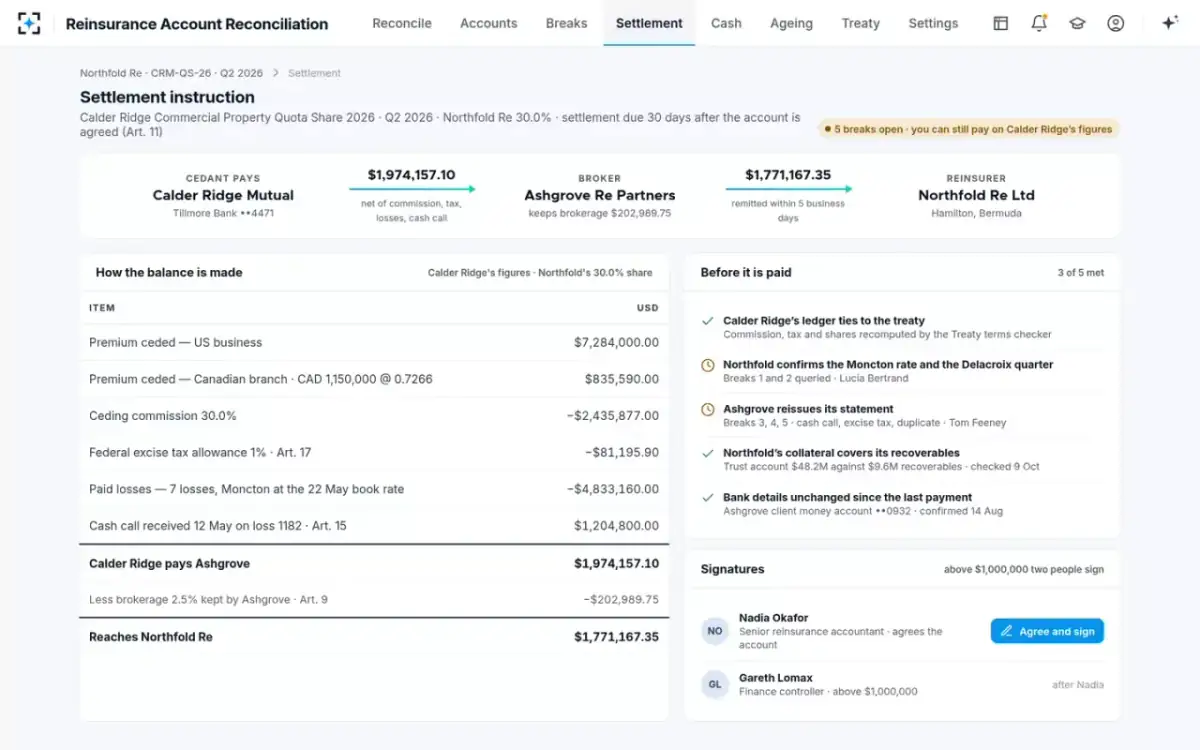
| Cedant pays broker | Net of all the above | $1,974,157.10 |
| Brokerage kept by the broker | 2.5% of gross premium, Art. 9 | −$202,989.75 |
| Reaches the reinsurer | Remitted within five business days | $1,771,167.35 |
The cash call line is the one that goes wrong. Northfold wired its $1,204,800.00 share of a large loss straight to Calder Ridge's bank on 12 May, not through the broker, so the broker's statement never showed it. Without the credit, Northfold's quarter would have charged it for the same loss twice. A settlement drafted from the broker's statement alone would have been $1,204,800.00 short.
Who approves reinsurance settlements?
The reinsurance accountant agrees the account, and someone else approves the payment above a threshold the company sets. That split is a basic control, and the U.S. Government Accountability Office's internal control standard sets it out: authorizing a transaction, processing and recording it, reviewing it and handling the assets involved should sit with different people, so that no one person controls every key step (GAO-14-704G).
Agents change the split, not the principle. The work they take over, reading, recomputing, matching and drafting, is the processing half of a settlement. The authorizing and releasing half has to remain with people who are not the processor, and that now includes the software. In the sample settings the accountant (Nadia Okafor or Dev Malhotra) agrees each account, any settlement above $1,000,000 needs the finance controller's second signature, and any write-off above $500 needs the finance controller too. The threshold is a setting with three positions, $500,000, $1,000,000 and $2,500,000, and each change is kept as a new version of the rules.
The drafted settlement instruction, with the checks still open before payment
Can AI release payments? What firms report, and where the line sits
Technically yes; in practice few regulated firms plan to let them, and a reinsurance settlement is a poor place to start. The Bank of England and FCA's 2026 survey of AI in UK financial services sorted agents into four levels: "'decision-support' (agents recommend actions, humans decide and execute)", "Constrained execution (agents execute actions within predefined limits and rules)", "Conditional autonomy (agents act independently but require human approval for certain actions)" and "Broad autonomy (agents can initiate and execute actions with limited real-time human involvement)" (Bank of England and FCA, 2026).
Few firms plan to let agents move money
9%
at most expected agents to initiate, execute or block payments, even counting the next 12 months' plans
8%
reported agents creating or modifying records in core systems today; 25% including plans
2%
reported any agents deployed with broad autonomy
The survey's wording on payments is worth reading in full: "even including planned deployment over the next 12 months, no more than 9% of respondents expected agents to: approve or decline customer outcomes; execute trades or place orders; initiate, execute or block payments; or change limits, thresholds and controls." Reinsurance Account Reconciliation sits at the first level for money and at the second for paperwork: its agents read, tick, explain and draft within the treaty and the settings, and a person decides and executes every step that changes a balance, a counterparty's figure or a bank account.
Writing the boundary down before go-live
The boundary between agent and person should be a table in the procedures, approved before the first quarter runs, not a habit the team discovers later. It has to say who may do each action, above what amount a second person is needed, and what the software may never do whatever the amount. The table below is the sample company's; the limits are settings, so each company writes its own.
Who may do what in a reinsurance settlement, as set up at the sample cedant
| Action | Agents | People | Limit in the sample settings |
|---|---|---|---|
| Read and tick the three statements | Do it, citing page and line | Review on screen | Tolerance $50 an item; below it a difference is ticked and noted |
| Explain a difference | Draft the cause, arithmetic, lines and clause | Accept or query | Seven causes, each with a default owner |
| Send a query to a broker or reinsurer | Draft it, with every line quoted | Send it | Always a person |
| Book an adjustment in the cedant's books | Never | Book it in the cedant's own systems | Outside the solution |
| Agree the account | Never | Reinsurance accountant | Nadia Okafor or Dev Malhotra |
| Write off a small difference | Never | Finance controller above $500 | $500 |
| Draft the settlement instruction | Do it; bank details must match the last payment | Check it | Every settlement |
| Release the payment | Never | Accountant, then finance controller above the limit | $1,000,000 |
Two lines in that table carry most of the risk. A wrong bank account is the one error a payment cannot recover from on the next account, so the drafter refuses changed bank details outright rather than flagging them for someone busy to wave through. And "book an adjustment" sits outside the software altogether: the agents explain what is wrong, and the correction is made by the party that owns it, in its own books.
Who bears the risk if the reinsurance broker fails?
On a U.S. cedant's treaty with a proper intermediary clause, the reinsurer does. The NAIC Credit for Reinsurance Model Regulation allows a cedant credit for reinsurance only if the agreement, among other things, "Includes a proper reinsurance intermediary clause, if applicable, which stipulates that the credit risk for the intermediary is carried by the assuming insurer" (NAIC Model #786, Section 15C). Each state's enacted version governs.
That clause is why a cedant can pay the broker and treat its side as settled, and why a reinsurer's technical accountant cares how long money sits with the broker. The broker also holds funds collected for the cedant in a fiduciary capacity and must pass them on within 30 days of receipt in states that follow the NAIC intermediary model, as the statement of account guide sets out. For the settlement process, the practical rule is to settle through the channel the treaty names and to match every cash movement, in either direction, to the account it belongs to.
How are cash calls settled between quarterly accounts?
A cash call is a demand for the reinsurer's share of a large paid loss before the quarter closes, and it is settled twice: once in cash, within the days the treaty allows, and again in the next account, where the payment must appear as a credit. In the sample wording, a single loss of $2,500,000 or more for 100% of the agreement may be called within 15 days, and any amount paid by way of cash call is credited in the next account whether paid to the company or through the broker.
On loss 1182, a hail loss of $4,016,000 for 100% of the agreement, all five panel reinsurers paid their shares between 12 and 15 May: $1,204,800 from Northfold, $1,004,000 from Tessellate, $803,200 from Halvard Rück, $602,400 from Kinnear and $401,600 from Oriel Bay. Matching each bank line to the cash call, and the cash call to the next account, is what stops the loss being charged twice. A cash call the reinsurer disputes is the harder case, and one disputed cash call is followed day by day.
Five checks before the money moves
Before a settlement is released, five things should be true, and each one should be checkable by the second signer without reopening the spreadsheets. They are the sample company's checks; the order matters, because the first two are about whether the figure is right and the last two are about whether the money will arrive.
Before a reinsurance settlement is paid
- The cedant's figures tie to the treaty
Commission, tax and each reinsurer's share recomputed from the wording, not taken from last quarter's spreadsheet.
- Every difference has an owner
Open breaks need not block payment on the cedant's figures, but each must be with the party that corrects it, with a date.
- Cash already exchanged is in the account
Cash calls, refunds and receipts outside the broker are credited, so nothing is paid twice.
- The reinsurer's security still covers what it owes
In the sample, Northfold's trust account of $48.2 million against $9.6 million of recoverables, checked the day the account was agreed.
- The bank details match the last payment
A changed account number stops the instruction; it is confirmed out of band before anything is released.
The fourth check belongs to a neighbouring discipline: whether a reinsurer's collateral still covers its obligations is the subject of collateral tracking for reinsurance. Here it is only a condition of the payment: if the security has fallen short, the settlement waits for the credit controller.
Agreed by the accountant, co-signed by the controller, released
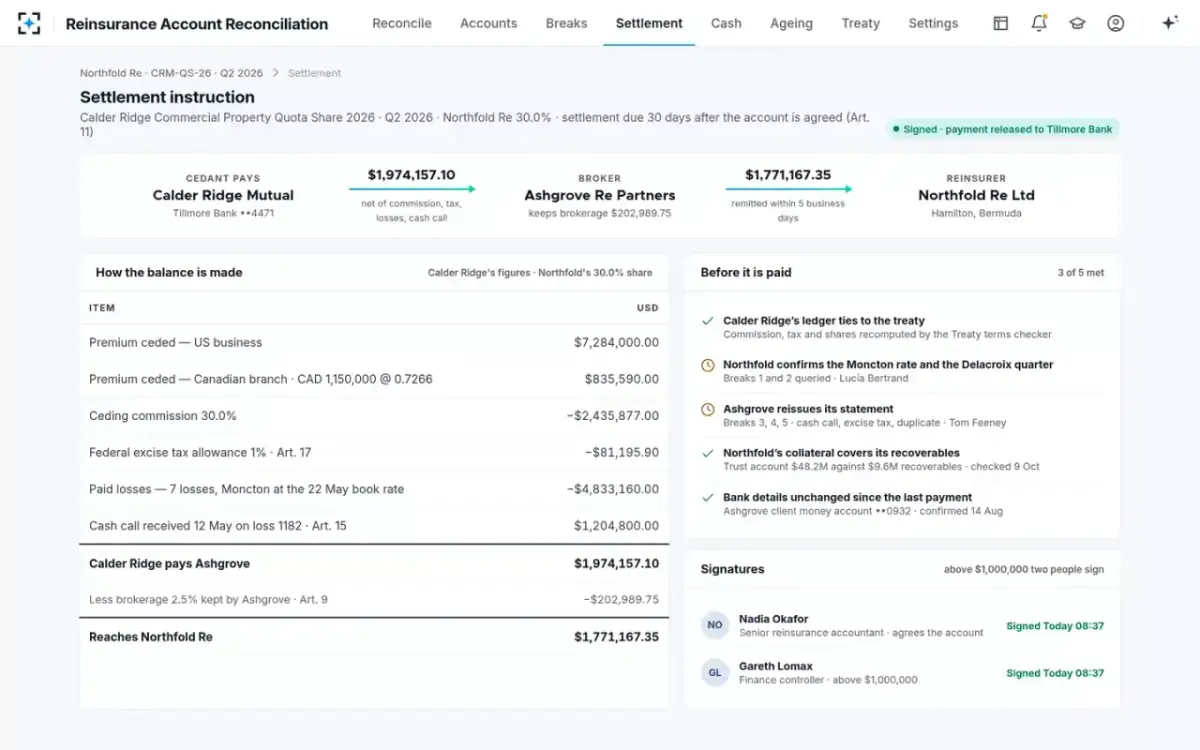
A settlement process built this way is faster for a plain reason: the second signer is looking at the three statements, the open breaks and their owners, not at a total someone typed. To see the drafting, the checks and the signatures on your own treaties, start from Reinsurance Account Reconciliation.
Questions people ask
What is a second signature on a reinsurance settlement?
It is an approval by a second, more senior person before a payment above a set amount is released, so that no one person both prepares and pays a large settlement. In the sample the reinsurance accountant agrees the account and signs first, and a finance controller co-signs anything above $1,000,000.
Can a cedant settle while differences are still open?
Yes, if its own figures match the treaty and its rules allow it; the open differences stay with the broker or reinsurer that owns them and are corrected in a reissued statement or the next account. Calder Ridge paid $1,974,157.10 on its own figures with five breaks open, all of them the broker's or the reinsurer's to correct.
What is a reinsurance settlement statement?
It is the statement that shows how the settlement figure is made, item by item, and who pays whom. In a brokered settlement it shows two legs: the cedant's payment to the broker and the broker's remittance to the reinsurer after brokerage, $1,974,157.10 and $1,771,167.35 in the sample.
How long after agreement is a reinsurance settlement due?
As long as the treaty says; the settlement date is a contract term. The sample wording allows 30 days after the account is agreed, and the broker's own terms with the cedant set how fast it passes money on, with 30 days of receipt as the outer limit in states that follow the NAIC intermediary model.
Should the same person agree the account and release the payment?
Not for large amounts. Separating those who authorize, process, review and hold the money is the basic segregation-of-duties principle in the GAO's internal control standard, and it applies with more force when software does the processing. A threshold, with one signature below it and two above, keeps small settlements quick without weakening the control on large ones.