A cash call in reinsurance is a cedant's demand that its reinsurers pay their share of a large loss as soon as the cedant has paid it, instead of waiting for the next quarterly account. The treaty's cash call clause sets the threshold (one loss above a stated amount), what must accompany the call, how many days the reinsurer has to pay, and how the payment is credited in the next account. It is a liquidity tool for the cedant and a control point for the reinsurer, and it goes wrong in predictable ways: the call is overstated, the documents are missing, part of the loss is disputed, or the payment arrives outside the broker's statement and is never credited. Botminds' Reinsurance Account Reconciliation matches cash calls to the bank file, credits them in the next account and keeps any disputed part visible with its owner and age. The case below, told largely from the reinsurer's side, shows why each of those matters.
The companies and people in this case are fictional and built for this guide: Thistlemere Mutual, the cedant; Cobbold Vane Re Brokers; Harrowby Re, which writes 20% of Thistlemere's 35% property quota share; and Quaystone Cold Storage, the insured. The figures are illustrative. The accounting rules it turns on are real and linked where they appear.
One cash call, two paths: the undisputed share paid in 11 days, the disputed share in 127
- Call to query, 3 days
- Query to documents, 4 days
- Documents to payment, 4 days
- Call to written dispute10 days
- Dispute open110 days
- Agreed to paid, 7 days
What is a cash call in reinsurance?
It is a call for early payment of a reinsurer's share of a large paid loss. Proportional treaties settle on quarterly accounts, which can leave a cedant funding a large loss alone for months; a cash call clause lets it ask for the reinsurers' shares as soon as it has paid, once a single loss crosses a threshold. The payment is then shown in the next quarterly account as a credit to the reinsurer, so the loss is not charged twice.
Every element is contractual. There is no statute that sets a cash call threshold or deadline; the wording does. In this case, Thistlemere's clause allows a call on any one loss of $3,000,000 or more for 100% of the agreement, requires proof of payment with the call, gives the reinsurer ten business days from a complete call, defines a loss net of salvage and recoveries received, and credits any cash call payment in the next account "whether paid to the Company or through the Intermediary". The solution's own sample wording, Article 15, has the same credit language with a $2,500,000 threshold and 15 days.
When can a cedant make a cash call?
When the clause's conditions are met, and not before: a paid loss, above the threshold, for the share the clause names, with whatever documents it requires. A call made on a reserve rather than a payment, on two losses added together to cross the threshold, or without the required proof is open to challenge, and the challenge costs days.
Thistlemere paid Quaystone Cold Storage $14,000,000 on 30 April for a fire on 6 April. Its cession is 35%, so the loss for 100% of the agreement was $4,900,000, well above the threshold, and Harrowby's 20% was $980,000. On Monday 4 May, Thistlemere's reinsurance accountant, Tamsin Rook, issued the call through the broker.
Day by day: from the call to the first payment
Day 0, Monday 4 May. The call goes to Cobbold Vane, which forwards it to the five reinsurers on the panel the next morning. Harrowby's share: $980,000, due ten business days after a complete call.
Day 3, Thursday 7 May. Harrowby's technical accountant, Saskia Lund, replies in writing with two questions. The call has no proof that Thistlemere paid the insured. And the adjuster's interim report, which Harrowby's claims team has, mentions salvage sold on 28 April for $600,000, which the call does not deduct. Under the clause, a call is complete only with proof of payment, and the loss is net of recoveries received.
We were never refusing the loss. We were refusing to pay a number we could not trace to a bank line and a clause.
Saskia Lund, technical accountant at the fictional Harrowby Re
Day 7, Monday 11 May. Thistlemere sends the bank confirmation of the 30 April payment and accepts the salvage point. The loss becomes $13,400,000, $4,690,000 for 100% of the agreement, and Harrowby's share $938,000. The ten business days run from this complete call.
Day 10, Thursday 14 May. Harrowby's claims team sends a formal written notice: $2,000,000 of the loss at 100%, the insured's business interruption after a utility outage, is in its view outside the treaty's property definition. Its share of the disputed part is $140,000. The remaining $798,000 is not disputed.
Day 11, Friday 15 May. Harrowby wires $798,000 straight to Thistlemere's bank, not through the broker, to save the days the broker's account would add. Thistlemere's cash team sees a receipt with Harrowby's name and a loss reference. The broker sees nothing.
How fast must a reinsurer pay a cash call?
As fast as the clause says, from the moment the call is complete. Ten or fifteen days is typical of the wordings in this guide; the clock that matters is when the call met the clause's conditions, which in this case was Day 7, not Day 0. Paying the undisputed part promptly, as Harrowby did, keeps the dispute narrow and keeps the reinsurer’s payment history clean.
Regulators watch payment histories. The NAIC Credit for Reinsurance Model Regulation measures a reinsurer's lack of prompt payment by tests that include the share of its recoverables that are overdue and in dispute, the share of its cedants with undisputed paid-loss recoverables 90 days or more overdue, and the aggregate of such undisputed overdue amounts (NAIC Model #786). Those tests apply to reinsurers granted reduced collateral; the guide to reciprocal reinsurers shows how to follow them across a panel. For one cash call, the lesson is that "disputed" and "overdue" are recorded differently, and the difference matters to both sides.
What happens if a cash call is disputed?
A query and a dispute are different events, with different consequences. Harrowby's Day 3 questions were a query: they asked for documents and a correction, and the call was not yet complete. Its Day 10 notice was a dispute in the statutory sense. The rule carried into SSAP No. 62R, quoted here from NAIC Issue Paper No. 75, explains: "The Annual Statement Instructions require notification of a dispute by a formal written communication from the reinsurer denying the validity of coverage" (NAIC Issue Paper No. 75).
Once a balance is in dispute, the cedant has a judgement to make. In the same text, "A ceding insurer, depending upon the individual facts, may or may not choose to continue to take credit for such disputed balances", and material disputed amounts and their status must be disclosed in the notes to the financial statements. The annual statement instructions quoted there also require disputed recoverables to be identified when the amount in dispute from any one reinsurer exceeds 5% of the cedant's surplus, or all disputed items together exceed 10%. Thistlemere's surplus was $210 million, so $140,000 came nowhere near either line, but the item still had to sit in the accounts as disputed, with its age, rather than as merely late.
What each side needed to see, and when it arrived
What Harrowby Re needed: Proof the loss was paid, and the loss net of recoveries the clause deducts.
What Thistlemere Mutual needed: Confirmation the call had reached all five reinsurers.
What Harrowby Re needed: The bank confirmation and the adjuster's report, both received.
What Thistlemere Mutual needed: An answer on the salvage point, given by accepting it.
What Harrowby Re needed: Its claims team's view on the business interruption, sent as a formal notice.
What Thistlemere Mutual needed: A clear split between the disputed $140,000 and the undisputed $798,000.
What Harrowby Re needed: Nothing more for the undisputed part; it paid.
What Thistlemere Mutual needed: The receipt matched to the call, though it had not come through the broker.
What Harrowby Re needed: The $798,000 credited, so the loss would not be charged again.
What Thistlemere Mutual needed: The disputed $140,000 kept open, aged and owned, not folded into the balance.
The receipt the broker never saw
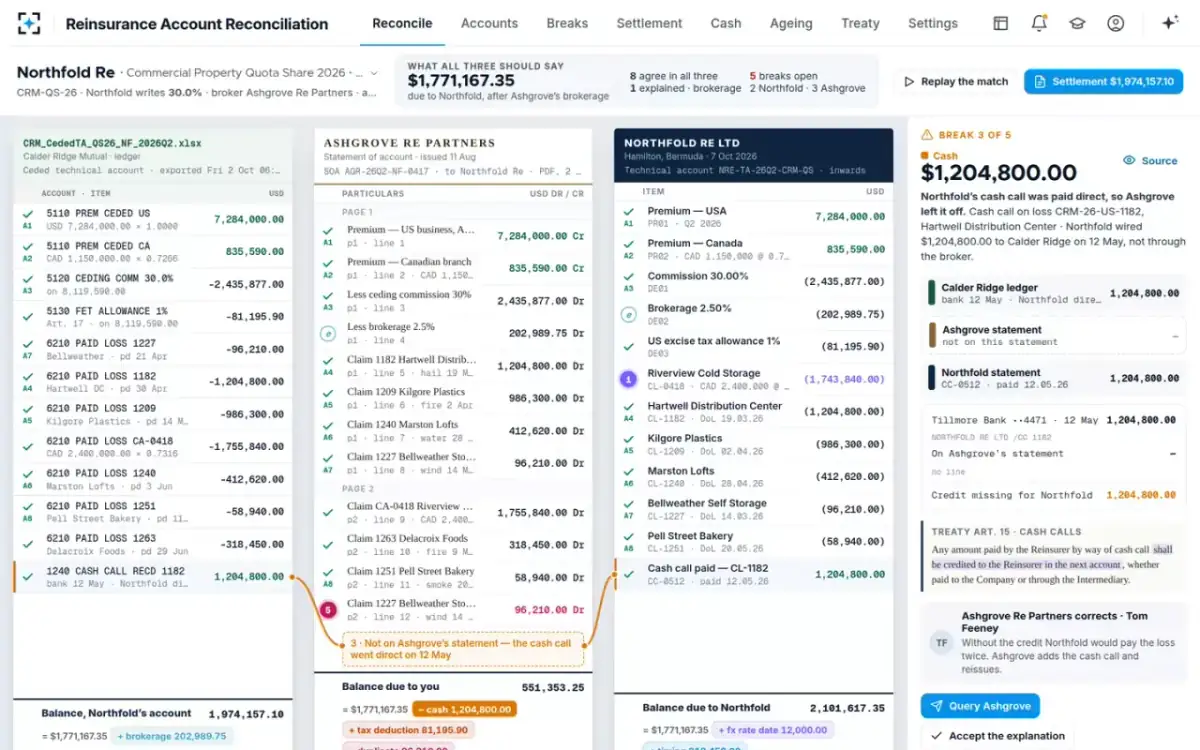
The part of this case most likely to cost real money happened on Day 11 and was invisible for three months. Harrowby paid direct. When Cobbold Vane issued its second-quarter statement of account to Harrowby in August, it showed the Quaystone loss as paid by Thistlemere and charged Harrowby its share in full, with no credit for the $798,000 it had already wired. Read on its own, the broker's statement asked Harrowby to pay the undisputed part of the loss a second time.
This is the cash cause in the solution's taxonomy, and in its own sample data it is the costliest: three cash breaks worth $1,626,675.00 out of $3,622,308.85 at stake across one quarter's book. The fix is mechanical once the bank file is read every day: match each receipt to the cash call it answers, and credit it in the next account whatever channel it came through.
How the solution shows a cash call paid direct and missing from the broker's statement
Can cash calls be offset?
A cash call already paid is credited in the next account, which is a form of netting the treaty itself requires. Withholding a disputed amount from something else the cedant owes the reinsurer is a different matter, and in this case it came up in August. Thistlemere's second-quarter account showed $410,000 of premium, net of commission and losses, due to Harrowby. Someone suggested paying $270,000 and holding back the disputed $140,000.
The finance controller declined, for two reasons. The treaty's offset clause allowed balances to be netted when "due and payable", and a disputed recovery is not agreed as due. And statutory accounting reports recoverables on paid losses as an asset without offset, even where offset criteria are met, so netting would have made the books less clear, not more. Thistlemere paid the $410,000 and kept the $140,000 as a separate disputed recoverable. When an offset clause allows netting sets out the rules in full.
The settlement, and the line in the next account
On Day 120, Tuesday 1 September, after the two companies' claims and coverage teams reviewed the business interruption claim, they agreed that $1,200,000 of the $2,000,000 at 100% fell within the treaty. Harrowby paid its share a week later. Thistlemere wrote off the rest of its disputed recoverable, with the finance controller's approval, through the accounts in which it had been carried.
The cash call, from first demand to final write-off
| Step | Calculation | Harrowby's 20% |
|---|---|---|
| Call as first issued | $14,000,000 paid × 35% cession | $980,000 |
| Corrected for salvage | ($14,000,000 − $600,000) × 35% | $938,000 |
| Disputed business interruption | $2,000,000 × 35% | $140,000 |
| Undisputed, paid direct on 15 May | $938,000 − $140,000 | $798,000 |
| Settled on 1 September | $1,200,000 × 35%, paid 8 September | $84,000 |
| Written off by the cedant | $140,000 − $84,000 | $56,000 |
The third-quarter account carried two credits for Harrowby, the $798,000 from May and the $84,000 from September, and one write-off on Thistlemere's side. Each had a bank line, a clause and an approval behind it. That is the standard a reconciliation should hold every cash call to, and the settlement process guide shows the approvals that sit around it.
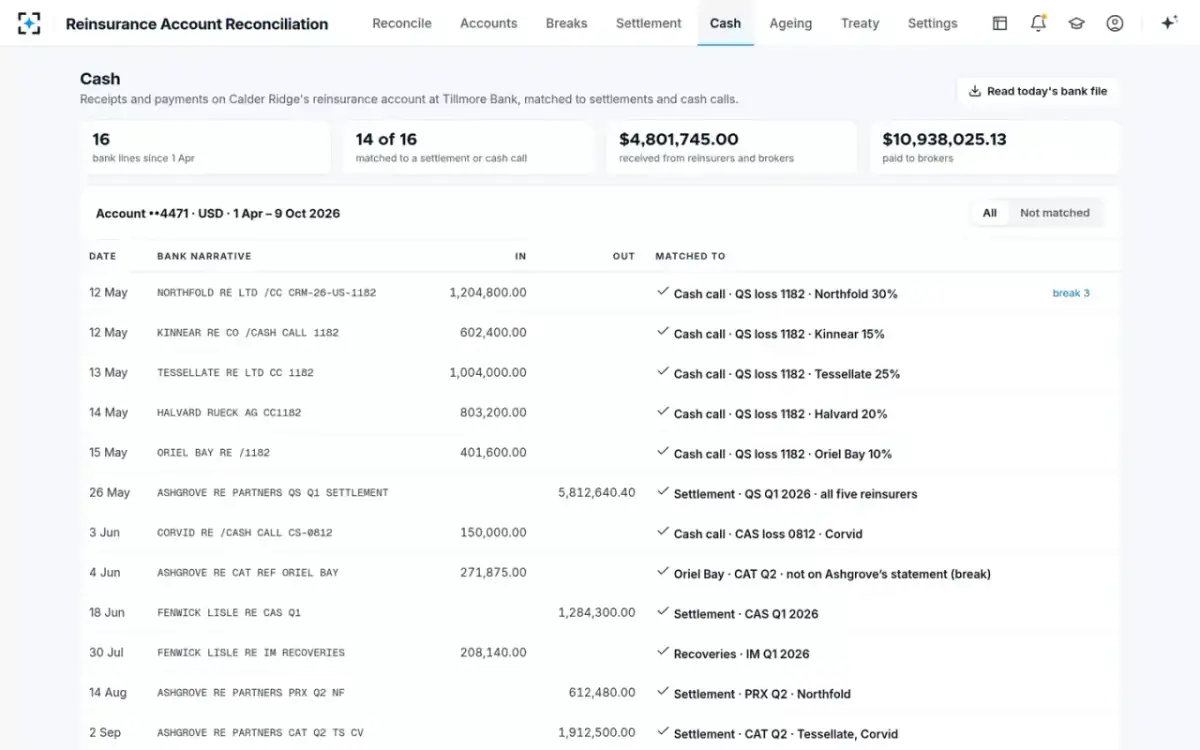
Cash calls matched to the bank file in Reinsurance Account Reconciliation
What would have shortened it
Most of the 127 days were the coverage question, which no accounting process can hurry. The other delays were avoidable, and each had a counterpart on the reinsurer's side.
A cash call that pays on the first complete demand
- Send proof of payment with the call
A call without it is not complete, and the clock does not start.
- Compute the loss as the clause defines it
Net of salvage and recoveries received, for the share and the cession the wording names.
- Split disputed from undisputed at once
The reinsurer pays what it does not dispute; the dispute stays narrow and has a named owner.
- Ask for a written notice if the reinsurer disputes
A formal written denial is what makes a balance disputed for statutory purposes; anything else is a query.
- Match receipts to calls from the bank file daily
A direct payment is the one the broker will not show; credit it in the next account regardless.
- Never net a disputed amount without the clause and the controller
Withholding is an offset; it needs a right of offset and a decision, not a spreadsheet adjustment.
A cash call is a small, fast transaction inside a slow quarterly cycle, and most of its risk comes from that mismatch. To see cash calls matched, credited and aged on your own treaties, start from Reinsurance Account Reconciliation.
Questions people ask
What is a cash call limit in reinsurance?
It is the loss size at or above which the cedant may call for early payment, usually stated for 100% of the agreement. In this case it was $3,000,000; in the solution's sample wording it is $2,500,000. Losses below the limit wait for the quarterly account.
Should a cash call be paid through the broker or direct?
Whichever the treaty allows; some wordings, like the ones in this guide, credit the payment in the next account whichever way it is paid. The risk with a direct payment is that the broker's statement omits it, so the cedant must match the receipt from its bank file and make sure the credit appears.
Is a reinsurer's query the same as a dispute?
No. A query asks for documents or corrections; under U.S. statutory accounting a balance is in dispute when the reinsurer sends a formal written communication denying the validity of coverage. The difference decides how the cedant reports the balance and whether it must be disclosed.
Does an unpaid cash call count as a paid-loss recoverable?
Yes: the cedant has paid the loss, so the reinsurer's share is a recoverable on paid losses from that date, and it ages like any other. If it passes 90 days unpaid it enters the overdue tests that feed the year-end provision for reinsurance.
Can a reinsurer offset a cash call against premium it is owed?
Only where the treaty's offset clause and the applicable law allow it, and a disputed amount may not be "due" in the sense such clauses require. The cleaner course, as in this case, is to settle the agreed balances and carry the disputed item separately until it is resolved.