The federal excise tax on reinsurance is a tax of one cent on each dollar of premium paid on a policy of reinsurance issued by a foreign reinsurer, imposed by section 4371(3) of the Internal Revenue Code and reported quarterly on IRS Form 720 under IRS No. 30. The person who pays the premium to the foreign reinsurer, or to a nonresident broker, pays the tax and files the return, so for a U.S. cedant ceding to an offshore reinsurer it is the cedant's liability, whatever its treaty says about who bears the cost. It is hard in practice because it hides in plain sight: a treaty may have the reinsurer allow the 1% as a deduction from premium, and a broker's statement or a reinsurer's technical account that leaves the line off still adds up. Botminds' Reinsurance Account Reconciliation recomputes the allowance from the treaty wording and the panel on every account and flags any statement that leaves it out, so the tax line is checked as often as the premium is.
The rules below are quoted from the U.S. Code, Treasury regulations and IRS publications, linked where they appear. Worked figures come from the solution's fictional sample data, Calder Ridge Mutual's 2026 commercial property quota share. This is a guide to the mechanics, not tax advice.
When the 1% tax applies to a reinsurance premium, case by case
| Who pays whom | Does the 1% apply? | Why |
|---|---|---|
| U.S. cedant to a foreign reinsurer | Yes, unless an exemption or treaty waiver applies | Section 4371(3) taxes premium paid on reinsurance issued by a foreign reinsurer. |
| U.S. cedant to a U.S. reinsurer | No | The reinsurer is not foreign. |
| U.S. cedant to a foreign reinsurer through a nonresident broker | Yes | Liability attaches when premium is transferred to the foreign reinsurer or to any nonresident broker. |
| Foreign reinsurer to another foreign reinsurer (retrocession) | No, in the situations of Rev. Rul. 2008-15 | The IRS revoked that ruling in 2016 after the Validus decision. |
| Foreign reinsurer to a foreign insurer that elected U.S. tax treatment under section 953(d) | Yes, absent a treaty waiver or exemption | Rev. Rul. 2016-03 names this case expressly. |
| Foreign reinsurer resident in a treaty country | Possibly not, if the treaty waives it | The reinsurer must disclose its treaty position; treaties can limit the waiver. |
What is the federal excise tax on reinsurance?
It is a federal tax on the premium itself, not on anyone's income. The statute imposes it "on each policy of insurance, indemnity bond , annuity contract, or policy of reinsurance issued by any foreign insurer or reinsurer", and for reinsurance sets the rate at "1 cent on each dollar, or fractional part thereof, of the premium paid on the policy of reinsurance covering any of the contracts taxable under paragraph (1) or (2)" (26 U.S.C. §4371). Paragraphs (1) and (2) are casualty insurance and indemnity bonds, and life, sickness, accident and annuity contracts.
The Treasury regulation reads "covering" broadly. It applies the tax to reinsurance issued by a foreign person as reinsurer "To any person against, or with respect to, any of the hazards, risks, losses, or liabilities covered by contracts of the type described in section 4371 (1) or (2)" (26 CFR §46.4371-2(c)). On that wording the test is the type of risk reinsured, not whether the underlying policies were themselves taxed, so reinsurance of a domestic insurer's policies can fall inside it even though those policies carry no excise tax. The same paragraph excludes a policy signed or countersigned by an officer or agent of the reinsurer in a state where the reinsurer is authorized to do business.
Is the reinsurance excise tax 1% or 4%?
One percent. The 4% rate applies to casualty insurance and indemnity bonds issued directly by a foreign insurer to a U.S. insured; reinsurance, like life, sickness and accident cover and annuities, is taxed at 1%.
Three rates, one statute
4%
casualty insurance and indemnity bonds issued by a foreign insurer to a U.S. insured
1%
life, sickness and accident policies and annuity contracts
1%
reinsurance covering contracts of either type
Who pays federal excise tax on reinsurance premiums?
The payer of the premium. The IRS instructions are direct: "The person who pays the premium to the foreign insurer (or to any nonresident person such as a foreign broker) must pay the tax and file the return. Otherwise, any person who issued or sold the policy, or who is insured under the policy, is required to pay the tax and file the return" (IRS, Instructions for Form 720).
The regulation adds one clarification that matters to cedants. For a reinsurance policy, the policyholders of the underlying insurance are not persons "for whose use or benefit" the reinsurance is made, so they are not liable for the tax on it (26 CFR §46.4374-1(a)). The liability sits with the cedant that pays. A treaty can shift the cost by having the reinsurer allow the tax as a deduction from premium; it cannot shift the duty to file.
When does the tax attach, and on what premium?
It attaches when the money moves, and it reaches every payment under the contract. The regulation says "The liability for the tax imposed by section 4371 shall attach at the time the premium payment is transferred to the foreign insurer or reinsurer (including transfers to any bank, trust fund, or similar recipient, designated by the foreign insurer or reinsurer), or to any nonresident agent, solicitor, or broker" (26 CFR §46.4374-1(b)).
The base is wider than the deposit premium. The regulation defines "premium payment" as "the consideration paid for assuming and carrying the risk or obligation, and includes any additional assessment or charge paid under the contract, whether payable in one sum or installments" (26 CFR §46.4371-3(b)). On those words, adjustment premiums and other additional charges paid to a foreign reinsurer belong in the base, which is why the tax line has to be recomputed whenever ceded reinsurance accounting books an adjustment (minimum and deposit premium shows where they come from), not only on the quarterly premium. How ceding commission and funds withheld affect the base is a question for a tax adviser on the specific contract.
Does the excise tax apply to retrocession?
Not between two foreign companies in the situations the IRS once tried to tax. In Rev. Rul. 2008-15 the IRS had applied the 1% to reinsurance passed from one foreign reinsurer to another, the so-called cascading tax. After the D.C. Circuit's decision in Validus Reinsurance, Ltd. v. United States (2015), it withdrew that position.
As a result, the IRS will no longer apply the one-percent excise tax imposed by section 4371(3) to premiums paid on a policy of reinsurance issued by one foreign reinsurer to another foreign insurer or reinsurer under the situations described in Rev. Rul. 2008–15. Rev. Rul. 2008–15 is hereby revoked.
IRS, Rev. Rul. 2016-03
The ruling is narrower than its headline. "No inference should be drawn that the revocation of Rev. Rul. 2008–15 affects the liability for excise tax under section 4371 on any other policies of insurance or reinsurance", it continues, and it names two foreign-to-foreign cases the IRS still taxes: reinsurance of a foreign insurer that has elected to be treated as a domestic corporation under section 953(d), and of a foreign insurer whose premiums are effectively connected with a U.S. trade or business (Rev. Rul. 2016-03). The current Form 720 instructions carry the change under a heading, "Section 4371(3) tax on foreign reinsurance premiums no longer applies", that is easy to misread as repeal. It is not: a U.S. cedant paying premium to a foreign reinsurer still owes the 1% unless an exemption or treaty waiver applies.
Which tax treaties exempt reinsurance premiums?
Some U.S. income tax treaties waive the excise tax for residents of the other country, on conditions, and the answer depends on the treaty, the reinsurer and where it passes the risk. Two parts of the rule apply whatever the treaty. First, the position must be disclosed: "Foreign insurers and reinsurers who take the position that a treaty of the United States overrules, or otherwise modifies, an Internal Revenue law of the United States must disclose such position", once a year, on a statement filed with the first-quarter Form 720, which is due before May 1 (IRS, Instructions for Form 720). Form 8833 may be usable as that statement.
Second, treaty waivers can be limited. Rev. Rul. 2016-03 says the IRS "will continue to enforce the provisions of treaties that place limits on the availability of a treaty waiver for premiums paid to a foreign insurer or reinsurer". In practice, a cedant should hold, for each reinsurer whose premium it pays without the tax, the reinsurer's stated treaty position and the evidence for it, and should re-check it at each renewal. The sample panel records a position for every reinsurer: two Bermuda reinsurers where the tax applies, a Swiss and a U.K. reinsurer marked as claiming a treaty exemption, and a U.S. reinsurer with no tax. Those labels are the sample data's; this guide makes no claim about any country's treaty.
What is Form 720 IRS No. 30, and when is it due?
IRS No. 30 is the line on the quarterly federal excise tax return for policies issued by foreign insurers. The filer enters the premiums paid in the quarter, multiplies them by the rates printed on the form for the three types of insurance, and enters the total on that line. The tax is generally deposited semimonthly by electronic funds transfer, unless the net liability for the taxes in Part I of the form, where IRS No. 30 sits, does not exceed $2,500 for the quarter, in which case it may be paid with the return.
The excise tax calendar for a cedant ceding abroad
| What | When | Source |
|---|---|---|
| Liability attaches | When premium is transferred to the foreign reinsurer, its designated bank or trust, or a nonresident broker | 26 CFR §46.4374-1(b) |
| Semimonthly deposit | By the 14th day after each half-month: generally the 29th, and the 14th of the next month | Form 720 instructions |
| Quarterly return | April 30, July 31, October 31 and January 31 | Form 720 instructions |
| Treaty position statement | With the first-quarter return, due before May 1 | Form 720 instructions |
| Records kept | At least 3 years from when the tax became due or was paid, whichever is later | 26 CFR §46.4371-4(b) |
The records rule is specific. The payer must keep records establishing, for each policy, the gross premium paid, whether it is a policy of reinsurance, the identity of the insured and of the foreign reinsurer, and the total premium charged with any instalment dates (26 CFR §46.4371-4(a)). A quarterly reconciliation that ties each reinsurer's premium to the tax line produces most of that as a by-product. The penalty for failing to comply with intent to evade is a fine of double the tax, on top of other penalties.
The 1% line in the account: why statements leave it out
Because most of the parties to the account do not owe it. The cedant files and pays; the broker and the reinsurer only have to allow it, if the treaty says so, and a statement that forgets the allowance still adds up. A typical clause, in the sample wording's Article 17, says the reinsurer "shall allow, for the purpose of paying the Federal Excise Tax, the applicable percentage of the premium payable hereon to the extent such premium is subject to the tax under Section 4371 of the Internal Revenue Code". The words "to the extent" mean the line depends on each reinsurer's position, which is why it has to be computed per reinsurer, not per treaty.
On Northfold Re's 30% share of the sample quota share, second-quarter premium ceded was $8,119,590.00 and the allowance was $81,195.90. Calder Ridge's own account showed it. Northfold's technical account showed it. The broker's statement of account did not, so the broker's balance overstated what was due to Northfold by exactly that amount. A reconciliation that only compared the broker's total with the reinsurer's would have flagged a difference and left someone to find the cause; the solution's treaty terms checker recomputed the 1% on the premium, noted that the broker had no tax line, and the explanation quoted Article 17.
The treaty terms, with each reinsurer's excise tax position on the panel
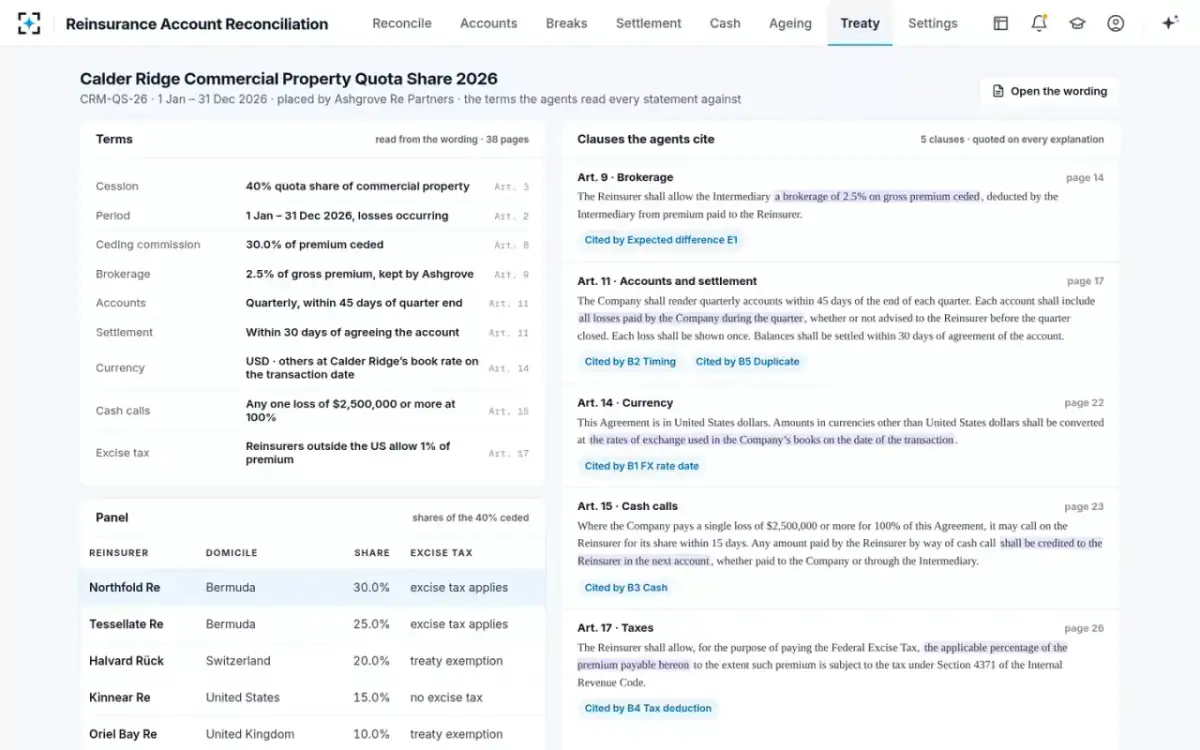
Across the sample company's book that quarter, six open breaks were tax deductions, worth $144,958.85 in total. None of them would have been found by checking that each statement adds up. The broader pattern, statements that agree with each other and are still wrong, is the subject of reinsurance balances that tie out and are still wrong.
Reconciling the excise tax every quarter
The tax is simple per dollar and easy to get wrong across a book, because the base, the rate and the exemption are decided reinsurer by reinsurer and payment by payment. A quarterly check in six steps keeps the return, the accounts and the treaty clauses aligned.
Six checks on the excise tax line, each quarter
- List every reinsurer paid in the quarter, by domicile
Foreign reinsurers and nonresident brokers are where the liability attaches.
- Hold each reinsurer's stated position and its evidence
Tax applies, exempt, or treaty waiver claimed and disclosed; re-check at each renewal.
- Recompute 1% on every premium payment
Including adjustment and other additional premium paid under the contract, not only deposits.
- Check the allowance on every statement
Cedant, broker and reinsurer should all carry it where the treaty provides for it.
- Tie the quarter's premium paid to Form 720, IRS No. 30
The return and the accounts should agree to the dollar for each quarter.
- Keep the records three years
Gross premium, policy type, insured, reinsurer, total premium and instalment dates.
The cedant cannot outsource the liability, but it can make the line impossible to lose. What stays the cedant's whoever does the work covers the other obligations that do not move with an outsourcing contract. To see the tax line checked on your own treaties, start from Reinsurance Account Reconciliation.
Questions people ask
When does the tax attach if the premium goes through a broker?
If the broker is nonresident, when the cedant pays the broker: the regulation lists transfers to the foreign reinsurer, its designated bank, trust fund or similar recipient, and any nonresident agent, solicitor or broker. A U.S. broker is not on that list, so on the regulation's words the liability attaches when the premium reaches the reinsurer or its designated recipient. Either way the cedant, as payer, owes the tax.
Is the excise tax a cost to the cedant or the reinsurer?
The legal liability is the cedant's as the payer of the premium. The economic cost depends on the treaty: where the reinsurer allows the tax as a deduction from premium, as in the sample wording's Article 17, the reinsurer bears it and the cedant pays it over to the IRS.
What happens if a reinsurer's treaty exemption is wrong?
The payer is exposed for the tax it did not pay, and the reinsurer's disclosure obligation does not remove the payer's liability. The IRS has said it will continue to enforce treaty provisions that limit the waiver, so a cedant should keep each reinsurer's stated position and evidence and review it at renewal.
Does the 1% apply to reinstatement premium?
The regulation's definition of premium payment includes "any additional assessment or charge paid under the contract", which on its plain words reaches reinstatement and adjustment premium paid to a foreign reinsurer. The treatment of a particular contract is for a tax adviser; the reconciliation should at least show the tax recomputed on every payment.
Where is the excise tax shown on Form 720?
On the line for IRS No. 30, policies issued by foreign insurers, in Part I of the quarterly return. The filer enters premiums paid during the quarter and applies the rates printed on the form for casualty insurance, life and accident cover, and reinsurance.