Reinsurance operations software, for the ceded account, is software that takes over the mechanical part of each quarter: reading the cedant's account, the broker's statements and the reinsurers' technical accounts, matching them, explaining the differences, drafting settlements and ageing what is owed. Buyers usually weigh it against two other ways of running the same quarter, an in-house team working by hand and an outsourced back office, and the honest comparison is not the licence fee against a salary. It is the full cost of a quarter, people's time, money left unbilled or paid twice, balances that age into a year-end provision, and the controls a regulator expects whoever does the work. Botminds' Reinsurance Account Reconciliation is one such product: six agents read, tick, explain and draft, and the company's own reinsurance accountant and finance controller agree and sign. This guide sets out the three options side by side, with a cost method a finance team can fill in with its own numbers.
Wage figures are from the U.S. Bureau of Labor Statistics; volumes and screens come from the solution's fictional sample company, Calder Ridge Mutual, with 28 treaty accounts a quarter.
An accountant costs much the same wherever the desk sits
What does reinsurance operations software do for the quarterly account?
It should do the reading and the matching, and leave every decision with a named person. For the ceded account, that means five jobs: read each statement in whatever form it arrives and check it adds up; recompute the treaty terms (commission, brokerage, taxes, each reinsurer's share) from the wording; tick the items that agree in all three versions; explain each one that does not, with the line in each statement and the clause that decides it; and draft the queries, the settlement and the chasers. It should not book entries in the general ledger, accept a difference on anyone's behalf, or release money.
Those jobs are where the quarter's days go. By Botminds' estimate for one treaty account carried by hand across cedant, broker and reinsurer, about 28 days pass from collecting the statements to settling, of which ten are spent chasing answers to questions that did not name the line; the solution's design target is five days from the last statement to an agreed account. The estimate and the target are ours, not a measured result, and the method below lets a buyer test them on its own book.
Three ways to run the quarter
The three options divide the same work differently. An in-house team does everything itself. An outsourced back office takes the reading, matching and chasing, and sends back an account for someone at the company to agree. Software with agents takes the reading, matching, explaining and drafting, and leaves the agreeing, querying and signing with the company's own staff.
Who does what under each option
| Step | In-house team | Outsourced back office | Software with agents |
|---|---|---|---|
| Read the three statements | Your accountant, by hand | The provider's staff | Agents, citing page and line |
| Recompute the treaty terms | Your accountant, from the wording | The provider, from the terms you supplied | Agents, quoting each clause |
| Tick and explain differences | Your accountant | The provider | Agents explain; your accountant accepts or queries |
| Query the broker or reinsurer | Your accountant | The provider, in your name | Drafted by agents, sent by your accountant |
| Agree the account and sign | Your accountant and controller | Your accountant and controller | Your accountant and controller |
| What you see | The working spreadsheets | The provider's report | Every line, explanation and signature |
| How cost moves with volume | Roughly with headcount | With the contract's pricing | Mostly fixed; review time grows with differences, not accounts |
Where the quarter's six steps sit under each option
In-house team
- Your staff · 6 of 6 · 100%
Outsourced back office
- Provider · 4 · 66.7%
- Your staff · 2 · 33.3%
Software with agents
- Agents, reviewed · 3 · 50%
- Your staff · 3 · 50%
The split matters more than it looks. Under outsourcing, the step that finds the error and the step that explains it sit outside the company, and the accountant agrees a report rather than the statements behind it. Under the software option, the explanation arrives with the lines and the clause attached, and the accountant who agrees the account can see why each figure is what it is.
How much does a reinsurance accountant earn?
No official series isolates reinsurance accountants or technicians, so the nearest measure is the occupation as a whole. The Bureau of Labor Statistics reports that "The median annual wage for accountants and auditors was $83,680 in May 2025", and that accountants and auditors in finance and insurance earned a median of $93,290 (BLS Occupational Outlook Handbook). The occupation held about 1.6 million jobs in 2025 and is projected to grow 5% from 2025 to 2035.
The industry rows say something useful about outsourcing. The median accountant in an accounting services firm earns $81,490, about 13% less than the median in finance and insurance. A provider's price also carries its margin, management and systems, so the labour inside an outsourced price is not much cheaper; what outsourcing buys is flexibility and someone else's management. That is a legitimate thing to buy, but it should be priced as such.
What does a quarterly reinsurance account cost? A method you can fill in
A quarter costs four things, and only the first appears on an invoice or a payroll. The other three, money lost to errors, balances that age, and the controls around the work, are why two options with the same salary bill can have very different totals.
The cost of one quarter's reinsurance accounts, in four terms
People and fees
hours × loaded hourly cost + provider fee or software price
Count reading, ticking, explaining, chasing and signing. BLS median wages in finance and insurance work out to about $45 an hour before benefits and overhead.
Finance operations
Errors that reach cash
Σ amounts unbilled, overpaid or paid twice
Missed cash-call credits, duplicates and missing tax allowances. In the sample quarter one missed cash call alone was $1,204,800.00.
Reinsurance accountant
Balances that age
paid-loss recoveries past 90 days × provision effect
Overdue recoveries from authorized reinsurers feed the statutory provision for reinsurance at year end.
Credit controller
Control and audit
review hours + audit queries + remediation
Evidence that each balance was agreed, by whom, under which rules; harder to produce from a provider's summary.
Finance controller
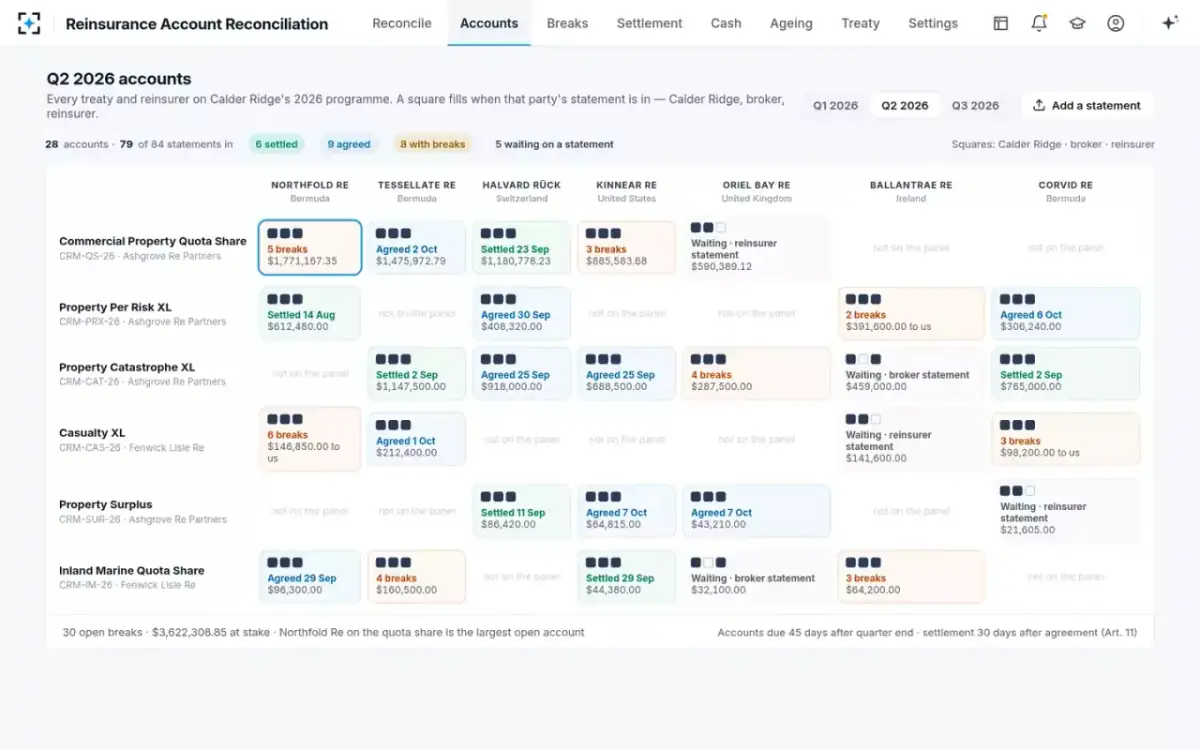
The second term is the one that changes the decision. On Calder Ridge's sample quarter the open differences across 28 accounts came to $3,622,308.85, of which $1,626,675.00 was cash that had moved outside the broker's statements. Most of that money is not lost, it is waiting, but a quarter in which one cash-call credit is missed and the settlement goes out anyway pays a loss twice, and recovering it costs more time than any reconciliation.
One sample quarter, by the numbers
28
treaty accounts across six treaties and seven reinsurers
79 of 84
statements in when the board was opened
30
open differences, $3.6 million at stake
5days
design target to agree an account after its last statement
Should reinsurance accounting be outsourced? What stays yours whichever you choose
It can be, but the obligations do not move with the work. Three of them stay with the insurer whatever the contract with a provider says, and they are the strongest argument for keeping the agreeing and the signing in-house.
Internal control over financial reporting. Under the NAIC Annual Financial Reporting Model Regulation, an insurer, or group, with $500 million or more of annual direct written and assumed premium must report on its internal control over financial reporting (NAIC Model #205, Section 17A; SOX-style controls for insurance companies covers the rule in full). Reinsurance balances are part of the financial statements that report covers, and management signs it, not the provider.
The excise tax. Liability for the 1% tax on premium paid to a foreign reinsurer attaches when the premium is transferred, and the return is filed by the person who makes the payment (26 CFR §46.4374-1). A provider can prepare the figures; the cedant still owes the tax, which the excise tax guide works through.
The broker's accounts. The NAIC intermediary model gives the insurer a right that only it can exercise: "The insurer will have access and the right to copy and audit all accounts and records maintained by the RB related to its business in a form usable by the insurer" (NAIC Model #790, Section 5B). Whoever reconciles, the cedant is the party that can insist on seeing the broker's working.
What controls are needed if we outsource reinsurance accounting?
The same ones you would need in-house, plus evidence that the provider ran them. In practice that means an approval matrix that keeps agreement and payment with your staff, access to the line-level working rather than a summary, a timetable tied to the treaty clauses, and a way to see, after the fact, which rules were applied to which account.
Controls to keep whoever does the work
- Agreement and payment stay with your staff
Your accountant agrees each account; a second signer approves payments above a threshold you set.
- Line-level working, not a summary
Each tick and each explanation traceable to a page and line in each statement.
- Terms read from the signed wording
Commission, brokerage, tax allowances, currency and cash-call clauses taken from the contract, not from last year's spreadsheet.
- A timetable tied to the treaty
Accounts, settlements and chasers dated from the wording's clauses, with overdue balances visible daily.
- Versioned rules
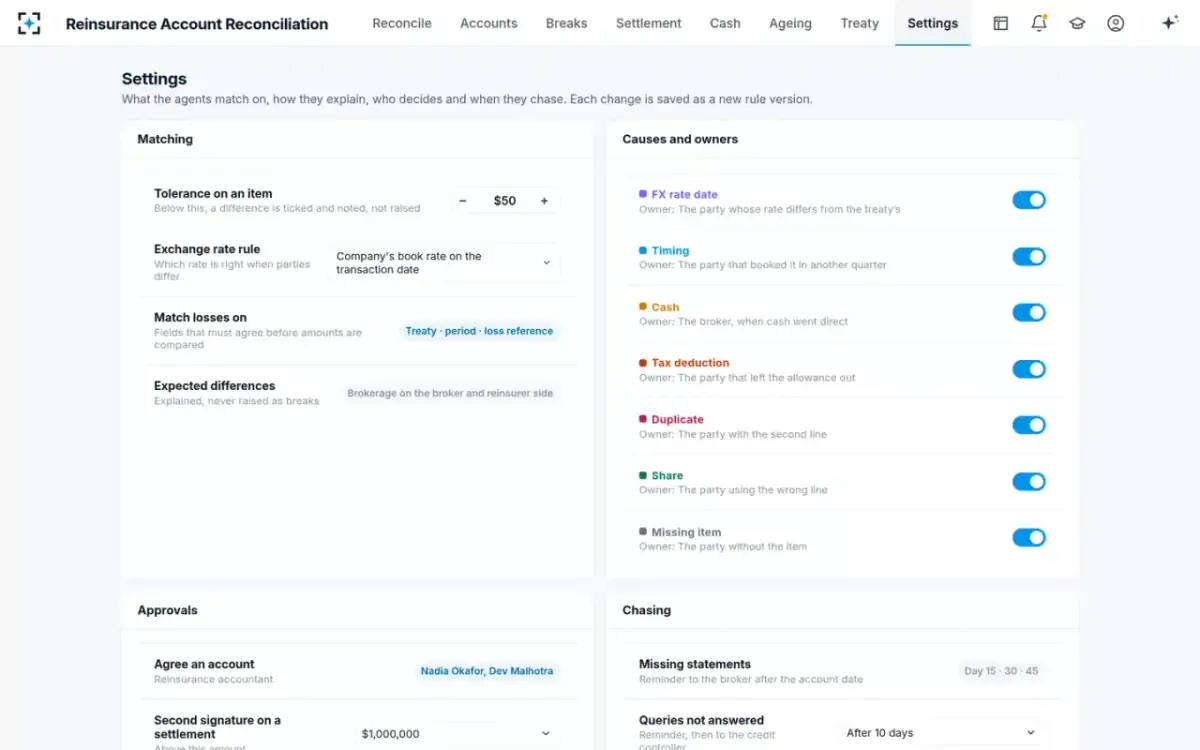
Tolerances, approvers and limits changed only with the change, its author and its date kept.
- Bank details locked to the last payment
A changed account stops the instruction until confirmed out of band.
The rules a team sets, each change saved as a new version
How to choose reinsurance operations software: questions for the demonstration
Ask to see your own statements, not the vendor's. A demonstration on a past quarter of your accounts, with a broker statement in PDF and a reinsurer's technical account by email, answers most of the questions below in an hour. Supervisors' surveys show why the last two matter: in EIOPA's survey of European insurers, back-office applications made up nearly two thirds of reported generative AI use cases, and insurers ranked wrong output as the leading risk (EIOPA, Generative AI Market Survey).
Six questions, and what a good answer looks like
| Ask | Why it matters | A good answer |
|---|---|---|
| Can it read our broker statements as they arrive? | Brokers will not change their formats for you. | PDF, spreadsheet and email read without templates per broker, each item with page and line. |
| Where do the treaty terms come from? | Terms carried over from last year are a direct route to a wrong share or rate. | Read from the signed wording and panel, each term with its clause. |
| How does it explain a difference? | A list of unmatched items is where the work starts, not ends. | A cause, the arithmetic, the line in each statement, the clause and the party who corrects. |
| What can it change on its own? | Agents that book or pay move the risk to the software. | Nothing in the books or the bank; drafts only. |
| How is an error in its reading caught? | Supervisors name inaccurate output as the main risk of generative AI. | Every figure traceable to its line; a statement that does not add up is reported, never altered. |
| What does it replace? | Replacing the general ledger or broker systems lengthens the project. | Nothing: it reads the systems you have and writes queries and drafts. |
Where Reinsurance Account Reconciliation fits, and where it does not
It fits a cedant, or a broker on the cedant's behalf, that agrees quarterly accounts with several reinsurers through brokers and wants every difference explained and owned before money moves. It reads the general ledger export, broker and reinsurer mailboxes, the treaty wordings and the daily bank file, and it writes queries, settlement drafts and chasers. It does not post to the general ledger, and it does not replace the systems that do.
It is not a calculator for adjustable features: reinstatement premiums, sliding-scale and profit commissions are worked out by Ceded Reinsurance Accounting, and the reconciliation then checks that every statement carries them. It does not monitor reinsurers' collateral or ratings beyond the check before a payment. And a company with one or two treaties and one reinsurer may find a careful spreadsheet enough; the case for the software grows with the number of panels, brokers and currencies.
The quarter at a glance: who has sent what, and which accounts are stuck
Whichever option a company chooses, the comparison should be run on a past quarter of its own accounts, with the money found and the days saved counted rather than assumed. To run that comparison on your own treaties, start from Reinsurance Account Reconciliation.
Questions people ask
What does a reinsurance back office do?
It renders and checks the accounts on each reinsurance contract, agrees them with brokers and reinsurers, settles balances, credits cash calls, chases overdue recoveries and files the excise tax on premium paid abroad. In a cedant with several panels it is quarterly, multi-currency work for a small team; in the sample company, 28 accounts and 84 statements a quarter.
Can software replace a reinsurance technician?
It can replace most of the reading and matching, not the judgement. The decisions, accepting or querying a difference, agreeing an account, and signing a payment, should stay with people, and the BLS still projects employment of accountants and auditors to grow 5% from 2025 to 2035.
How long does it take to go live?
For Reinsurance Account Reconciliation, the inputs are the treaty wordings, examples of each broker's and reinsurer's statement layouts and a quarter of past statements. The sensible first step is to replay that past quarter and compare the differences found with what the team found by hand, before any live account depends on it.
Does outsourcing move the excise tax liability to the provider?
No. Under the Treasury regulation the tax is paid on a return by the person who pays the premium to the foreign reinsurer or to a nonresident broker, and only otherwise by others who issue or benefit from the policy. A provider can prepare the return; the payer remains liable.
Is software cheaper than an outsourced back office?
It depends on volume and on how many differences each quarter produces, which is why the cost should be measured on your own past quarter. Salaries are similar either way: BLS medians for accountants differ by about 13% between finance and insurance ($93,290) and accounting services firms ($81,490).