Automated reconciliation software matches two or more accounts of the same money using rules, a key that must agree, an amount within a tolerance, a date window, and ticks every pair that passes; whatever fails goes to an exception queue for a person. That is the right tool for high volumes of near-identical items such as bank lines. A reinsurance account is different: it has few items, three sources in three layouts, and differences that are decided by a treaty clause rather than by a tolerance, so after the matching the real work is still to come. Botminds' Reinsurance Account Reconciliation adds agents to that second half: they read the statements as they arrive, tick what agrees, and give every exception a cause, the arithmetic, the line in each statement, the clause that decides it and the party that must correct it. People still accept, query and sign. The comparison below runs one sample account through both approaches.
The account is fictional sample data: Northfold Re's 30% share of Calder Ridge Mutual's 2026 commercial property quota share for the second quarter, placed by Ashgrove Re Partners.
The same account under rules and under agents: 14 items, the same ticks, different exceptions
Rule-based matching
- Ticked in all three · 8 · 57.1%
- Exceptions to investigate · 6 · 42.9%
Agents
- Ticked in all three · 8 · 57.1%
- Explained: cause, clause, owner · 6 · 42.9%
What is automated reconciliation software?
It is software that replaces ticking by hand with matching by rule. The meaning people search for is simple: two lists of the same transactions, compared automatically, with the agreements cleared and the disagreements listed. The value is speed and consistency on volume; the limit is that a rule can only say whether two items agree, not why they do not.
In outline, such products work in three steps. Data arrives in structured form, from a bank file, a subledger or a spreadsheet with known columns. Rules match on keys and amounts, sometimes one to one, sometimes one to many. Items that fail every rule go to an exception queue, where analysts investigate, annotate and resolve them. The software's job ends where the queue begins.
How does automated reconciliation work on a reinsurance account?
The matching step works the same way, with keys chosen for reinsurance. In the solution's sample settings, a loss is compared only when treaty, period and loss reference agree, an amount difference below $50 is ticked and noted rather than raised, and nothing is ever matched across treaties, quarters or reinsurers. Brokerage is set as an expected difference, because the broker keeps it and its statement and the reinsurer's will always differ from the cedant's by that amount.
The trouble is upstream of the rules. A reinsurance account rarely arrives as structured data: the broker's statement is a PDF of particulars, the reinsurer's technical account is an email in its own order, and only the cedant's general ledger export has known columns. Rule-based software needs the first two keyed or templated before it can match anything. The agents read them as they come, item by item with page and line, and check that each statement adds up to its own balance before matching starts.
One account, from three statements to five explained breaks
41s
for the six agents to read, tick and explain the sample account
12
items read from each of the three statements, each with page and line
$50
tolerance below which a difference is ticked and noted, a setting from $0 to $500
Ticking is the easy half: what is left after the match
On the sample account, both approaches tick the same eight items: the two premium lines, ceding commission and five losses that all three parties converted and booked identically. The difference is in the other six. Under rules, six items sit in a queue marked unmatched. Under agents, each arrives with an explanation a person can accept or query.
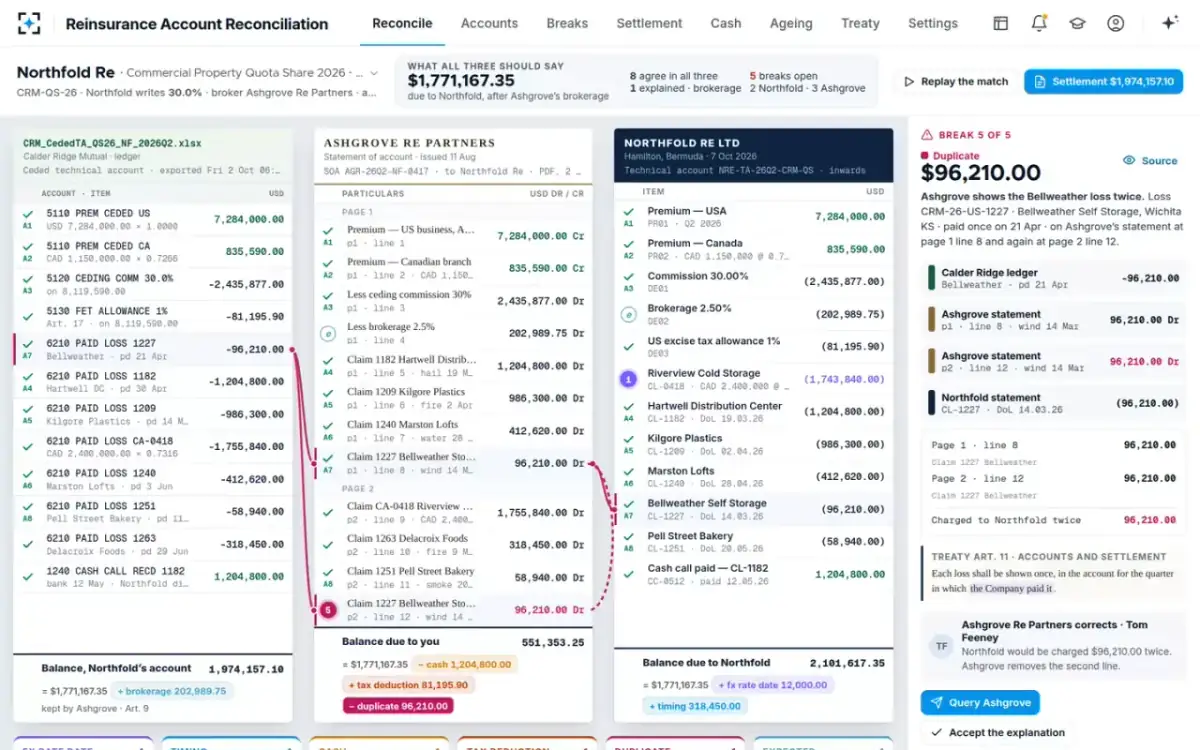
The six were: a Canadian loss converted at the quarter-end rate by the reinsurer instead of the book rate on the payment date ($12,000.00); a loss paid on 29 June that the reinsurer booked in the third quarter ($318,450.00); a $1,204,800.00 cash call the reinsurer paid straight to the cedant, missing from the broker's statement; a 1% federal excise tax allowance of $81,195.90 the broker left off; a $96,210.00 loss the broker showed twice; and the broker's $202,989.75 brokerage, which is expected. A rule can flag each. Only a reading of the treaty can say who is right: Article 14 for the rate, Article 11 for the period and the duplicate, Article 15 for the cash call, Article 17 for the tax and Article 9 for the brokerage.
A duplicate on the broker's statement, threaded across all three versions
Can reconciliation software explain differences?
Rule-based software can label them; it cannot read the contract that decides them. Explaining a reinsurance difference takes three things a matching engine does not hold: the treaty wording, the panel of shares, and the bank lines that show cash moving outside the account. With those, an explanation can state the cause, show the arithmetic, quote the line in each statement and the clause, and name who corrects.
Matching engine and agents, on the same reinsurance account
Rule-based automated reconciliation: Structured files; PDFs and emails keyed or templated first.
Agents in Reinsurance Account Reconciliation: Statements read as they arrive, each item with page and line, checked against the statement's balance.
Rule-based automated reconciliation: Keys, amounts and tolerances, applied consistently.
Agents in Reinsurance Account Reconciliation: The same, on treaty, period and loss reference, never across treaties, quarters or reinsurers.
Rule-based automated reconciliation: Entered as reference data if at all.
Agents in Reinsurance Account Reconciliation: Read from the wording; commission, brokerage, tax and shares recomputed with the clause quoted.
Rule-based automated reconciliation: Unmatched, with the amount and the missing partner.
Agents in Reinsurance Account Reconciliation: A cause, the arithmetic, the line in each statement, the deciding clause and the party who corrects.
Rule-based automated reconciliation: Written by the analyst.
Agents in Reinsurance Account Reconciliation: Drafted with every line quoted, one letter per counterparty; sent by a person.
Rule-based automated reconciliation: Investigates each exception from scratch.
Agents in Reinsurance Account Reconciliation: Accepts or queries each explanation, agrees the account, signs the settlement.
The two are not rivals in every respect. Matching by key and tolerance is exactly what the agents do in their matching step, and a company with a reconciliation platform for its bank accounts can keep it. The question for reinsurance is whether the exception queue is the end of the software's work or the middle of it.
What is exception management in reconciliation?
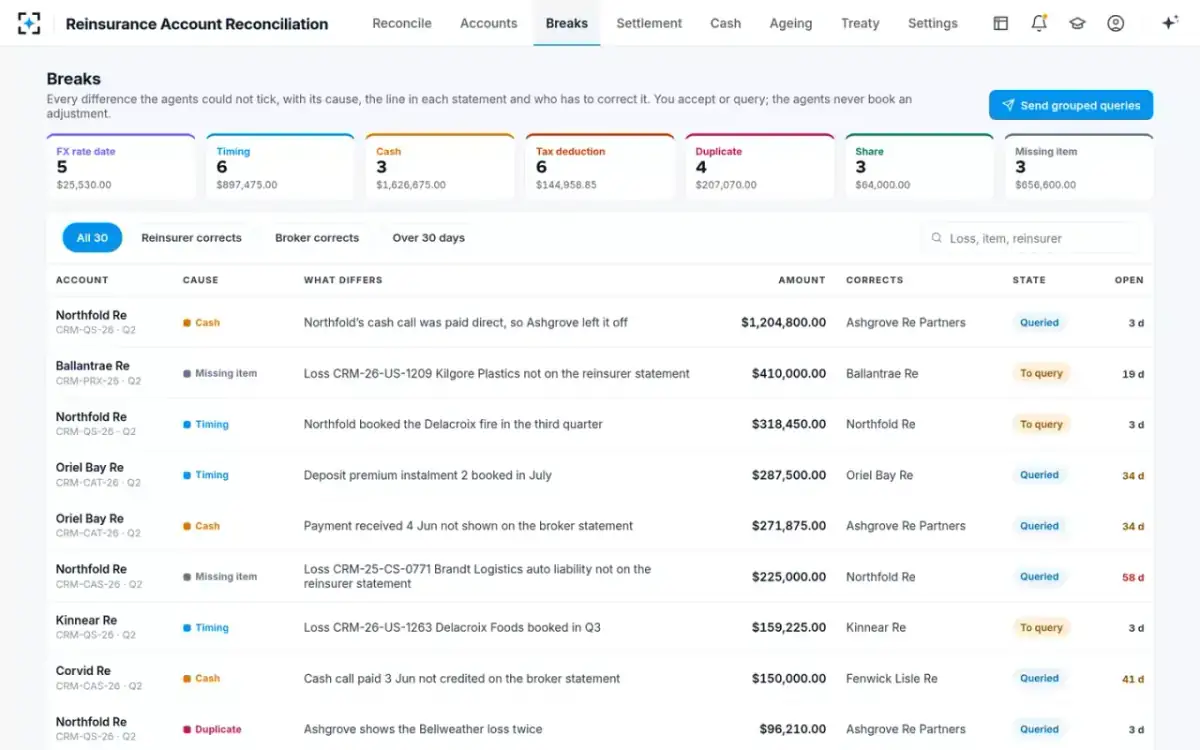
It is the work of resolving what matching could not: sorting exceptions by cause, assigning each to the party that must act, chasing until it is fixed and closing it with evidence. On a book of reinsurance accounts it is most of the quarter. Calder Ridge's sample quarter had 30 open breaks across 28 accounts, and every one of them had a cause and an owner before anyone wrote a query.
Thirty exceptions sorted by cause before anyone opened them
Every exception with its cause, what differs, who corrects and how long it has been open
What match rate should we expect from reconciliation software?
Expect a high rate by count and treat it with suspicion. On the sample account, 8 of 14 items, 57%, matched automatically, and the six that did not carried all of the money in dispute. A match rate reported by count rewards the easy items: two premium lines and a commission line count the same as a $1.2 million cash call.
Three measures say more. The share of the money at stake that is explained, not just matched; the share of exceptions with an owner and a date; and the age of the oldest open difference. In the sample book the three cash breaks were 10% of the count and $1,626,675.00, about 45%, of the $3,622,308.85 at stake. A tool that reports 90% matched by count can leave most of the money unexplained.
Where agents go wrong, and the controls that catch them
Agents that read documents can misread them, and an explanation can be confidently wrong. European insurers are proceeding with that in mind: EIOPA's survey reports that "Human oversight remains dominant; current adoption is dominated by "Assisted" models requiring human oversight" (EIOPA, Generative AI Market Survey). The answer is not to trust the agents more but to make every output checkable and none of them final.
How each kind of agent error is caught before it matters
| What could go wrong | How it is caught |
|---|---|
| A figure misread from a PDF | The items read must add up to the statement's own balance; every item cites its page and line. |
| A term applied that is not in the treaty | The terms checker applies only terms it can quote, and every explanation shows the clause. |
| Two different losses matched as one | Matching requires the same treaty, period and loss reference before amounts are compared. |
| A wrong cause or owner | The accountant accepts or queries each explanation; nothing is sent or booked without a person. |
| A payment drafted to the wrong account | Bank details must match the last payment; above $1,000,000 a second person signs. |
How to compare the two on a quarter you have already closed
Run both on a closed quarter whose answers you already know, and score them on what matters to the second signer rather than on speed. The quarter should be one your team agreed by hand, so every difference it found is a known answer.
Choose the accounts. Ten accounts are enough if they are the awkward ones: at least two with foreign-currency losses, one where a cash call moved outside the broker, one with a revised broker statement, and one with a panel change at renewal. Easy accounts flatter every tool.
Use the documents as they arrived. The broker's PDFs and the reinsurer's emails, not a cleaned spreadsheet someone prepared for the test. A rule-based product that needs the statements keyed first should be timed including the keying.
Score four numbers. Items ticked that your team also ticked; differences explained correctly, judged by the accountant who agreed the quarter; differences found that your team missed; and person-hours from the last statement to an agreed account. The third number is the one that pays for the project, and the fourth is the one most often guessed rather than measured.
Read five explanations in full. Pick them at random and check each against the statements and the treaty yourself. An explanation that cites the wrong clause or the wrong line is worse than none, because it is believed; the rate at which that happens on your own documents is the number to put in front of the finance controller.
Does automated reconciliation work for reinsurance?
For the matching, yes, once the statements are read. For the explaining, rules on their own fall short, because the deciding information is in the treaty and the bank, not in the two lists being matched. A cedant with a handful of accounts and one broker may manage with a matching tool and a careful analyst; a cedant with panels of five or more reinsurers, several brokers and foreign-currency losses will find the queue is where its quarter goes.
The choice is easiest to make on evidence. Replay a closed quarter: count what each approach ticks, what it explains, and what your team found that it missed. What to test in insurance reconciliation software lists the checks, and why tied-out balances can still be wrong shows the errors that matching alone never surfaces.
Rule-based matching or agents: which fits which job
| Situation | Rule-based matching | Agents with people deciding |
|---|---|---|
| Thousands of near-identical bank lines a day | Strong fit | More than the job needs |
| Structured files with stable columns | Strong fit | Works, little added |
| Broker PDFs and emailed technical accounts | Needs keying or templates first | Reads them as they come |
| Differences decided by a treaty clause | Queues them unexplained | Explains them with the clause |
| Cash moving outside the broker's statement | Matches the bank line if keyed | Credits it in the next account and explains the gap |
| Queries to counterparties | Written by the analyst | Drafted with each line quoted; sent by a person |
Automated matching and agents answer different questions: whether the items agree, and why they do not. A reinsurance account needs both answers before anyone pays. To see the explanations on a quarter of your own statements, start from Reinsurance Account Reconciliation.
Questions people ask
What is the difference between automated reconciliation tools and software?
Mostly scale and scope. Tools are often spreadsheet add-ins or scripts that match two lists; software adds workflow, an exception queue, approvals and an audit trail. For reinsurance, the more useful distinction is whether the product reads unstructured statements and the treaty, or only matches lists someone has already prepared.
Can you automate reinsurance reconciliation in Excel?
Partly. Lookups and formulas can tick items with matching keys and amounts once the statements are keyed into columns. What a spreadsheet does not do is read a broker's PDF, quote the treaty clause behind a difference or keep a trail of who accepted what, which is why spreadsheet reconciliations tend to stop at the list of unmatched items.
What tolerance should reconciliation software use?
A small one, set by policy and visible to the auditors. In the sample settings an item differing by less than $50 is ticked and the difference noted, and the setting runs from $0 to $500; a tolerance hides nothing if every use of it is shown.
Do agents replace matching rules?
No; they use them. Keys, tolerances and the rule never to match across treaties, quarters or reinsurers are how the agents' matching step works. What agents add is the reading before the match and the explanation after it.
Is a 100% match rate the goal?
No. Some differences should never match, such as brokerage, which the broker keeps and the cedant does not show, and a forced match hides a real error. The design target in Reinsurance Account Reconciliation is that 100% of differences are given a cause, the lines in each statement and an owner, not that everything matches.