An offset clause in a reinsurance contract allows the cedant and the reinsurer to set the amounts each owes the other against each other and settle only the balance, often across this and other contracts between them. It decides what can be netted in the cash. It does not decide what can be netted on the balance sheet, where U.S. statutory accounting allows premiums payable to be deducted from amounts due from the same reinsurer only where a legal right of offset exists, and reports recoverables on paid losses as an asset without any offset at all. And it does not decide what survives an insolvency, where state liquidation statutes allow setoff of mutual debts only on their own conditions. Netting balances is therefore allowed when three things line up: the clause, the accounting rule and, if one party fails, the statute. Botminds' Reinsurance Account Reconciliation nets within an agreed account, credits cash calls already paid and takes off brokerage; it never nets across contracts or against a disputed amount unless a person decides to under the clause.
The rules below are quoted from NAIC Issue Paper No. 75, the Florida Statutes and the California Supreme Court, linked where they appear. Worked figures come from the solution's fictional sample data. This guide explains the mechanics; it is not legal advice on any contract.
Netting in the cash is not netting on the balance sheet
In the settlement: Netted: premium, commission, tax, losses and credits settle as one balance.
In the statutory annual statement: Premiums payable and recoverables are still classified by type.
In the settlement: Netted if the offset clause allows and both are due.
In the statutory annual statement: Ceded premiums payable may be deducted only where a legal right of offset exists.
In the settlement: Netted in the settlement if the clause allows.
In the statutory annual statement: Reported as an asset without any available offset.
In the settlement: Not netted unless the clause covers amounts not yet agreed and a person decides to.
In the statutory annual statement: Disclosed as disputed; the cedant judges whether to keep taking credit.
In the settlement: Governed by the liquidation statute, not the clause alone.
In the statutory annual statement: Mutual debts set off and only the balance allowed, subject to the statute's exceptions.
What is an offset clause in reinsurance?
It is the term that lets mutual balances be netted. Wordings differ in scope, and the differences matter: whether the clause reaches only this contract or "any other" agreement between the parties, whether it covers balances that are due and payable or any amounts owed, whether it applies to premium, losses and funds held alike, and whether it says anything about insolvency.
The broad form appears in the reported cases. In a leading California case, the setoff clauses provided "in substance" that the reinsureds and the reinsurer "agree that the parties thereto may offset any and all reinsurance debts owed by or to them 'under the same or any other reinsurance agreement between them.'" Some of those clauses also acknowledged that, on insolvency, setoff rights would be controlled by the state's liquidation statute (Prudential Reinsurance Co. v. Superior Court, 3 Cal.4th 1118 (1992)). The sample wording in the solution is narrower: balances are settled within 30 days of agreement of each account, and a cash call already paid is credited in the next account.
Can a cedant offset premiums against recoverables?
In the cash, if the clause allows it; on the statutory balance sheet, premiums payable can be deducted from some amounts due, but not from recoverables on paid losses. The rule carried into SSAP No. 62R, quoted here from NAIC Issue Paper No. 75, has two halves. First: "Ceded reinsurance premiums payable (net of ceding commission) shall be classified as a liability. Consistent with Issue Paper No. 76—Offsetting and Netting of Assets and Liabilities (Issue Paper No. 76), ceded reinsurance premiums payable may be deducted from amounts due from the reinsurer, such as amounts due on assumed reinsurance, when a legal right of offset exists" (NAIC Issue Paper No. 75).
Notwithstanding the fact that reinsurance recoverables on paid losses may meet the criteria for offsetting under the provisions of Issue Paper No. 76, reinsurance recoverables on paid losses are to be reported as an asset without any available offset.
NAIC Issue Paper No. 75, paragraph 6
The second half is the one people miss. Even where the offset criteria are met, the cedant's paid-loss recoverables stay gross on the statutory balance sheet. The issue paper's reasoning for the payable side is that it is a liability in its own right and fails the offsetting criteria against agents' balances; for paid-loss recoverables the rule is simply categorical. Under the GAAP standard of the time, as the issue paper quotes it, "Amounts receivable and payable between the ceding enterprise and an individual reinsurer shall be offset only when a right of setoff exists, as defined in Interpretation 39."
How are offsets shown in the annual statement?
Mostly as separate lines, with a few defined deductions. Ceded premiums payable are shown net of ceding commission. Commissions receivable on ceded business are an offset to ceded balances payable, in the issue paper's words "Commissions receivable on reinsurance ceded business should be included as an offset to 'Ceded Reinsurance Balances Payable'". Amounts the cedant withholds as security are reported separately as funds held. Recoverables on paid losses are an asset on their own line, without offset.
The practical consequence for reconciliation is that two different nets must both be right. The settlement net, one figure per account that moves as cash, and the statutory presentation, where the same items are split back into premiums payable, funds held and paid-loss recoverables. A reconciliation that only proves the settlement net can leave the statutory lines wrong, which is why reinsurance balances receivable are tested item by item, not only as a balance.
What the settlement nets, and what it never nets
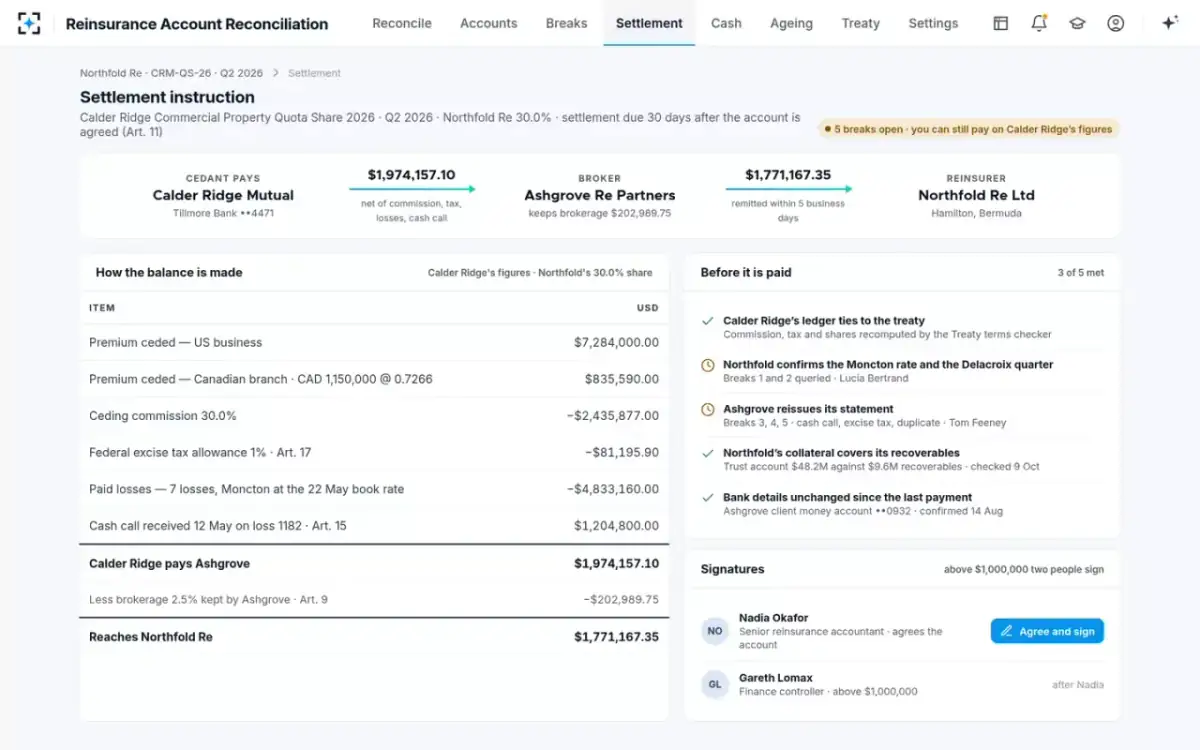
Within one agreed account, almost everything nets, and most of the premium never moves as cash. On Northfold Re's 30% share of the sample quota share, $8,119,590.00 of premium was ceded in the second quarter. After commission, brokerage, the excise tax allowance and paid losses net of a cash call already received, $1,771,167.35 reached the reinsurer.
Of $8.1 million of premium ceded to one reinsurer, 22% moved as cash
Northfold Re, second quarter 2026
- Ceding commission · 30%
- Brokerage · 2.5%
- Excise tax · 1%
- Losses net of cash call · 44.7%
- Cash to the reinsurer · 21.8%
That netting is the treaty's own mechanism and nobody disputes it. The netting that causes trouble is outside the account: withholding premium on one treaty because a recovery is unpaid on another, or deducting a disputed amount from an agreed balance. The solution's settlement drafter does not do either on its own. It nets the agreed account, credits cash calls already received and takes off brokerage, and any wider offset is a decision a person makes, with the clause in front of them.
One settlement instruction: everything netted inside the agreed account
What is offset in insolvency?
It is a statutory right, in the insurer liquidation laws of several states, to set off mutual debts and pay or claim only the balance when an insurer is in liquidation. Florida's statute follows the common form: "In all cases of mutual debts or mutual credits between the insurer and another person in connection with any action or proceeding under this chapter, such credits and debts shall be set off and the balance only shall be allowed or paid, except as provided in subsection (2)" (Florida Statutes s. 631.281).
The exceptions do the work. Florida allows no offset where the insurer's obligation would not entitle the other party to share as a claimant in the estate, and adds for reinsurance: "In the case of a reinsurance agreement, the insurer's obligation must be incurred as of the date of the order of liquidation to allow an offset." No offset is allowed for an obligation bought or transferred in order to use it as an offset, and "No claim of offset shall operate to create a secured claim."
When a state liquidation statute refuses an offset, on Florida's model
| Situation | Offset allowed? | Statute |
|---|---|---|
| Mutual debts between the insurer in liquidation and its reinsurer | Yes; only the balance is allowed or paid | s. 631.281(1) |
| The insurer's obligation would not let the other party share as a claimant | No | s. 631.281(2)(a) |
| A reinsurance obligation not incurred by the date of the liquidation order | No | s. 631.281(2)(a) |
| A claim bought or transferred in order to be used as an offset | No | s. 631.281(2)(b) |
| An assessment owed to a mutual or reciprocal, or unpaid stock subscription | No | s. 631.281(2)(c) |
| Turning an offset into a secured claim | Never | s. 631.281(4) |
What is mutuality in setoff?
Mutuality is the condition that makes two debts eligible to be set off, and it is narrower than "they owe us, we owe them". The California Supreme Court, applying its state's equivalent statute in a reinsurance liquidation, quoted Justice Cardozo: "To be mutual, [the debts] must be due to and from the same persons in the same capacity" (Prudential Reinsurance, 1992).
The court then set out three respects. The debts must be owed before or at the liquidation order, so a pre-insolvency debt cannot be set off against one arising after the liquidator is appointed. They must exist between the same persons or entities, so an affiliate's balance cannot be set off without an express agreement making it a mutual debtor and creditor. And they must be owed in the same capacity: "debts owed in a fiduciary, agency, trustee, or partnership capacity are not subject to setoff." On the facts, the court held that reciprocal reinsurance contracts between the reinsurer and the insolvent insurer created mutual credits and debts, and allowed the setoff.
The capacity point reaches into the everyday account. Under the NAIC intermediary model, a broker holds funds collected for the cedant in a fiduciary capacity, which is one reason a broker's balance and a reinsurer's balance are kept apart in a reconciliation even when they concern the same contract. The settlement process guide covers who carries the broker's credit risk.
Do all reinsurance treaties allow offset?
No. Offset between solvent parties is a matter of contract, and a treaty without an offset clause, or with a narrow one, does not let either party net across contracts or against amounts that are not yet due. Where the cedant fails, the liquidation statute applies whatever the clause says, and the contract cannot widen the statute's exceptions.
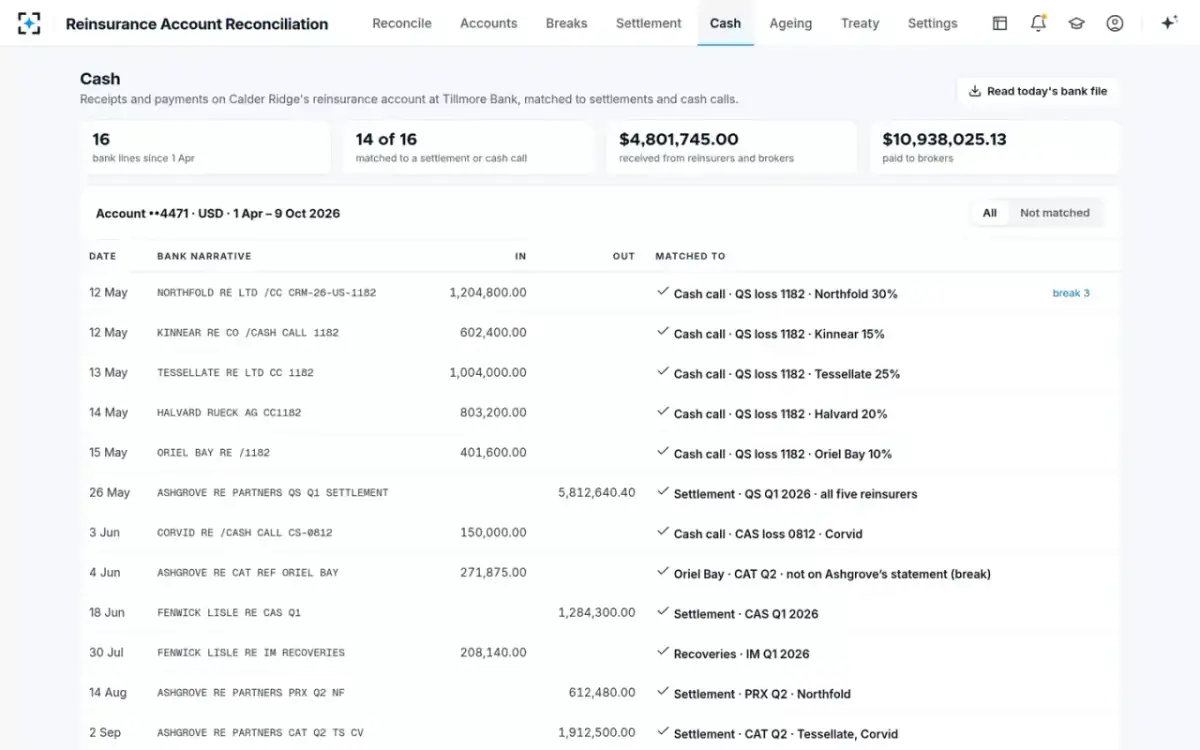
The disputed-amount case is the one a reconciliation meets most. A reinsurer that disputes part of a recovery may want to net it against premium it owes on another account; a cedant may want to withhold premium until a disputed recovery is paid. Both are offsets, and both depend on whether the clause reaches amounts that are disputed rather than agreed. One disputed cash call shows a finance controller declining to withhold for exactly that reason, and carrying the disputed recovery separately instead.
Every receipt matched to its settlement or cash call before anything is netted
Offsetting reinsurance balances in accounting: a short checklist
Three questions decide every proposed offset, and they should be asked in order. Does the contract allow it, for these balances, between these entities, in this state of agreement? Does the accounting framework allow the presentation, given that statutory accounting keeps paid-loss recoverables gross? And is either party in, or near, a liquidation that would bring the statute's mutuality conditions into play? An offset that passes all three can be booked; one that passes only the first is a cash convenience that the balance sheet will undo.
Reinsurance Account Reconciliation keeps the first question visible by quoting the clause on every explanation, and keeps the second simple by never folding a disputed or cross-contract item into a settlement on its own. To see what is netted, and why, on your own treaties, start from Reinsurance Account Reconciliation.
Questions people ask
What does an offset clause mean in a reinsurance contract?
It means the parties may set amounts each owes the other against each other and pay only the difference. Its reach depends on its words: some clauses cover only the contract they sit in, others "any other" agreement between the parties, as in the clauses the California Supreme Court reviewed in 1992.
Are reinsurance recoverables on paid losses ever netted on the balance sheet?
Not under U.S. statutory accounting: the rule carried into SSAP No. 62R reports them as an asset without any available offset, even where offset criteria would otherwise be met. They can still be netted in the cash settlement if the contract allows.
Can a reinsurer set off what it owes an insolvent cedant?
Often, if the debts are mutual and pre-date the liquidation order, under the state's liquidation statute. Florida's version, for example, requires that a reinsurance obligation of the insurer be incurred as of the date of the liquidation order, and refuses offsets that would create a secured claim.
Can a broker net balances between different reinsurers?
Not as a setoff between the reinsurers, because the debts are not between the same persons in the same capacity. The broker holds funds for its principals in a fiduciary capacity under the NAIC intermediary model, and each reinsurer's statement of account should show only that reinsurer's share.
Is funds withheld the same as offset?
No. Funds withheld are amounts the cedant keeps under the treaty as security and reports separately, as funds held under reinsurance treaties; offset is the netting of two balances that are each due. A reconciliation treats movements in funds held as cash on both sides, not as a deduction from what is owed.