Reinsurance premium reconciliation is agreeing the premium on a ceded contract across every party that records it, and then agreeing it to the cash. For ceded reinsurance that means taking the premium a cedant cedes under a treaty in a period, applying the cession and each reinsurer's share, converting currencies and deducting commission, brokerage and taxes as the wording says, and then ticking each item in three places: the cedant's books, the broker's statement of account and the reinsurer's technical account. It is unglamorous work that nobody describes, and it is where premium goes missing between sets of books that each add up. Botminds' Reinsurance Account Reconciliation does the three-way tick with a shared reference written in every margin, so one item can be followed across all three statements, and gives every item that does not tick a cause and an owner.
Worked figures come from the solution's fictional sample data, Calder Ridge Mutual's 2026 commercial property quota share with Northfold Re on 30% of the cession. Market figures come from the U.S. Bureau of Economic Analysis and the NAIC, linked where they appear. (If you arrived looking for the health insurance premium tax credit: that reconciliation is done on an individual's tax return with IRS Form 8962, and is unrelated.)
The three-way tick on one quarter's premium, item by item
| Item | Cedant | Broker | Reinsurer | Tick |
|---|---|---|---|---|
| Premium ceded, U.S. business | $7,284,000.00 | $7,284,000.00 Cr | $7,284,000.00 | A1, all three |
| Premium ceded, Canadian branch, CAD 1,150,000 at 0.7266 | $835,590.00 | $835,590.00 Cr | $835,590.00 | A2, all three |
| Ceding commission, 30.0% | −$2,435,877.00 | $2,435,877.00 Dr | ($2,435,877.00) | A3, all three |
| Brokerage, 2.5% of gross premium | not shown | $202,989.75 Dr | ($202,989.75) | Expected: the broker keeps it |
| Federal excise tax allowance, 1% | −$81,195.90 | not shown | ($81,195.90) | Break: broker left it off |
What is premium reconciliation?
It is proving that the premium one party says it ceded is the premium the others say they received, for the same contract and period, and that the cash followed. In direct insurance it usually means agreeing premium written with premium billed and collected. In ceded reinsurance the chain is longer: premium written on the subject business, the treaty's cession, each reinsurer's share, deductions under the wording, the broker's statement, the reinsurer's books and the bank.
A premium reconciliation is not a check that each document adds up. Each of the three statements in the sample added up to its own balance; they still disagreed by more than $1.5 million. It is a check that the same item appears with the same amount in every place it should, and nowhere it should not.
How much reinsurance premium goes abroad?
A great deal, and every dollar of it crosses at least three sets of books. The U.S. Bureau of Economic Analysis records, in its supplemental detail on insurance transactions, $229.2 billion of premiums paid to foreign insurers in 2024, up from $191.1 billion in 2023, against $118.2 billion of losses recovered from them (BEA, U.S. International Transactions, second quarter 2025). Those lines cover all insurance with foreign insurers; BEA's services account shows how much of the trade is reinsurance, with imports of reinsurance services of $80.2 billion out of $95.1 billion of insurance services imports in 2024.
U.S. insurance transactions with foreign insurers, 2024
Domestic reinsurance is larger still, but most of it never needs a three-way tick. The NAIC's 2025 analysis reports that "Ceded premiums written amounted to $1.0 trillion" for the U.S. property and casualty industry, and that "U.S. intercompany pooling agreements comprised 58.9% of reinsured business, followed by 28.3% affiliated nonpooled business" (NAIC, 2025 full-year results). The 21 professional reinsurers in the NAIC's analysis assumed $51.5 billion of unaffiliated premium, about half of the industry's unaffiliated total, which on our arithmetic is roughly $100 billion. The premium that crosses a broker and a third-party reinsurer, abroad or at home, is the premium that has to be reconciled three ways.
How do you reconcile reinsurance premiums? Step by step
Start from the subject premium and work forward, so that every figure on every statement can be recomputed rather than compared. Comparing statements alone finds disagreements; recomputing from the treaty finds the errors all three share.
From subject premium to the net premium on one reinsurer's account
Subject premium
$67,663,250
Premium written on the business the treaty covers, in the period. Implied by the sample's shares; the starting point in the cedant's books.
Cedant
Cession and share
× 40% × 30% = $8,119,590
The treaty's cession, then the reinsurer's line on the signed panel. Each currency converted under the currency clause.
Treaty and panel
Commission, brokerage, tax
− $2,435,877.00 − $202,989.75 − $81,195.90
30.0% ceding commission, 2.5% brokerage on gross premium, 1% excise tax allowance where it applies.
The wording
Net premium to the reinsurer
= $5,399,527.35
Before losses, cash calls and other items on the account; the figure the premium half of the tick must reach.
All three statements
Then tick. Each item the cedant's books, the broker's statement and the reinsurer's technical account all show with the same amount gets the same reference in each margin. Items that appear in only two get a cause: in the sample, brokerage appears only on the broker's and the reinsurer's statements, as it should, because the broker keeps it; the excise tax allowance appears only on the cedant's and the reinsurer's, because the broker left it off. Finally, tie the net to the cash: the settlement paid, the cash calls received and any premium refunds, matched from the bank file.
Tying the premium to the cash
A premium reconciliation is finished only when the agreed net has been paid and the bank shows it. On a brokered account the cash moves in two legs, cedant to broker and broker to reinsurer, and the premium is netted with losses and cash calls on the way, so the bank line never equals the premium alone. The tie is made through the settlement: the agreed account, the instruction that implements it, and the bank line that settles it.
On the sample account, the premium net of deductions was $5,399,527.35; after seven paid losses of $4,833,160.00 and the credit for a $1,204,800.00 cash call already received, Calder Ridge paid the broker $1,974,157.10, and the broker remitted $1,771,167.35 to Northfold after keeping its brokerage. Across the quarter, the cedant's reinsurance bank account showed 16 lines since 1 April, 14 matched to a settlement or a cash call; the two that were not are exactly the lines a reconciliation must explain before the year-end statements are drawn.
What is a shared reference in reconciliation?
It is the same mark written beside the same item in every document, so that anyone can follow one item across all of them. Accountants did it with a pencil tick and a letter; the principle survives because it answers the auditor's first question, which line in this statement is that line in the other one, without anyone having to explain.
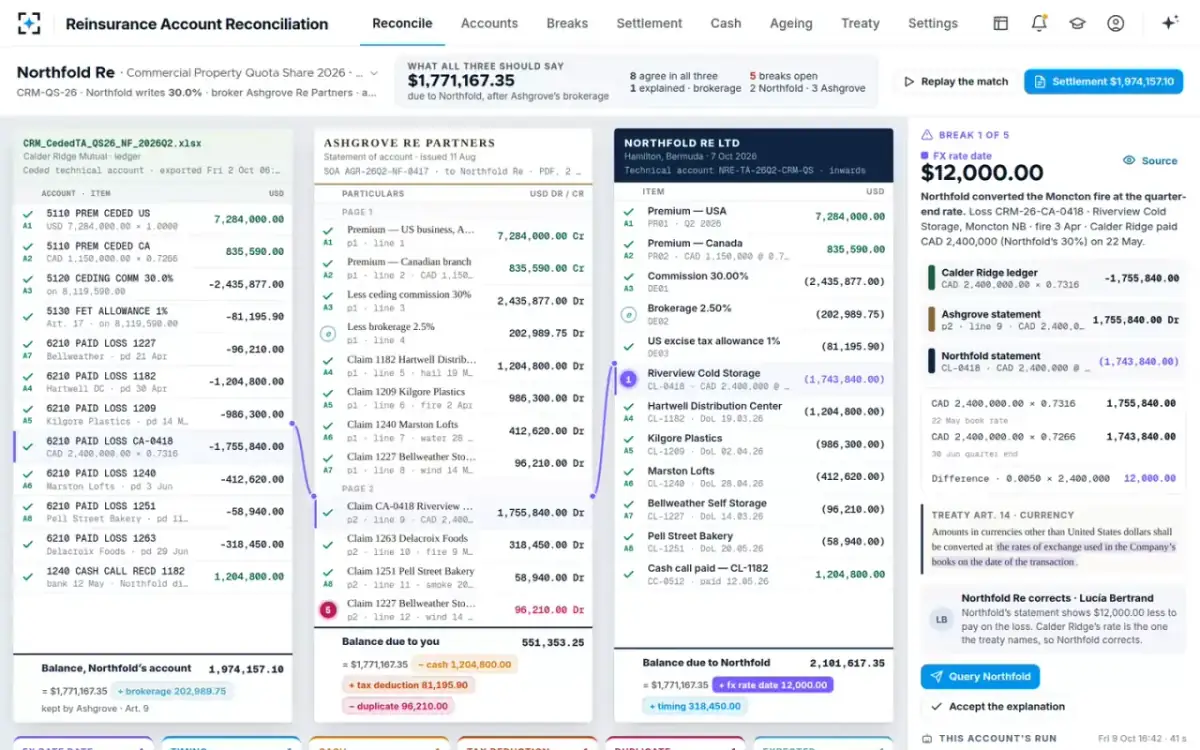
In Reinsurance Account Reconciliation the references are A1, A2 and onward, written in the margin of each of the three statements as the line matcher ticks an item that agrees in all three to the cent. On Northfold's sample account eight items carry a reference in all three margins. Items without one are the breaks, and each has its own number and a thread joining the lines that do exist.
Shared references in every margin of three statements
Why the reinsurer's books lag the cedant's
Because the reinsurer learns of the premium last. The rule carried into SSAP No. 62R, quoted here from NAIC Issue Paper No. 75, names the problem: "A lag will develop between the time of the entry of the underlying policy transaction on the books of the ceding insurer and the transmittal of information and its entry on the books of the assuming company" (NAIC Issue Paper No. 75). The same text requires assuming companies to estimate unreported premiums and related costs where needed to prevent material distortions.
For the reconciliation, the lag means timing differences are normal and must be explained rather than chased as errors. A premium adjustment booked by the cedant in the last week of a quarter may reach the reinsurer's technical account in the next. The test is whether the item appears in the right account under the wording, not whether all three parties booked it on the same day. Adjustable premiums, such as deposit premium adjusted to the final subject premium, add a second layer of timing; calculating them is the work of Ceded Reinsurance Accounting (minimum and deposit premium, explained), and the reconciliation then checks that each statement carries them.
What is a broker statement, and what must a broker keep?
A broker statement, or statement of account, is the broker's account to one reinsurer of the premium and other items on a contract for a period, built from the cedant's account. Under the NAIC intermediary model, the broker must keep for each transaction, among other things, how balances are to be reported and settled and its "Financial records, including but not limited to, premium and loss accounts" (NAIC Model #790, Section 5A). Those accounts are what the cedant's premium reconciliation leans on when a broker's statement does not agree.
The statement's layout is the broker's choice, which is why the reconciliation must read it as it comes. Ashgrove's sample statement was a two-page PDF of particulars, with the premium, commission and brokerage on page 1 and losses running onto page 2; the line numbers it printed are the ones the query quotes back. The statement of account guide follows the document through the quarter.
Who owns a reconciliation difference?
The party whose figure departs from the treaty, not the party that found the difference. That rule turns a reconciliation from a negotiation into a list of corrections, and it can be written down per cause before the quarter starts.
Who corrects what, when the premium does not tick
Today
Owns every difference by default, because the cedant found it, and chases each one by email.
With agents
Owns differences in the cedant's own figures; the rest are routed to their owners with the lines and clause attached.
Still theirs: accepting or querying each explanation, and agreeing the account
Today
Hears that the totals disagree and searches the statement for the cause.
With agents
Receives the lines on the broker's statement that depart from the wording: a missing tax allowance, a cash call left off, a duplicate.
Still theirs: reissuing the statement
Today
Receives a total and a request to correct it.
With agents
Receives the item in the technical account that departs from the wording, with the clause: a rate taken on the wrong date, an item booked in the next quarter.
Still theirs: correcting the reinsurer's own books
Today
Sees unreconciled premium only when it ages.
With agents
Sees each open difference with its owner and days open, and chases after the set interval.
Still theirs: escalation when a query goes unanswered
Seven causes and the default owner of each
| Cause | Default owner | In the sample book |
|---|---|---|
| Exchange-rate date | The party whose rate differs from the treaty's | 5 open, $25,530.00 |
| Timing | The party that booked it in another quarter | 6 open, $897,475.00 |
| Cash | The broker, when cash went direct | 3 open, $1,626,675.00 |
| Tax deduction | The party that left the allowance out | 6 open, $144,958.85 |
| Duplicate | The party with the second line | 4 open, $207,070.00 |
| Share | The party using the wrong line | 3 open, $64,000.00 |
| Missing item | The party without the item | 3 open, $656,600.00 |
The premium reconciliation process across a year
Quarterly accounts carry most of the work, but premium reconciliation has an annual rhythm too. Deposit and adjustment premiums are reconciled when the adjustment is made, panels change at renewal and shares must be re-read, and the year-end statements must carry balances that every party has agreed or explained.
In practice, three dates matter. The quarterly account date, when the cedant renders and the broker issues (45 days after quarter end in the sample wording). The renewal, when the panel, shares, commission and brokerage are re-read from the new wording before the first account under it. And year end, when unagreed balances and overdue items feed the statutory schedules. A reconciliation that ticks premium against the treaty every quarter arrives at year end with differences explained, owned and dated; one that does not arrives with a list. To run the three-way tick on your own treaties, start from Reinsurance Account Reconciliation.
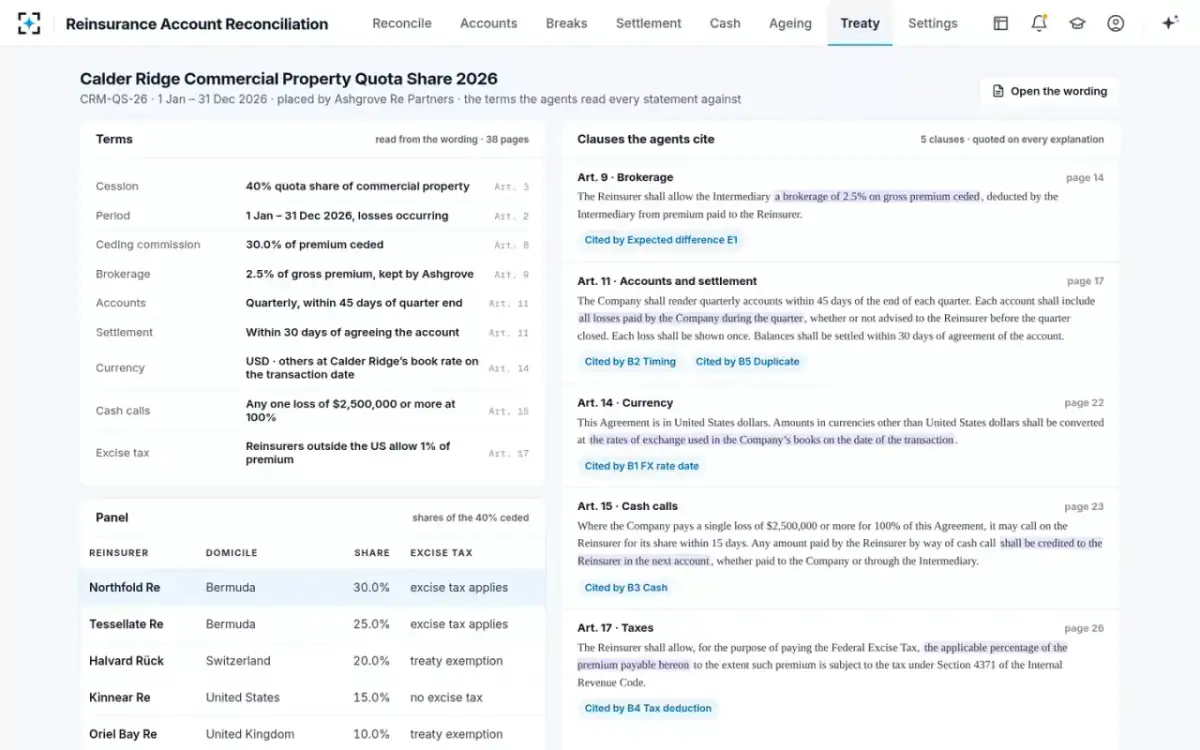
The treaty terms the premium is recomputed from
Questions people ask
What does premium reconciliation mean in insurance?
It means agreeing premium across every account of it: written, billed, collected and, for reinsurance, ceded and received by each reinsurer. The aim is that every dollar of premium can be traced from the policy to the cash, with any difference explained and owned.
How often should reinsurance premium be reconciled?
At least as often as accounts are rendered under the treaty, quarterly in the sample wording, and again whenever an adjustment premium is booked or the panel changes. Cash should be matched daily, because cash calls and refunds can move between accounts.
Why does the reinsurer's premium differ from the cedant's?
Usually because of timing, currency or deductions: the reinsurer books later, converts at a different rate, or applies commission, brokerage or tax differently. Each is decided by the treaty, so each can be explained from the wording rather than argued.
Does premium reconciliation include brokerage?
Yes, as an expected difference. The broker deducts brokerage before remitting, so the broker's and reinsurer's statements show it and the cedant's account to the broker may not; in the sample it was 2.5% of gross premium, $202,989.75, explained by the wording rather than raised as a break.
Is there a standard format for reinsurance premium statements?
Not one that every party uses. Brokers and reinsurers issue statements from their own systems, as PDFs, spreadsheets or emails, which is why the reconciliation has to read each layout and cite the page and line it took each figure from.