The NAIC list of reciprocal reinsurers is the list of reciprocal jurisdiction reinsurers, and certified reinsurers, that the NAIC's Reinsurance Financial Analysis (E) Working Group has reviewed and recommended for passporting, published on the NAIC's Certified and Reciprocal Jurisdiction Reinsurers page alongside links to each state's own list. A reciprocal jurisdiction reinsurer is licensed and domiciled in the EU, the UK, an NAIC-accredited U.S. state or another recognised jurisdiction, and meets capital, solvency and prompt-payment conditions; a ceding insurer then takes full credit for reinsurance with it without any collateral. That changes what a credit team watches. There is no letter of credit to expire and no trust to value; there are three tests of prompt payment, a capital and solvency floor, and treaty clauses that restore 100% security if the reinsurer resists a judgment or enters a solvent scheme. Botminds' Reinsurance Counterparty Risk Monitoring keeps reciprocal reinsurers on the same watch as the rest of the panel, through their ratings, payment record and concentration rather than their collateral.
Where the security sits for each status: in collateral, or in conditions
Unauthorized reinsurer
- Collateral · 100%
Certified reinsurer at Secure-4
- Collateral · 50%
- Credit on certification · 50%
Reciprocal jurisdiction reinsurer
- Credit on conditions, until a trigger · 100%
Where is the NAIC list of reciprocal jurisdiction reinsurers?
It is on the NAIC's Certified and Reciprocal Jurisdiction Reinsurers page, which states: "Included in the link below is a list of all certified and reciprocal jurisdiction reinsurers that have been reviewed by ReFAWG and recommended for Passporting. Each tab in the link will include the different categories of reinsurer." (NAIC, Certified and Reciprocal Jurisdiction Reinsurers). The same page links each state's own certified and reciprocal pages, published "to facilitate accurate reporting of reinsurance transactions within the statutory financial statements", and the NAIC's separate lists of qualified and reciprocal jurisdictions.
The NAIC list is a recommendation for passporting, not a grant of credit in every state. The model regulation requires each commissioner to "timely create and publish a list of assuming insurers that have satisfied the conditions" and lets a commissioner defer to another accredited state's determination (Model Regulation #786, Section 9E). The list a cedant's file should cite is its own domiciliary state's. In the NAIC's state index as captured in April 2026, most states had pages for both statuses, and at least one, Nevada, linked only a certified page.
What is a reciprocal jurisdiction reinsurer?
A reciprocal jurisdiction reinsurer is an assuming insurer that is licensed to write reinsurance by, and has its head office or domicile in, a reciprocal jurisdiction, and that meets the conditions in the model regulation (#786, Section 9). In the NAIC's summary, reinsurers in reciprocal jurisdictions that meet the standards of the models are allowed "to not post collateral" (NAIC, Reinsurance topic page).
The conditions are specific. Capital and surplus of at least $250 million; a solvency ratio of 100% of the solvency capital requirement for EU and UK reinsurers under the covered agreements, or 300% of authorized control level risk-based capital for reinsurers in accredited U.S. states; a signed Form RJ-1 consenting to the state's courts and to paying final judgments; a treaty clause requiring 100% security if it resists a final judgment; confirmation that it is in no solvent scheme involving the state's cedants; annual confirmation from its home supervisor; and "a practice of prompt payment of claims under reinsurance agreements" (#786, Section 9C). The plain-words guide to the credit for reinsurance model law explains how the status arose.
How many reciprocal reinsurers are there?
The Reinsurance Financial Analysis (E) Working Group had approved 107 reciprocal jurisdiction reinsurers for passporting, and 49 states and two territories had passported at least one, according to the Reinsurance (E) Task Force's minutes of 9 December 2025 (NAIC Reinsurance (E) Task Force, 2 March 2026 materials). Those minutes were published marked "Draft Pending Adoption"; we have not found a later count from a document we could read, and the figure should be cited with its date.
Reciprocal jurisdiction reinsurers by the numbers
107
reciprocal jurisdiction reinsurers approved for passporting, per draft minutes of December 2025
51
states and territories (49 and 2) that had passported at least one, per the same minutes
$250million
minimum capital and surplus for the status
0%
collateral, unless a treaty trigger fires
Which countries are reciprocal jurisdictions?
Three groups qualify. Every EU member state and the United Kingdom, through the covered agreements; every U.S. jurisdiction that meets the NAIC's financial standards and accreditation requirements; and qualified jurisdictions the commissioner finds meet further conditions on reciprocity, local presence, group supervision and information sharing (#786, Section 9B). In October 2025 the NAIC's Mutual Recognition of Jurisdictions (E) Working Group reapproved Bermuda, Japan and Switzerland as reciprocal jurisdictions in the third group, according to the same December 2025 draft minutes, which also noted that Bermuda, Japan and the UK were changing their regulatory systems under NAIC staff monitoring.
A reciprocal reinsurer's status therefore rests on two things that can change: its own compliance and its home jurisdiction's standing. The model lets a commissioner remove a qualified jurisdiction from the reciprocal list if it stops meeting the requirements, though not an EU, UK or accredited U.S. jurisdiction (#786, Section 9D).
Do reciprocal reinsurers post collateral? Only when a trigger fires
Not in the ordinary course: collateral is eliminated for reciprocal jurisdiction reinsurers that meet the conditions. Collateral returns in two treaty situations and can return in a third. The treaty must require 100% security if the reinsurer resists enforcement of a final judgment or a properly enforceable arbitration award, and the reinsurer must provide 100% security if it enters a solvent scheme of arrangement involving the state's cedants. And if the cedant itself is in rehabilitation, liquidation or conservation, its receiver may ask the court to order security for all outstanding liabilities (#786, Sections 9C(4) and 9H).
The events that change a reciprocal reinsurer's credit, and what the cedant can see of each
The reinsurer resists a final judgment or a properly enforceable arbitration award
What followsThe treaty clause the model requires obliges it to provide security equal to 100% of its liabilities under that agreement.
What you can see of itYour own disputes and arbitrations with it; your counsel knows first.
The reinsurer enters a solvent scheme of arrangement involving your state's cedants
What followsIt must notify you and the commissioner and provide 100% security, consistent with the scheme's terms.
What you can see of itAnnouncements and court filings in its home jurisdiction; its notice to you.
Capital falls below $250 million, or the solvency ratio below the required level
What followsIt must give prompt written notice to the commissioner; eligibility may be suspended or revoked after a remedy period.
What you can see of itIts published results and solvency reports; rating actions and outlooks.
It fails a prompt-payment test
What followsThe condition of prompt payment is not met; the commissioner may begin the same remedy-then-revoke process.
What you can see of itOnly your own slice: your overdue and disputed balances with it.
Its home jurisdiction is removed from the reciprocal list
What followsCredit continues only where another route allows it; covered-agreement and accredited U.S. jurisdictions cannot be removed this way.
What you can see of itNAIC committee materials and your state's list.
You, the cedant, enter rehabilitation, liquidation or conservation
What followsYour receiver may seek a court order requiring it to post security for all outstanding liabilities.
What you can see of itNot a monitoring signal; a reason the clause exists.
Two of the six depend on clauses in the treaty. A credit controller who has never read the 100% security clause in each agreement with a reciprocal reinsurer does not know what the trigger actually says, or whether the broker's wording matches the model. That is a contract question, answered in reinsurance contract review.
The prompt-payment tests, measured from your side
The model regulation treats a lack of prompt payment as shown by any one of three tests: more than 15% of the reinsurer's recoverables overdue and in dispute as reported to the commissioner; more than 15% of its ceding insurers with undisputed paid recoverables at least 90 days overdue and above $100,000 each, or as a covered agreement specifies; or undisputed paid recoverables at least 90 days overdue totalling more than $50 million, or as a covered agreement specifies (#786, Section 9C(6)). The tests are measured across the reinsurer's whole U.S. book, using data the reinsurer can be asked to give the commissioner no more than semi-annually.
No cedant can compute them. What a cedant can compute is whether it is one of the data points. If its own undisputed paid balance with a reciprocal reinsurer has passed 90 days and $100,000, it is one of the ceding insurers counted in the second test. If its disputes with the reinsurer are large, they feed the first. A reinsurer that is late with you, and reported in the press to be disputing allocations with others, is a candidate for a regulator's question. That is information a security committee wants before 1/1, and it comes from the recoveries desk's ageing, not from any rating.
What happens if a reciprocal reinsurer pays slowly?
Before denying credit or requiring security because a reciprocal reinsurer no longer meets a condition, the commissioner must tell the cedant, the reinsurer and its supervisor, and give the reinsurer "30 days from the initial communication to submit a plan to remedy the defect, and 90 days from the initial communication to remedy the defect", except where a shorter period is needed to protect policyholders (#786, Section 9G). If the defect is not cured, the commissioner may suspend or revoke the reinsurer's eligibility.
The consequences differ sharply. During a suspension, agreements issued, amended or renewed after the suspension get no credit except to the extent secured. After a revocation, no credit may be granted for any agreement, including older ones, except to the extent secured (#786, Section 9F). A cedant notified on day one of a remedy period has up to 90 days to arrange security for every agreement with that reinsurer; one that hears at quarter-end may have none. The overdue balances themselves also count against the cedant's own statement through the provision for overdue reinsurance, whatever the reinsurer's status.
Watching without collateral, seat by seat
Without collateral, the watch on a reciprocal reinsurer is spread across the people who see its conditions: ratings and results, payment record, disputes, the treaty clauses and the share of the panel it holds. In the solution's fictional sample carrier, a mutual with 34 reinsurers, four reciprocal reinsurers in the panel's top eleven held $165.3 million of recoverables between them, and two moved in the same week: one, in the UK, was downgraded from A to A- by an agency on 8 October; another, in Switzerland, had carried a negative outlook since 2 October and held 10.3% of the panel's recoverables. Neither posts collateral, so neither move changed a collateral number. The security committee kept the downgraded reinsurer and capped its line at the current 7.5% until two quarters of results.
Who watches a reciprocal reinsurer when there is no collateral to value, with Reinsurance Counterparty Risk Monitoring
Today
Files reciprocal reinsurers as "no collateral required" and looks again at the annual review.
With agents
Sees each one ranked nightly on ratings, outlooks, news, payment record and share of recoverables.
Still theirs: The decision to put a reinsurer on watch.
Today
Chases overdue balances without knowing they feed a regulatory test.
With agents
Sees which balances pass 90 days and $100,000 at a reciprocal reinsurer, and which are in dispute.
Still theirs: Billing, disputes and the accounts.
Today
Reads the 100% security clause when an arbitration starts.
With agents
Has each treaty's trigger clause on file and is alerted when a dispute nears an award.
Still theirs: Enforcement and the reading of the clauses.
Today
Learns of a solvent scheme or a strategic review after renewal shares are set.
With agents
Sees it flagged before 1/1 shares are agreed.
Still theirs: Shares and lines inside the approved list.
Today
Sees concentration in a reinsurer that posts nothing only at quarter-end.
With agents
Sees it every morning against the carrier's limit.
Still theirs: Thresholds and the regulator relationship.
Signals on reciprocal reinsurers in Reinsurance Counterparty Risk Monitoring: a downgrade and a negative outlook in one week
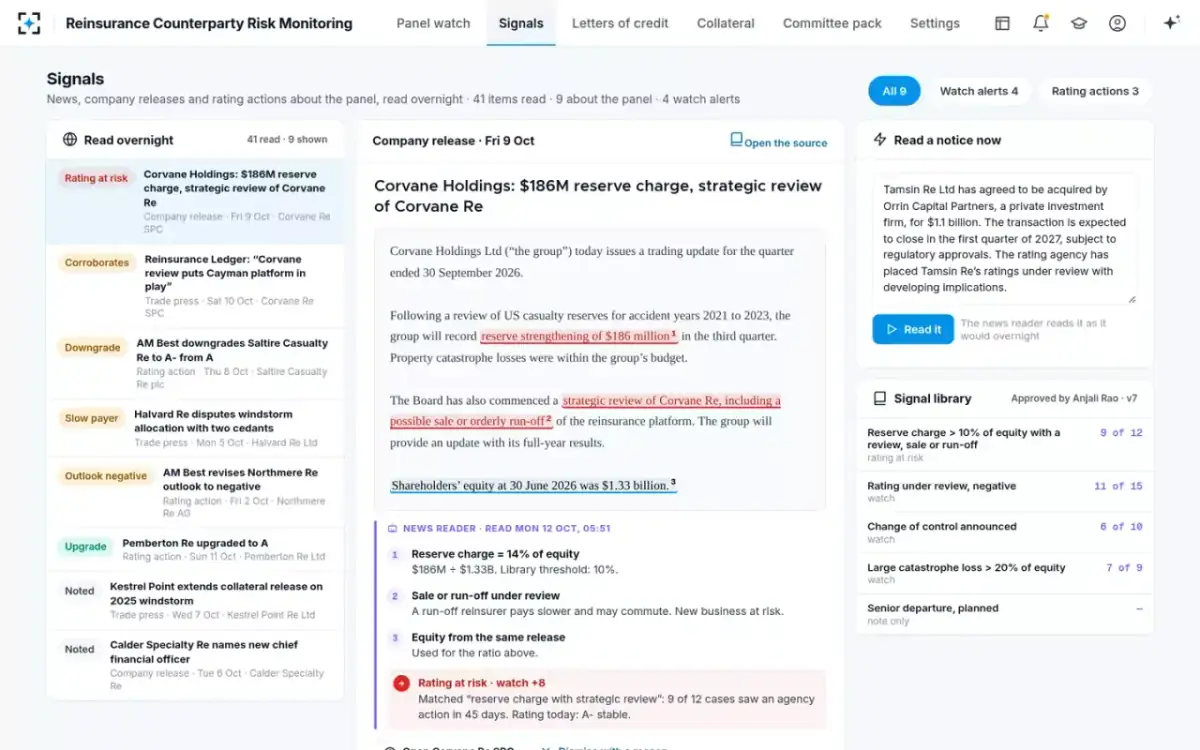
Reinsurance Counterparty Risk Monitoring treats a reciprocal reinsurer as a full member of the watch: the rating watcher reads its actions and outlooks, the news reader flags reserve charges, strategic reviews and schemes before agencies act, the recoverables ager ages its balances and computes its share of the panel, and the status itself is checked against the published lists. What the solution does not do is read the treaty triggers for you or decide the response; the credit controller and counsel do. See it on the Reinsurance Counterparty Risk Monitoring page, and compare the certified reinsurer rating route, where collateral still moves with the rating.
Questions people ask
Is the NAIC list of reciprocal jurisdictions the same as the list of reciprocal reinsurers?
No. The list of reciprocal jurisdictions names the places, such as EU member states, the UK, accredited U.S. states and Bermuda, Japan and Switzerland; the list of reciprocal jurisdiction reinsurers names the companies recommended for passporting. A reinsurer needs both: a qualifying home and its own compliance with the conditions.
Can a cedant ask a reciprocal reinsurer for collateral anyway?
Yes, by contract. The model law says the reciprocal route does not limit the parties' capacity to renegotiate, and does not let a reinsurer withdraw or reduce security already provided except as the agreement permits. Some security committees ask for collateral from reinsurers near the bottom of their appetite regardless of status.
Does a rating downgrade affect a reciprocal reinsurer's collateral?
Not directly. Unlike a certified reinsurer, whose collateral is set by a rating level, a reciprocal reinsurer posts none whatever its rating, as long as it meets the capital, solvency and prompt-payment conditions. A downgrade is still a signal to watch those conditions, and to reconsider the reinsurer's line at renewal.
Do reciprocal reinsurers need a U.S. license?
No. They must be licensed to write reinsurance by their reciprocal jurisdiction and have their head office or domicile there, and must consent to the jurisdiction of the cedant's state courts and to the commissioner as agent for service of process. The commissioner may also require that consent to appear in each reinsurance agreement.
What is passporting?
The NAIC's process by which one state's review of a certified or reciprocal jurisdiction reinsurer is relied on by others, so the reinsurer need not file the same documentation in every state. The model regulation lets a commissioner defer to another accredited state's determination; it is the commissioner's choice, which is why each state publishes its own list.