The difference between an authorized and an unauthorized reinsurer is whether the reinsurer is licensed or otherwise approved in the ceding insurer's state, and it decides what the cedant must hold to take credit for the reinsurance on its statutory balance sheet. Ceding to an authorized reinsurer, the cedant takes credit with no collateral required by law. Ceding to an unauthorized reinsurer, it takes credit only up to the security it holds: cash, qualifying securities, letters of credit or a trust. Whatever is not secured at the statement date is charged against surplus through the provision for reinsurance. The cost of the distinction is therefore not the reinsurer's creditworthiness; it is whether the collateral is in place on 31 December. Botminds' Reinsurance Counterparty Risk Monitoring reads every letter of credit, trust statement and bank notice nightly and projects that charge for the next statement date.
One unauthorized reinsurer's collateral, today and if its letter of credit lapses
Today: $42.6M required, $43.1M held
- Trust $24.6M · 57%
- Letter of credit $18.5M · 43%
Letter of credit ends 30 Oct, nothing done by 31 Dec
- Trust $24.6M, credited · 58%
- Unsecured $18.0M, charged to surplus · 42%
Authorized vs unauthorized reinsurer, in one paragraph
An authorized reinsurer is licensed, or in some states accredited, where the ceding insurer is domiciled, and is regulated there like any other licensed insurer; the cedant takes full credit "without a regulatory requirement for the reinsurer to post any collateral". An unauthorized reinsurer has no such standing, and reinsurers "that are not licensed in the U.S., often referred to as “alien” or offshore companies, must post 100% collateral to secure the transaction, unless they are a Certified Reinsurer or a Reciprocal Jurisdiction Reinsurer" (NAIC, Reinsurance topic page). The same page observes that most reinsurance premium is placed outside the United States, which is why the distinction touches most third-party programs.
Authorized and unauthorized reinsurers, side by side
Authorized reinsurer: Licensed or accredited; subject to the state's solvency regulation and examination.
Unauthorized reinsurer: Neither licensed nor accredited; regulated, if at all, elsewhere.
Authorized reinsurer: None.
Unauthorized reinsurer: 100% of the liabilities the cedant wants credit for, unless certified or reciprocal.
Authorized reinsurer: Not applicable.
Unauthorized reinsurer: Cash, NAIC-listed securities, clean irrevocable letters of credit from a qualified U.S. bank, trusts, or other security the commissioner accepts.
Authorized reinsurer: No collateral charge; overdue and disputed balances still attract a provision.
Unauthorized reinsurer: The unsecured part is provided for in full, reducing surplus.
Authorized reinsurer: Ratings, payment record and concentration.
Unauthorized reinsurer: All of that, plus every instrument's value, expiry and notice window.
What is an authorized reinsurer, and what is an accredited one?
An authorized reinsurer is one licensed to accept reinsurance in the ceding insurer's state; the NAIC's own definition is a reinsurer "that is licensed to accept reinsurance in a state or territory" (NAIC). The model law gives three related routes that work the same way for the cedant. An accredited reinsurer is licensed in at least one state, files with the commissioner, submits to examination and, as a rule, keeps at least $20 million of surplus; a reinsurer domiciled in another state with substantially similar credit rules qualifies on similar terms; and a reinsurer that keeps a trust for all its U.S. cedants qualifies if the trust holds its liabilities plus trusteed surplus, at least $20 million for a single reinsurer (Model Law #785, Sections 2B to 2D).
For a monitor, "authorized" is a status that can be lost, not a permanent quality. If an accredited reinsurer's accreditation is revoked, credit is not allowed, and credit is denied for business ceded while the accreditation was suspended (Model Regulation #786, Section 5). A watchlist that notes status once, when the reinsurer joined the panel, will miss the change that matters most.
What is an unauthorized reinsurer, and what must it post?
An unauthorized reinsurer is any reinsurer that meets none of the model law's routes to credit, and the cedant may then take credit only as "a reduction from liability" equal to the security it holds, capped at the liabilities it carries (#785, Section 3). The security must be held in the United States, "subject to withdrawal solely by, and under the exclusive control of, the ceding insurer", or in a trust at a qualified U.S. financial institution.
Four forms qualify: cash; securities listed by the NAIC's Securities Valuation Office that qualify as admitted assets; clean, irrevocable, unconditional letters of credit issued or confirmed by a qualified U.S. financial institution; and any other form the commissioner accepts, which the model regulation extends to funds withheld under the cedant's exclusive control (#786, Sections 11 and 14). The comparison of collateral tracking tools explains why each form needs different watching.
"Liabilities" here is wider than paid claims. For property and casualty business the model regulation counts paid losses and loss expenses recoverable, reserves for reported and unreported losses, reserves for loss expenses, and unearned premiums. That is why the sample reinsurer's requirement, $42.6 million, is larger than its $41.2 million of recoverables: the extra $1.4 million is unearned premium.
How does reinsurance collateral affect surplus?
Collateral affects surplus through the provision for reinsurance, a statutory liability whose change is charged directly to surplus. The Casualty Actuarial Society's study text describes the piece that applies here plainly:
"The provision for unauthorized reinsurance requires that the insurance company establish a liability to protect against the inability to collect on amounts due from a reinsurer not authorized by the insurance company’s jurisdiction to write business and therefore not regulated by that jurisdiction."
Odomirok et al., Financial Reporting Through the Lens of a Property/Casualty Actuary, CAS (2014 edition)
In the method that text sets out, the liability for each unauthorized reinsurer equals its recoverables less the security held, plus a further charge where paid balances are more than 90 days overdue or in dispute, capped at the total recoverable (CAS, 2014 edition). The annual statement's schedule has been restructured since that edition, so the part and column numbers have moved; the principle has not. Unsecured means provided for in full.
The same text adds a caution worth repeating to any board: "Just because a reinsurer is not authorized to transact business in the jurisdiction in which the reporting entity operates doesn’t mean that the reinsurer is not viable and will not pay claims owed under the terms of the reinsurance contract." The charge is a regulatory measure of security, not a forecast of default. A strong unauthorized reinsurer with a lapsed letter of credit costs surplus; a weak one fully secured costs nothing at the statement date.
One lapsed letter of credit, priced
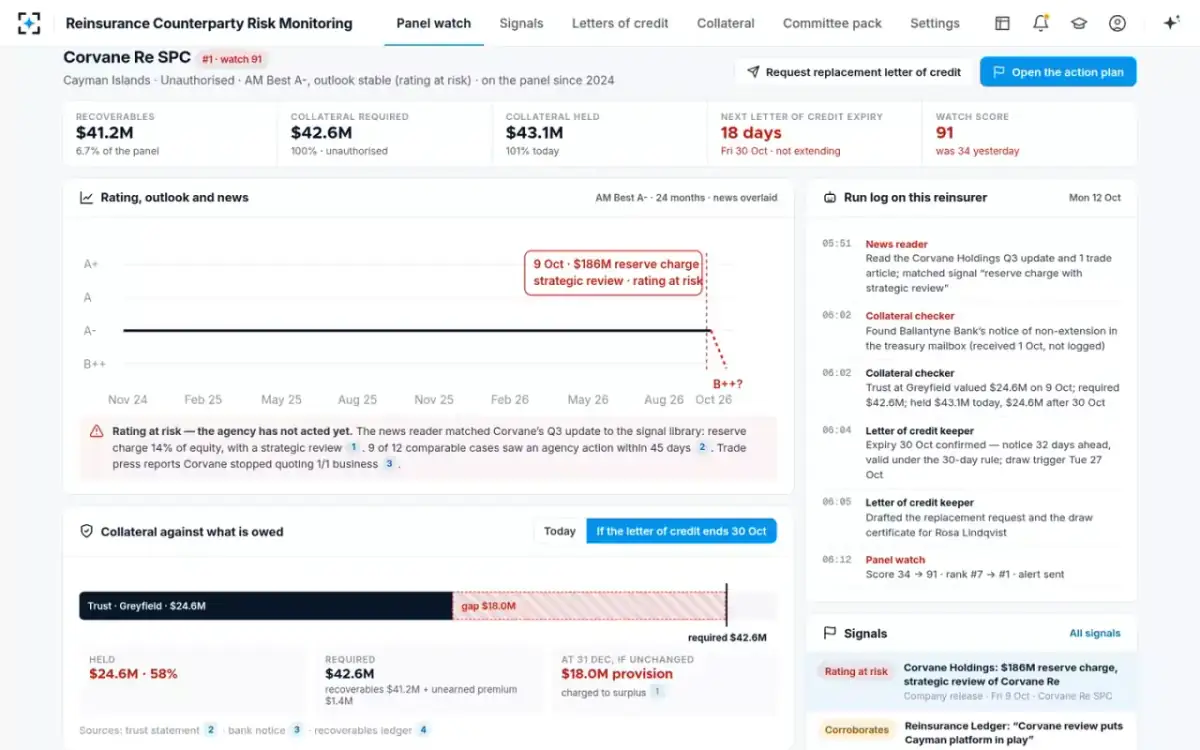
Take the solution's fictional sample carrier, a mutual with 34 reinsurers, $612.8 million of recoverables and $1,120 million of surplus. One unauthorized reinsurer, domiciled in the Cayman Islands and rated A- by AM Best, owes $41.2 million of recoverables and holds $1.4 million of unearned premium, so the carrier needs $42.6 million of security. It holds $43.1 million: an $18.5 million letter of credit and a trust worth $24.6 million. On 12 October the overnight run found the bank's notice that the letter would not be extended past 30 October.
The year-end charge if the letter of credit lapses and is not replaced
| Step | Calculation | Amount |
|---|---|---|
| 1. Liabilities to secure | Recoverables $41.2M + unearned premium $1.4M | $42.6M |
| 2. Security held today | Letter of credit $18.5M + trust $24.6M | $43.1M (101%) |
| 3. Security after 30 October | Trust $24.6M only | $24.6M (58%) |
| 4. Unsecured at 31 December | $42.6M − $24.6M | $18.0M |
| 5. Overdue or disputed balances | None at this reinsurer | $0 |
| 6. Charge to surplus | Unsecured amount, provided in full | $18.0M = 1.6% of $1,120M surplus |
What one unlogged bank notice was worth on the sample book
$18.0million
charge to surplus at 31 December if the letter lapses unreplaced
1.6%
of the carrier's surplus, from one instrument
11days
the bank's notice sat unlogged in the treasury mailbox
18days
left before expiry when the overnight run found it
The 18 days were enough. The credit controller requested a replacement the same morning, the security committee met on 21 October, and the treasurer co-signed a draw certificate to be held until 27 October, three business days before expiry, under the treaty's security clause. A draw would move $18.5 million into the reinsurer's trust, keeping security at 101% and the charge at zero. Had the notice been found at the quarter's close, the letter would already have ended and the only question left would have been how to explain $18.0 million to the board.
If the letter of credit ends: Reinsurance Counterparty Risk Monitoring shows the gap before it opens
Certified and reciprocal: the statuses in between
Two statuses sit between the poles and change the arithmetic. A certified reinsurer posts a percentage set by the rating a state assigns, from 0% at Secure-1 to 100% at Vulnerable-6, so the gap a lapse opens depends on the level, and a downgrade can create a gap with no lapse at all. The certified reinsurer rating guide follows that case.
A reciprocal jurisdiction reinsurer, the status added in the 2019 model revisions, posts no collateral if it meets capital, solvency and prompt-payment conditions. Its cost appears only if it loses the status or triggers the treaty clauses that require 100% security, such as resisting a final judgment. A monitor that treats reciprocal reinsurers as risk-free is watching the wrong thing; the triggers, not the collateral, are what move.
Why the statement date makes timing the whole cost
Credit is measured at each statement date, and the model law ties collateral to that date. A letter of credit counts only if it is "effective no later than December 31 of the year for which the filing is being made, and in the possession of, or in trust for, the ceding insurer on or before the filing date of its annual statement" (#785, Section 3C). A trust reduces the liability only if it was established on or before the filing date, and only up to "the current fair market value of acceptable assets available to be withdrawn from the trust account at that time" (#786, Section 12E).
That makes two kinds of event expensive in the fourth quarter. A letter of credit that ends between October and December without replacement leaves a gap at exactly the wrong moment. A trust valued at the end of September that loses value afterwards, or whose assets were short at the last statement, is measured at what it holds then, not at what it was meant to hold. In the sample, one collateralized reinsurer's trust stood at 97% of its requirement after the 30 September valuation, $0.3 million short, and the carrier had asked for a top-up.
How to keep the year-end number from surprising you, with Reinsurance Counterparty Risk Monitoring
Keep three things current for every unauthorized and certified reinsurer: the requirement, recomputed when recoverables or status change; the security, with each letter of credit's expiry and notice window and each trust's latest value; and the projected charge at the next statement date. The third is the one boards remember, and it is only as good as the first two.
Reinsurance Counterparty Risk Monitoring does that nightly. Its collateral checker matches letters of credit, trusts and funds withheld to the requirement by status and rating and reads bank notices where they land; its letter of credit keeper holds every expiry and notice window; the projection shows what the charge would be if nothing were done and what it falls to once each gap is closed. It does not book the provision or move collateral, and the controller's ceded reinsurance accounting stays the book of record. Run it on your own panel from the Reinsurance Counterparty Risk Monitoring page.
Questions people ask
Is an unauthorized reinsurer the same as an alien reinsurer?
Not exactly. "Alien" describes domicile outside the United States; "unauthorized" describes standing in the cedant's state. An alien reinsurer can be authorized through a licensed U.S. branch, certified, or recognized as a reciprocal jurisdiction reinsurer, and a U.S. reinsurer licensed only in other states can be unauthorized in yours unless it is accredited or meets the domiciled-in-another-state route.
Can a cedant use funds withheld as collateral for an unauthorized reinsurer?
Yes. Model Regulation #786 allows credit for unencumbered funds withheld by the ceding insurer in the United States, subject to withdrawal solely by the cedant and under its exclusive control. Because the cedant already holds the money, funds withheld cannot lapse the way a letter of credit can, though the balance must still match the liabilities it secures.
Does the provision for reinsurance reduce income or surplus?
Surplus. The minimum provision is recorded as a liability and its change between years goes directly to unassigned surplus, not through the income statement, according to the CAS study text quoting the statutory accounting rule. A $18.0 million rise in the provision is an $18.0 million fall in surplus.
What is a reciprocal jurisdiction reinsurer?
A reinsurer licensed and domiciled in a jurisdiction covered by a U.S. covered agreement, an NAIC-accredited U.S. state, or a qualified jurisdiction that meets extra conditions, and which meets capital, solvency and prompt-payment conditions itself. It posts no collateral unless a contractual trigger fires; the NAIC list of reciprocal reinsurers explains how to watch one.
How much collateral does an unauthorized reinsurer need for unearned premium?
The same 100%. Unearned premiums are among the liabilities Model Regulation #786 lists for property and casualty business, so a reinsurer that holds unearned premium must secure it along with paid and reserved losses for the cedant to take full credit.