Counterparty risk management software for reinsurance is a system that watches the credit of every reinsurer a carrier cedes to, ratings, collateral, letters of credit, trusts and overdue recoverables, and turns what it finds into ranked alerts and drafted actions. The useful version does the reading and the arithmetic every night and stops at the point where money moves or policy changes. Drawing on a letter of credit, moving trust assets, changing the approved reinsurer list, changing a threshold and booking the provision for reinsurance stay with named people. The reason is not caution for its own sake: those acts carry legal and accounting consequences that a carrier must be able to attribute to someone. Botminds' Reinsurance Counterparty Risk Monitoring is built on that division, with six agents that watch and draft and a credit controller, treasurer, security committee and CRO who decide.
Watch versus act in Reinsurance Counterparty Risk Monitoring: what the agents do, and what stays with a person
Read rating actions, outlooks and reviews
The agentsEvery night, with the action cited
The personCredit controller reviews the ranked result
Read company releases and trade press; flag a rating at risk
The agentsMeasures the event against equity and the carrier's signal library; no alert from an unsourced item
The personCredit controller decides whether it changes anything
Find a bank's notice of non-extension
The agentsReads the treasury mailbox and matches the notice to the letter of credit on file
The personTreasury confirms with the bank
Measure the collateral gap if security lapses
The agentsRecomputes required against held, by status and rating
The personCredit controller accepts the figure
Draft a replacement request and a draw certificate
The agentsDrafts both, citing the treaty clause and the notice
The personCredit controller edits and sends; agents never contact a reinsurer
Present a draw on a letter of credit
The agentsNever
The personCredit controller approves; treasurer co-signs; certificate held to the trigger date
Move or substitute trust assets
The agentsNever
The personBeneficiary's authorised signatories, through the trustee
Change the approved list or a reinsurer's cap
The agentsNever; drafts a recommendation for the pack
The personSecurity committee votes
Change a threshold, window or source
The agentsNever; changes are saved as a draft
The personChief risk officer approves
Book the provision for reinsurance
The agentsProjects it for the next statement date
The personController books it; the agents never write to the accounts
What counterparty risk management software does for a reinsurance panel
Counterparty risk software for a reinsurance panel does four jobs: it collects the signals about each reinsurer from where they land, it measures each reinsurer's exposure against the security held, it ranks the panel so the worst problems surface first, and it drafts the paper that the people in the chain sign. Banks buy counterparty tools for trading exposures that change by the minute. A reinsurance panel changes more slowly but in more places at once, and the places are not connected.
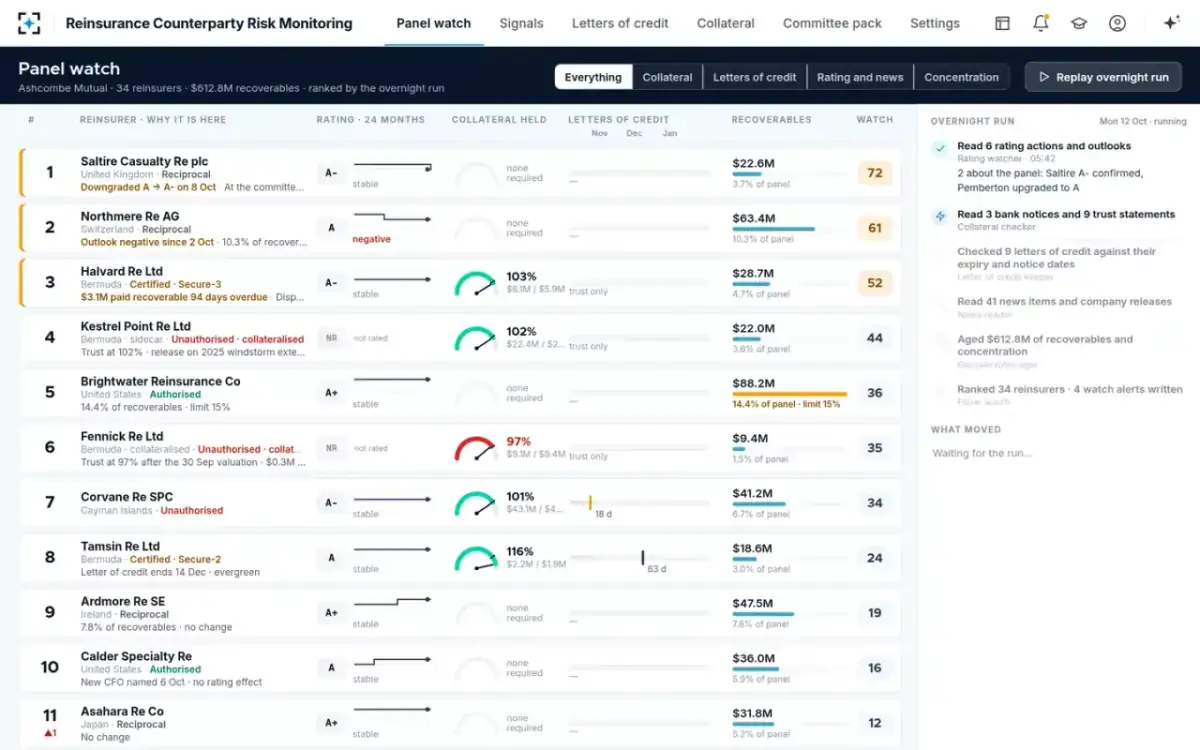
Take the solution's fictional sample carrier, a mutual with 34 reinsurers and $612.8 million of recoverables. In one overnight run on 12 October the agents read six rating actions and outlooks, three bank notices, nine trust statements, nine letters of credit and 41 news items, and aged every recoverable. One reinsurer climbed from seventh to first on the watchlist: its bank would not extend an $18.5 million letter of credit due to end on 30 October, and its parent had announced a $186 million reserve charge and a strategic review. Neither fact was new to the carrier. Both had been sitting in different inboxes.
The overnight run, mid-way: each agent reports and the panel re-ranks
The line between watching and acting
The line falls where an action has an owner outside the software: a counterparty, a bank, an auditor or a regulator. Reading a rating action affects nobody. Sending a replacement request to a reinsurer's CFO is a commercial act between two companies. Presenting a draw certificate to a bank turns collateral into cash and usually ends the relationship. Booking the provision for reinsurance moves surplus. Each of those needs a name next to it, and the frame above puts the name in the right column.
Some acts sit in between, and the software's job is to make them quick without making them automatic. A replacement request is drafted in full, with the amount, the expiry date, the treaty article and the deadline, so the credit controller's work is to read and send it. A draw certificate is drafted at the same moment, so the treasurer can co-sign it days ahead and hold it. The model regulation lets a treaty allow the cedant to draw "at any time" for listed purposes (Model Regulation #786, Section 13H). The right to draw belongs to the carrier, so the decision does too.
There is a second reason to keep people at the line. In Porch.com v. Gallagher Re, the insurer alleged that it had relied on its broker's assurances that a collateral letter was a letter of credit, and the Fifth Circuit noted the allegation that the broker had assured the insurer it could "safely" allow a $25 million withdrawal from the reinsurance account (5th Cir., No. 25-10489, April 2026). Those are allegations taken as true on a motion to dismiss, not findings. They show what is at stake when the person who should decide relies on someone else's reading of the collateral.
Can AI monitor reinsurer ratings? Yes, with three limits
AI agents can read rating actions, outlooks and company releases reliably enough to rank a panel overnight, provided three limits hold. Every rating the system shows must cite the agency action it came from. News must never be treated as a rating, however alarming. And no alert may come from an unsourced item; an unnamed-source story needs corroboration before it moves a reinsurer up the watch.
Within those limits, reading the news is where software adds the most, because agencies act after events. In the sample, the reinsurer's parent announced reserve strengthening of $186 million against $1.33 billion of equity, 14%, above the 10% threshold in the carrier's own signal library, together with a strategic review "including a possible sale or orderly run-off". The library recorded that 9 of 12 comparable cases saw an agency action within 45 days. The rating that night was still A- stable. The solution marked it as a rating at risk, said why, and left the rating alone.
The signal library is the carrier's, not the vendor's. In the solution it changes only as a draft the CRO approves, like every threshold. A buyer should ask any vendor the same question: who decides what counts as a warning sign, and can you see the evidence behind each match?
Who decides to draw a letter of credit?
The carrier decides, through two people: the credit controller who approves the action plan and the treasurer who co-signs the draw. The plan in the sample is dated to the day. A replacement was requested on 12 October, the security committee met on 21 October, the replacement deadline was 23 October, and the draw of the full $18.5 million into the reinsurer's trust was set for 27 October, three business days before the letter ended. The three-day trigger is the carrier's treaty clause; the model regulation's own reference point for an expiring letter is obligations still undischarged ten days before termination.
Approved and co-signed: the draw is ready and held
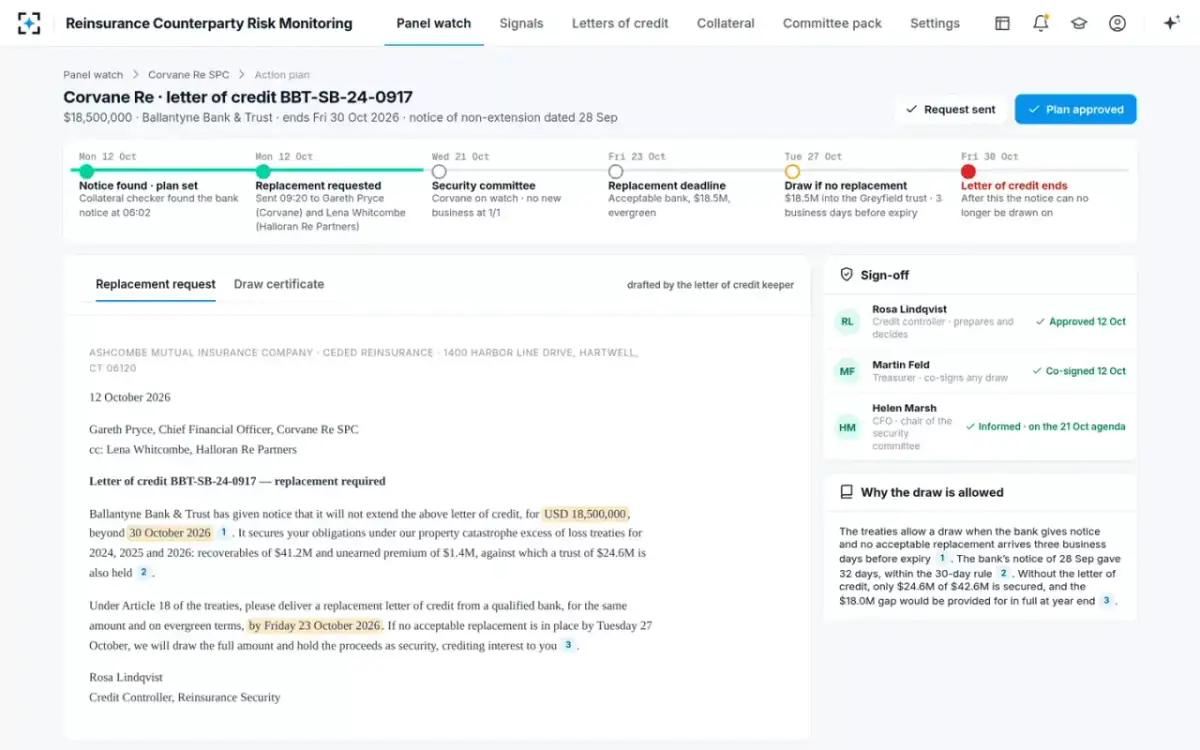
What the software contributes is time and evidence. The notice arrived on 1 October and was found on 12 October, leaving 18 days. Each day it had sat unread came out of the 30 days' notice the model requires the bank to give (#786, Section 13D). And the plan explains itself: the panel beside the signatures states why the draw is allowed, citing the treaty clause, the bank's notice and the collateral arithmetic, so the treasurer signs a reasoned document rather than an email.
What does a security committee pack contain?
A security committee pack should open with what changed since the last meeting and the decisions asked, each with a recommendation, and only then show the watchlist, collateral and letters of credit, the signals behind any rating at risk, and the approved list. Most packs are built the other way round, as a full panel table with commentary, which buries the three things the committee has to decide under thirty it does not.
In the sample, three decisions led the pack: one reinsurer to watch with no new business at 1/1, a recently downgraded reinsurer kept with its line capped at 7.5%, and a third reinsurer's share cut by two points to keep it under the carrier's 12.5% concentration alert. Every figure linked to its source. The pack writer agent drafted it in the early morning; it does not record votes and cannot change the list. The seat-by-seat guide to reinsurance credit risk sets out who sits on that committee and what each signature means.
How often should reinsurers be reviewed?
Reinsurers should be watched daily and reviewed by the committee quarterly, with a full review before renewal. The two rhythms answer different questions. The daily watch asks whether anything changed; the quarterly review asks what to do about it. Regulators work on a similar split: a certified reinsurer must tell the commissioner of a rating change within ten days, while reciprocal jurisdiction reinsurers may be asked for an updated list of disputed and overdue claims no more than semi-annually (#786, Sections 8B(7) and 9C(5)).
The cost of doing the daily part by hand is what keeps most carriers on the quarterly rhythm. Botminds estimates that one quarterly review of a 34-reinsurer panel takes about 16 working days by hand, spread across copying ratings, reconciling letters of credit and trust statements with treasury, ageing recoverables and checking concentration, reading the press and writing the pack, and about 2.7 days with the solution doing the reading and drafting. That is our estimate for a panel of that size, not a measurement at a customer.
What supervisors expect of AI agents in 2026
Supervisors expect agents to recommend and people to decide when the decision has consequences, and the industry has largely built them that way. In the Bank of England and FCA survey published on 26 October 2026, 80% of responding firms reported agents deployed for decision support, where the agent recommends and people decide and execute, and 2% reported agents with broad autonomy.
How much autonomy UK financial firms give the AI agents they run
The same survey asked what firms expect agents to do over the next year, and the answer maps onto the frame at the top of this page: even counting plans, no more than 9% expected agents to move or block payments or change limits, thresholds and controls (Bank of England and FCA, 2026; the settlement process guide quotes the finding in full). Drawing on a letter of credit is a payment; changing a concentration limit is a change to a threshold. The survey also names the gap a buyer of any monitoring tool inherits:
"Oversight of third-party AI systems was the most commonly reported area of governance uncertainty or implementation challenge."
Bank of England and FCA, Artificial intelligence in UK financial services 2026
A counterparty tool is a third-party system watching third parties, so the questions further down ask how its readings can be checked without trusting it. The European supervisor's opinion on AI governance points the same way, setting expectations for governance and risk management on a risk-based, proportionate basis, with human oversight among them (EIOPA, Opinion on AI Governance and Risk Management, 6 August 2025). A reinsurance counterparty tool that kept its agents on the watching side of the line would sit comfortably inside both.
Twelve questions to put to any counterparty risk software vendor
The questions that separate tools are about sources, status and limits, not dashboards. The list below works for any product, including ours.
Before you buy counterparty risk management software for a reinsurance panel
- Which rating agencies does it read, and under whose licence?
You need the agencies your security policy names; their data is licensed separately from any software.
- Does every rating on screen cite the action it came from?
A rating without a dated action cannot go in a committee pack or an audit file.
- Can it tell an authorized, certified, reciprocal and unauthorized reinsurer apart?
Status decides how much collateral the law requires; a tool that only knows ratings will get collateral wrong.
- Does it apply the certified collateral table by the state-assigned rating?
Model Regulation #786 sets 0% to 100% by Secure-1 to Vulnerable-6; the commissioner assigns the level, not an agency.
- Can it read a bank's notice of non-extension where it actually arrives?
Usually a treasury mailbox. A tool fed only by manual entry inherits the delay it was bought to remove.
- Does it know each letter of credit's evergreen terms and notice window?
The notice period, at least 30 days for a qualifying letter, is the real deadline, not the expiry date.
- Does it value trusts at each statement, and flag a shortfall?
A trust valued once a year can fall short for eleven months unseen.
- Does it measure concentration by reinsurer group?
The model law's notice triggers count affiliated groups, not legal entities.
- What can its agents never do, and is that written into them or only a setting?
Drawing, moving trust assets, changing the approved list and booking provisions should be impossible, not merely discouraged.
- Who approves changes to thresholds and the signal library?
One named role, with every change kept on the record.
- Can it project the provision for reinsurance at the next statement date?
Projection, with the working shown, is what lets you act before 31 December.
- Can you run it on your own panel before you buy?
A demo on the vendor's data proves the screens; your panel proves the reading.
Where Reinsurance Counterparty Risk Monitoring fits, and where it does not
Reinsurance Counterparty Risk Monitoring fits carriers that cede to a panel of reinsurers with mixed U.S. status and hold letters of credit and trusts as collateral, where the security work is split across ceded reinsurance, treasury and accounting. It does the watching and drafting described above and projects the provision for reinsurance at the next statement date.
It does not replace several things a buyer should keep. It reads the rating agencies and news sources the carrier already licenses; it does not supply them. It checks a letter of credit's terms and notices, but legal review of a new instrument's wording stays with counsel and treasury. It projects the provision; the controller books it, and the ceded accounting work stays where it is. And for a carrier whose reinsurance is almost entirely with authorized reinsurers inside its own group, the collateral side has little to do.
The way to judge it is on your own panel. The demo on the Reinsurance Counterparty Risk Monitoring page runs on fictional data; the useful test is a sample of your reinsurers, letters of credit and recoverables, and the go-live plan for counterparty risk monitoring shows how to run that test before the year-end statement.
Questions people ask
Is counterparty risk management software the same as a credit rating feed?
No. A rating feed tells you what agencies have said; counterparty software combines ratings with collateral, letter of credit terms, trust values, overdue balances and concentration to show what the carrier is exposed to. A reinsurer with a stable A- rating can still be the panel's biggest problem if its only letter of credit is about to lapse.
Can the software send a replacement request to a reinsurer automatically?
It should not, and in Reinsurance Counterparty Risk Monitoring it cannot: the letter of credit keeper drafts the request and the credit controller sends it. A request to a reinsurer's CFO is a commercial step with consequences for the relationship, so a person reads it first.
What is a reinsurer watchlist?
A ranked list of the reinsurers that need attention now, with the reasons each is there: a downgrade, a negative outlook, a rating at risk from news, a lapsing letter of credit, a trust shortfall, an overdue balance or concentration near the limit. Unlike the approved list, which the committee owns, a watchlist changes every night and approves nothing.
Does the software decide which reinsurers are approved?
No. The approved list belongs to the security committee. The software drafts recommendations into the committee pack, such as putting a reinsurer on watch or capping its line, and the committee votes; no agent changes the list or records a vote.
How does it handle a reinsurer with no rating?
An unrated reinsurer, such as a collateralized vehicle, is watched through its collateral instead: the trust balance at each statement against what it must hold, and any release of collateral it announces. In the sample, two unrated reinsurers were tracked this way, one with a trust at 102% of the requirement and one at 97% with a top-up requested.