Counterparty risk monitoring for reinsurers is the daily watch over every reinsurer a carrier cedes to: its rating and outlook, its U.S. status, the collateral it has posted and when each instrument expires, what it owes and how late, and how concentrated the panel is. Setting it up means loading four things the carrier already has in different places, the panel list, the collateral register, the recoverables ageing and the security policy, and running the watch beside the existing process long enough to trust it. The deadline that matters is the statement date. Collateral counts toward credit for reinsurance only if it is in place when the statement is struck, and a change missed in November is a charge to surplus in December. Botminds' Reinsurance Counterparty Risk Monitoring is built to be loaded from those existing records and run in parallel for a quarter, so that it carries the year-end watch rather than learning during it.
What to load before counterparty risk monitoring can go live
- The panel: every reinsurer, its group and its share by treaty
Concentration is counted by group, so the group map matters as much as the names.
- U.S. status for each reinsurer in your domiciliary state
Authorized, accredited, certified with its assigned level, reciprocal jurisdiction or unauthorized; it decides the collateral required.
- The collateral register
Every letter of credit with bank, amount, expiry, evergreen terms and notice period; every trust with trustee and last statement; funds withheld balances.
- Recoverables by reinsurer and treaty
Paid, case, IBNR and unearned premium, with paid balances aged and disputes marked.
- The treaty security clauses
Funding clauses, draw triggers and any security above the legal minimum the committee agreed.
- Your security policy as settings
Rating floor, watch triggers, warning windows, concentration limit and named approvers, each approved by the CRO.
- Read access to where notices arrive
Usually a treasury mailbox for bank notices and trust statements; without it the watch inherits the old delay.
- The rating and news sources you already license
The solution reads them; it does not supply them.
What counterparty risk monitoring means for a ceded reinsurance panel
For a ceded panel, counterparty risk monitoring means knowing, on any morning, which reinsurers could cost the carrier credit for reinsurance or cash, and why. Banks use the same phrase for trading exposures marked to market; a ceding insurer's exposures are slower but scattered across ratings agencies, banks, trustees, brokers and its own claims and accounting systems. The watch joins those sources and ranks the panel. The decisions it informs stay with the credit controller, the treasurer, the security committee and the CRO, as the guide to who decides on reinsurance credit risk sets out.
The model regulation states the standard the watch is held to. Its drafters conditioned credit on matters existing "as of any date on which" credit is claimed, "to ensure that requisite conditions for credit exist at the time the credit is claimed or reported and that the conditions remained satisfied at all times thereafter until information reported in one statement was replaced by information reported in a subsequently filed statement" (Model Regulation #786, Section 4 drafting note). Monitoring is how a carrier shows the second half of that sentence.
Why 31 December sets the deadline
The year-end statement is the date most collateral rules point at. A letter of credit supports credit for the annual statement only if it is in effect by 31 December of the year being reported and in the cedant's possession, or in trust for it, by the filing date (Model Law #785, Section 3C). A trust reduces the liability up to the fair market value of its assets at that time. Whatever is not secured on that date is provided for in full, as the authorized versus unauthorized reinsurer guide prices on one sample book.
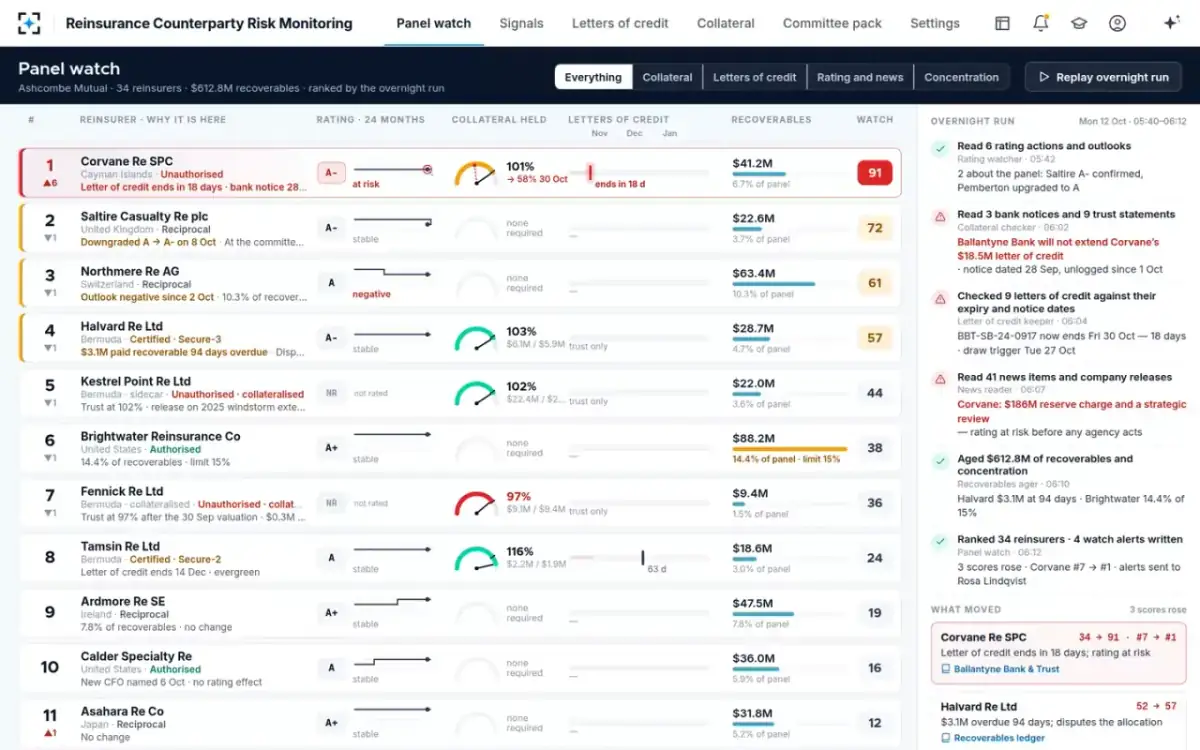
The fourth quarter is also when instruments cluster. In the solution's fictional sample carrier, a mutual with 34 reinsurers and $612.8 million of recoverables, seven of nine letters of credit, worth $46.0 million, ended within 120 days of 12 October, two of them on 31 December itself. A watch that goes live in January has missed the period it was bought for. One that goes live in October with no parallel run is learning on the most expensive days of the year.
Twelve weeks to Reinsurance Counterparty Risk Monitoring live: load, run in parallel through the September quarter-end, switch before the year-end
- Load2 wk
- Settings1 wk
- Parallel run through 30 September and the Q3 committee7 wk
- Switch2 wk
- Load, posters first2 wk
- Parallel run to mid-December5 wk
- Switch2 wk
What data does reinsurer counterparty monitoring need?
It needs the panel, the status of each reinsurer, the collateral register, the recoverables ageing and the security policy, and nothing that the carrier does not already keep. The work is not in finding new data. It is in joining the copies that sit in ceded reinsurance, treasury and accounting, and in deciding which copy wins when they disagree.
Where each input lives, and how often the watch refreshes it
| Input | Usually held by | Refreshed by the watch | Why it matters |
|---|---|---|---|
| Panel list, groups and shares | Ceded reinsurance; broker placement records | When a treaty is placed or amended | Concentration notices count affiliated groups (Model Law #785, Section 2K) |
| U.S. status and certified level | Credit control; state and NAIC lists | Every night against the published lists | Status sets the collateral required; levels change on written notice |
| Rating actions and outlooks | Agency services the carrier licenses | Every night, each action cited | The lowest agency rating caps a certified reinsurer's level |
| Letters of credit | Treasury | Every night; bank notices read from the mailbox | A qualifying letter must give at least 30 days' notice before it ends |
| Trust statements | Treasury; the trustee | At each statement | A trust counts at the fair market value of withdrawable assets |
| Recoverables and ageing | Ceded accounting; claims | Every night | Overdue and disputed balances drive both the provision and regulators' payment tests |
| Security policy settings | CRO and security committee | Only as a draft the CRO approves | The thresholds are the carrier's appetite, not the vendor's |
Status deserves a step of its own in the load. Each state publishes its certified and reciprocal jurisdiction reinsurers, and the NAIC keeps a page linking those lists (NAIC, Certified and Reciprocal Jurisdiction Reinsurers). A panel spreadsheet that records "certified" without the assigned level, or "reciprocal" without the date the domiciliary state recognised the reinsurer, will compute the wrong requirement on the first night.
Running in parallel with the spreadsheet
The parallel run should cover at least one quarter-end and one security committee, because those are the moments the old process does its best work. Run both, compare the committee pack each produces, and list every difference with its cause. Some differences will be the watch's errors, usually a letter of credit matched to the wrong reinsurer or a group mapping missing. Others will be the spreadsheet's: a bank notice nobody logged, a trust valued at last year's figure, a downgrade copied a week late. A carrier starting too late for a live quarter-end can run the watch back over the last one, using the September figures and pack, and compare those instead.
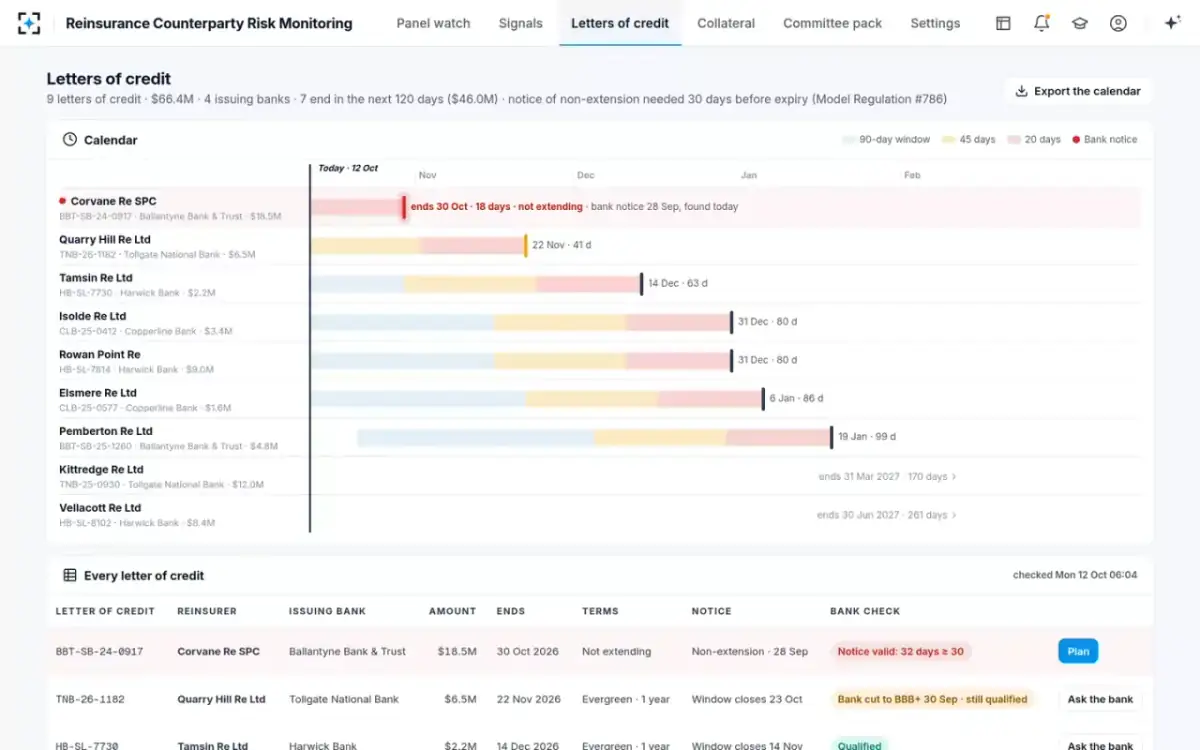
The comparison is the business case. A carrier that finds, during the parallel quarter, a notice of non-extension that its manual process missed has measured the value of the switch on its own book. The sample carrier's version of that moment was a bank notice dated 28 September, received on 1 October, unlogged, and found by the overnight run on 12 October with 18 days left before the $18.5 million letter of credit ended.
Every letter of credit on one calendar, with its notice window
Can counterparty monitoring track letters of credit? The first week shows
Yes, and the first week of loading is the test of it. Each letter of credit needs its issuing or confirming bank, amount, beneficiary, expiry date, evergreen terms and notice period, and the model regulation requires a qualifying letter to run for at least a year with an evergreen clause giving "no less than thirty (30) days notice prior to expiration date or nonrenewal" (#786, Section 13D). A letter whose notice period cannot be found in the register has to be read from the instrument itself.
Once loaded, tracking means two clocks per letter: the expiry date and the last day the bank can give notice. The second is the one that matters operationally. In the sample, a $6.5 million evergreen letter ending on 22 November had a notice window closing on 23 October, from a bank downgraded to BBB+ on 30 September but still qualified; the calendar showed it as the next one to chase. The comparison with bank collateral trackers explains why a bank's downgrade matters most at the next extension.
Does it calculate the Schedule F provision?
It projects the provision for reinsurance at the next statement date and shows the working; the controller books the provision. The projection covers unsecured balances at unauthorized reinsurers, collateral shortfalls at certified reinsurers against the requirement for their level, and overdue and disputed paid balances, using the carrier's own ageing.
The sample carrier's projected year-end provision, before and after one action
$18.9million
projected provision for reinsurance at 31 December if nothing is done
$18.0million
of it from one unauthorized reinsurer whose letter of credit was ending
$0.9million
projected once that reinsurer is secured by replacement or draw
1day
target from a downgrade, notice or shortfall to the watchlist
A projection is only as good as its inputs, which is the argument for the parallel quarter. If the projected provision at 30 September matches what the controller booked, the inputs are right. If it does not, the differences point to the register entries to fix before 31 December.
Who approves changes to the monitoring thresholds?
One named role, usually the chief risk officer, with every change kept as a draft until approved and recorded once it is. Thresholds are policy: the minimum rating for new business, the triggers that put a reinsurer on watch, the letter of credit warning windows, the concentration limit and alert, the overdue days that start a watch. They belong in the security policy the committee owns, and the watch should apply them, not set them.
The sample carrier's settings show what a go-live should approve before the parallel run starts: an A- floor from two agencies for new business; watch on a negative outlook, a review or a rating at risk; warning windows at 90, 45 and 20 days before a letter of credit ends; a draw trigger three business days before expiry with no replacement, taken from the treaty security clause; a concentration limit of 15% of recoverables per group with an alert at 12.5%. Those numbers are the carrier's own. The model law's concentration notices sit much higher, at 50% of surplus and 20% of premium (#785, Section 2K).
The panel watch in Reinsurance Counterparty Risk Monitoring on the first morning after the switch
What success looks like by the first statement
Success by the first year-end statement is measurable without any vendor's figures. Every letter of credit and trust in the register is matched to a reinsurer and a requirement. Every bank notice received during the parallel quarter appears on the watch within a day of arriving. The projected provision at the quarter-end matches the booked one, or every difference is explained. And the security committee's pack for its fourth-quarter meeting is drafted from the watch, with each figure traceable to its source.
What the go-live does not need is a big-bang replacement of anything else. Ratings come from the services already licensed, recoverables from the systems already billing them, and the recoverables management process keeps chasing what is overdue. Start the plan from the Reinsurance Counterparty Risk Monitoring page, on a sample of your own panel.
Questions people ask
How long does it take to set up counterparty risk monitoring for a reinsurance panel?
Our plan allows two weeks to load the panel, statuses, collateral register and ageing, a week to approve the settings, and a parallel run through at least one quarter-end, about twelve weeks in all. A carrier starting in late October can compress it to about nine by loading the reinsurers that post collateral first.
Should monitoring start with the whole panel or the reinsurers that post collateral?
With the collateral posters when time is short. Unauthorized and certified reinsurers are where a missed notice or a valuation shortfall becomes a year-end charge; authorized and reciprocal reinsurers can follow a week later, since their risks show first in ratings, payment record and concentration.
What happens to the old spreadsheet after go-live?
Keep it read-only for at least one statement cycle. Auditors and examiners may ask how a prior figure was reached, and the parallel quarter's comparison is the evidence that the new process reproduces or improves on it.
Can monitoring go live in the middle of a renewal season?
It can, and the 1/1 renewal is a reason to. A rating at risk, a strategic review or a lapsing letter of credit seen before shares are agreed is a placement decision; seen after, it is a collateral problem for a year.
Does counterparty risk monitoring replace the security committee review?
No. The committee still approves the panel, caps and exceptions, quarterly and before renewal. Monitoring changes what it reviews: a pack built from a daily watch, opening with what changed and the decisions asked, rather than a spreadsheet rebuilt by hand for the meeting.