Reinsurance credit risk is the risk that a reinsurer on a carrier's panel cannot or will not pay the recoverables it owes: paid losses billed and unpaid, reserves it will owe later, and unearned premium it would return. It is managed by a chain of people rather than one owner. A credit controller watches ratings, collateral and ageing; a treasurer holds letters of credit and trusts and co-signs any draw; a security committee approves which reinsurers may be used; and the chief risk officer answers to the regulator when the exposure to one group grows too large. The work is hard because the signals arrive in different places, a rating action on an agency site, a bank notice in a treasury mailbox, an overdue balance in the ceded accounts, while each signature depends on all of them. Botminds' Reinsurance Counterparty Risk Monitoring reads those sources every night and ranks the whole panel on one watchlist, so each person in the chain decides from the same picture.
Five seats carry reinsurance credit risk, and each signs for something different
Today
Copies ratings from agency sites before each committee and learns of a lapsing letter of credit when treasury forwards the bank letter.
With agents
Starts the day on a ranked watchlist with the bank notice found, the collateral gap measured and a replacement request drafted.
Still theirs: Decides the action on a reinsurer and sends every request.
Today
Holds letters of credit and trust statements in treasury files, outside the view of the people tracking ratings.
With agents
Co-signs a drafted draw certificate days ahead, held until the date the treaty allows a draw.
Still theirs: The second signature on any draw; custody of collateral.
Today
Receives a pack rebuilt by hand each quarter, describing the panel as it stood weeks earlier.
With agents
Gets a pack that opens with what changed since the last meeting and the decisions asked, each with a recommendation.
Still theirs: The approved list and every exception to it.
Today
Sees concentration by reinsurer group at quarter-end, when a notice deadline may already be running.
With agents
Sees concentration every morning against the limit, and approves every change to thresholds.
Still theirs: Risk appetite, thresholds and the regulator relationship.
Today
Learns which reinsurer is weakening after the 1/1 shares are agreed.
With agents
Sees a reserve charge or a strategic review flagged as a rating at risk before the placement closes.
Still theirs: Who gets a line at renewal, inside the approved list.
What is reinsurance credit risk? Three exposures in one balance
Reinsurance credit risk is one number made of three exposures that behave differently. Paid recoverables are cash the carrier has already paid out and billed; they are a receivable today. Reserves ceded on reported and unreported claims are money the reinsurer will owe as those claims settle, sometimes over decades in casualty lines. Unearned premium is what the reinsurer would hand back if the cover ended. The NAIC's model regulation lists exactly these when it defines the liabilities a reinsurer's trust must cover: losses and allocated loss expenses paid by the cedant, reserves for reported and for incurred-but-not-reported losses, reserves for allocated loss expenses, and unearned premiums (Model Regulation #786, Section 7).
The size of the exposure is easy to underrate because most premium a U.S. carrier cedes never leaves its own group. The NAIC's 2025 results put ceded premiums written by property and casualty insurers at $1.0 trillion, while the 21 professional reinsurers in its analysis assumed $51.5 billion from companies outside their own groups, about half of all such premium assumed in the U.S. (NAIC, 2025 full-year results). Much of the rest of the true third-party market sits offshore, beyond the reach of a U.S. license. The third-party slice is small in the industry's totals and large on any one carrier's balance sheet, because it is concentrated on a panel of a few dozen names.
The law treats the exposure as continuous rather than periodic. The drafting note to the model regulation says insurers must satisfy the conditions for credit when it is first taken and "shall maintain compliance at all times thereafter in which the credit is taken. The drafters believe the requirements to be perpetual, not periodic." (#786, Section 4 drafting note). A quarterly review is a reporting rhythm. The obligation it reports on runs every day.
Who manages reinsurer credit risk, seat by seat
Reinsurer credit risk is managed by whoever the carrier's security policy names, and in practice the work splits along the three places the signals land. Ratings and news belong to whoever watches the market, usually a credit controller inside ceded reinsurance or risk. Collateral belongs to treasury, which holds the letters of credit and receives trust statements. Ageing belongs to ceded accounting, which bills recoverables and sees what is overdue. The credit controller's job is to join the three, and the quarterly spreadsheet is where that join has traditionally happened.
The trouble with a join done by hand is timing. A downgrade on the 8th, a bank notice received on the 1st and a balance passing 90 days on the 15th are three facts that together say one reinsurer needs attention. In a spreadsheet refreshed before each committee they meet weeks later, if the person refreshing it happens to see all three. The solution's sample carrier is a useful example: a fictional mutual with 34 reinsurers and $612.8 million of recoverables, where a bank's notice that it would not extend an $18.5 million letter of credit sat unlogged in the treasury mailbox for eleven days.
From the overnight read to a signed decision: who does what in Reinsurance Counterparty Risk Monitoring
Agent
Rating watcherReads rating actions, outlooks and reviews every night and keeps a 24-month history per reinsurer.
Never: changes the approved list.
Agent
Collateral checkerMatches letters of credit, trusts and funds withheld to the collateral each reinsurer must post; reads bank notices.
Never: draws on a letter of credit or moves trust assets.
Agent
Recoverables agerAges paid recoverables, flags slow payers and computes concentration by reinsurer group.
Never: writes to the accounts.
A person decides
Credit controllerReviews the ranked watchlist, decides the action on each reinsurer and sends requests.
A person decides
TreasurerCo-signs any draw certificate, held until the date the treaty allows.
Agent
Committee pack writerDrafts the security committee pack with every figure linked to its source.
Never: records a vote.
A person decides
Security committeeVotes on the approved list, caps and exceptions; the CRO approves thresholds.
What is a reinsurance security committee, and what does it decide?
A reinsurance security committee is the internal body that decides which reinsurers a carrier may use and on what terms. It is usually chaired by the CFO or CRO, with treasury, ceded reinsurance and risk around the table. No model law requires one by that name. The committee exists because the law makes the carrier answer for its reinsurers' credit, and someone has to own the panel.
What it decides is narrow and consequential: adding or removing a reinsurer from the approved list, capping a reinsurer's share, setting collateral terms tighter than the legal minimum, and granting exceptions. The model regulation explicitly leaves room for the last of these. For certified reinsurers it states that nothing "shall prohibit the parties to a reinsurance agreement from agreeing to provisions establishing security requirements that exceed the minimum security requirements" (#786, Section 8A(6)). The committee is where a carrier decides to ask for more than the law requires.
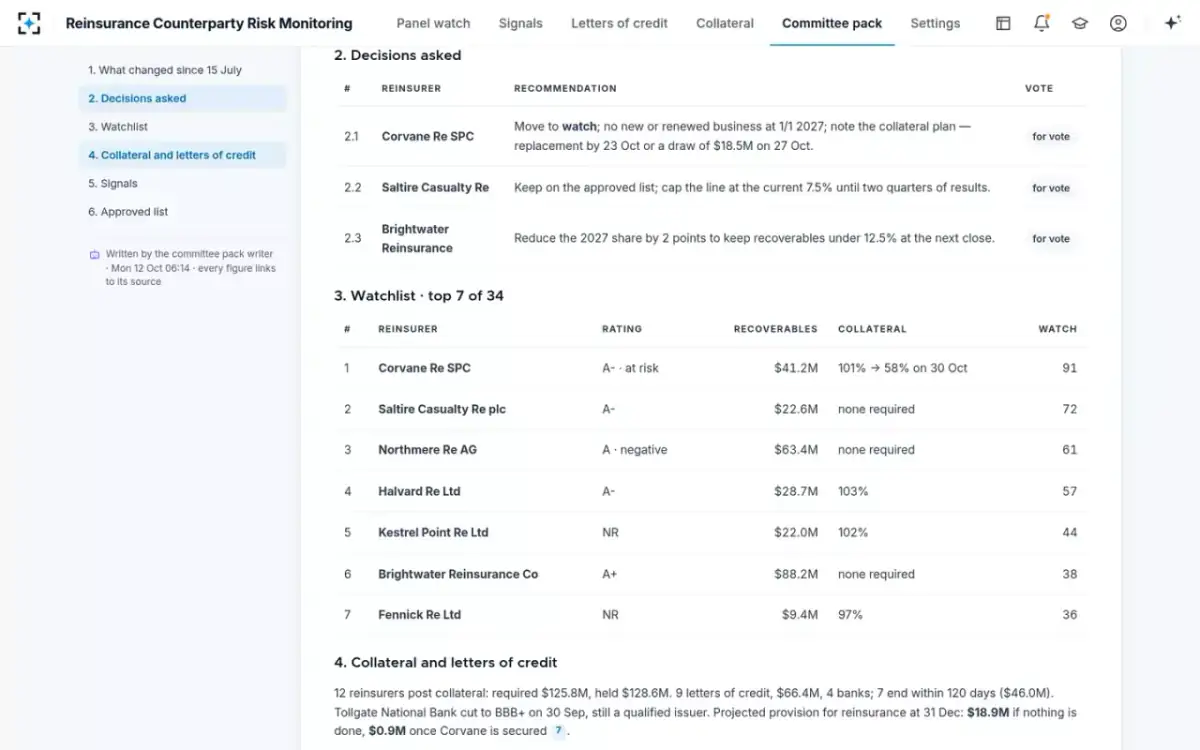
The committee needs a pack that leads with change. In the sample, the pack for a meeting on 21 October opened with three decisions: put one reinsurer on watch with no new business at 1/1, keep a recently downgraded reinsurer but cap its line at its current 7.5%, and cut another's 2027 share by two points to keep it under the concentration alert. Each decision carried a recommendation; none carried a vote until the committee cast one.
The committee pack in Reinsurance Counterparty Risk Monitoring, written from the overnight watch
What is an approved reinsurer list, and what must it say?
An approved reinsurer list is the security committee's register of reinsurers the carrier may cede to, with the terms attached to each. It is a company control, not a regulatory filing, and that is why its content varies so much. A list that holds only names says little. One that holds the conditions of approval is the instrument the rest of the chain works from.
A useful entry carries the reinsurer's legal entity and group, its U.S. status (authorized, accredited, certified, reciprocal jurisdiction or unauthorized), the minimum rating the policy requires and the rating the reinsurer holds, the collateral the status requires and any extra the committee asked for, a maximum line or share, and the date of the last review. Status matters as much as rating, because it decides how much collateral the law requires. The difference between an authorized and an unauthorized reinsurer can be worth a year-end charge to surplus on its own.
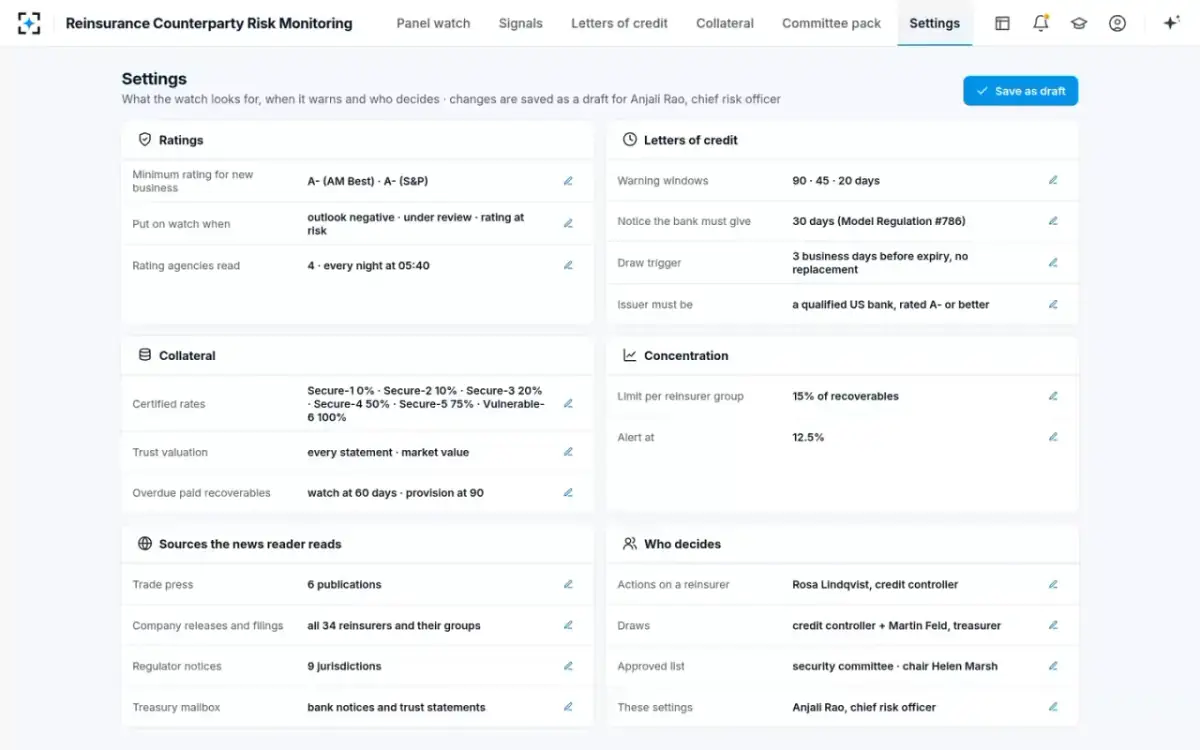
The sample carrier's policy sets a floor of A- from AM Best and A- from S&P for new business, puts a reinsurer on watch on a negative outlook, a review or a rating at risk, and keeps every one of those settings as a draft until the CRO approves it. The rating floor applies to new business. A reinsurer already on the panel that falls below it is a committee question, not an automatic exit.
When must a cedant notify the regulator about reinsurance concentration?
A domestic ceding insurer must notify its commissioner within 30 days after recoverables from one reinsurer or affiliated group exceed 50% of its last reported surplus, or after it cedes more than 20% of the prior year's gross written premium to one reinsurer or group (Model Law #785, Section 2K). Both triggers also fire when the carrier determines the limit is likely to be exceeded, so the clock can start before the number is crossed.
The two concentration notices in the credit for reinsurance model law
| Notice | Trigger | Deadline | What the notice must show |
|---|---|---|---|
| Recoverables concentration | Recoverables from one reinsurer or affiliated group exceed 50% of the cedant's last reported surplus, or are likely to | 30 days after the trigger | That the exposure is safely managed by the ceding insurer |
| Cession concentration | More than 20% of prior-year gross written premium ceded to one reinsurer or affiliated group, or likely to be | 30 days after the trigger | That the exposure is safely managed by the ceding insurer |
The section opens with a duty, not a number: a ceding insurer "shall take steps to manage its reinsurance recoverables proportionate to its own book of business" (#785, Section 2K(1)). The 50% and 20% lines are notice points. A carrier that waits for them to manage concentration has read the section backwards, which is why most security policies set an internal limit far lower. The sample carrier's is 15% of recoverables per reinsurer group with an alert at 12.5%, and its largest group stood at 14.4% on the morning the pack was written.
The legal lines a reinsurance credit chain works against
30‑day
deadline to notify the commissioner of a concentration trigger
50%
of surplus in recoverables from one reinsurer group
20%
of prior-year gross written premium ceded to one group
100%
collateral for an unauthorized reinsurer, unless certified or reciprocal
Who can draw on a letter of credit, and who must not
The ceding insurer, as beneficiary, draws on a qualifying letter of credit, and inside the carrier the decision usually takes two signatures: the credit controller who decides the action and the treasurer who signs the draft. The model regulation lets a reinsurance agreement stipulate that the letter of credit "may be drawn upon at any time, notwithstanding any other provisions in the agreement", but only for listed purposes, such as paying the reinsurer's share of losses or moving the money into a separate account in the cedant's name when the letter is about to expire unrenewed (#786, Section 13H).
A draw is the last resort and the one step that cannot be late. The model ties the expiry case to obligations that "remain unliquidated and undischarged ten (10) days prior to the termination date". Treaties often set their own trigger inside that window; the sample carrier's security clause allows a draw three business days before expiry if no replacement has arrived, and the solution drafts the certificate early so the treasurer co-signs it days ahead and holds it. What no agent does is present it. The limit is written into the solution, not left to a setting.
Who must not draw matters as much. A broker that administers collateral, a trustee and an investment manager each have roles in the chain, and none of them is the beneficiary. The letter of credit pre-mortem shows what happens when a carrier relies on someone else's word that the instrument it holds is the instrument the treaty promised.
Why the watch must be daily when the committee is quarterly
The committee's rhythm is quarterly because the decisions it takes are slow by nature: who stays on the panel, who gets a line. The events it decides about are not. A rating moves on a Thursday; a bank's notice of non-extension gives 30 days, and every day it sits unlogged comes out of those 30. Collateral is measured at the statement date: a letter of credit counts for a year-end statement only if it is effective by 31 December and in the cedant's hands by the filing date (#785, Section 3C).
The sample shows the arithmetic. The bank's notice was dated 28 September for a letter ending 30 October, and arrived on 1 October. It was found on 12 October, 18 days before expiry, which left time to ask for a replacement, hold a committee on 21 October and keep a draw ready for 27 October. Found at the quarter's close, the same notice would have arrived at a lapsed letter and a trust covering 58% of the collateral required.
Supervisors ask the same question from the other side. The model regulation requires a certified reinsurer to notify the commissioner "within ten (10) days" of a rating change by an approved agency (#786, Section 8B(7)(a)). The regulator expects to know within ten days. A cedant that learns a quarter later is behind its own supervisor.
How is reinsurance credit risk measured, and where does the chain break?
Reinsurance credit risk is measured reinsurer by reinsurer as exposure minus security, adjusted for the reinsurer's strength and its payment record, and then summed by group for concentration. Exposure is the recoverables total described above. Security is collateral held: letters of credit, trusts and funds withheld. Strength is the rating and status. Payment record is the ageing of paid recoverables and the share in dispute. The statutory version of the same measurement is the provision for reinsurance, which, as the Casualty Actuarial Society's study text describes it, is a liability set up for recoverables that may not be collected, with its change charged directly to surplus (Odomirok et al., CAS, 2014 edition).
The chain breaks in three predictable places. The first is the handoff between treasury and the credit controller, where bank notices and trust valuations wait in a mailbox. The second is the handoff between ceded accounting and risk, where an overdue balance is visible to the people billing it and invisible to the people rating the reinsurer. The recoverables desk sees ageing every day; the security committee sees it once a quarter. The third is the pack itself, assembled by hand from the other two and out of date the day it is printed.
Each break has the same remedy: one view, refreshed nightly, with each figure tied to its source. That is the narrow job of the agents in Reinsurance Counterparty Risk Monitoring. The signatures stay where they are. The credit controller still decides, the treasurer still co-signs, the committee still votes and the CRO still approves the thresholds.
Your security policy, written as settings the CRO approves
Questions people ask
What is the difference between reinsurance credit risk and counterparty risk?
In reinsurance they describe the same exposure from two angles. Credit risk is the chance the reinsurer fails to pay; counterparty risk adds the risks of the instruments around it, such as a letter of credit whose bank weakens or a trust whose assets fall in value. A monitoring program has to watch both, because collateral can fail while the reinsurer itself is sound.
Does a rating downgrade change how much collateral a reinsurer must post?
Only for certified reinsurers, whose collateral is set by a rating the state assigns: from 0% at Secure-1 to 100% at Vulnerable-6 under Model Regulation #786. Authorized reinsurers post none by law, and reciprocal jurisdiction reinsurers post none unless a contractual trigger fires. The certified reinsurer rating guide follows a downgrade through the file.
Who should chair a reinsurance security committee?
Most carriers give the chair to the CFO or the CRO, because the committee's decisions land on the balance sheet and in the risk appetite. What matters more than the title is separation: the person who places reinsurance should not be the only voice approving the reinsurers it is placed with.
How often should a reinsurer's credit be reviewed?
The panel as a whole is commonly reviewed quarterly by the security committee and in depth once a year before renewal. The signals that change a reinsurer's credit, ratings, bank notices, trust valuations and overdue balances, arrive daily, which is why the model regulation calls the conditions for credit "perpetual, not periodic" and why a watch between meetings is worth having.
Is concentration measured by reinsurer or by group?
By group. Both notice triggers in Model Law #785 count "any single assuming insurer, or group of affiliated assuming insurers", so two subsidiaries of one parent are one exposure. A panel list that shows only legal entities will understate concentration whenever a group writes through more than one company.