Collateral tracking software records assets pledged against an obligation, values them, and warns when coverage falls or a document expires; most products were built for lenders, who track real estate, receivables, equipment and securities against loans. Reinsurance collateral looks similar and behaves differently. The amount a reinsurer must post is set by law according to its U.S. status, and for certified reinsurers by a rating a state assigns, so the requirement can change while the collateral stays still. The instruments are mostly letters of credit and trusts with their own rules: evergreen clauses with notice periods, issuing banks that must qualify, trust assets that must be withdrawable by the cedant alone. A tool that tracks collateral against a fixed loan balance misses most of what moves. Botminds' Reinsurance Counterparty Risk Monitoring tracks collateral against each reinsurer's requirement by status and rating, alongside ratings, overdue recoverables and concentration.
The second set of counterparties: one sample carrier's letters of credit, by issuing bank
What collateral tracking software was built for
Collateral tracking software was built mostly for lenders: it ties each pledged asset to a loan, revalues it, tracks the documents that perfect the lender's claim, and flags when coverage drops below a ratio or a document lapses. Variants serve derivatives desks, where collateral moves daily against a marked-to-market exposure, and asset-based lenders, who test a borrowing base. In each case the obligation is the lender's own loan or trade, and the requirement is a contractual number the lender sets.
Reinsurance turns that around. The ceding insurer is the beneficiary, the reinsurer posts, and the requirement is set largely by state law rather than by negotiation. The obligation is not a loan balance but the reinsurer's share of losses paid, losses reserved and premium unearned, which moves every month as claims develop. And the collateral is held for a regulatory purpose: to let the cedant take credit for the reinsurance on its statutory balance sheet.
A loan collateral tracker and Reinsurance Counterparty Risk Monitoring, row by row
Loan collateral tracker: A loan or credit line with a known balance.
Reinsurance counterparty monitoring: Paid, case and IBNR recoverables plus unearned premium, which move as claims develop.
Loan collateral tracker: The credit agreement, usually a coverage ratio.
Reinsurance counterparty monitoring: State law: 100% for unauthorized reinsurers, 0% to 100% by assigned level for certified ones, none for authorized or reciprocal ones.
Loan collateral tracker: Real estate, receivables, inventory, securities, guarantees.
Reinsurance counterparty monitoring: Letters of credit, single-beneficiary trusts, multi-beneficiary trusts, funds withheld, cash.
Loan collateral tracker: Maturity, insurance and lien filing renewals.
Reinsurance counterparty monitoring: Letter of credit expiry and notice window; trust statement dates; the 31 December statement date.
Loan collateral tracker: Appraisers, insurers of the collateral.
Reinsurance counterparty monitoring: The issuing or confirming bank and the trustee, each against regulatory standards.
Loan collateral tracker: Borrower financials and covenants.
Reinsurance counterparty monitoring: Ratings and outlooks, status changes, overdue recoverables, concentration by reinsurer group.
Loan collateral tracker: Coverage ratio and exceptions report.
Reinsurance counterparty monitoring: Required against held by reinsurer, projected provision for reinsurance, a ranked watchlist and committee pack.
What collateral do reinsurers post?
Reinsurers post cash, securities listed by the NAIC's Securities Valuation Office, clean irrevocable letters of credit from a qualified U.S. bank, trusts, and other security the commissioner accepts, and the cedant may also count funds it withholds itself (Model Regulation #786, Sections 11 and 14). In practice most panels lean on two forms: letters of credit, which cost the reinsurer a bank fee and keep its assets free, and trusts, which tie up assets but can be sized to the requirement each quarter.
Each form fails differently. A letter of credit fails all at once, when it ends without renewal or its bank stops qualifying. A trust fails gradually, when the assets lose value or the requirement grows faster than the deposits. Funds withheld rarely fail, because the cedant holds the money, but they can be the wrong size for the liabilities they secure. A tracker that treats all three as "collateral value" will miss how each one breaks.
Collateral that depends on who the reinsurer is
The amount a reinsurer must post depends on its U.S. status, and that is the first thing a loan tracker cannot model. An authorized reinsurer posts nothing by law. An unauthorized reinsurer posts 100% of its liabilities to the cedant for full credit. A certified reinsurer posts a percentage set by the rating a state assigns, 0% at Secure-1 rising through 10%, 20%, 50% and 75% to 100% at Vulnerable-6. A reciprocal jurisdiction reinsurer posts nothing unless it resists a final judgment or enters a solvent scheme of arrangement, when its treaties require 100%.
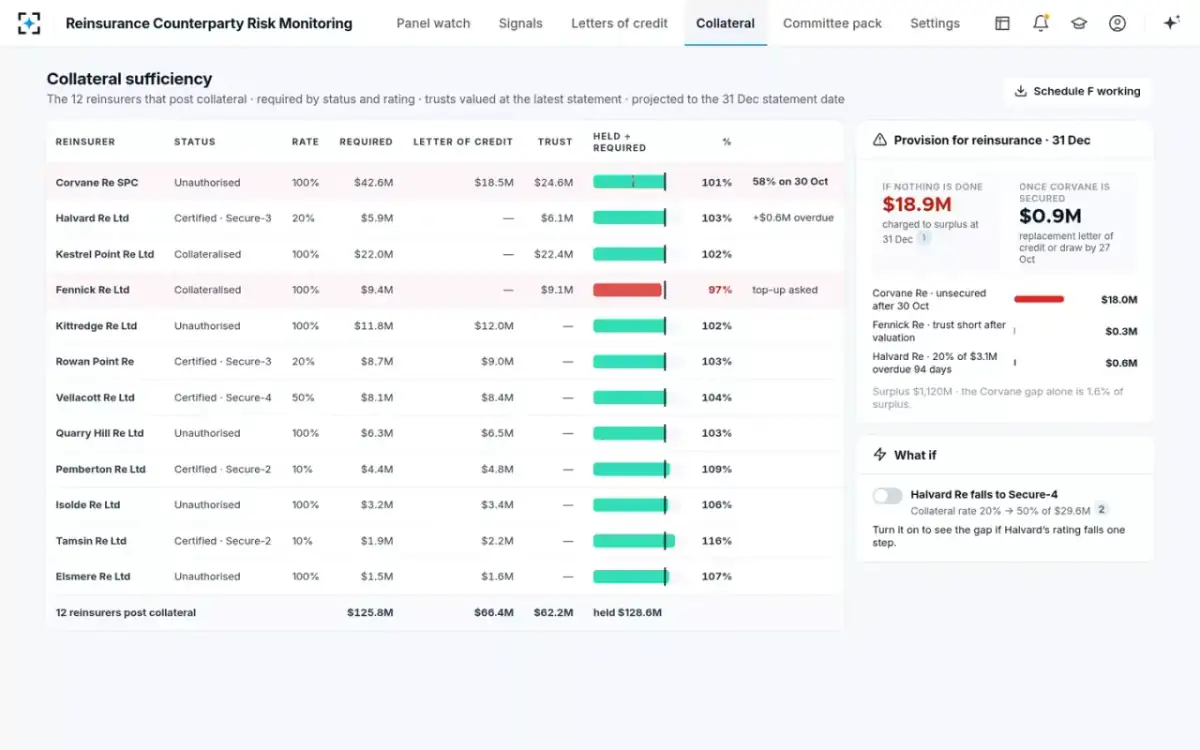
So the requirement moves on events unconnected to the collateral. A certified reinsurer downgraded from Secure-3 to Secure-4 must post 50% rather than 20% on all business it has assumed as a certified reinsurer; in the solution's fictional sample carrier that one step would take a $5.9 million requirement to $14.8 million against $6.1 million held. A reinsurer that loses accreditation becomes unauthorized. The certified reinsurer rating guide shows the full table and the file to keep.
A letter of credit has two clocks
Every reinsurance letter of credit has an expiry date and a notice window, and the notice window is the one to track. A qualifying letter must run for at least a year and contain an evergreen clause that stops it expiring "without due notice from the issuer", with at least 30 days' notice before expiry or non-renewal (#786, Section 13D). Once the bank gives notice, the cedant has the rest of those days to get a replacement or draw. The expiry date is when the money stops being available; the notice is when the work starts.
A letter issued by a bank that is not itself a qualified U.S. financial institution needs a qualified U.S. bank to confirm it, designated as the issuer's agent for receiving and paying drafts, and its evergreen clause must give 30 days' notice (#786, Section 13G). A letter governed by the ICC's documentary credit or standby rules must also provide for extra time to draw if one of the events listed in Article 36 of UCP 600 occurs. Those are terms to check when a letter is loaded, not features a loan tracker would hold.
One reinsurer: what is owed, what is held, and the next expiry
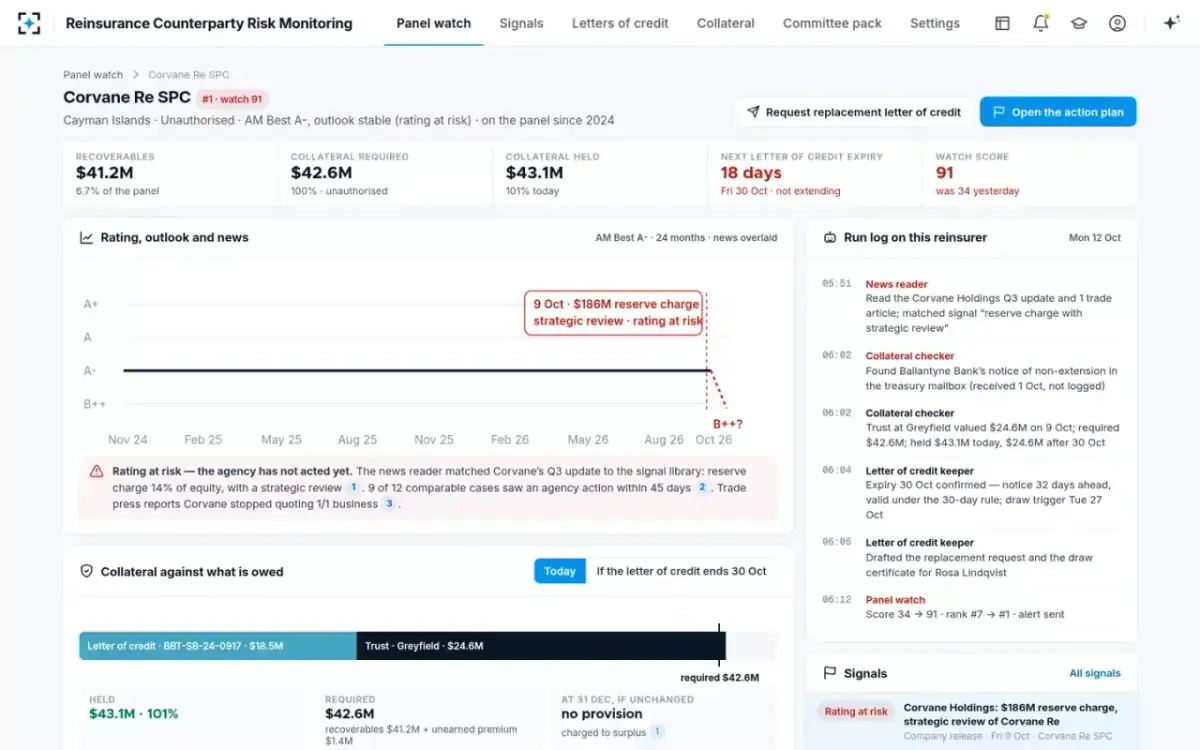
A bank's downgrade bites at the next extension
When an issuing bank stops meeting the standard, its existing letters of credit do not stop counting at once. The model law keeps a letter that met the issuer standard when issued acceptable "until their expiration, extension, renewal, modification or amendment, whichever first occurs" (Model Law #785, Section 3C(2)). The drafters explained why:
"letters of credit acceptable when first obtained will, in the event of the subsequent nonqualification of the issuing (or confirming) institution, continue to be acceptable as security until the account party and beneficiary would first have, in the normal course of business, an opportunity to replace the credit support facility."
Drafting note to NAIC Credit for Reinsurance Model Law #785, Section 3C
For an evergreen letter, the next automatic extension is that opportunity. In the sample, Tollgate National Bank was cut to BBB+ on 30 September and stayed on the qualified list; its $6.5 million evergreen letter for one reinsurer ends on 22 November and the bank's notice window closes on 23 October. If Tollgate stops qualifying, that letter's next extension is the date its acceptability ends, and the replacement conversation has to happen before it. The carrier's own policy, which requires issuers rated A- or better, flags the bank already. A loan tracker would record the bank's rating, if at all, as a property of the collateral, not as a deadline.
What is a reinsurance trust, and what does it ask of a tracker?
A reinsurance trust is an account at a qualified U.S. bank, set up by the reinsurer as grantor for the sole benefit of the ceding insurer, holding assets the cedant can withdraw at any time without the reinsurer's consent. The model regulation values the assets at current fair market value and limits them to U.S.-dollar cash, certificates of deposit from a U.S. bank and permitted investments, with no more than 5% of investments in entities affiliated with the grantor or beneficiary (#786, Section 12B). New York's version, Regulation 114, is read strictly, as the guide to the Reg 114 trust sets out.
A trust asks three things of a tracker. It must be valued at each trustee statement, which the model requires at least quarterly, against a requirement that may have moved since the last one. It must be checked for structure as well as balance: the assets in the trustee's custody, nothing referenced outside the agreement. And releases must be watched, because a treaty may let the reinsurer, with the cedant's approval, withdraw assets only if it replaces them with assets of equal value or leaves the trust at no less than 102% of the required amount (#786, Section 12D(2)). In the sample, one collateralized reinsurer's trust stood at 97% of its requirement after the 30 September valuation, $0.3 million short, and the carrier asked for a top-up.
What is funds withheld in reinsurance?
Funds withheld is collateral the ceding insurer keeps instead of paying it to the reinsurer: premium or other amounts it holds back under the treaty as security. The model regulation allows credit for "unencumbered funds withheld by the ceding insurer in the United States subject to withdrawal solely by the ceding insurer and under its exclusive control" (#786, Section 14). The cedant reports them as a liability, funds held under reinsurance treaties, and offsets them against what the reinsurer owes.
For a tracker, funds withheld is the easiest collateral to hold and the easiest to forget. It does not expire and no bank can withdraw it, but it is sized at the treaty's terms, not the reinsurer's current liabilities, so it can fall behind as reserves grow. Matching the balance to the requirement each quarter is the whole job.
Twelve questions to put to any collateral tool before you use it for reinsurance
Can this collateral tracking software handle a reinsurance panel?
- Does it compute the requirement from the reinsurer's U.S. status?
Authorized, accredited, certified with level, reciprocal or unauthorized; each sets a different percentage.
- Does it apply the certified table by the state-assigned level?
And recompute all business assumed as certified when the level falls.
- Does it measure liabilities as recoverables plus unearned premium?
Paid, case and IBNR recoverables and unearned premium, by reinsurer and treaty.
- Does it hold each letter of credit's notice window, not only its expiry?
At least 30 days for a qualifying letter; the work starts at notice.
- Can it read bank notices where they arrive?
A notice keyed in by hand days later defeats the purpose.
- Does it track the issuing and confirming bank's standing?
A bank that stops qualifying ends a letter's acceptability at its next extension.
- Does it value trusts at fair market value at each statement?
And flag a shortfall the day the statement arrives.
- Does it check trust structure, not only balance?
Sole beneficiary, assets with the trustee, no outside references, eligible assets.
- Does it watch releases against the 102% floor or replacement?
The common treaty condition for a reinsurer to withdraw trust assets.
- Does it carry funds withheld against the liabilities they secure?
Not just as a balance.
- Does it project the provision for reinsurance at 31 December?
Required minus held, by reinsurer, with the working shown.
- Does it see beyond collateral: ratings, overdue balances, concentration?
Collateral is one of several ways a reinsurer becomes a problem.
Where Reinsurance Counterparty Risk Monitoring fits, and where a bank tool is still the right choice
If the collateral a team tracks secures loans, a lender's collateral tracker is the right tool, and the asset-based lending collateral monitoring solution is ours for that job. Reinsurance Counterparty Risk Monitoring is for ceding insurers: it computes each reinsurer's requirement from status and rating, holds every letter of credit's expiry, evergreen terms and notice window, reads bank notices and trust statements as they arrive, and puts collateral on the same row as ratings, overdue recoverables and concentration.
Collateral sufficiency across the reinsurers that post it
It does not value trust assets itself; it reads the trustee's statement at market value. It does not draw on letters of credit or move trust assets; people do. And it is not a derivatives margin system. For the reinsurance panel itself, see the Reinsurance Counterparty Risk Monitoring page, and run it on a sample of your own register.
Questions people ask
Can bank collateral tracking software track reinsurance collateral?
It can store the instruments, but it cannot compute what they must cover, because the requirement depends on the reinsurer's U.S. status and, for certified reinsurers, on a state-assigned rating. It also rarely holds letter of credit notice windows or trust rules as deadlines. Most carriers that try end up keeping the requirement in a spreadsheet beside it.
What is an evergreen clause in a reinsurance letter of credit?
A clause that renews the letter automatically unless the bank gives notice that it will not. Under Model Regulation #786 a qualifying letter must run for at least one year and its evergreen clause must give no less than 30 days' notice before expiry or non-renewal, so the notice date, not the expiry, is the deadline to track.
How is reinsurance trust collateral valued?
At current fair market value, under Model Regulation #786, and only assets the cedant can withdraw count. The trustee must send statements at least at the end of each calendar quarter, and the reduction a cedant takes at a statement date is capped at the value of acceptable assets available to withdraw at that time.
Do reciprocal jurisdiction reinsurers need collateral tracking?
Not for collateral they post, because they post none unless a treaty trigger fires. They still need watching: their status, ratings, payment record and the triggers themselves, which the guide to the NAIC list of reciprocal reinsurers covers.
Is a letter of credit or a trust better collateral for a cedant?
Each has a weakness. A letter of credit can be drawn in full on a sight draft but can end on 30 days' notice and depends on its bank. A trust holds real assets the cedant can withdraw at any time but can lose value between statements. Many security committees accept both and watch each for its own failure.