A certified reinsurer rating is the level, from Secure-1 to Vulnerable-6, that a U.S. state insurance commissioner assigns to a reinsurer it has certified, and it decides how much collateral that reinsurer must post for a ceding insurer to take full credit: 0% at Secure-1, then 10%, 20%, 50%, 75% and 100% at Vulnerable-6. The commissioner sets the level, but it can be no better than the reinsurer's lowest financial strength rating from an acceptable agency, and it falls a level when the reinsurer pays too slowly. For the cedant, the rating is a moving part of the balance sheet: a one-level downgrade can more than double the collateral required on every contract the reinsurer has assumed as a certified reinsurer. Botminds' Reinsurance Counterparty Risk Monitoring tracks each certified reinsurer's level, the agency ratings behind it and the security held, and shows the gap a downgrade would open before it happens.
The certified reinsurer file, field by field, and the rule each field answers to
Certifying state and passport
What to recordThe state that certified the reinsurer, whether your domiciliary state defers to it, and the effective date.
The rule behind itA change in the other state applies automatically in yours from the date it takes effect there (#786, 8D).
Rating assigned by the commissioner
What to recordSecure-1 to Vulnerable-6, with the date of the written notice that set it.
The rule behind itThe commissioner assigns the rating and publishes the list (#786, 8B(2)).
Agency ratings behind it
What to recordEvery financial strength rating from an acceptable agency, with dates; mark the lowest.
The rule behind itThe lowest rating sets the maximum level; fewer than two ratings ends eligibility (#786, 8B(4)(a)).
Collateral percentage
What to recordThe percentage the assigned level requires, and any higher figure the treaty or committee set.
The rule behind itTable in #786, Section 8A(1); parties may agree more (8A(6)).
Liabilities secured
What to recordPaid recoverables, case and IBNR reserves, loss expenses and unearned premium, split before and after certification.
The rule behind itReduced collateral applies only to contracts entered into or renewed after certification (#786, 8A(5)).
Security held
What to recordEach letter of credit, trust and funds-withheld balance, with expiry dates and the last valuation date.
The rule behind itSecurity must take a form the model allows (#786, Sections 12 to 14).
Payment record
What to recordPaid recoverables 90 days overdue and not in dispute, and the share in dispute.
The rule behind itSlow payment raises the requirement by at least one level (#786, 8B(5)).
Date checked, and by whom
What to recordThe date of the last full check and the person who signed it off.
The rule behind itCredit conditions are "perpetual, not periodic" (#786, Section 4 drafting note).
What is a certified reinsurer?
A certified reinsurer is a reinsurer that is not licensed in the ceding insurer's state but has been certified by the commissioner, which lets it post less than the 100% collateral normally required of an unauthorized reinsurer. The status came from the NAIC's 2011 amendments to its credit for reinsurance models, which in adopting states "allow certified foreign reinsurers to post significantly less than 100% consumer protection collateral for U.S. claims" (NAIC, Covered Agreement topic page).
Eligibility is demanding. The reinsurer must be domiciled and licensed in a qualified jurisdiction, keep capital and surplus of at least $250 million, and hold financial strength ratings from two or more acceptable agencies, which the model lists as Standard & Poor's, Moody's, Fitch, A.M. Best and any other nationally recognized statistical rating organization (Model Regulation #786, Section 8B(3)). The ratings must be interactive, "based on interactive communication between the rating agency and the assuming insurer", not built from public information alone. The reinsurer also files Form CR-1, submitting to the state's jurisdiction and agreeing to post 100% security if it resists enforcement of a final U.S. judgment.
Certification sits between the two older statuses. An authorized reinsurer, licensed in the state, posts no collateral; an unauthorized one posts 100%. A reciprocal jurisdiction reinsurer, the status added in 2019, posts none unless a contractual trigger fires. The comparison of authorized and unauthorized reinsurers prices what those differences mean at year-end.
How is a certified reinsurer rated? The lowest agency rating sets the ceiling
A certified reinsurer is rated by the certifying commissioner, on a legal entity basis, using its financial strength ratings as a cap and a list of other factors as evidence. The model is explicit about the cap: "The commissioner shall use the lowest financial strength rating received from an approved rating agency in establishing the maximum rating of a certified reinsurer." (#786, Section 8B(4)(a)). A reinsurer rated A by one agency and A- by another can be assigned Secure-4 at best, not Secure-3.
Below the cap the commissioner may weigh the reinsurer's business practices with ceding insurers, its record of complying with contract terms, its Schedule F or Form CR-F, regulatory actions against it, its auditor's report, the liquidation priority of cedants' claims in its home jurisdiction, any solvent scheme of arrangement involving U.S. cedants, and its reputation for prompt payment, measured from cedants' Schedule F reporting "with specific attention given to obligations payable to companies that are in administrative supervision or receivership" (#786, Section 8B(4)(b) to (k)). The assigned level can therefore be lower than the agencies' view. It cannot be higher.
That rule is the first thing to check in any file. A certified level that sits above what the reinsurer's lowest agency rating allows is either out of date or wrong, and either way the collateral calculated from it is too low.
Secure-1 to Vulnerable-6, and the collateral each needs
Each level maps to a band of agency ratings and to a percentage of the reinsurer's liabilities that must be secured for the cedant to take full credit. The percentages come from the table in Section 8A of the model regulation; the rating bands from Section 8B(4)(a).
Certified reinsurer rating levels: the agency ceiling and the security required
| Level | Security required | AM Best | S&P | Moody's | Fitch |
|---|---|---|---|---|---|
| Secure-1 | 0% | A++ | AAA | Aaa | AAA |
| Secure-2 | 10% | A+ | AA+, AA, AA- | Aa1, Aa2, Aa3 | AA+, AA, AA- |
| Secure-3 | 20% | A | A+, A | A1, A2 | A+, A |
| Secure-4 | 50% | A- | A- | A3 | A- |
| Secure-5 | 75% | B++, B+ | BBB+, BBB, BBB- | Baa1, Baa2, Baa3 | BBB+, BBB, BBB- |
| Vulnerable-6 | 100% | B and below | BB+ and below | Ba1 and below | BB+ and below |
The steps are uneven, and that is where the money is. Moving from Secure-3 to Secure-4 raises the requirement from 20% to 50%, two and a half times. Moving from Secure-4 to Secure-5 adds 25 points; from Secure-1 to Secure-2 only 10. A single-notch agency downgrade from A to A- at one agency is enough to cross the most expensive line in the table.
The percentage applies to the reinsurer's liabilities to the cedant, not only to paid balances. Reduced collateral also applies only to contracts entered into or renewed on or after the date of certification; collateral for earlier business follows the old rules unless the contract is amended or replaced, and then only for losses and reserves from that date (#786, Section 8A(5)). A file that mixes pre- and post-certification balances under one percentage will be wrong in both directions. The Casualty Actuarial Society's study text made the same point about the annual statement, which split certified balances before and after certification when the status was introduced (Odomirok et al., CAS, 2014 edition).
What happens when a certified reinsurer is downgraded?
When an agency downgrades a certified reinsurer, the commissioner assigns a new rating on written notice, and the reinsurer must then meet the security requirement of the new level "for all business it has assumed as a certified reinsurer" (#786, Section 8B(8)(a) and (c)). Upgrades work differently: the reinsurer may meet a lower requirement only on a prospective basis, and must keep posting at the old level for contracts in force before the upgrade. Downgrades bite the whole book at once; upgrades only help new business.
Take the solution's fictional sample carrier, with 34 reinsurers on its panel, and one certified reinsurer whose liabilities to it are $29.6 million. At Secure-3 the requirement is 20%, about $5.9 million, against $6.1 million held in trust. Switch on a one-level downgrade to Secure-4 and the requirement becomes 50%, $14.8 million, against the same $6.1 million: an $8.7 million gap the reinsurer would have to fill, or the cedant would carry as a provision at the statement date.
What if a rating falls one level: the gap Reinsurance Counterparty Risk Monitoring shows before it opens
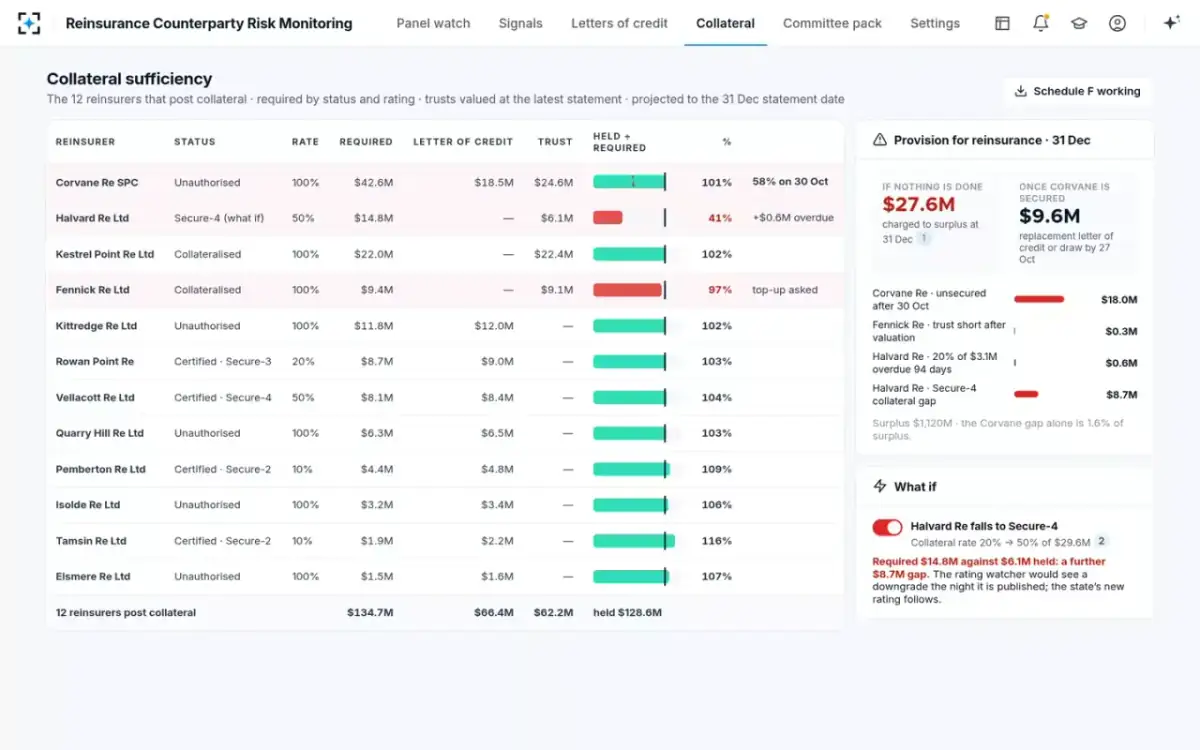
The model softens the timing for cedants. Notwithstanding a change of rating or a revocation, a domestic insurer "may not be denied credit for reinsurance for a period of three (3) months for all reinsurance ceded to that certified reinsurer, unless the reinsurance is found by the commissioner to be at high risk of uncollectibility" (#786, Section 8B(8)(d)). Three months is time to collect more security, not time to wait. On a plain reading, a rating change in mid-October still sits inside that window at the 31 December statement date and one in mid-September does not; check how your domiciliary state's text counts the period.
The certified reinsurer numbers a file should hold
42
certified reinsurers approved for passporting, per NAIC draft minutes of December 2025
$250million
minimum capital and surplus for certification
10days
for a certified reinsurer to report a rating change to the commissioner
3months
before a cedant can be denied credit after a rating change, unless at high risk
Slow payment moves the rating a level, whatever the agencies say
A certified reinsurer that pays slowly must post more even if no agency moves. The model directs the commissioner, at a minimum, to raise the required security by one rating level if more than 15% of the reinsurer's ceding clients have overdue paid recoverables of 90 days or more, not in dispute, above $100,000 each, or if its undisputed paid recoverables 90 days overdue total more than $50 million (#786, Section 8B(5)).
Those tests are measured across the reinsurer's whole U.S. book, which no single cedant can see. What a cedant can see is its own share of the pattern: its paid recoverables from that reinsurer, aged, with disputes marked. A reinsurer that is 94 days late with you and disputing an allocation with other cedants is a candidate for a one-level increase at the state. The recoverables side of the work produces that ageing (the 90-day and 20% lines); the counterparty file needs it every night, not at quarter-end.
Exceptions a certified reinsurer file has to show
Four provisions change the collateral number without any rating change, and a file that holds up records which of them applies. First, catastrophe recoverables: a certified reinsurer need not post security for recoverables on listed lines of business for one year from the cedant's first reserve entry for a catastrophe the commissioner recognises, as long as it keeps paying claims on time. Second, the cedant's own failure: on an order of rehabilitation, liquidation or conservation against the ceding insurer, the certified reinsurer must post 100% (#786, Sections 8A(3) and 8A(4)).
Third, the treaty itself. Contracts entered into or renewed with a certified reinsurer must include "a proper funding clause, which requires the certified reinsurer to provide and maintain security in an amount sufficient to avoid the imposition of any financial statement penalty on the ceding insurer" (#786, Section 8E). That clause is what lets a cedant demand more security after a downgrade, and the file should cite it by article. Fourth, any requirement above the minimum that the security committee negotiated, which the model allows and the collateral calculation must use.
Six checks before a certified reinsurer file goes to the auditor or examiner
- The assigned level is no better than the lowest agency rating
If one agency moved and the state has not, record both and the date of each.
- The reinsurer still has at least two acceptable ratings
Losing one ends eligibility for certification, which is a status change, not a downgrade.
- Balances are split before and after certification
Reduced collateral applies only from the certification date, contract by contract.
- Every letter of credit, trust and funds-withheld balance is valued at a stated date
Trust assets at fair market value; letters of credit with expiry and notice window.
- The payment record is attached
Paid recoverables 90 days overdue, disputes marked, from your own ageing.
- The funding clause is cited by treaty and article
It is the contractual route to more security when the level falls.
How many certified reinsurers are there, and where are they listed?
The NAIC's Reinsurance Financial Analysis (E) Working Group had approved 42 certified reinsurers for passporting by December 2025, alongside 107 reciprocal jurisdiction reinsurers, according to the Reinsurance (E) Task Force's minutes of 9 December 2025, published in its March 2026 materials and still marked as a draft pending adoption (NAIC Reinsurance (E) Task Force, 2 March 2026). Passporting means other states may defer to the certifying state's decision and rating; it does not mean every state has certified every reinsurer.
The NAIC keeps a page listing the passported certified and reciprocal jurisdiction reinsurers and linking each state's own page (NAIC, Certified and Reciprocal Jurisdiction Reinsurers). Each commissioner must "publish a list of all certified reinsurers and their ratings" (#786, Section 8B(2)), and the domiciliary state's list is the one a cedant's file should cite. The guide to the NAIC list of reciprocal reinsurers covers the other half of that page.
How Reinsurance Counterparty Risk Monitoring keeps the file current
The solution keeps each certified reinsurer's rating, collateral and security on one row and recomputes the requirement every night. The rating watcher reads agency actions and cites each one. The collateral checker applies the model's table to the level and liabilities, matches letters of credit and trusts to the requirement, and values trusts at each statement. The recoverables ager adds the payment record. A what-if shows the cost of the next level down before any agency moves.
Collateral sufficiency: required against held, by status and rating
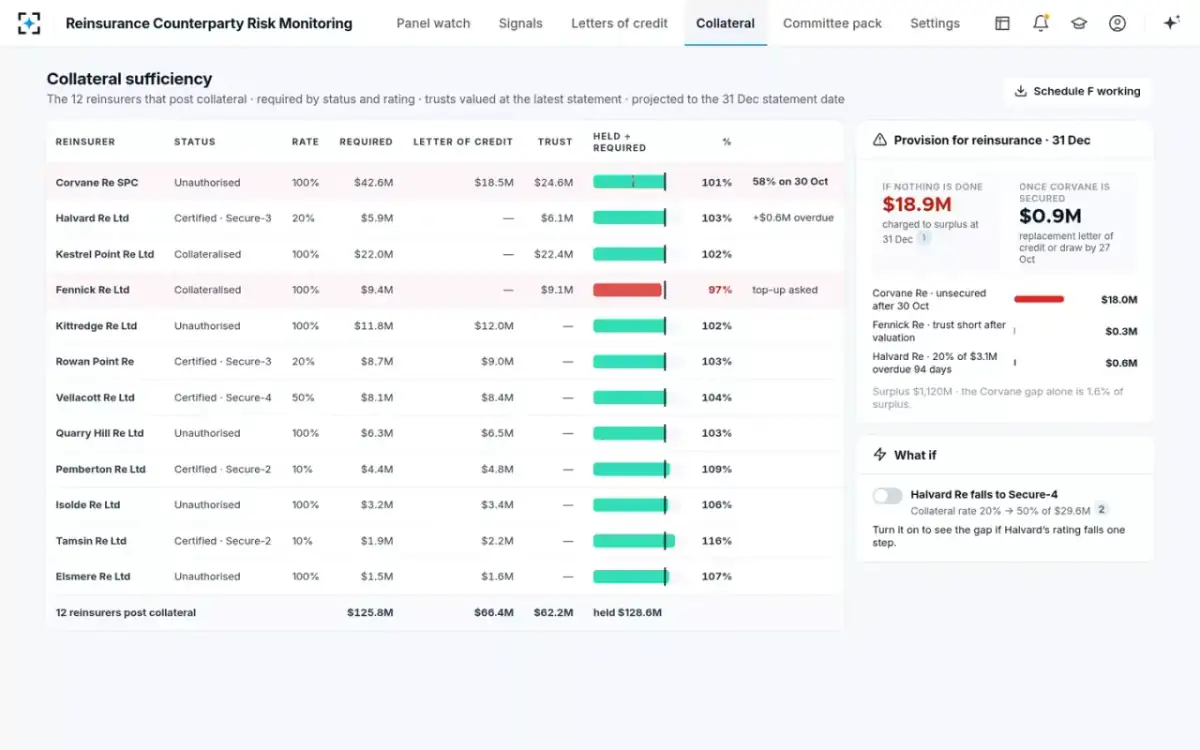
It does not assign ratings or decide eligibility; states do. It does not hold the funding clause negotiation; the credit controller does, with the broker. What it gives the controller is a file that is current on the morning an auditor asks, and a warning on the morning a downgrade lands. See the whole panel on the Reinsurance Counterparty Risk Monitoring page.
Questions people ask
What is the difference between a certified and a reciprocal reinsurer?
A certified reinsurer posts collateral on a sliding scale, 0% to 100%, set by the rating a state assigns. A reciprocal jurisdiction reinsurer, a status created by the 2019 model revisions, posts none at all if it meets capital, solvency and prompt-payment conditions, unless it resists a final judgment or enters a solvent scheme of arrangement.
Who assigns a certified reinsurer rating?
The commissioner of the certifying state assigns it by written notice, and other states may defer to that rating under passporting. Agencies do not assign it, though the lowest agency rating caps it. A change in the certifying state's rating applies automatically in a deferring state from the date it takes effect.
Can a cedant require more collateral than the certified rating requires?
Yes. Model Regulation #786 states that nothing prevents the parties from agreeing security requirements above the minimum for certified reinsurers. Many security committees do so for reinsurers near the bottom of their appetite.
What happens to collateral if certification is revoked?
The reinsurer must post security as an unauthorized reinsurer for the cedant to keep taking credit, which generally means 100%. The cedant may not be denied credit for three months after a revocation, unless the commissioner finds the reinsurance at high risk of uncollectibility.
Do certified reinsurers have to post collateral after a hurricane?
Not at first. Under Model Regulation #786 a certified reinsurer need not post security for catastrophe recoverables on listed lines of business for one year from the cedant's first reserve entry for a recognised catastrophe, provided it keeps paying claims on time. After that the normal percentage applies.